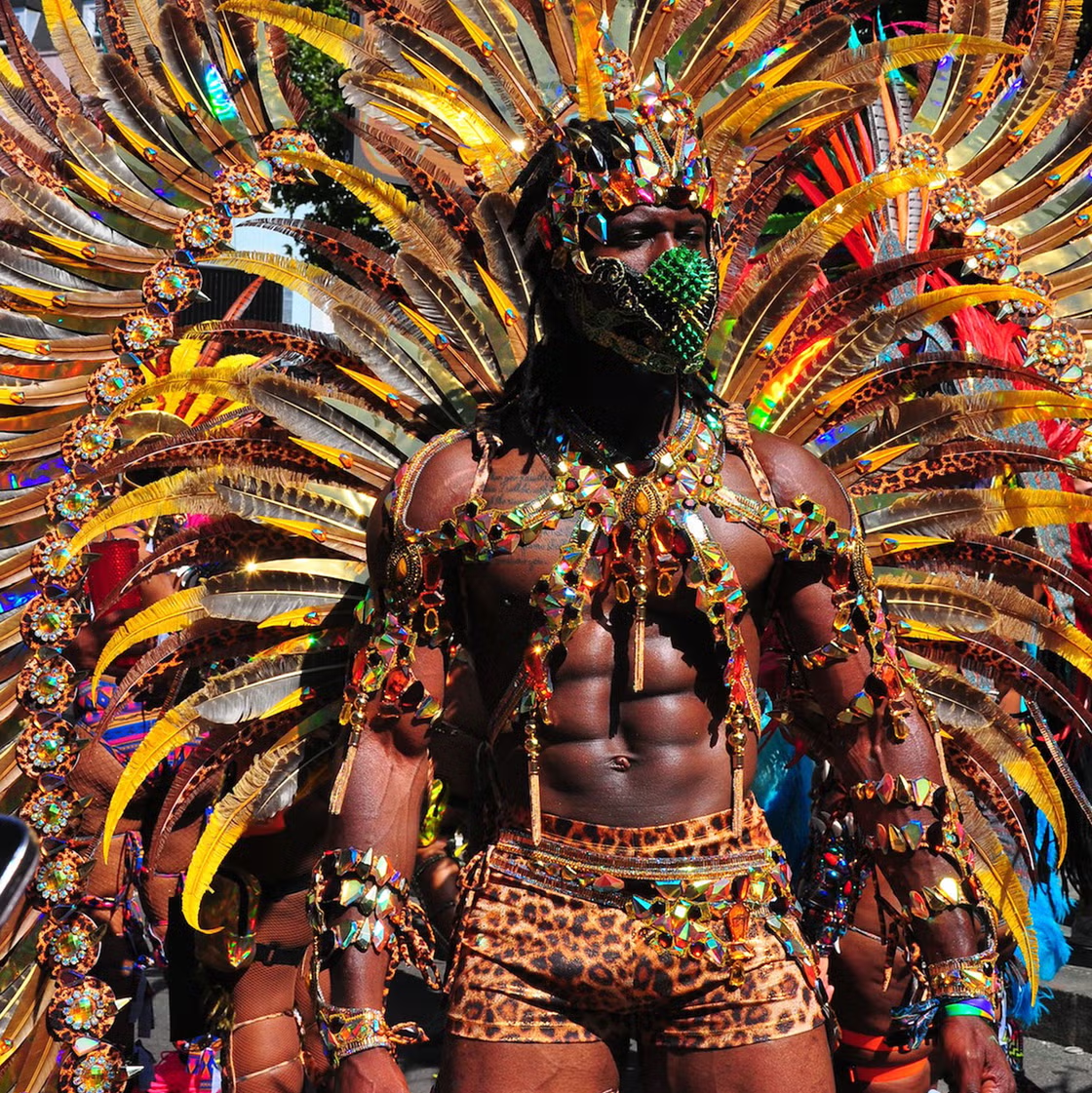
On 30 and 31 August 2026, Notting Hill Carnival celebrated its Diamond Jubilee: 60 years since the first outdoor street carnival in 1966. Up to 50 registered mas bands competed at the official judging point on Great Western Road, each presenting costumes built around an annual theme, designed in mas camps across West London, constructed over months by teams of designers, seamstresses, wire workers, feather specialists, and embellishment artists. Around two million people attended. British fashion media covered what to wear on the route.
The African fashion and beauty market is worth $ 31 billion. Notting Hill Carnival meets every criterion by which the British fashion industry defines an institution: it has a 60-year documented history; a production system involving professional designers and specialised craft labour; a competitive judging structure with formal evaluation criteria; a community of practitioners who transmit design knowledge across generations; a cultural authority rooted in specific Caribbean traditions; and an annual audience of two million. As the Notting Hill Carnival’s official documentation of its mas bands confirms, costume bands are considered the most colourful, elaborate, and visually stunning part of the whole carnival, with up to fifty bands, each designing costumes around a theme that represents cultural heritage and tells a story. A mas camp is a space where costumes are usually made, where the band’s designers and members come together to create the costumes to be worn at the street parade. That is a fashion atelier. British fashion media has not consistently described it as one.
Notting Hill Carnival has 60 years of costume design, up to 50 competing bands, and a production system that runs year-round. British fashion media covers what to wear.
What British Fashion Media Does Instead
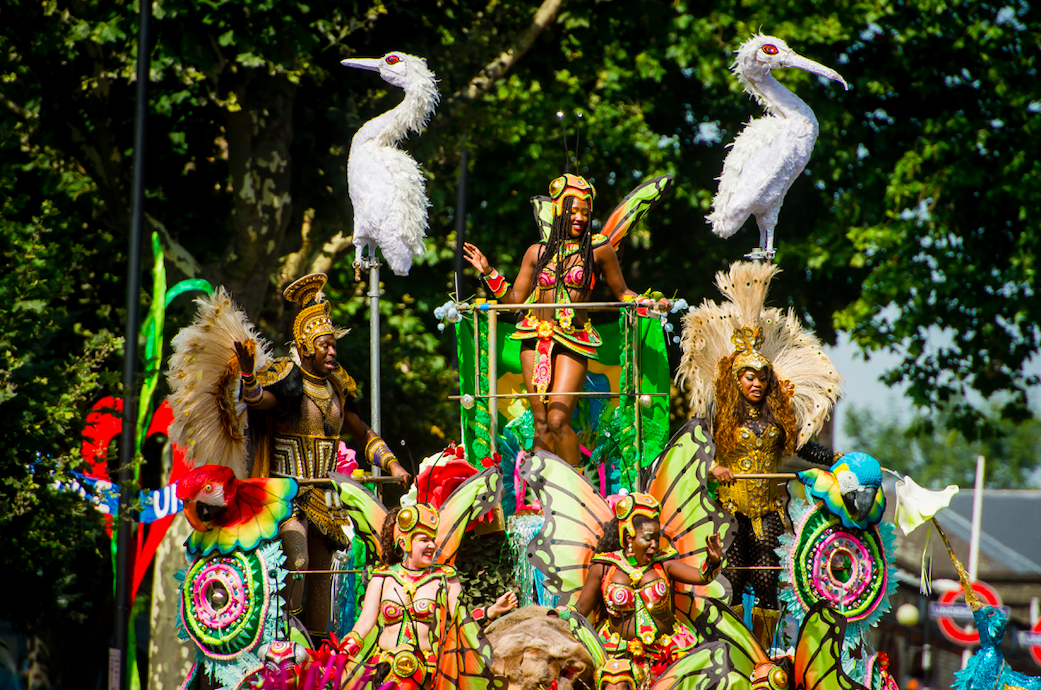
Each year, ahead of Carnival, British fashion media publishes guides to what to wear. These are not small editorial gestures. They are full production pieces: photo shoots, shopping edits, links to sequin shorts, recommendations for comfortable shoes, and advice from editors who have attended for years. The content is useful for spectators. It is not fashion coverage. It is event preparation advice, and it consistently occupies the space that coverage of Carnival’s actual design community could and should fill.
The exemplary version of this coverage appears in multiple British publications. As ITV News London’s Diamond Jubilee Carnival coverage from 25 August 2026 confirms, the 60th anniversary is described as a particularly significant event, with millions expected to attend. Even this milestone coverage foregrounds the spectacle of the event rather than the labour that produces it. The costumes, the sound systems, the food: all of these are documented as the visitor’s experience. The designer who built the costume, the band whose theme is being presented, the mas camp that worked through the winter to produce it: these are largely absent.
What British fashion media does instead of covering Carnival as a fashion institution is cover it as a background. Carnival provides the backdrop for the September fashion content: the sequins that appeared at Carnival become the sequins recommended for autumn party season. The feathers in the parade become the feathers in the trend edit. The colour combinations from the masquerade bands appear in the magazine’s colour story for next season. The aesthetic intelligence of the Carnival costume designers enters British fashion without attribution, credit, or the names of the people who produced it.
British fashion media’s Carnival coverage tells readers what to wear on the route. It does not tell them who designed the costumes parading past them, how many months those costumes took to make, what the mas band’s theme is and why, where the mas camp is and who works in it, or what the judging criteria at Great Western Road actually evaluate. The design work happens. The coverage looks the other way.
The History That Explains the Failure
Notting Hill Carnival did not emerge as an entertainment event that later came to have cultural significance. It emerged as a political act in response to racial violence. As Travel Noire’s July 2026 documentation of Carnival’s founding history confirms, Trinidadian activist Claudia Jones organised an indoor Caribbean Carnival at St Pancras Town Hall in 1959, after racist violence had shaken Notting Hill’s Caribbean community: the 1958 riots and the 1959 murder of Antiguan carpenter Kelso Cochrane. The first outdoor Carnival was later curated by social worker Rhaune Laslett as a celebration for people of all races and ethnicities, building on Jones’s foundation.
The Caribbean community that built Notting Hill Carnival built it out of resistance and community solidarity rather than from any institutional invitation. The creative labour involved in producing mas costumes and the sound systems was the work of a community that the mainstream British cultural establishment had consistently failed to recognise. The Carnival’s emergence from that context means its design culture was never going to be treated as such by an establishment that had not recognised the community producing it. The coverage failure is not accidental. It is the continuation of a structural pattern in which Black Caribbean creative practice is visible as spectacle and invisible as craft.
What the Mas Camp Actually Is
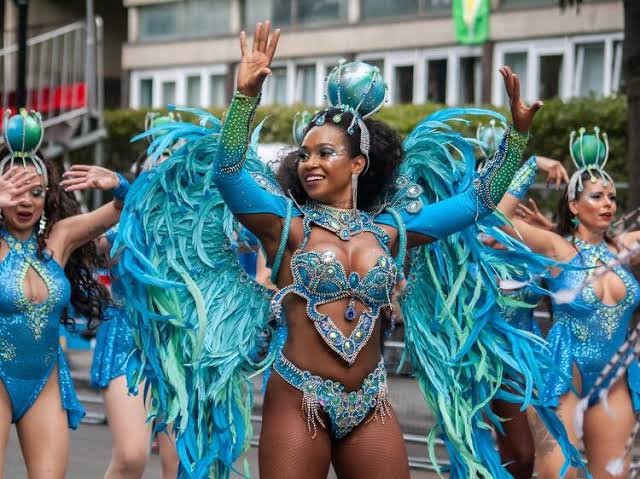
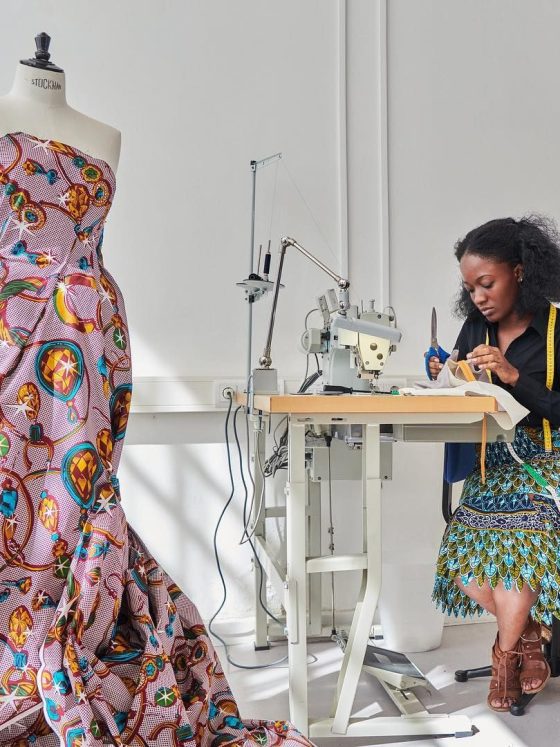
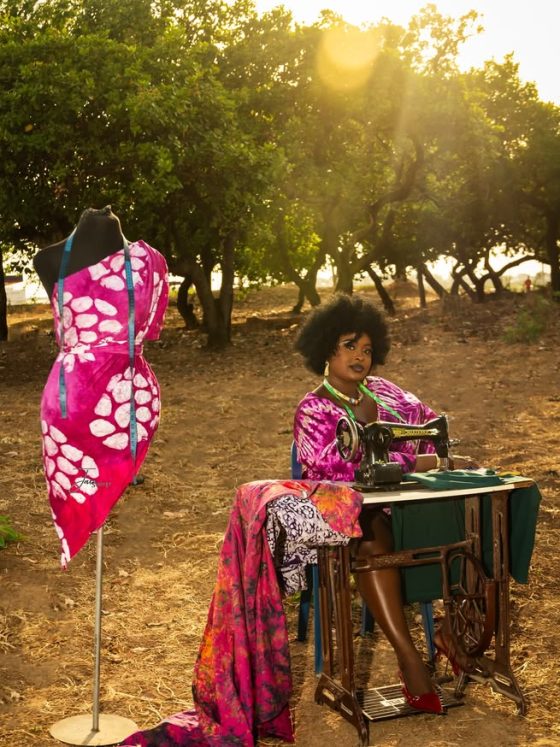
The mas camp is where Carnival costumes are designed and produced. It is the equivalent of a fashion house’s atelier, a theatrical costume workshop, and a community arts studio simultaneously. Designers develop annual themes, sketch concepts, source materials (feathers, beads, wire, foam, fabric, rhinestones), and lead teams of makers through months of construction. The costume for a principal band member is as much an engineering project as a design one: it must stay on the body during dancing, withstand hours of physical exertion, be visible from a distance while remaining wearable at close range, and be repairable in the field when wires bend, or feathers dislodge.
The V&A’s documentation of Maya Scarlette making a Notting Hill Carnival costume provides one of the most precise institutional descriptions of this process available in the British cultural record. As the V&A’s documentation of Scarlette’s design process confirms, the self-taught fashion designer and maker constructs a glittering wire bra costume, padded with car foam and embellished with rhinestones. This is the designer’s problem-solving vocabulary: car foam for structural padding, rhinestones for light-catching embellishment, wire for armature. The materials and their specific applications are not documented in British fashion coverage of Carnival. The V&A documents them as part of an exhibition on design and disability, which is the institution that recognised the design practice for what it is.
Mangrove Mas Band, one of the longest-running mas bands in the UK with more than 30 years of continuous participation, represents the generational transmission of design knowledge that characterises an institution. The design knowledge held in a 30-year-old mas band, the accumulated understanding of which materials work in British August heat, which construction methods survive the parade route, which colour combinations read correctly from the street level at which the judging happens: this is institutional knowledge. It is not treated as such in any fashion media record this article has been able to locate.
The Judging and Why It Matters
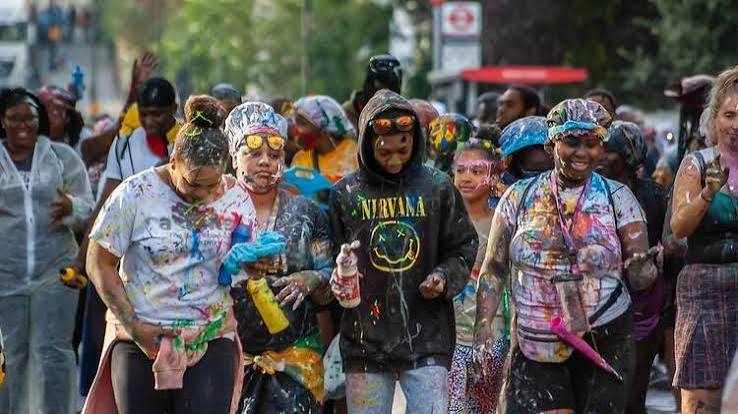
Notting Hill Carnival has a formal competitive structure. Registered mas bands are judged at the official judging point on Great Western Road across both Carnival days. The competition evaluates costume design, construction quality, thematic coherence, and the band’s overall presentation as a designed ensemble. This is a fashion show with a jury. It is not described as one.
The gap between how the fashion press covers London Fashion Week and how it covers Notting Hill Carnival is the most precise measurement of the coverage failure. London Fashion Week: designer profiles, collection analyses, trend reports, buyer commentary, runway photography with designer credit, show notes published and discussed, institutional history documented. Notting Hill Carnival: route maps, what to wear, food recommendations, transport advice. The two events are both fashion competitions with professional designers, production teams, and formal judging. One receives fashion coverage. One receives event preparation guides.
The 60th Anniversary as Missed Reckoning
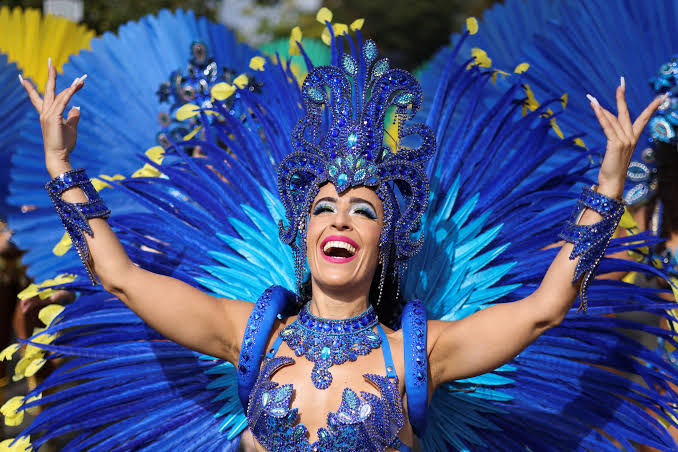
The Diamond Jubilee Carnival of 2026, described by CEO Matthew Phillip as a special year, was an opportunity for British fashion media to deliver the institutional coverage that 60 years of costume-design tradition deserve. As Soca News’s 2026 Carnival coverage confirms, the bands preparing for the anniversary Carnival included Magical Mas, MASQ by Naitram/ABIR, and Lagniappe, each producing costumes that have taken months and, in some cases,s much of the year to create. These names, these timelines, and this production scale are the material of institutional fashion coverage. Whether the fashion press produced that coverage in time for the Diamond Jubilee is what the annual review of Carnival coverage will need to assess.
What the coverage should have included: profiles of the mas band designers whose work the two million attendees saw; documentation of the mas camps where costumes were built; analysis of the annual themes and what they communicate about Caribbean cultural memory; the judging criteria and what they evaluate; the economic scale of the costume production system; and the names and practices of the designers who have been producing this work for one, two, and three decades without institutional recognition from the fashion press that has borrowed their aesthetic vocabulary for sixty years.
The Omiren Argument
Notting Hill Carnival is a fashion institution. It has a 60-year history, a competitive design structure, a professional production system, a community of designers who transmit knowledge across generations, a formal judging process, and an annual audience of two million. The African fashion and beauty market is worth $ 31 billion. The Carnival’s mas bands include bands that have been producing costume collections for more than 30 years. The mas camps where those costumes are built are ateliers. The designers who conceptualise annual themes, source materials, solve the engineering problems of wearable performance costume, and lead teams of skilled makers through months of production are fashion designers. They are not described as fashion designers by the British fashion press, which covers Carnival primarily as a spectacle to attend and a visual source for what sequins and feathers to wear to autumn parties. That coverage failure is not incidental. It is the continuation of a structural pattern in which Black Caribbean creative labour is acknowledged as the source of aesthetic inspiration and not acknowledged as the source of design authority. Sixty years in, the Diamond Jubilee was the most visible opportunity yet to correct that pattern. Whether the British fashion press took it is the question that this anniversary year leaves open.
Also Read:
- Brixton’s Caribbean Dress Legacy: Tailoring, Fabric, Beauty and Cultural Memory
- Black British Designers Are Changing Who London Luxury Is Allowed to Credit
- The African Origins of Carnival Costume: Feathers, Beads, and the Masquerade Tradition
- Who Should Define Cultural Authority in Fashion? Start With the Maker
Frequently Asked Questions
What is a mas band at Notting Hill Carnival?
A mas band (short for masquerade band) is a registered costume design and production organisation that participates in Notting Hill Carnival’s parade. Each mas band develops an annual theme representing cultural heritage and telling a story, designs and produces all costumes around that theme, and allows the public to purchase a costume and join the band to parade at the event. Bands are registered with Notting Hill Carnival and judged at the official judging point on Great Western Road. Up to 50 costume bands participate each year, including children’s bands, adult bands, and specialist categories.
Who designs Notting Hill Carnival costumes?
Carnival costumes are designed by the creative teams of each registered mas band, working from a mas camp where costumes are produced. These designers develop annual themes, conceptualise costume designs, source materials (feathers, wire, foam, beads, rhinestones, fabric), and lead teams of makers through months of construction. Some mas bands have been producing costumes for more than 30 years, accumulating institutional design knowledge about which materials and construction methods work for the specific demands of the parade route. The V&A’s documentation of designer Maya Scarlette’s costume-making process for Carnival provides one of the few institutional records of this practice.
How long does it take to make a Carnival costume?
According to production documentation from mas bands and the V&A’s record of individual costume-making, Carnival costumes take months to produce and, in some cases, much of the year to make. A principal costume requires conceptual design, material sourcing, structural construction (including a wire armature, foam padding, and feather or fabric embellishments), and fitting and adjustment. The timeline reflects the engineering demands of the costume: it must remain attached to the body during hours of physical dancing, be visible from the street-level distance at which judging occurs, and be repairable in the field. This production timeline is comparable to those of major fashion collections.
What is a mas camp?
A mas camp is the workspace where a mas band’s costumes are designed and produced for Notting Hill Carnival. The official Notting Hill Carnival website describes it as a space where the band’s designers and members come together to create the costumes to be worn at the street parade. In practice, it functions as a combination of a fashion atelier, a theatrical costume workshop, and a community arts studio, with professional designers leading teams of skilled makers through months of costume production. Mas camps are located across West London and represent the primary production infrastructure of Carnival’s design culture.
When did Notting Hill Carnival start?
The outdoor Notting Hill Carnival began in 1966, making 2026 its 60th anniversary, designated the Diamond Jubilee. The Carnival’s foundation was laid earlier by Trinidadian activist Claudia Jones, who organised an indoor Caribbean Carnival at St Pancras Town Hall in 1959 in response to racist violence against Notting Hill’s Caribbean community, including the 1958 riots and the 1959 murder of Antiguan carpenter Kelso Cochrane. Social worker Rhaune Laslett later curated the first outdoor event on the streets of Notting Hill. The Carnival has grown from its political and community foundations into Europe’s largest street festival, attracting around two million attendees.
Explore More
Read the full Fashion > Opinion section for Omiren Styles’ documented positions on Caribbean carnival traditions, Black British fashion institutions, and the coverage failures that prevent fashion media from accurately documenting the creative practices it most benefits from.
Discover travel and heritage intelligence across the Caribbean and the African diaspora at Rex Clarke Adventures.