The African fashion market is worth 31 billion dollars. The events that present African fashion to international buyers, press, and trade audiences have been building institutional scale for nearly thirty years. In 2026, African fashion events collectively report combined visitor numbers in the hundreds of thousands, across Lagos, Cape Town, London, Berlin, Copenhagen, and smaller regional platforms. What those numbers cannot tell you, in almost every case, is how many of those visitors are genuine trade buyers: the wholesale account holders, retail buyers, and commercial decision-makers whose attendance at a fashion event translates into orders and stockist relationships rather than photographs and social media content.
That distinction between visitors and trade buyers is the most important data gap in the African fashion industry’s commercial self-reporting. As Omiren Styles’ analysis of what Lagos Fashion Week has actually done for Nigerian designer revenue confirms, over 10,000 people attended Lagos Fashion Week 2024, a 15% increase from 2023, and the Rising Stars showcase that year resulted in over 30 international retail partnerships for the 15 emerging designers featured. That second figure is commercially specific. The first figure is an attendance count. The gap between those two types of data is where most African fashion event reporting lives: visitor numbers are available; buyer conversion rates are not.
African fashion events report large visitor numbers. What they rarely report is how many visitors are genuine trade buyers. Here is what the data shows and where it stops.
The Events and Their Reported Numbers: What Is and Is Not Known
Lagos Fashion Week
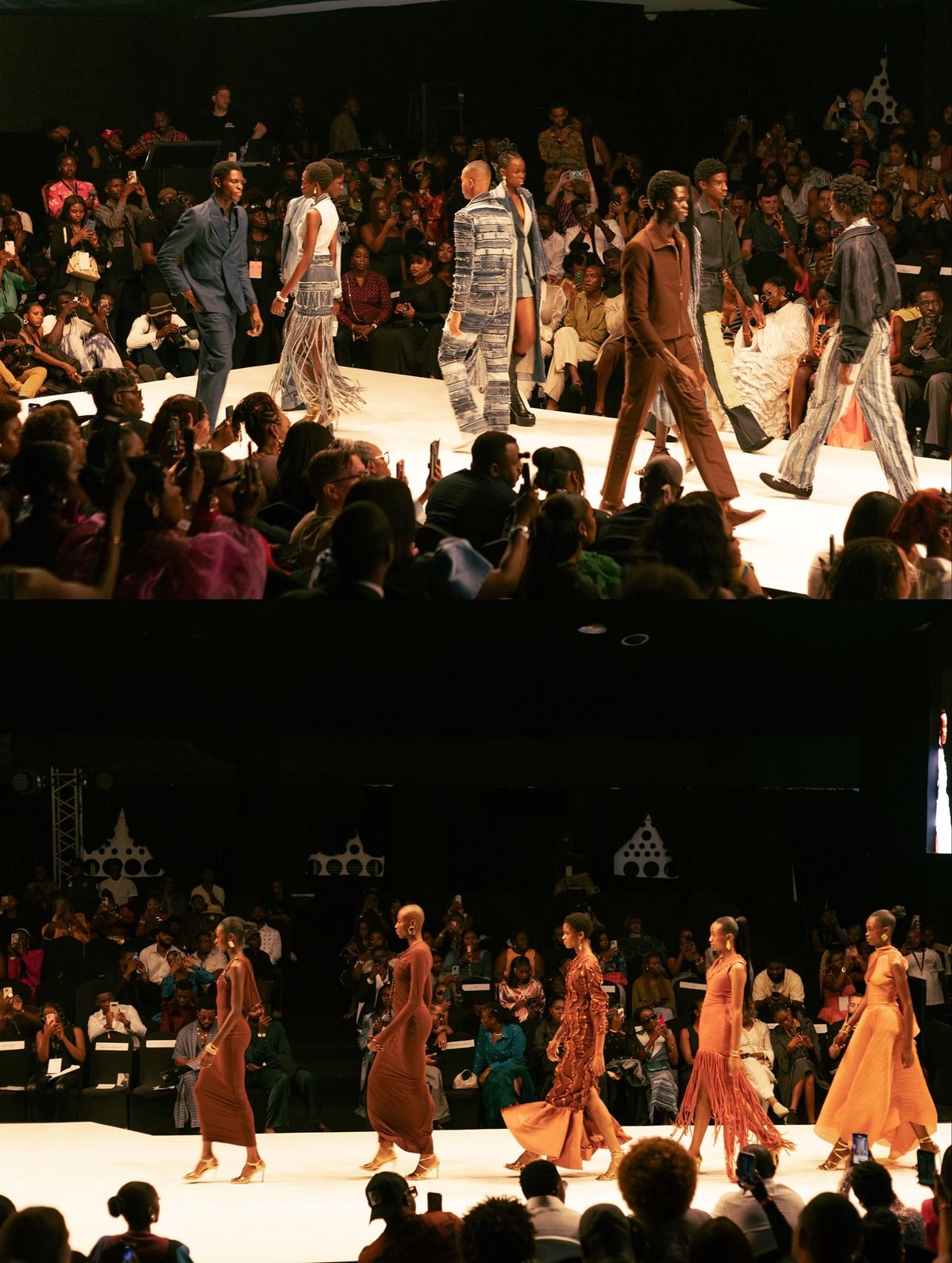
Lagos Fashion Week 2025, the fifteenth edition, drew over 15,000 guests over five days and showcased more than 60 designers, as confirmed by the Lagos Fashion Market Report 2026. The event moved to culturally significant venues including the J. Randle Centre for Yorùbá Culture and History, signalling platform maturity in how African fashion presents itself to international buyers and press. The Earthshot Prize win in November 2025 for waste-free fashion innovation was the most significant external institutional recognition the event has received.
What is documented:
Attendance: 15,000+ guests, 2025 edition (LFW 2024: 10,000+, a 15% increase from 2023).
Designer count: 60+ designers per season.
Moda Operandi: sent buyers to Lagos Fashion Week for the first time in 2024 (confirmed independently).
Rising Stars 2024: 30+ international retail partnerships for 15 emerging designers featured.
SHF Trains programme: partners with the Nigerian Export Promotion Council on international order fulfilment capacity.
Earthshot Prize: November 2025, Build a Waste-Free World category.
What is not documented:
No published breakdown of the 15,000+ guests by category: trade buyers vs press vs consumers vs cultural visitors.
No published total number of confirmed wholesale orders generated per season.
No published data on international buyer attendance by country of origin.
No published follow-through rate: of the 30+ retail partnerships from Rising Stars 2024, how many resulted in sustained stockist relationships one year later?
Africa Fashion Week London
AFWL 2026, the 16th edition scheduled for 17-23 August 2026 at 8 Northumberland Avenue, London, reports cumulative lifetime attendance of 80,000 visitors across its editions, including buyers, retailers, industry professionals, and global media. 3,000+ designers and exhibitors have participated across 16 editions. 26 African countries and 67 countries in total have been represented, including diaspora designers from Brazil, Europe, Asia, the Caribbean, and the Americas.
What is documented:
Cumulative lifetime visitors: 80,000+ across 16 editions.
Cumulative designer and exhibitor count: 3,000+.
Geographic reach: 26 African countries, 67 countries total, including diaspora.
Shop The Runway 2026: first commercial retail mechanism; buyers, stylists, and media can purchase directly from participating designers.
British Council Creative DNA partnership: confirmed for 2026.
What is not documented:
No published breakdown of the 80,000 lifetime visitors by buyer vs consumer vs press vs cultural visitor.
No published per-edition buyer attendance figure.
No published data on wholesale orders or stockist relationships generated through AFWL editions.
Shop The Runway 2026 is the first edition to include a direct purchasing mechanism; baseline data for commercial outcomes do not yet exist.
The fashion industry reports visitor numbers because visitor numbers are available. It does not consistently report buyer conversion rates because buyer conversion requires tracking commercial relationships across time, which is significantly harder to measure and less immediately impressive to announce. The data gap is not primarily due to dishonesty. It is structural. African fashion events face the same challenge as European and American fashion weeks: meaningful commercial data is harder to collect than attendance data.
Berlin Fashion Week and the Berlin Contemporary Programme
Berlin Fashion Week’s Berlin Contemporary programme awarded €25,000 grants to three African labels for the AW26 season and a further three for SS27. As Omiren Styles’ Omiren Index 2026 confirms, Orange Culture, Kenneth Ize, and Buzigahill received AW26 grants; Orange Culture, Buzigahill, and Fruché received SS27 grants. Each grant was valued at €25,000 and included production support for a show or presentation at ICC Berlin during the fashion week.
What is documented:
Berlin Contemporary grants to African labels: AW26 (Orange Culture, Kenneth Ize, Buzigahill) and SS27 (Orange Culture, Buzigahill, Fruché).
Grant value: €25,000 per label per season.
Format: studio2retail (AW26) and NEWEST format at ICC Berlin (SS27).
Buyer access: the studio2retail format specifically connects designers to retail buyers as part of the programme structure.
What is not documented:
No published data on international buyer attendance at Berlin Contemporary presentations by African labels.
No published data on wholesale accounts opened or orders placed following Berlin Contemporary presentations by African labels.
The studio2retail format implies buyer engagement, but no outcome data has been published in the open literature.
Copenhagen Fashion Week
IAMISIGO’s official Copenhagen Fashion Week slot in SS26, secured through the Zalando Visionary Award, is the most documented instance of an African label on a Nordic fashion week official schedule. Copenhagen Fashion Week publishes aggregate attendance data for the full event but does not publish per-show buyer attendance data. The Zalando Visionary Award specifically funds and provides platform access; the commercial outcomes for award recipients are not published in the available documentation.
What is documented:
IAMISIGO: official CPHFW SS26 schedule slot secured through Zalando Visionary Award (2025, €50,000).
CPHFW attendance: generally described as significant press and buyer presence at a sustainability-focused Nordic fashion week; specific buyer counts are not published for individual shows.
What is not documented:
No published buyer attendance figure for IAMISIGO’s CPHFW presentation.
No published commercial outcomes from the CPHFW slot for IAMISIGO or prior Zalando Visionary Award recipients from African labels.
Week of Fashion South Africa
The Week of Fashion South Africa AW26, held 24-25 April 2026 at Longkloof Precinct in Cape Town, presented 33 designers. As Omiren Styles’ AW26 report confirms, the platform’s nine-pillar structure includes TheShowRooms, a dedicated retail- and trade-facing commercial space that directly addresses the buyer conversion gap by creating a separate commercial infrastructure alongside the runway programme.
What is documented:
AW26 designer count: 33 designers across two days.
TheShowRooms: dedicated retail and trade-facing space within the WOF ecosystem.
COO Leon Haasbroek confirmed buyer and guest experience improvement as a primary AW26 objective.
What is not documented:
No published AW26 total attendance or buyer attendance figure.
No published data on TheShowRooms commercial outcomes: orders placed, buyer meetings held, or accounts opened.
The Benchmark Comparison: What European Fashion Weeks Report
Understanding the African fashion event data gap requires comparing it to what established European fashion weeks report. London Fashion Week reports over 5,000 press and buyers per edition; this is a combined figure that also does not disaggregate trade buyers from press. Milan Fashion Week reports aggregate visitor numbers but not buyer-specific data in publicly available releases. Paris Fashion Week’s official figures, managed by the Fédération de la Haute Couture et de la Mode, report industry professional attendance without distinguishing buyer conversion rates.
The data gap at African fashion events is therefore not unique to Africa. It reflects an industry-wide convention in which attendance figures are the primary metric reported because they are the easiest to collect and the most impressive to announce. What distinguishes the African fashion event data gap from the European equivalent is the commercial consequence: a European fashion house whose collection is seen by buyers has typically already established the retail relationships within which those buyers are visiting. An African designer presenting at Lagos Fashion Week or AFWL is typically seeking to establish those relationships in the first place. The visitor number means something different at each end of that commercial spectrum.
What Better Data Would Require
The specific data points that would enable genuine commercial assessment of African fashion events are: the number of credentialed trade buyers attending per edition, disaggregated from press, cultural visitors, and consumers; the number of commercial meetings or buyer conversations that take place within the event infrastructure; the number of wholesale orders placed or confirmed within 30, 60, and 90 days following an event; and the number of stockist relationships that are sustained across at least two seasons following an event introduction.
None of these data points is routinely collected or published by African fashion event organisers in 2026. Some of this data is difficult to collect because buyer conversations happen informally, wholesale orders are often confirmed outside the event infrastructure, and stockist relationships may not be disclosed by either the designer or the retailer. But some of this data is collectable through a post-event survey infrastructure of the kind that established trade fairs routinely deploy, and its absence from African fashion event reporting is a strategic gap rather than an inherent limitation.
The Clearly Invincible agency’s Lagos Fashion Week 2025 Trend Report, launched January 2026 and targeted at brands, international buyers, institutions, and reference media, is one documented attempt to fill part of this gap through independent documentation. As Africa Fashion Tour’s documentation confirms, the report targets a high-level audience and is available in a free public edition and an extended paid edition priced at €100. The existence of a paid commercial intelligence product built around LFW data is itself a market signal. There is demand for commercial intelligence about the event that the event’s own published data does not satisfy.
The Omiren Argument
African fashion events in 2026 are more commercially developed than at any point in the industry’s thirty-year platform history. Lagos Fashion Week 2025 drew 15,000+ guests and produced 30+ international retail partnerships through its Rising Stars programme. AFWL has accumulated 80,000 visitors over 16 editions and launched its first direct commercial purchasing mechanism in 2026. Berlin Fashion Week invested in six African label grants across two seasons. Copenhagen Fashion Week gave IAMISIGO its first official schedule slot at a Nordic fashion week. The African fashion market is worth 31 billion dollars. All of this is genuine development. And the data that would tell us how much of that development is converting into sustained commercial relationships for African designers is largely absent from the public record. Visitor numbers measure who came. They do not measure what happened commercially after they arrived. Trade buyer numbers would measure who came ready to place orders. Follow-through data would measure which conversations became confirmed orders. African fashion events do not consistently collect or publish either metric. The industry that wants to make the case that African fashion is commercially ready for international trade has a problem with reporting standards. The ambition is real. The accountability infrastructure for that ambition is still being built.
Also Read:
- The African Fashion Week Circuit Is Broken — Here Is How to Fix It
- The State of African Fashion 2026: Continent-Wide Growth, Fragmented Infrastructure
- Carrying the Runway: Gara, Kente, and Aso-Oke Making Their Mark at LFW
Frequently Asked Questions
How many buyers attend Lagos Fashion Week?
Lagos Fashion Week does not publish a disaggregated buyer attendance figure separate from its total visitor count. The 2025 edition drew over 15,000 guests across five days. The specific number of credentialed trade buyers within that total has not been publicly disclosed. The most commercially specific data available is from the Rising Stars programme: the 2024 edition resulted in over 30 international retail partnerships for 15 emerging designers, which establishes buyer presence and outcome in that specific programme context without giving a platform-wide buyer count.
Who attends Africa Fashion Week London as buyers?
AFWL describes its cumulative 80,000+ lifetime visitors as including buyers, retailers, industry professionals, and global media, but does not publish a disaggregated buyer count separate from that combined total. The 2026 edition introduced Shop The Runway, described as the first opportunity for buyers, stylists, and media to purchase directly from participating designers at the event, thereby generating commercial data for the first time through the retail mechanism itself. Buyers, retailers, and industry professionals are listed as attending, but the proportion of total attendance they represent is not published.
What is the difference between visitors and buyers at fashion weeks?
At fashion weeks and trade events, visitors are a broad category that includes everyone who attends, including consumers, cultural visitors, press, photographers, social media creators, students, industry professionals, and trade buyers. Trade buyers are the specific subset whose attendance at a fashion event is oriented toward commercial decision-making: they are evaluating collections to place wholesale orders, establish stockist relationships, or identify designers for commercial partnership. The difference matters commercially because a fashion event with 15,000 visitors, primarily consumers and press, is a different commercial environment from one with 2,000 visitors, primarily wholesale buyers. Most African fashion events publish total visitor figures without the buyer-specific breakdown.
Which African fashion events attract the most international buyers?
Based on available public data, Lagos Fashion Week has the most documented evidence of international buyer engagement: Moda Operandi sent buyers for the first time in 2024; the Rising Stars programme secured 30+ international retail partnerships in 2024; and the SHF Trains programme builds designers’ capacity specifically for international order fulfilment. Berlin Fashion Week’s studio2retail format within Berlin Contemporary is designed specifically to connect grant recipients with retail buyers. AFWL’s 2026 Shop The Runway is the first AFWL mechanism to enable direct commercial transactions within the event. Copenhagen Fashion Week’s sustainability framing has attracted buyers oriented toward ethical sourcing. However, no comparative buyer count across events has been independently published.
Why don’t African fashion weeks publish buyer data?
African fashion events do not consistently publish buyer-specific data for the same structural reasons that European fashion weeks do not: buyer conversations are informal, wholesale orders are confirmed outside event infrastructure, either party may not disclose retail relationships, and total visitor numbers are easier to collect and more immediately impressive to announce. A secondary factor is that collecting buyer-specific data requires a credentialing and tracking infrastructure that adds cost and complexity to event management, and smaller or younger events are less equipped to implement it. The gap is a strategic and operational limitation rather than a deliberate concealment.
Explore More
Read the full Fashion > Industry section for Omiren Styles’ documented intelligence on African fashion market development, trade event commercial data, and the buyer infrastructure that determines whether platform visibility converts into designer revenue.
Discover travel and heritage intelligence across Africa at Rex Clarke Adventures.