The most persistent misunderstanding in global fashion writing about the Senegalese boubou is the word traditional. It is used as though it means fixed. As though the grand boubou of 2026 is the same object as the grand boubou of 1886 or 1586. As though the garment has been standing still while everything around it changed. It has not. The boubou has been in motion for as long as it has existed, absorbing new materials, responding to new political conditions, adapting to new social registers, and arriving in the present carrying all of that motion without losing the cultural logic at its core.
The African fashion market is worth 31 billion dollars. Senegalese dress culture is not a preserved system of identity but a continuously reconstructed practice of social meaning shaped through use. What appears as continuity is a negotiation between established dress structures and present-day production conditions. Meaning is produced at the point of wearing rather than being inherited intact. That is the correct description of a living dress culture. It is also the correct description of the boubou.
The Senegalese boubou is often described as traditional dress. That description freezes something that has always been in motion. Here is the evidence.
The Senegalese Boubou Was Never Static: The Evidence Starts at the Origin
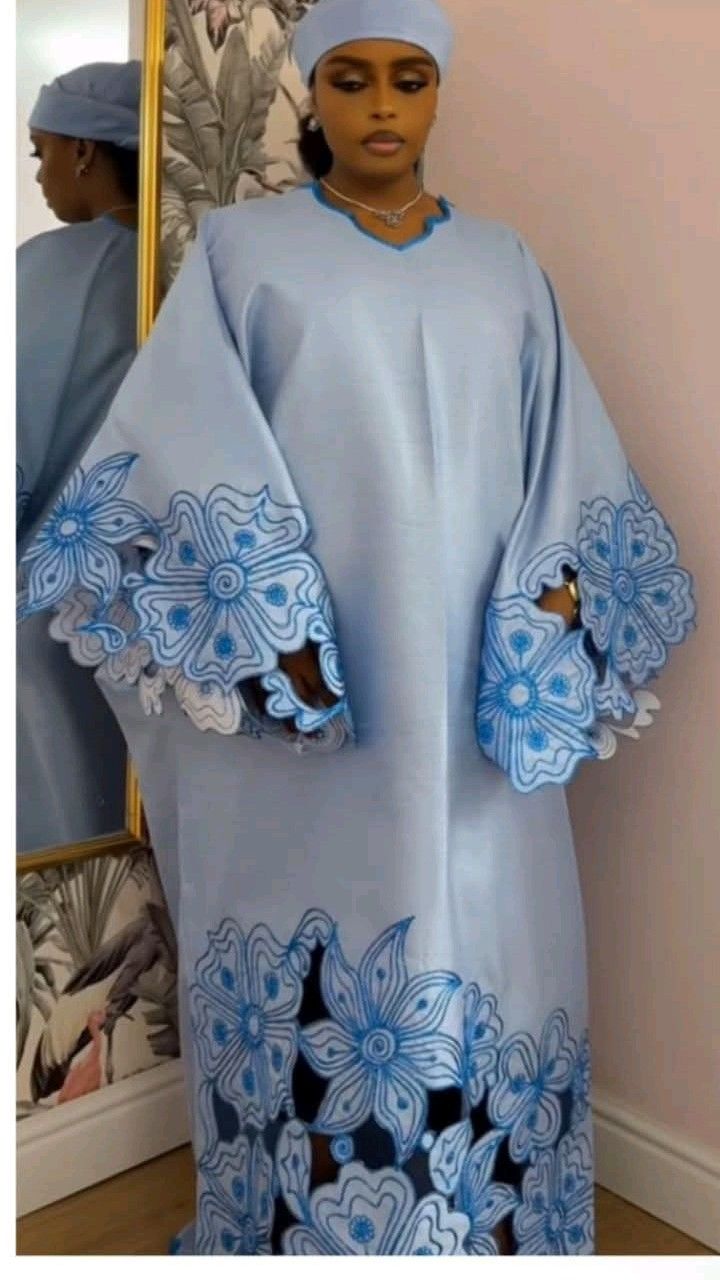
The Senegalese boubou did not begin in Senegal. Its earliest documented form is a garment of the trans-Saharan trade routes, worn by Wolof, Mande, Songhai-Zarma, Hausa, Kanuri, and Toubou peoples as protection from the harsh sun and sub-freezing desert nights of the Sahara crossing. The mbubb, the Wolof word whose sound gives us boubou, was a loose robe pulled over the head, designed for the specific physical challenge of Saharan travel. It was functional before it was ceremonial. It was a desert garment before it was a court garment.
That first transformation is the key to understanding every subsequent one. When the boubou moved from the trade route into the royal courts of the Sahelian empires, Ghana, Mali, and Songhai, it did not arrive as a finished cultural object and stay fixed. It absorbed the visual grammar of those courts: the embroidery traditions of Islamic scholarship, the colour hierarchies of specific royal houses, the specific fabric weights and drape properties that distinguished the court robe from the traveller’s robe. It became something different without becoming something unrecognisable.
That is the pattern the boubou has repeated at every significant historical moment. The roots of the boubou stretch deep into pre-colonial West Africa, shaped by the great Sahelian empires whose influence spread Islam, scholarship, and trade across the region. It is clothing that announces respectability, wisdom, and belonging without words. But the way it announces those things has changed continuously as the social conditions that require the announcement have changed.
The boubou absorbed bazin riche from Portuguese traders and made it its own. It absorbed Islamic court embroidery traditions and built them into its grammar. It survived colonial suppression and re-emerged as a statement of independence. Tradi-moderne designers are now reworking it without losing jom. If that is a static silhouette, the word static has been applied to the wrong garment.
Bazin Riche: How the Boubou Absorbed a Portuguese Trade Material
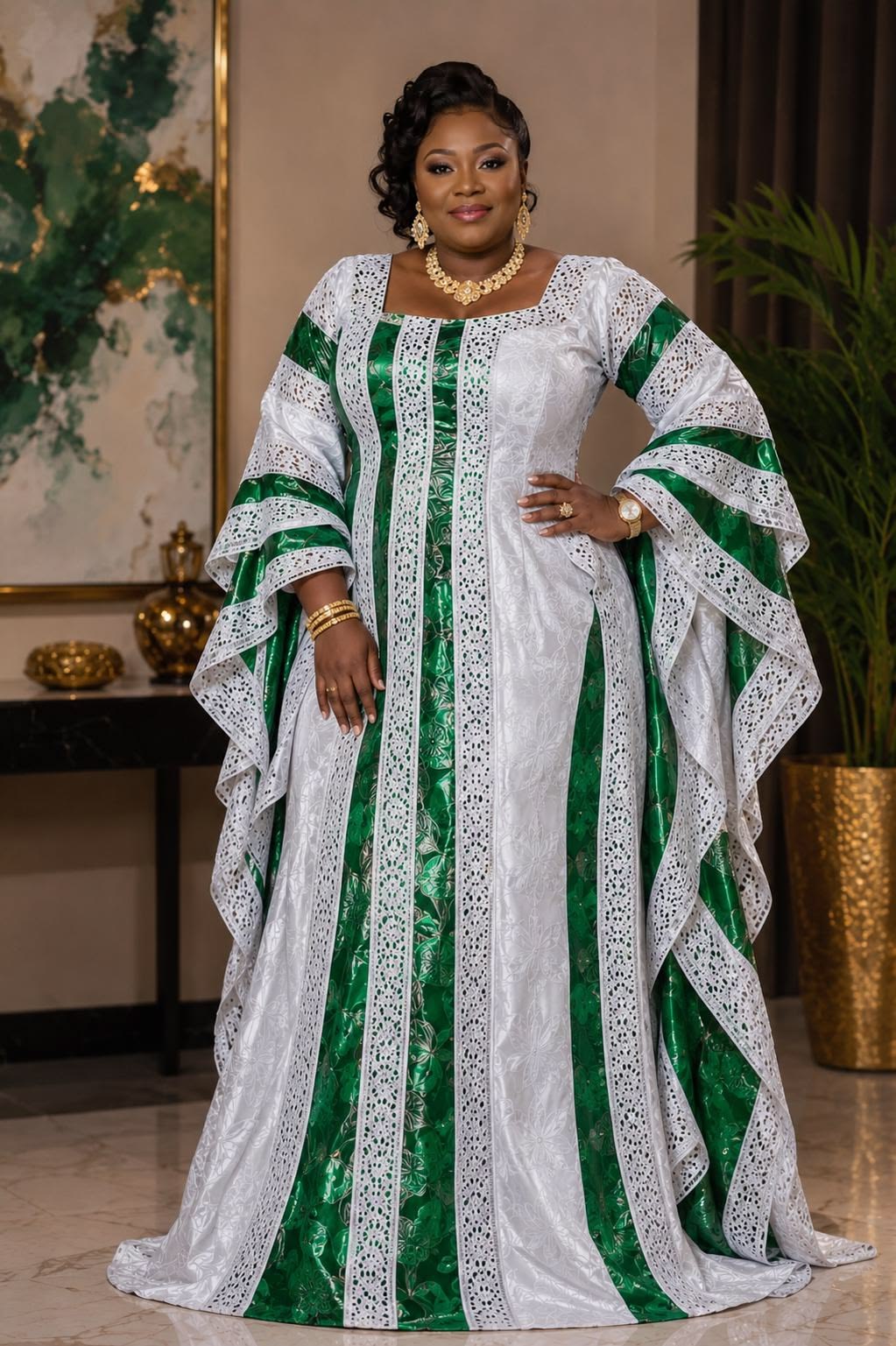
Bazin riche, the mercerised cotton damask that has become the most prestigious boubou fabric in Senegal, is not a traditional Wolof material. It arrived through European trade. As Omiren Styles’ documentation of bazin styles and Wolof fashion confirms, the tradition of flowing, voluminous robes worn at Wolof royal courts was established long before European traders arrived with cotton damask. What the trade routes brought was a superior canvas for an existing tradition. The Wolof court did not adopt the material and change the garment. They adopted the material and used it to do more precisely what the garment had always been doing.
Bazin riche is mercerised cotton damask that has been treated to achieve a distinctive sheen and stiffness. It holds a pressed crease with authority. It does not wilt in heat. It does not rumple in movement. For a garment whose social function is to declare composure and dignity across an entire day of presence, that is not a trivial property. The Wolof concept of jom, the refusal of smallness, the commitment to bearing that the community is always reading, required a fabric that carried itself. Bazin carries itself. The material absorption was not cultural capitulation. It was precision.
The 1980s bazin boom extended this logic further. The informal trade sector in dyed fabric expanded dramatically across Senegal, and bazin became the most universally desired fabric in the country, moving from exclusively ceremonial use into everyday wearing. That expansion was not a dilution of the boubou tradition. It was a democratisation: the visual grammar of dignity previously accessible mainly at weddings and formal occasions became part of daily life. The garment adapted its social register without changing its cultural logic.
Colonialism and the Politics of the Boubou’s Survival
The French colonial project in Senegal was, among many other things, a campaign to reshape public dress. European clothing was associated with education, modernity, and social advancement. Traditional dress was associated with the opposite. This was not an accidental association. It was a deliberate administrative strategy: to make the boubou a marker of the unmodern, the uneducated, the unfit for civic participation.
The boubou survived that campaign by doing what it had always done: adapting. In the cities, it moved between registers, worn at home and for ceremony, while European dress was adopted for the colonial professional contexts that required it. In the countryside, it remained the primary garment. And after independence in 1960, it re-emerged in the cities as something more politically charged than it had been before. Post-independence Senegalese leaders, intellectuals, and artists embraced the boubou as an assertion of African modernity. The garment that had been marked as unmodern by the colonial system was now claimed as the proof that African modernity did not need European dress to legitimate it.
Léopold Sédar Senghor, Senegal’s first president and one of the architects of Negritude, wore the boubou alongside Western suits throughout his presidency, using his dress to navigate between registers rather than choosing one over the other. That navigation was itself a statement: the two registers were not opposites, and an educated African leader did not have to perform European dress to demonstrate his modernity. The boubou’s re-emergence as a political assertion after independence was not a return to tradition. It was the creation of a new argument using traditional materials.
Dakar’s Tailoring Economy and the Continuous Remaking
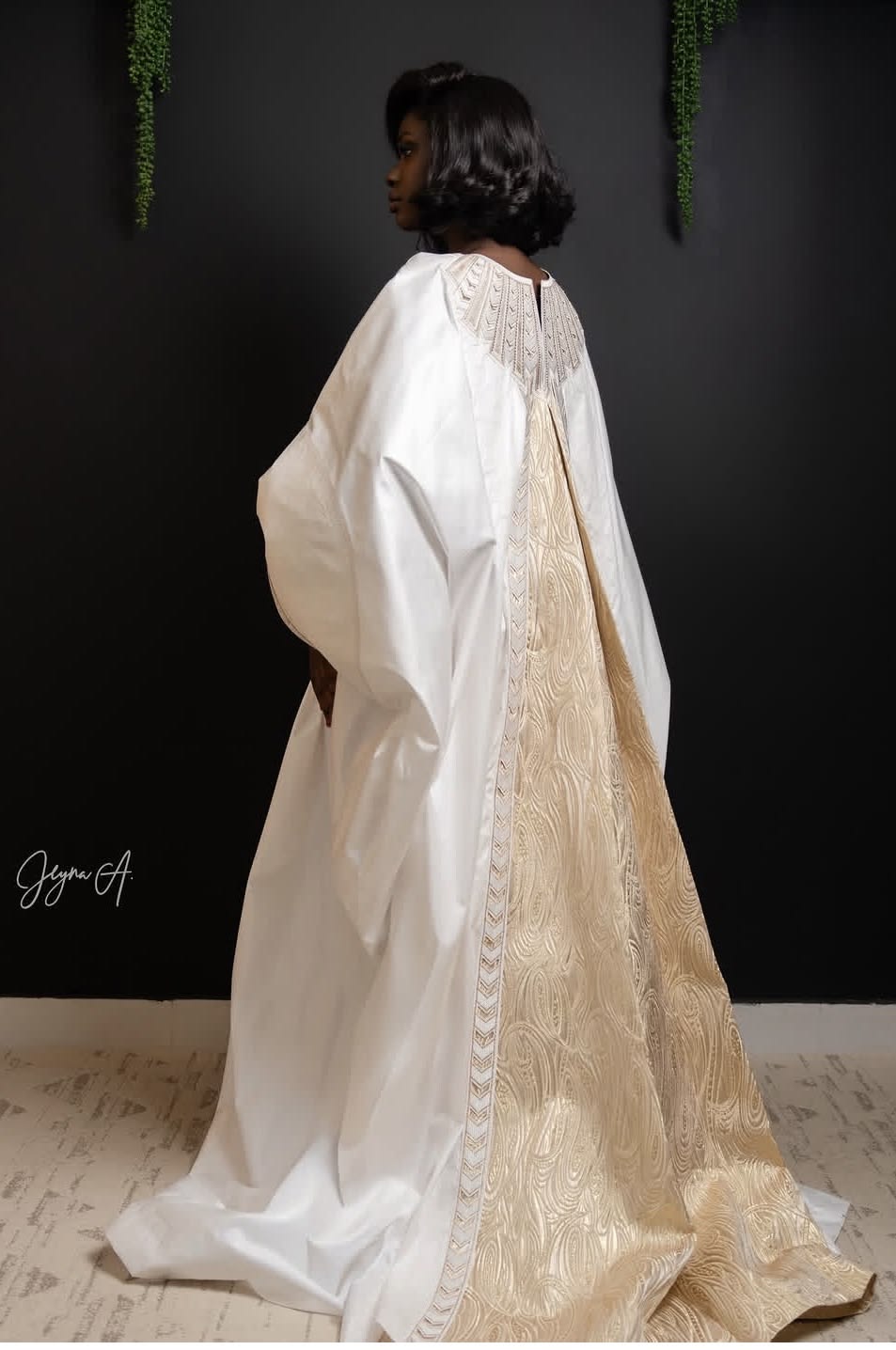
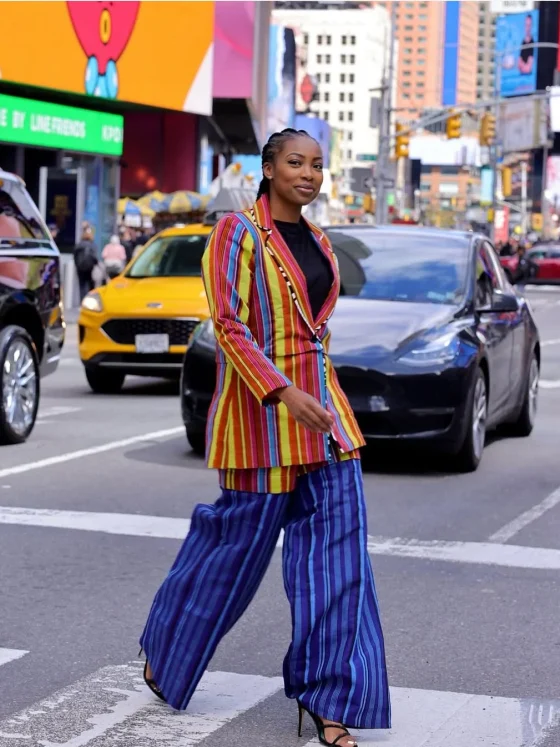
The boubou’s most powerful contemporary evidence of motion is Dakar’s tailoring economy itself. Senegalese youth incorporate grand boubou sleeves shortened into modern shirts, head wraps styled with hoodies, and embroidered fabrics combined with denim and sneakers. This is not the boubou being abandoned. It is the boubou being read by a generation that understands its grammar and is using individual elements of that grammar in new syntactic combinations. The sleeve is a boubou sleeve. The shirt is not. The combination is specifically Dakar 2026.
The tradi-moderne movement among Senegalese designers formalises what the street has been doing informally. The demi-saison, a shorter structured form that sits between a shirt and a full boubou, produces the same declaration of composure in a silhouette that works in professional settings. The Turki ndiarem, traditionally associated with clerical dress, has been reworked in new colours and fitted versions for everyday urban wear. The Diomaye three-piece African suit takes the boubou’s grammar into a tailoring format that competes with European suiting. These are not compromises. They are the latest moment in a sequence of adaptations that goes back to the Saharan trade routes.
The infrastructure behind this motion is Dakar’s fashion ecosystem. As Omiren Styles’ documentation of the future of fashion in Senegal confirms, Dakar hosts Dakar Fashion Week, launched in 2002, numerous designer ateliers, and Marché HLM, one of West Africa’s most significant textile markets. That ecosystem is not preserving the boubou. It is producing its next version in real time.
What Jom Explains
The concept of jom is why the boubou has been able to change so continuously without losing itself. Jom is not a style. It is not a silhouette. It is not a fabric. It is a complete orientation toward being present in the world: a refusal of smallness, a commitment to composure, the awareness that the community is always reading one’s bearing. The boubou is jom made visible. But jom can be made visible in a demi-saison as well as in a grand boubou, in bazin riche as well as in silk, in a tradi-moderne three-piece as well as in the flowing robe of the imperial Sahelian courts.
What cannot be removed is the requirement that the garment declare composure. That is the constant across every version of the boubou from the desert trade routes to the Dakar runway. The specific form changes. The specific fabric changes. The specific occasion changes. The declaration does not. That is what makes the boubou a living tradition rather than a museum piece: it is anchored to a cultural requirement, not to a fixed form, and that anchor allows it to move freely without losing its direction.
The Omiren Argument
The Senegalese boubou was never a static silhouette because the Senegalese cultural logic that produced it was never static. The African fashion market is worth 31 billion dollars. The boubou’s contribution to that figure is built on centuries of purposeful adaptation: from desert robe to court garment, from court garment to independence assertion, from independence assertion to tradi-moderne design, from tradi-moderne design to Dakar street style synthesis with denim and sneakers. Each of those transitions is evidence not that the boubou has lost its cultural logic but that its cultural logic, jom, dignity declared through bearing and composure, is robust enough to survive every material change it has been asked to carry. The garment that absorbed Portuguese cotton damask in the fifteenth century and turned it into bazin riche is the same garment whose sleeves young Dakar designers are shortening into shirts in 2026. The garment has not changed. The method of declaring jom has found new forms. Omiren Styles documents this as the argument the boubou has always been making: that what is alive does not stay still.
ALSO READ:
- Agbada, Boubou, Grand Boubou: One Silhouette, Four Expressions of Power
- Grand Boubou: The Most Prestigious West African Garment
- Senegalese Boubou Tailoring for the Modern Man
- The African Diaspora Wardrobe Does Not Choose Between Two Cultures. It Holds Both
Frequently Asked Questions
Has the Senegalese boubou always looked the same?
No. The Senegalese boubou has changed continuously throughout its history. It began as a practical garment worn by trans-Saharan traders from multiple West African cultures. It absorbed the embroidery traditions of Islamic courts when it entered royal settings. It incorporated bazin riche, a mercerised cotton damask from European trade, and made it into the most prestigious boubou fabric in Senegal. It survived colonial suppression and re-emerged as a statement of post-independence African modernity. Tradi-moderne designers are currently reworking it into shorter, more structured forms including the demi-saison and the Turki ndiarem. The silhouette has changed at every stage. The cultural logic, declaring composure and dignity, has not.
What is jom and why does it matter for the boubou?
Jom is a Wolof concept that translates inadequately as dignity or honour but describes a complete orientation toward life: a refusal of smallness, a commitment to composure, and the awareness that the community is always reading one’s bearing. The grand boubou is jom made visible. What makes jom important for understanding the boubou’s evolution is that it anchors a cultural requirement rather than a fixed form. Because jom describes how one must be present rather than what one must wear, the boubou can change its silhouette, fabric, and occasion register while retaining its essential argument. The demi-saison and the grand boubou declare jom in different contexts.
What is bazin riche and how did it become part of the boubou tradition?
Bazin riche is a mercerised cotton damask treated to achieve a distinctive sheen and stiffness. It holds a pressed crease with authority and does not wilt in heat or rumple in movement. It arrived in Senegal through European trade routes, likely through Portuguese traders, but was absorbed by the Wolof court tradition rather than replacing it. The Wolof tradition of flowing robes pre-existed the material. Bazin provided a superior canvas for a garment that needed to declare composure and dignity through its physical bearing. The 1980s saw a bazin boom that made it the most universally desired fabric in the country, extending the boubou from purely ceremonial use into everyday dress.
What is tradi-moderne in Senegalese fashion?
Tradi-moderne is a design direction in Senegalese fashion that adapts traditional garment forms for contemporary everyday and professional use without abandoning their cultural logic. Examples include the demi-saison, a shorter structured form that sits between a shirt and a full boubou; the Turki ndiarem produced in new colours and fitted versions for urban wear; and three-piece African suit formats like the Diomaye that take the boubou’s grammar into tailoring that competes with European suiting. Tradi-moderne is not a departure from the boubou tradition. It is the most recent moment in a long sequence of adaptations.
Why is the boubou often called traditional dress if it has always been changing?
The word traditional in global fashion writing is often used to mean static, as though a garment described as traditional has not changed since its origin. This is a misapplication. The boubou is traditional in the correct sense: it carries a cultural logic, jom, across generations. But traditional does not mean frozen. The boubou has absorbed new materials, responded to colonial politics, re-emerged as a political assertion, and is currently being reworked by contemporary designers. Calling it static erases the history of how it survived and misrepresents why it is culturally significant.
Explore More
Read the full Fashion > Opinion section for Omiren Styles’ documentation of African fashion arguments, cultural inheritance, and the garments that have survived by moving rather than by standing still.