On 15 August 2019, a collection landed in more than 60 H&M stores across the United States, the United Kingdom, France, Spain, Portugal, the Netherlands, Belgium, Mexico, Chile and Israel that had never existed before: an African designer’s work, distributed at global fast-fashion scale.
The designer was Palesa Mokubung. The label was Mantsho, a Johannesburg-based brand she had founded in 2004. In Sesotho, her native language, the word means “Black is Beautiful.” The collection launched simultaneously in South African stores and selected flagships worldwide, making Mokubung the first African designer to collaborate with H&M in the retailer’s history. H&M had previously collaborated with Karl Lagerfeld, Alexander Wang, Balmain, Moschino and Versace. Mantsho was the first African name on that list.
“This is my love letter to the world from Africa,” Mokubung said.
The collection sold. Store traffic at Mantsho’s South African locations increased. The brand gained international recognition it hadn’t had before. Ruth E. Carter, the Oscar-winning costume designer of Black Panther, wore Mantsho to the film’s premiere. True Love Magazine named Mokubung “the African trend dictator” of 2019. The collaboration became the most globally visible African fashion moment of its era.
Placing an African designer’s name in 60 countries simultaneously is no small feat. But the question this series has been building toward applies here, too: what did the collaboration produce beyond visibility? And who designed the terms under which that visibility became, or did not become, commercial power?
This article revisits the Mantsho × H&M collaboration not to diminish it, but to examine it seriously. As this series has argued, Visibility Is Not Market Power; attention and commercial power are different. A designer can be seen globally and still lack equity, ongoing royalties, control over how their name is used next, or the production infrastructure to capitalise on the audience the collaboration created. Examining the Mantsho × H&M blueprint is not about blame. It is about what every African designer considering a similar conversation should understand before they sign.
When Mantsho became the first African label to collaborate with H&M in 2019, it made history. Five years on, Omiren examines what the collaboration produced and what every African designer should understand before making a similar deal.
What the Collaboration Was

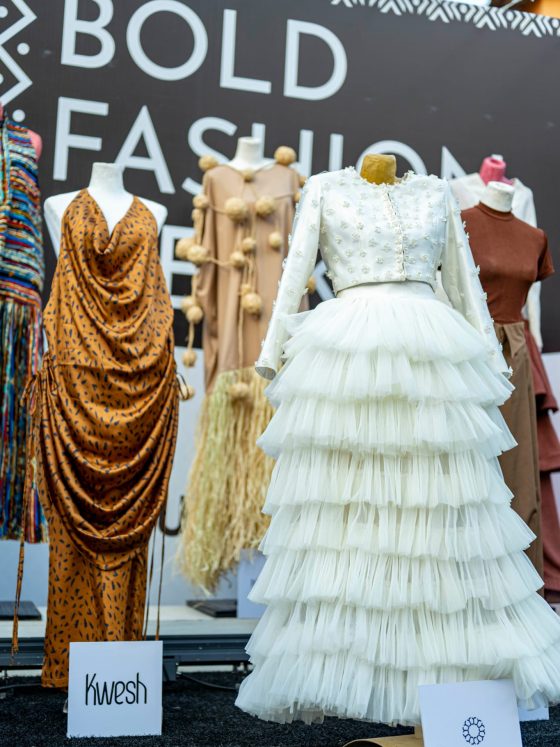
The Mantsho × H&M collection was a capsule range of women’s fashion and accessories designed by Palesa Mokubung for H&M’s global distribution infrastructure. As CNN’s coverage at the time confirmed, the collection featured flowing, easy-fitting cuts in hues of pink, amber, blue, brown and black, together with chunky earrings and a print-heavy clutch bag. Mokubung created four new prints specifically for the collaboration. H&M and Mantsho described the collection as “celebrating the elegance and vibrancy of Africa with modern edgy designs created for the stylish carefree woman.”
The structural logic of an H&M collaboration is well-established. H&M provides the manufacturing scale, retail infrastructure, global distribution network, and marketing reach. The collaborating designer provides the creative direction, the aesthetic identity and, crucially, the cultural authority that makes the collection newsworthy. H&M sells a product. The designer earns a fee and gains the largest-scale visibility event of their career.
The terms of that exchange are typically negotiated confidentially. H&M does not publish the fee structures, royalty arrangements or equity terms of its designer collaborations. Mokubung has not published the specific terms of her agreement with H&M. The public record shows what was visible: the collection, the press, the store distribution, and Mokubung’s own reported experience of the collaboration’s effects on her brand.
Essence’s documented interview with Mokubung records that she reported increased sales and store traffic at the South African Mantsho stores following the launch. It records her assessment that Mantsho was now recognised as an international brand. It records her framing the collaboration as an encouragement and inspiration for African designers who are well worth global recognition but have not yet been discovered. Neither Mokubung nor H&M has published the underlying commercial structure: what she was paid, what royalty structure, if any, applied, what rights Mantsho retained over the prints and designs created for the collaboration, and what ongoing commercial relationship, if any, followed from the initial collection.
The Three Questions Any Collaboration Must Answer
The Mantsho × H&M collaboration raises three questions that apply to every African designer considering a partnership with a global fashion brand. They are questions about control, scale and credit.
Control asks what the designer retains after the collaboration ends. Who owns the prints created for the collection? If a designer creates new work specifically for a collaboration, does that work remain in their intellectual portfolio, or does it become the collaborating brand’s property? Can the designer use similar prints, silhouettes or design approaches in their own subsequent collections, or have those design directions been commercially licensed in a way that restricts future creative freedom? Can H&M use the designer’s name in subsequent marketing without additional agreement? What prevents the collaborating brand from using the creative relationship as a template for further work that does not involve the original designer?
Scale is the question of what the designer captures from the commercial activity the collaboration generates. A collaboration that sells in 60 countries simultaneously generates revenue that is a multiple of what an independent designer can produce from their own retail channels. Who captures that revenue? The standard H&M collaboration structure pays the designer a fixed fee and, in some arrangements, a royalty on sales. But the royalty on a garment sold at H&M’s price points is a fraction of what that garment would generate at the designer’s own retail price. The scale of reach is enormous. The commercial return per unit sold is constrained by the mass-market pricing model that enables reach.
The question of credit is whether the collaboration advances the designer’s long-term commercial position or primarily advances the collaborating brand’s cultural authority. A collaboration can make a brand internationally known without providing the distribution infrastructure, repeat-buyer relationships, wholesale access, or production capacity it needs to capitalise on that recognition. The designer becomes associated with H&M’s global scale. Does the designer then have access to the commercial conversations that global scale should enable? Or does the collaboration create a one-time visibility event that the brand cannot sustain independently because the infrastructure that made the visibility possible was H&M’s, not Mantsho’s?
What the Collaboration Produced
Based on the public record, the Mantsho × H&M collaboration produced several documented commercial and reputational outcomes for Palesa Mokubung and the Mantsho brand.
It produced the most significant global visibility event in the brand’s fifteen-year history. A designer who had shown at South African Fashion Week, in New York, Senegal, Greece, India and Nigeria, and who had built a loyal local customer base in Johannesburg, was suddenly visible in over 60 countries simultaneously through one of the world’s most recognisable retail brands.
It produced increased traffic and sales at Mantsho’s own South African retail points. The collaboration created consumer awareness, which translated into visits and purchases at the brand’s home-market locations.
It produced international brand recognition. Mokubung described the collaboration as making Mantsho an international brand in a way it had not been before.
It produced an historical record. Mokubung is documented as the first African designer to collaborate with H&M. That fact persists in fashion journalism, academic documentation, institutional histories of African fashion, and Mantsho’s own public identity. It cannot be undone.
It produced a creative statement. The collection was Mokubung’s work: her prints, her silhouettes, her vision of the woman she designs for. It carried African creative intelligence into H&M’s global retail environment in a way that no amount of “inspired by Africa” brand language could replicate.
What it did not produce, according to the available public record, was an ongoing commercial relationship with H&M. It did not produce documented evidence of a royalty stream that continues to benefit Mantsho as the original prints circulate in H&M’s archive and marketing materials. It did not produce a structural change in Mantsho’s wholesale access, production infrastructure, or international distribution that would allow the brand to independently sustain the level of international commercial activity the collaboration initiated.
The Gap Between Reach and Infrastructure

The Mantsho × H&M collaboration is the clearest illustration of the gap between reach and infrastructure in African fashion.
Reach is H&M’s contribution to the collaboration: 60 countries, flagship stores, global marketing, a distribution infrastructure that took decades and billions of investment to build. No independent African designer has that infrastructure. No independent designer anywhere has that infrastructure without a major global partner.
Infrastructure is what the designer needs to capitalise on the reach: production capacity that scales with demand, wholesale relationships that sustain beyond a single collection, a direct-to-consumer presence capable of serving international demand, a team structure that can manage international orders, and the capital to finance the production cycle required by international demand.
The gap is not Mokubung’s failure. It is the structural condition of being an independent African designer entering a collaboration with one of the world’s largest fashion retailers. The retailer brings infrastructure built over decades. The designer brings creative authority and cultural identity. The collaboration is not between equals, and its terms reflect that asymmetry.
As documented in Three African Designers and the Gaps They Reveal, Thebe Magugu, Kenneth Ize and Adebayo Oke-Lawal have all built internationally recognised practices under conditions that required exceptional resilience precisely because the infrastructure the fashion industry provides to European designers was not automatically available to them. Mokubung built Mantsho over fifteen years before the H&M collaboration arrived. The collaboration expanded her reach massively. It did not automatically solve the infrastructure gap that limits how much of that reach can be converted into durable commercial expansion.
This is the dynamic that Kingston to Milan: The Aesthetic Export With No Export Deal is named in the context of Caribbean creative culture: a community’s aesthetic travels globally, generating commercial value at every point of distribution. In contrast, the originating community lacks the commercial infrastructure to capture a proportionate share of the value of its creativity. The Mantsho × H&M collaboration has a named designer and a documented fee structure, which already places it ahead of the unnamed cultural references the fashion industry typically absorbs without credit. But the structural question remains: in the five years since the collaboration, has Mantsho been able to build the international distribution, wholesale access and production scale that the visibility implied should follow?
What a Better Collaboration Structure Looks Like

Critiquing the terms of a collaboration that has not been made public requires careful framing. This analysis is not a claim that the Mantsho × H&M terms were unfair. It argues for what should be standard in any collaboration between a global fashion brand and an independent African designer, regardless of the specific terms negotiated.
A collaboration structure that produces durable commercial benefit for the African designer, rather than merely a visibility event, should include several specific elements.
Intellectual property retention. Prints, surface designs, and distinctive design elements created for the collaboration should remain in the designer’s portfolio and be available for subsequent use in their own collections, unless specific, limited-term exclusivity has been agreed, with explicit compensation for that limitation.
Production development. The collaborating global brand has manufacturing relationships that the independent designer does not. A collaboration structure that includes introductions to, or support for, production partners capable of working at the scale implied by the brand’s visibility would create lasting infrastructure benefits, not a one-time collection.
Distribution access. A designer who has demonstrated global commercial viability through a successful collaboration with H&M has demonstrated something that international wholesale buyers should find relevant. A collaboration structure that includes formal introduction to buyers in the global brand’s market relationships would create lasting distribution access rather than temporary visibility.
Ongoing royalty. A single upfront fee captures a fixed amount. A royalty on sales of the collaboration collection and on any subsequent use of prints or design elements creates a commercial relationship whose value compounds with the collaboration’s reach. If H&M’s marketing continues to reference the Mantsho collaboration in subsequent years, that ongoing value should generate ongoing return to the designer.
Capital access. The commercial success of a global collaboration should improve the designer’s access to working capital and trade finance for subsequent collections. A formal relationship with the collaborating brand that includes a reference or endorsement for the designer’s credit applications would create financial infrastructure benefit.
As Credit Is Not Compensation established, the scorecard for what global fashion owes African creative communities includes acknowledgement, documentation, consent, compensation, commissioning, continuity and accountability. A collaboration between H&M and Mantsho satisfies the acknowledgement requirement: Mokubung’s name and brand identity are explicitly credited. The question this scorecard raises is whether the subsequent elements were also satisfied: whether the compensation reflected the full commercial value the collaboration generated, whether the commercial relationship has continued, and whether accountability to document and disclose what the collaboration produced for both parties has been exercised.
The Blueprint for Designers Considering Similar Conversations

The Mantsho × H&M collaboration established that global fashion brands will collaborate with African designers when the creative authority is strong enough and the moment is right. That has value. It normalised African design in the history of global fast-fashion collaborations.
The blueprint also established for the designers who come after Mokubung a set of questions that must be asked and answered before signing a similar collaboration.
What is the fee, and how was it calculated? Is there a royalty on sales, and at what rate? What happens to the prints and designs created specifically for the collaboration? Can the designer use similar work in their own subsequent collections without restriction? Does the global brand commit to a minimum marketing effort to ensure the collaboration reaches an audience whose attention justifies the terms? Does the collaboration’s success imply an introduction to wholesale buyers and production partners? What ongoing commercial relationship, if any, follows from the initial collection? How will the collaboration be documented and attributed in the global brand’s marketing, and for how long?
As established in How Buyers Assess an Independent Label, range, margin, delivery, fit, and retail readiness determine whether a commercial relationship produces durable outcomes. The same logic applies to collaboration terms: the visibility a collaboration provides is the equivalent of a runway appearance. The question is whether the collaboration also builds the margin, the delivery infrastructure, the fit with ongoing market access and the retail readiness that convert the visibility moment into sustained commercial capability.
The Mantsho × H&M blueprint is not a cautionary tale. It is a historic achievement. Mokubung made history for African fashion in a way that cannot be undone. This analysis adds the recognition that making history and building sustainable commercial infrastructure are not the same thing, and that designers who come after Mokubung deserve to understand both what the collaboration achieved and what it left open as questions for the next generation of African designers entering global conversations about collaboration.
The Omiren Argument
Palesa Mokubung did something in 2019 that the global fashion industry had not done itself: she put African design at the centre of one of its most powerful distribution systems. That took fifteen years of building Mantsho, a creative intelligence that H&M recognised as worth its weight in gold, and a willingness to enter a commercial conversation with a partner whose structural power dwarfed her own. The courage and commercial preparation required for that moment should not be understated.
What Omiren Styles adds, in the context of everything this series has argued, is the recognition that the value the Mantsho × H&M collaboration generated is larger than what either the press coverage or the collaboration’s terms made explicit. A global brand used the creative authority of African design, the cultural cachet of African aesthetic identity, and the name of an independent African designer to create one of its most commercially and reputationally significant designer collaborations in a decade. That cultural authority has a commercial value. As After Attribution: Who Owns the Commercial Life of a Cultural Reference? established, the commercial life of a reference extends beyond the moment in which it is credited. The Mantsho × H&M collaboration is still being referenced in histories of African fashion, in journalism about African designers seeking global partnerships, and in the documentation of H&M’s own collaboration history. That ongoing value should generate ongoing return to Mokubung and to Mantsho.
The blueprint this collaboration established should be developed further by the designers who follow it, with better terms, stronger IP protections, clearer royalty structures, formal introduction to wholesale buyers and production partners, and an explicit commitment from the collaborating global brand to invest in the designer’s commercial infrastructure as well as their visibility. The Global South made fashion and never got credit. The Mantsho × H&M collaboration got credit. The next generation of African designer collaborations should get the commercial structure that converts credit into durable power.
ALSO READ
- Three African Designers and the Gaps They Reveal
- Credit Is Not Compensation: What Fashion Owes Beyond Naming a Cultural Source
- Visibility Is Not Market Power: Why Global Attention Still Fails Independent African Fashion Brands
- After Attribution: Who Owns the Commercial Life of a Cultural Reference?
- Kingston to Milan: The Aesthetic Export With No Export Deal
- The Global South Made Fashion. It Just Never Got Credit.
Frequently Asked Questions
Who is Palesa Mokubung and what is Mantsho?
Mantsho is a Johannesburg-based fashion label founded by Palesa Mokubung in 2004. In Mokubung’s native Sesotho language, the name means “Black is Beautiful.” The brand is known for its vibrant prints, bold, edgy designs, distinct silhouettes, and strong attention to fabric and textile development. Mokubung has showcased at South African Fashion Week and internationally in the United States, Senegal, Greece, India and Nigeria. She holds a Bachelor of Arts in fashion design. She has received multiple awards, including the Carol Bouwer Mbokodo Award in 2014 for her contribution to Arts and Culture in South Africa. In 2019, True Love Magazine named her “the African trend dictator.”
What was the Mantsho × H&M collaboration and why was it historic?
As CNN documented at the time, the Mantsho × H&M collaboration launched on 15 August 2019 and was the first collaboration in H&M’s history with an African designer. The collection was distributed in over 60 H&M flagship and online stores worldwide, including the United States, the United Kingdom, France, Spain, Portugal, the Netherlands, Belgium, Mexico, Chile, and Israel. It featured women’s clothing and accessories with flowing cuts, a range of colour palettes, four new prints created specifically for the collaboration, chunky earrings and a print-heavy clutch bag. Previous H&M collaborations had included Karl Lagerfeld, Alexander Wang, Balmain, Moschino and Versace. Mantsho was the first African name on that list.
What did the Mantsho × H&M collaboration produce for Palesa Mokubung and the Mantsho brand?
Mokubung’s documented account records increased sales and store traffic at Mantsho’s South African locations following the launch. She reported that Mantsho was now recognised as an international brand as a result of the collaboration. The collaboration also created an historical record: Mokubung is permanently documented as the first African designer to collaborate with H&M. What the public record does not contain is information about the financial terms of the collaboration, the IP arrangements for the prints and designs created specifically for H&M, the royalty structure, if any, or the commercial relationship, if any, that followed the initial collection.
What should an African designer consider before entering a collaboration with a global fashion brand?
The three central questions are control, scale and credit. Control concerns what the designer retains after the collaboration ends: who owns the prints, designs, and creative work produced for the collaboration; what ongoing restrictions, if any, apply to the designer’s subsequent creative work; and what rights the global brand holds to use the designer’s name and work in subsequent marketing. Scale concerns the financial return: how the fee was calculated; whether there is a royalty on sales and, if so, at what rate; and how the financial return compares to the commercial value generated by the collaboration across the full distribution network. Credit concerns whether the collaboration advances the designer’s long-term commercial infrastructure: whether it includes introduction to wholesale buyers and production partners; whether it improves the designer’s access to working capital; and whether a formal ongoing commercial relationship follows from the initial collection.
How does the Mantsho × H&M collaboration connect to the wider argument about African fashion and global brands?
The collaboration is the most precise available illustration of the difference between visibility and infrastructure in African fashion. H&M contributed global reach: 60 countries, flagship stores, a marketing and distribution infrastructure that no independent designer can replicate. Mokubung contributed creative authority and cultural identity. The collaboration was not between equals in terms of structural power, and its terms reflect that asymmetry. The argument this series has made throughout is that visibility is not market power: a designer can be seen globally through a collaboration and still lack the production scale, wholesale access, distribution infrastructure and capital access needed to capitalise independently on the audience the collaboration created.
What would a collaboration structure that produces durable infrastructure for an African designer look like?
A durable collaboration structure for an independent African designer would include: intellectual property retention over prints and designs created for the collaboration, or explicit and limited-term exclusivity with specific compensation; a royalty on sales that creates ongoing commercial return proportionate to the collaboration’s reach; formal introduction to wholesale buyers and production partners within the global brand’s network; a marketing commitment that ensures the collaboration reaches audiences in ways that build the designer’s own brand independently; access to working capital or trade finance facilitated by the commercial relationship; and a documented ongoing commercial engagement rather than a single collection. These are standard elements of commercial partnership structures in other industries. The fashion industry has not consistently applied them to its collaborations with independent African designers.
EXPLORE MORE
Read the full The Lens and Industry sections at Omiren Styles for ongoing analysis of African designer collaboration terms, commercial intelligence and the structural conditions that determine whether global partnerships produce durable commercial power or visibility without infrastructure. Discover travel and heritage intelligence across Africa at Rex Clarke Adventures.