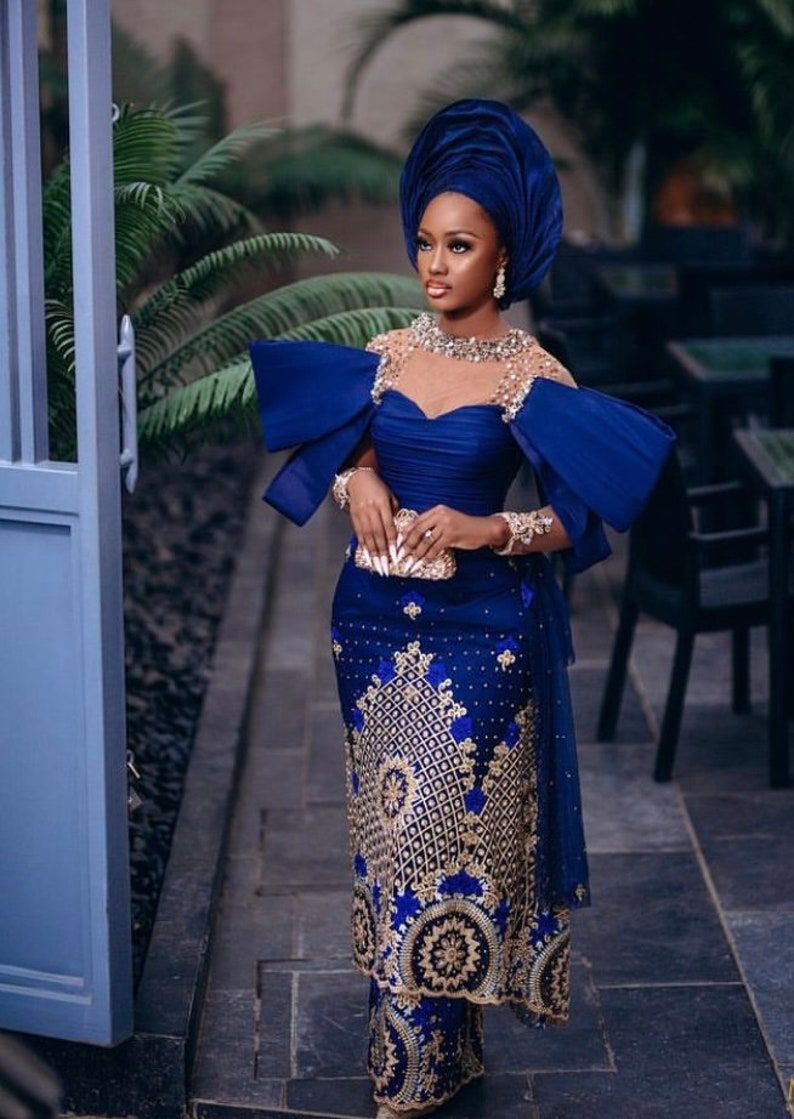
George fabric should not, by any reasonable cultural logic, be the prestige textile of Igbo women’s ceremonial dress. It arrived from India, carried into southeastern Nigeria by British colonial traders during the 19th century, and its original purpose in South Asian textile culture had nothing to do with the coral-beaded, palm-wine-carrying, Ichafụ-tied elegance of an Igbo traditional wedding. Yet that is exactly what it became. The Igbo women who first encountered George fabric, with its shimmering embroidery, its dense woven weight, and its capacity to carry gold and silver thread without losing composure, recognised in it a material worthy of the occasions they were already dressing for. They adopted it, adapted it, gave it Igbo names, commissioned specific weaves and colour ways from Indian manufacturers, and made it so thoroughly their own that it is now one of the most immediately recognisable markers of Igbo women’s cultural identity on the planet.
This is the Omiren Styles argument about George: the fabric’s Indian origin is not a complication to be set aside. It is the most interesting thing about it. The Igbo women who chose George did not choose it because they lacked an indigenous textile tradition. They had Akwete. They made that choice. They recognised beauty and weight when they saw it, because they understood how a fabric could carry the authority of an occasion, and because they were not then and are not now a culture that requires its ceremonial cloths to have been invented within its own borders. The question was never where George came from. The question was what Igbo women could do with it. The answer, over more than a century, has been extraordinary.
Discover the top 5 George styles for Igbo women in 2026, from the Bridal George double wrapper to the Intorica gown. Explore the history of George fabric in Igbo culture, its varieties, ceremonial grammar, and the styles defining Igbo women’s fashion this year.
From Madras to the Niger Delta: How George Became Igbo
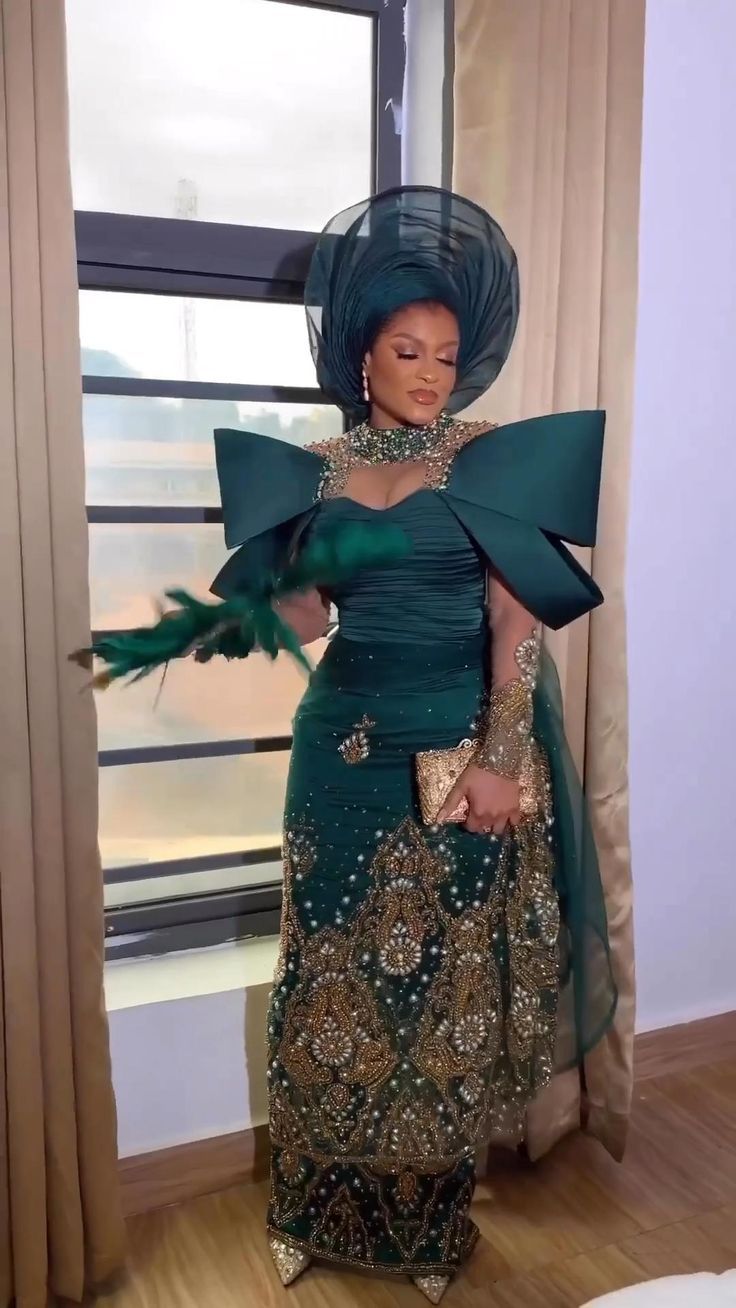
George fabric is a plaid cotton cloth woven in Madras, India, known in South Asia as ‘Madras cloth’. It arrived in West Africa during the expansion of British colonial trade in the late 19th century. It was quickly adopted along the Niger Delta trading routes, where its embroidered versions, heavy with metallic thread and dense with pattern, were immediately legible to communities that had long understood ceremonial dress as a statement of wealth and social standing. As Historical Nigeria’s account of traditional Nigerian clothing records, George fabric became fully integrated into Nigerian ceremonial fashion by the 1920s. Its shimmering embroidery symbolised affluence and cosmopolitan identity for southeastern women, and the Igbo in particular made it the cloth of their most significant occasions.
The name ‘George’ itself, as on Okwu ID documents, is the Igbo pronunciation and adoption of the fabric’s colonial-era name, given during the reign of King George and transliterated into local use as ‘Jorji’. That transliteration is itself a cultural act: a community taking a foreign term, shaping it to its own phonetic logic, and claiming the thing the term describes as its own. George is Jorji. Jorji is Igbo. The etymology is the history.
The varieties of George used by Igbo women today reflect over a century of refinement and differentiation. Plain George, also called the original plaid madras, is the foundational form: a woven plaid in cotton and sometimes silk, worn as a wrapper and associated with everyday ceremonial occasions. Arochukwu George is a specific variant of Plain George used by the Aro Igbo subgroup of the Arochukwu Kingdom, featuring the Aro people’s emblem incorporated into its plaid pattern. Intorica George is a second Indian import, distinct from Plain George in its weave and finish, and is typically worn by mature women on significant occasions. Bridal George is the most elaborate form: heavily embroidered, beaded, and sequinned, commissioned from Indian manufacturers specifically for Nigerian brides, and the fabric most people mean when they use the word ‘George’ in the context of Igbo weddings.
By the 1970s and 1980s, as Ankara.com.ng’s account of George fabric history records, George had become a household name among fashion-conscious Nigerians. Women wore double and triple-layered George wrappers with matching blouses, while men draped the fabric around their waists and shoulders. George was not merely popular for its appearance. It made its wearers feel a specific way: a sense of belonging, confidence, and standing that no cheaper fabric could replicate. That feeling is still the standard against which every George occasion is measured.
George did not arrive in Igboland as an outsider. It arrived as a material that Igbo women immediately recognised as capable of carrying the weight of the occasions they already had. They were right. A century later, nothing else does what George does at an Igbo traditional wedding.
The 5 George Styles Defining Igbo Women’s Fashion in 2026
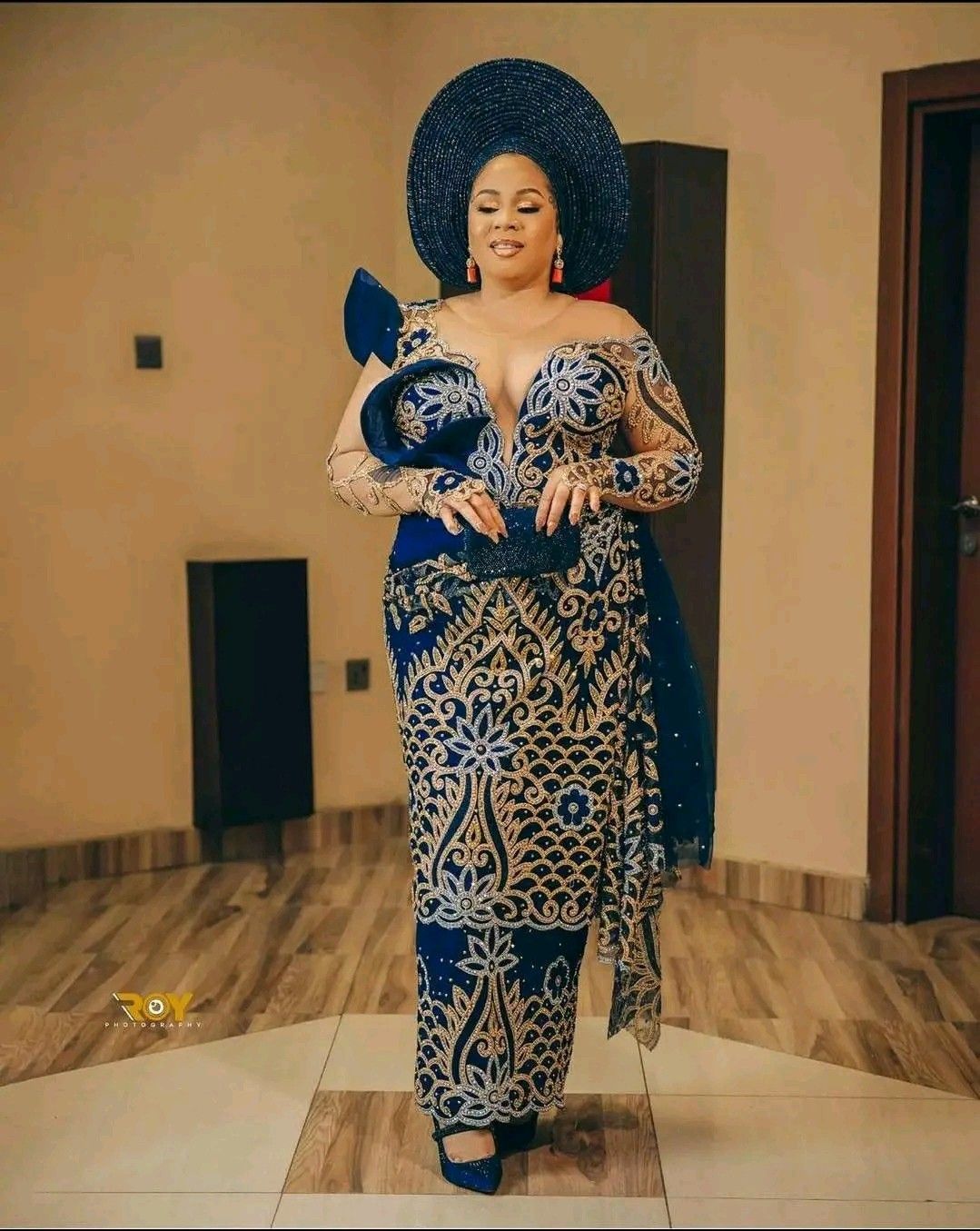
1. The Bridal George Akwa Abuo (Double Wrapper With Blouse and Ichafụ)
There is no style in Igbo women’s dress that carries more ceremonial authority than the Bridal George double wrapper worn at Igba Nkwu. The Akwa Abuo, meaning two wrappers, with the lower wrapper falling to the ankle and the upper folded at mid-calf, both in matching heavily embroidered Bridal George, paired with a fitted puff-sleeve blouse in the same fabric, a precisely tied Ichafụ at the crown, and a full set of original coral beads at the neck, wrist, and ankle: this is the Igbo bridal standard, and it is the standard against which everything else in Igbo women’s ceremonial dress is calibrated.
The embroidery on a Bridal George wrapper communicates the investment behind it. At the top end of the market, a piece commissioned from an Indian manufacturer for a high-society Igbo wedding carries gold and silver threadwork dense enough to catch light from across a room. The depth and coverage of the embroidery are legible to every Igbo woman in the gathering. A bride who arrives in a flat, lightly worked, George has made a statement she did not intend. A bride who arrives in a piece where the embroidery runs the full length of the wrapper has made the correct one. The Ichafụ, shaped and sized to complement the weight of the fabric below it, and the hand fan carried in the right hand, complete the silhouette. Nothing about this style is decorative in the casual sense. Every element is doing cultural work.
In 2026, Bridal George is moving towards richer colour combinations: royal blue with gold embroidery, deep plum with silver thread, and the classic red-and-gold pairing that remains the dominant bridal choice across Igbo communities from Anambra to Abia to the diaspora cities of London and Atlanta.
2. The Plain George (Jorji) Wrapper and Buba
Plain George, the original plaid madras that Igbo women call Jorji, is the everyday ceremonial fabric: the wrapper-and-blouse combination worn to Umuada meetings, to church occasions, and to the semi-formal social gatherings that constitute the routine of Igbo community life. Where Bridal George is the highest register, Plain George is the one that sustains the culture across the ordinary calendar. As Africanthings.org documents, George fabric is the prestigious fabric of the Igbo double wrapper, worn with coral beads for formal occasions, and the Plain George wrapper and blouse is the form in which that prestige is most regularly expressed outside the ceremonial peak of a traditional wedding.
The Buba, the fitted Igbo blouse worn with the wrapper, comes in several sleeve configurations in the Plain George context. The puff-sleeve Buba, shaped over decades into a form that is entirely Igbo despite its partial European origins, is the standard for senior women at important social occasions. A fitted long-sleeve Buba in Plain George for a younger woman attending a titled elder’s ceremony, or a loose short-sleeve version for a community meeting, represents the range of Plain George’s flexibility. The fabric’s plaid geometry means it reads as formal without requiring embellishment: the pattern does the work that embroidery does in Bridal George.
The Arochukwu subgroup of the Igbo wear their own variant of Plain George, incorporating the Aro people’s emblem into the plaid weave. This variant communicates an ethnic sub-identity within the broader Igbo category: a woman in Arochukwu, George, at a gathering is declaring not only that she is Igbo but that she is Aro, and that she knows the difference matters.
3. The Intorica George Gown
Intorica George is the Indian import that occupies the register just below Bridal George in the Igbo women’s dress hierarchy. Mature women typically wear it at significant occasions, and its association with seniority and established social standing gives it a different cultural weight from the bridal fabrics, one that is less spectacular but no less serious. As Okwu ID’s documentation of Igbo cultural materials notes, Intorica is another Indian import into Nigeria, worn on special occasions. It is particularly associated with women who have earned, through age and community standing, the right to a quieter kind of authority.
The Intorica George gown in 2026 is being cut into two dominant forms. The first is the floor-length fitted gown with a modest neckline and full sleeves, the Ichafu worn flat at the crown and original coral beads at the neck: a silhouette that is contemporary in its construction but entirely Igbo in its accessories and cultural register. The second is the Intorica wrapper worn in the traditional double formation with a structured Buba, the elder woman’s version of the same style that younger women wear in Bridal George. In both forms, the fabric’s particular sheen and weight convey what Intorica wearers intend: that they are women of standing, that they have dressed for the occasion with full cultural knowledge, and that the occasion has been honoured.
4. The George Skirt Suit
The George skirt suit, a structured, fitted jacket and matching A-line or pencil skirt in embroidered George, is the style that carries Igbo women’s ceremonial dress into formal institutional settings without requiring the full Akwa Abuo arrangement. It is worn to Ozo title ceremonies, graduations, professional cultural events, and any gathering where an Igbo woman requires her cultural identity to be present and legible in a setting that may not be configured for the full traditional ensemble. The suit communicates institutional authority through its structure. The George fabric communicates cultural identity through its pattern and embroidery. Together they make the argument that the Omiren Styles editorial team has been building across this series: that African fashion is not a departure from professional life but a complete and self-sufficient register within it. For the broader context on how African fabric carries civilisational authority into contemporary spaces, The Invisible Thread: How African Oral Tradition Shapes Fashion and Heritage Textiles on Omiren Styles addresses the cultural mechanics directly.
In 2026, George skirt suits are being commissioned with increasing specificity from Nigerian tailors both in Nigeria and in diaspora fashion houses. The jacket embroidery placement, typically at the collar, lapels, and cuffs, echoes the grammar of the traditional George wrapper without being a direct translation. The skirt is cut to allow movement, and the full coral bead accessory set is worn rather than substituted with costume jewellery. The result is a garment that is modern in its form and unambiguously Igbo in its cultural argument.
5. The George Kaftan
The George Kaftan, a flowing, wide-sleeved gown in embroidered or Intorica George, is the style that has the broadest reach across the full range of Igbo women’s occasions. It is formal enough for a chieftaincy installation, relaxed enough for a naming ceremony, and culturally appropriate at every point on the Igbo social calendar. The Kaftan silhouette in George fabric absorbs the fabric’s weight and drape without requiring the structured architecture of the suit or the full ceremonial arrangement of the double wrapper. It is, in that sense, the most accessible of the five styles: the one that requires the least technical knowledge of how to tie, fold, and arrange, while still communicating the full cultural seriousness of a woman who has chosen George.
In the diaspora, particularly, the George Kaftan has become the style of choice for Igbo women who want to dress culturally for Iri Ji celebrations, Umuada gatherings, and occasions where being visibly Igbo is the intention. Still, the setting may not accommodate the full double-wrapper arrangement. A well-cut George Kaftan with original coral beads and a carefully chosen Ichafụ is a complete Igbo cultural statement. No wrapper tying required. As the African Style section on Omiren Styles demonstrates across this series, the contemporary silhouette does not diminish a fabric’s cultural authority. George Kaftan makes that argument in the most comfortable way available.
When George Speaks: The Fabric Across Igbo Ceremonies
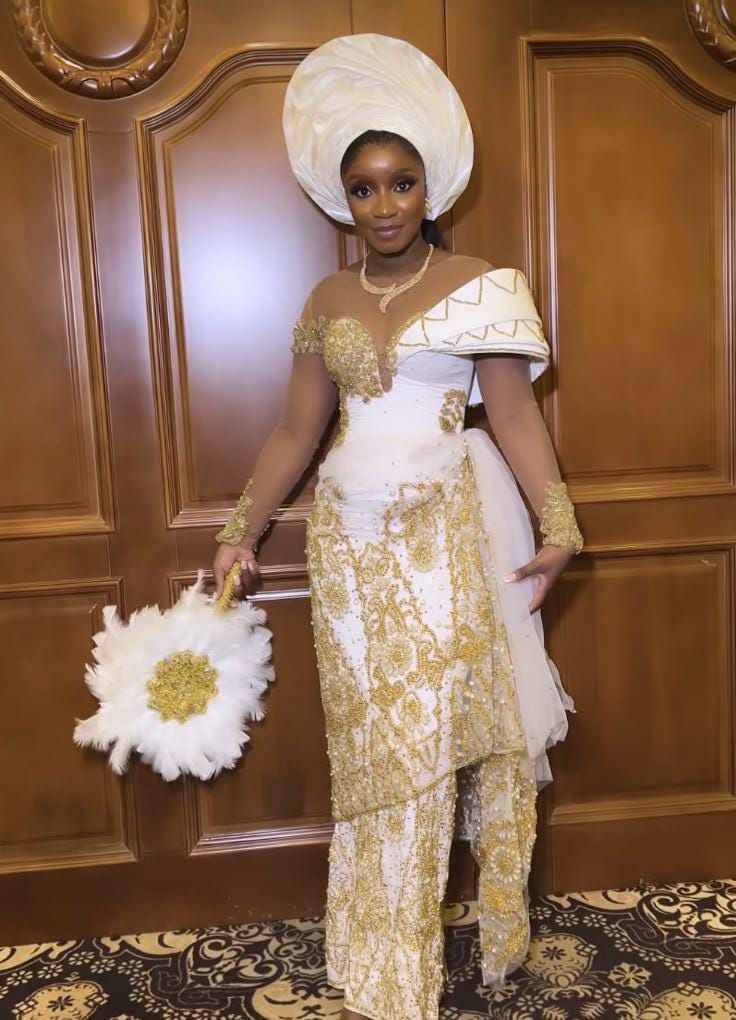
George fabric moves through Igbo ceremonial life according to a grammar refined over more than a century of use. The variety worn, the embroidery weight, the colour, and the accessories chosen all communicate something specific about the occasion and the wearer’s relationship to it.
Igba Nkwu (Traditional Marriage Ceremony)
The Igba Nkwu is the occasion for which Bridal George exists. The bride in her heavily embroidered double wrapper, with coral beads at the neck, wrist, and ankle, the Ichafụ shaped at the crown, and the hand fan carried as she searches the assembled crowd to present her cup of palm wine to the man she has chosen: this is the defining image of Igbo women’s ceremonial dress, and it is inseparable from George fabric. Female guests and family members coordinate in Aso-Ebi George, the shared fabric marking collective belonging to the celebration. The mother of the bride typically wears an Intorica George. The bride’s friends wear their own Bridal George in colours selected to complement rather than compete. The whole ceremony is, among other things, a demonstration of how a community uses fabric to organise itself visually around an occasion.
Iri Ji (New Yam Festival)
The Iri Ji festival, the New Yam celebration that marks the harvest season and remains one of the most significant cultural events in the Igbo calendar, is an occasion for George in its most celebratory configurations. Rich red and gold George wrappers, green and silver Intorica Kaftans, and the full coral bead vocabulary of Igbo women’s dress are all present at Iri Ji gatherings from Enugu to Imo to the diaspora festivals organised by Igbo associations in London and Houston. The festival is, as the Wikipedia entry on the wrapper garment notes, one of the occasions when the full cultural significance of the wrapper ensemble is publicly displayed and communally affirmed.
Iwa Akwa (Chieftaincy and Title Installations)
The conferral of a title in Igbo society, whether the Ozo title or other community honours, is one of the most formally dressed occasions in Igbo life—the women of the titled man’s household and extended family dress at the highest register they possess. Bridal George or the finest Intorica George, with a full set of original coral beads whose weight and quantity communicate the family’s accumulated status, and an Ichafụ sized and styled to match the occasion’s formality, is the standard for women at Iwa Akwa. The George fabric worn here is read by everyone present. No woman attends the conferral of a title in a cloth that does not reflect the honour being given.
Ito Ogbo (Naming Ceremonies)
The naming ceremony, the rite of formal community welcome for a new child held eight days after birth, is a predominantly female gathering at its social core. George in Plain or Intorica form, worn as a wrapper-and-Buba combination with appropriate beadwork, is the standard dress for the women who constitute the ceremony’s community. The mother receives gifts of George fabric from female relatives, the quality of those gifts communicating the community’s investment in her new status as a mother. A mother who arrives at her own child’s naming ceremony in plain, unembellished fabric has, by the logic of Igbo social dress, communicated something about her household’s preparedness for the occasion that she did not intend to communicate.
Ikwa Ozu (Funeral Rites)
George at Igbo funerals appears in its most restrained configurations: white or black wrappers, or the sober end of the George colour palette, worn with measured accessories. The quality of the fabric, even in mourning, is not reduced. A senior Igbo woman attending the funeral of a peer wears a George that reflects her standing and her relationship to the deceased. The community reads the cloth at a funeral with the same attentiveness it brings to a wedding. Completeness and quality of dress remain obligations. Only the colour and accessory register shifts.
At every Igbo occasion, the George a woman wears is her opening statement. The community reads it before she has spoken a word. That is not pressure. That is the privilege of a dress culture that takes its occasions seriously.
Also Read:
- Top 5 Akwete Styles for Igbo Women in 2026
- Top 5 Isi-Agu Styles for Igbo Women in 2026
- The Invisible Thread: How African Oral Tradition Shapes Fashion and Heritage Textiles
- When Dressing Becomes Declaration: Clothing as Cultural Identity
The Omiren Argument
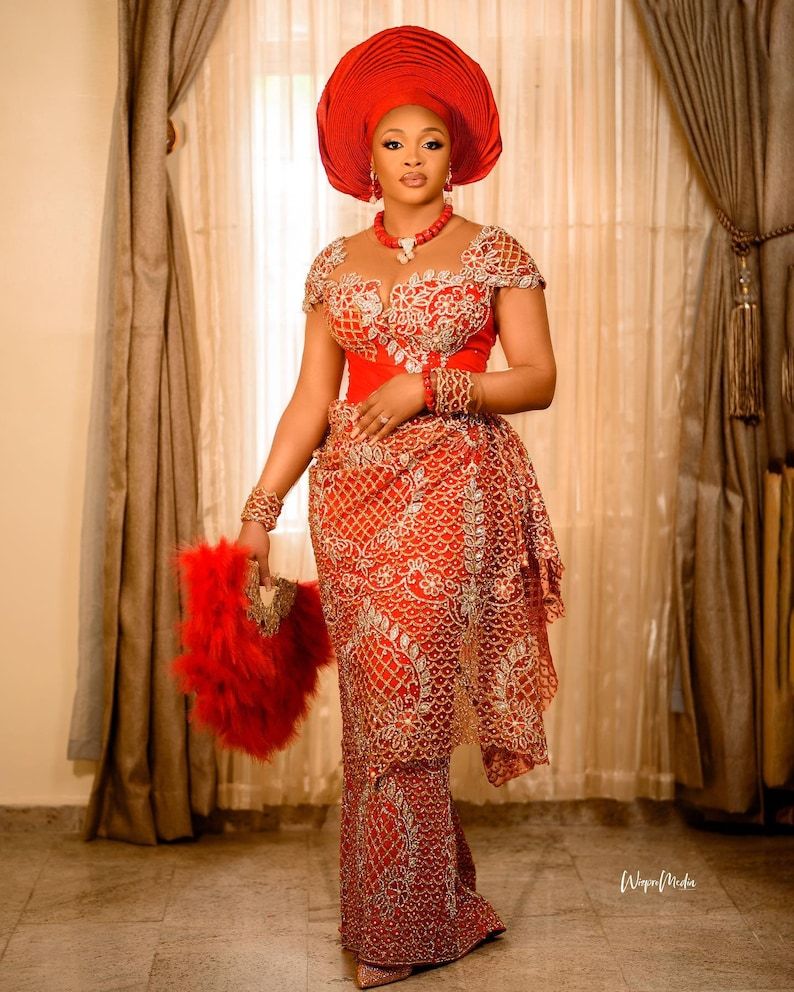
George Fabric’s Indian origin is, in the context of this series on African women’s dress traditions, the single most instructive fact in the entire article. The Igbo women who adopted it did not do so because they lacked a textile tradition of their own. They had Akwete, one of the most technically accomplished handwoven cloths in Nigeria, woven by women on Nkwe looms in Abia State, featuring over a hundred named motifs drawn from Igbo cosmology and social life. They had Akwa Ocha, the white woven cloth of the Anioma. They chose George because they recognised in it a fabric capable of carrying the weight of their most serious occasions, and because they were, as the Igbo have always been, a culture of trade, contact, and creative absorption.
What happened next is what matters for fashion history. The Igbo did not merely adopt George. They differentiated it, naming distinct varieties including Plain George (Jorji), Arochukwu George, Intorica, and Bridal George. They commissioned specific weaves and colour ways from Indian manufacturers, and they developed a ceremonial grammar for which variety is worn at which occasion and by whom. They made the fabric so completely their own that a newcomer encountering it at an Igbo traditional wedding would have no way of knowing it was not indigenous. That is not cultural appropriation. That is cultural mastery.
The fabric travelled from Madras to the Niger Delta. What the Igbo made of it has been travelling to the world ever since.
Browse the full African Style collection at Omiren Styles.
Frequently Asked Questions
1. What is George fabric, and why is it associated with Igbo culture?
George fabric is a plaid-embroidered cloth originally woven in Madras, India, where it was used as a saree fabric. It arrived in West Africa during the expansion of British colonial trade in the 19th century. It was adopted with particular enthusiasm by Igbo and Niger Delta communities, who made it the prestige textile of their most significant ceremonies. The Igbo transliterated its name into Jorji and developed several distinct varieties suited to different occasions and social registers. It is now considered by Igbo communities as culturally their own, despite its Indian origin. A comprehensive account of this history is available at Ankara.com.ng.
2. What do Igbo women wear the different types of George fabric?
The main varieties are Plain George (Jorji), the original plaid madras used for everyday ceremonial occasions; Arochukwu George, the Aro Igbo subgroup’s variant incorporating the Aro emblem into the plaid weave; Intorica George, an Indian import associated with mature women and senior social occasions; and Bridal George, the heavily embroidered, beaded, and sequinned fabric commissioned from Indian manufacturers specifically for Nigerian brides and the highest-register ceremonies. Each variety carries its own social meaning and is appropriate at specific occasions. Okwu ID’s guide to Igbo cultural materials provides a clear overview of these distinctions.
3. How does George fabric differ from Akwete cloth in Igbo dress culture?
Akwete is an indigenous Igbo textile, handwoven on vertical Nkwe looms in Ndoki, Abia State, by women who have practised the craft for generations. It carries Igbo cosmological motifs, is produced within Igboland, and is the true indigenous fabric of the Igbo. George is an adopted fabric of Indian origin that became culturally Igbo through more than a century of use, refinement, and ceremonial integration. Both are considered appropriate Igbo ceremonial dress, but they carry different cultural registers: Akwete carries the authority of indigenous production and ancestral motifs, while George carries the authority of prestige, wealth, and the accumulated weight of the ceremonies it has dressed since the 1920s.
4. What accessories are worn with the George fabric in Igbo women’s dress?
The standard accessories for George in Igbo women’s ceremonial dress are original coral beads at the neck, wrist, and ankle; an Ichafụ headscarf, shaped and sized appropriately for the occasion; and a hand fan carried in the right hand at weddings and title ceremonies. Coral beads are not merely decorative in Igbo culture: their quantity and quality communicate marital status, family standing, and the wearer’s position within the social hierarchy of the gathering. A senior Igbo woman at an Ozo title ceremony wears coral that communicates everything her George wrapper confirms about her standing. Neither element is complete without the other.
About Omiren Styles
Omiren Styles is an Africa-rooted fashion and culture editorial platform. Fashion. Culture. Identity. We do not follow trends. We inform them.
REPURPOSING NOTE
This article can be repurposed as: (1) a 5-slide Instagram and LinkedIn carousel on the five George styles, with the cultural occasion guide as a sixth slide; (2) a short-form video script on how a fabric from Madras became the most recognisable marker of Igbo women’s ceremonial identity; (3) a Pinterest board pairing each George variety with its appropriate ceremony; (4) an email editorial feature timed to Igbo wedding season in Nigeria.