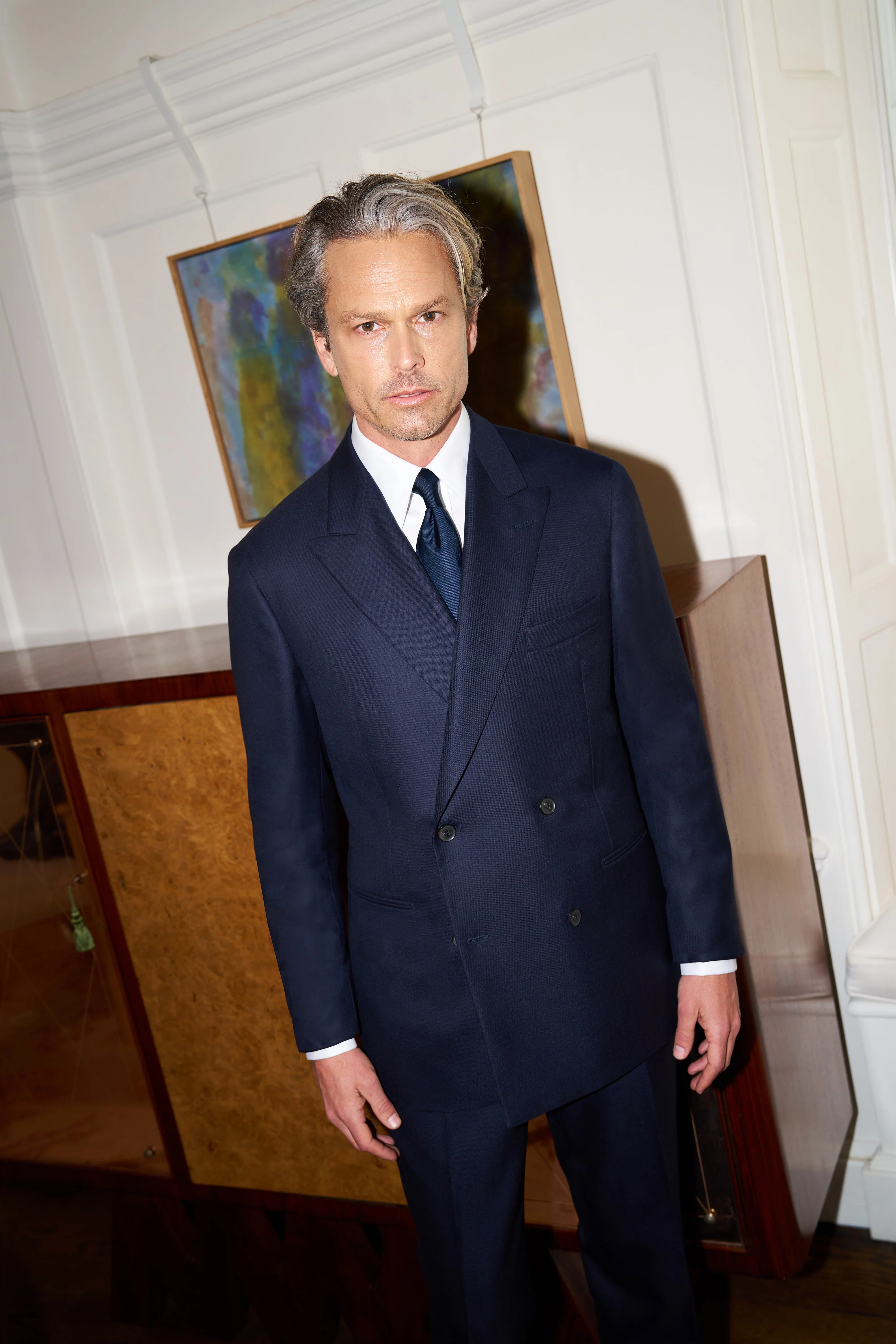
At Casely-Hayford, choosing a suit and having its pattern adapted to your body are different transactions. Made-to-order uses standard ready-to-wear sizing, while made-to-measure begins with the house block and adjusts it using individual measurements, posture, balance and styling preferences.
The distinction explains what personalisation is intended to change. The wearer does not replace the house’s design framework; the service brings that framework into a more individual relationship with the body.
A house block is the starting pattern framework from which a garment is adapted. In Casely-Hayford’s published process, it provides continuity, while the consultation and fitting introduce client-specific information.
The question is not simply whether the finished suit is “custom”, but which decisions remain part of the selected design and which are adjusted for its wearer.
For another look at how tailoring shapes a public image, see our profile of stylist Ola Ebiti, whose work draws on Nigerian heritage and tailoring.
Casely-Hayford adapts a house block to individual measurements and posture. Explore how made-to-measure differs from made-to-order and handmade.
The house style does not disappear.
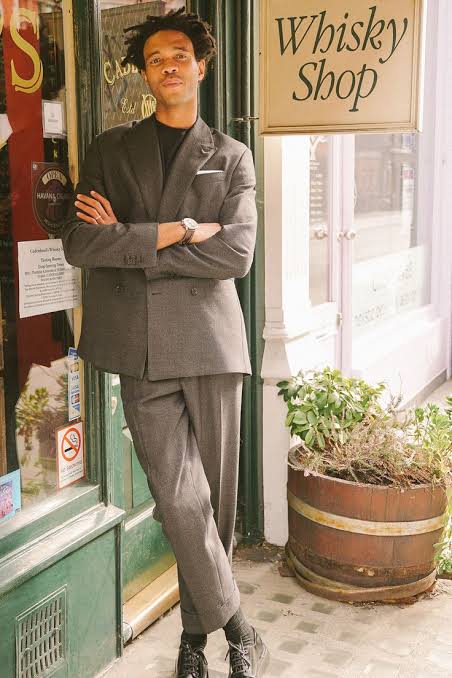
Casely-Hayford’s published range includes several distinct propositions. Its made-to-order page lists Ofili as a concealed-button suit, Yinka as double-breasted, Lakin as wide-leg and Haiden as notch-lapel.
These descriptions establish variety within the selection rather than a single suit repeated in different fabrics.
They also show why choosing a tailoring house is not the same as choosing a neutral template. A concealed front, a double-breasted jacket and a wide trouser leg are design decisions before a client’s measurements enter the process.
Those named styles belong to the made-to-order listing. Their presence there does not mean everyone is available through made-to-measure or that every proportion can be altered without restriction, so availability must be confirmed for a proposed commission.
The house’s own description of its cut gives a sense of the framework. Its business suits page describes sloping shoulders, a full chest, a defined waist, a high armhole for mobility and minimal padding.
“Personalisation is not the absence of a point of view. It is a point of view that has learned to listen to one body.” Omiren Styles Editorial Intelligence
The broader point is that personalisation works within an existing design. A client may be drawn to a particular shape or attitude and still need adjustments to how it sits on their body, and made-to-measure is the house’s stated route for negotiating that relationship.
What the consultation is designed to establish
On its made-to-measure service page, Casely-Hayford describes an initial discussion of the client’s needs, preferences and lifestyle. They take measurements while considering posture and body configuration and develop fabric and styling decisions with the house.
The business suits page adds that consultations take place at the Chiltern Street store, with a 45-minute Discovery Consultation or a 90-minute Full Consultation covering cloth, cut, styling and measurements.
The consultation therefore has more than one purpose. It gathers information about the body, but it also establishes what the garment is expected to do and how the client wants it to look.
Published styling examples include lapel choices and shoulder construction. These indicate areas for discussion rather than an unlimited menu of possible changes, and the page does not define every permitted adjustment or identify the requests that would fall outside the service.
That boundary is important. A personalised service is not necessarily one in which every feature can be redesigned, so the useful question is which decisions are available within the selected starting point and which remain integral to it.
The consultation should make that relationship explicit before the commission proceeds. A client needs to understand both the scope of adaptation and the character of the garment being adapted.
Cloth is part of the commission.
Casely-Hayford says its made-to-measure service offers more than 3,000 cloths from mills in the UK, Italy and Japan, covering different textures, patterns and weights. The number describes the house’s advertised selection, not a guarantee that every cloth is available for every commission.
The editorially useful detail is the place of cloth within the process. It is considered alongside cut, styling and the client’s requirements, rather than being presented as a purely decorative choice after the garment has been settled.
The consultation question is therefore not only which fabric the client likes. It is which cloth suits the intended garment and use and which options are available within the chosen service.
The published pages do not provide a commission-specific answer, and they do not justify assigning a particular fabric weight, seasonal purpose or performance benefit to an imagined client. For a broader checklist on cloth claims, see our guide to verifying a fashion brand’s fabric claims.
Nor should mills’ locations be confused with garment manufacturing locations. The page identifies where cloths are sourced but does not state where standard made-to-measure suits are cut and assembled; those are separate production questions.
Measurements become a retained record.

Once measurements and design details are agreed, Casely-Hayford says they are translated into a digital pattern built from the house block. That pattern is retained for future orders.
This is one of the clearest differences from selecting a standard size. The process records client-specific information rather than relying only on the dimensions associated with a ready-to-wear size label.
The house also states that it incorporates fitting alterations into the digital pattern. The retained record can therefore reflect adjustments made after the first measurements were taken.
Its practical value is continuity, because later commissions have a documented starting point rather than an entirely disconnected set of instructions.
That does not mean a retained pattern permanently resolves fit. The published service promises a record, not that a wearer’s measurements, preferences, or requirements will remain unchanged; a later order may still need review.
The distinction keeps pattern retention useful without turning it into a promise that every subsequent commission will be automatic.
Fitting tests the proposed adaptation.
Casely-Hayford describes the suit as being assembled to a near-complete stage before a fitting. The process then includes chalking, pinning and adjustment, followed by completion, pressing and a final fitting.
This sequence gives the wearer’s information more than one opportunity to affect the result. Measurements guide the pattern, while the fitting provides a stage to review the garment on the body.
That is the service’s central procedural value: individualisation does not end when a tape measure is put away.
The house uses promotional language about perfect fit, and this article does not adopt that as an independently established outcome. The more useful account is the published mechanism: the garment is reviewed, alterations can be made, and those changes are recorded.
A fitting is therefore not simply a ceremonial confirmation of a decision already made. Within the stated process, it tests the proposed adaptation before final approval.
Three services, three starting points
Casely-Hayford’s terminology becomes clearer when you place its services side by side.
- Made-to-order: the published starting point is selected from current and previous styles in standard ready-to-wear sizing. The house says style and house-fabric selection change, with alterations available on request.
- Made-to-measure: the published starting point is the signature house block. Individual measurements, posture, balance and styling preferences inform the adaptation.
- Handmade: the published starting point is an elevated offering positioned alongside the house’s made-to-measure service. The house describes additional hand construction, specified jacket construction and further fittings.
These are process distinctions, not an independently tested ranking of finished quality.
The made-to-order service is particularly clear about standard sizing. It offers access to selected styles and fabrics, including some previous designs, but does not promise an individually adapted pattern as its starting point, and alterations are available on request.
Made-to-measure introduces that client-specific adaptation. The difference is not merely that a garment is produced after an order; it is the basis on which the garment is specified.
Handmade does not mean entirely hand-cut
Casely-Hayford describes its handmade service as an elevated part of its made-to-measure offering. Its page states that suits are initially cut by machine and sewn by hand, and for the jacket it specifies a full floating canvas, hand-padded chest piece and shaped lapels.
Those details belong to that service, and they should not automatically be assigned to standard made-to-measure.
The page also describes additional fittings and a retained digital pattern. Although it uses “bespoke” descriptively in places, the service name remains handmade and is positioned within made-to-measure.
The clearest editorial treatment is to preserve that name and explain the stated process rather than use the terms interchangeably.
Precision here is not an argument against craftsmanship. It identifies the operations and construction features the house actually publishes.
Timing and price need the same precision.

The standard made-to-measure page gives a typical completion period of seven to eight weeks. Made-to-order advertises collection in six weeks, and both are published indications that should be confirmed for a particular commission and deadline.
The handmade page describes a different sequence: a return around six to seven weeks after consultation, followed by two or three additional fittings. That should not be read as a promise that the entire commission is completed within six or seven weeks.
Prices must also be matched to the service. Product prices displayed on the made-to-order page are not quotations for made-to-measure or handmade tailoring.
For a client, the essential questions are what the quotation covers, which choices may change it and how the fitting and completion schedule will work. A loosely assembled price comparison would obscure those differences rather than explain them.
The Omiren Argument
Casely-Hayford’s published process places adaptation within an existing design framework. Made-to-measure does not promise that the house disappears; it proposes that the house block can be adjusted through measurements, posture, cloth and styling decisions, then reviewed through fitting.
The meaningful distinction is not “standard” versus “special”. It is which decisions belong to the selected design, which can change for the wearer, and when those changes are tested.
Made-to-order, made-to-measure and handmade answer different versions of that question. Understanding them requires attention to the process, not the assumption that “custom” describes one uniform service.
The house style provides the reason to begin. The individual wearer gives it reason to adapt.
More of our writing on tailoring and menswear is at Omiren Styles.
Also Read:
- The Intimacy of Tailoring Is How Clothes Learn the Language of Your Life
- How African Men Are Reclaiming the Suit, And Redefining Global Tailoring
- How Menswear Is Finally Having Its Cultural Reckoning on the Global Stage
- Meet the African Menswear Designers You Should Know Before the Rest of the World Does
Frequently Asked Questions
How does made-to-measure differ from made-to-order?
Casely-Hayford’s made-to-order service uses standard ready-to-wear sizing. Made-to-measure adapts the house block using individual measurements, posture, balance and preferences.
Does Casely-Hayford retain a client’s pattern?
The house says it retains the digital pattern and incorporates fitting alterations for future reference. This does not eliminate the need to review later requirements.
Is its handmade service entirely hand-cut?
No. The published process describes initial machine cutting followed by hand sewing.
What timetable does the house publish?
Standard made-to-measure typically takes seven to eight weeks, while made-to-order advertises a six-week collection. Handmade has a separate fitting sequence, so confirm the schedule directly before committing to an event deadline.