In the Great Lakes region of Central Africa, the line between military drill and ceremonial performance was deliberately blurred. The Intore, whose name means chosen ones or selected in Kinyarwanda and Kirundi, began as a class of elite royal warriors trained from youth in the court of the Mwami, the king, to move between war, ritual, and dance as a single discipline. They were fighters who performed and performers who had fought. The dance they produced was not entertainment. It was a military report, rendered in movement, rhythm, and poetry, for the eyes of the king.
The African fashion market is worth 31 billion dollars. Within that figure, the ceremonial dress traditions of the Great Lakes kingdoms represent some of the most precisely governed sartorial systems on the continent: regalia in which every element has a function, and in which the garment is inseparable from the governance system it represents. The Intore’s costume, its sisal wigs, leopard skins, ankle bells, beaded neckpieces, spears, and shields, is that kind of system. As UNESCO’s inscription of the Intore as a Rwandan intangible cultural heritage in December 2024 confirms, the Intore dance arranges performers in lines representing the ranks of warriors on a battlefield. Through their movements, they mimic combat with an invisible adversary, leaping and wielding spears and shields to the rhythm of traditional drums and horns, supported by songs and poems of triumph and strength.
The Intore is not a dance. It is a choreographed military report performed before kings. Here is where it began, what its regalia encodes, and where it stands today.
Burundi Intore Ceremonial: The Origin and the Royal Court Function
The Intore originated in the royal courts of the Burundian kingdom before crossing into Rwanda. As M Travel and Tours Burundi’s 2025 documentation of the tradition confirms, the Intore dance originated in the royal courts of Burundi, where it was performed by elite warriors who protected the kingdom and upheld justice. In the 1830s, when the royal Muyange fled fighting in the neighbouring Burundian kingdom and was granted asylum by the King of Rwanda, the Intore tradition crossed with him. What began as a Burundian royal warrior tradition became a shared cultural practice of the Great Lakes region, performed in both kingdoms and maintaining its martial grammar across both.
Within the Burundian monarchy, the Intore had a specific ceremonial function. After returning from battle, the warriors would perform before the Mwami and the assembled court, displaying their bravery, recounting victories, and reaffirming loyalty through movement and recitation. The chief or leader of the Intore would recite poems praising the king, describing battles, and invoking ancestral connections, while the dancers responded with synchronised leaps, shouts, and spear gestures. This call-and-response structure made the performance a collective act of memory: each movement echoed a specific feat, a specific lineage, a specific act of service to the royal house.
The warriors selected for Intore training were chosen from among young men across the kingdom based on physical and moral attributes. Their training, conducted in institutions called Itorero, was not limited to combat. It encompassed cultural values, governance principles, public speaking, traditional games, poetry, and the performing arts. The Intore warrior was expected to be as accomplished at the recitation of epic praise poetry as at spear work. The dance encoded both.
The Intore was not entertainment. It was a military report rendered in movement, rhythm, and poetry, performed before the king after battle. The choreography encoded specific military actions, victories, and royal praises. Every leap meant something.
Regalia and Costume: What the Visual Language Encodes
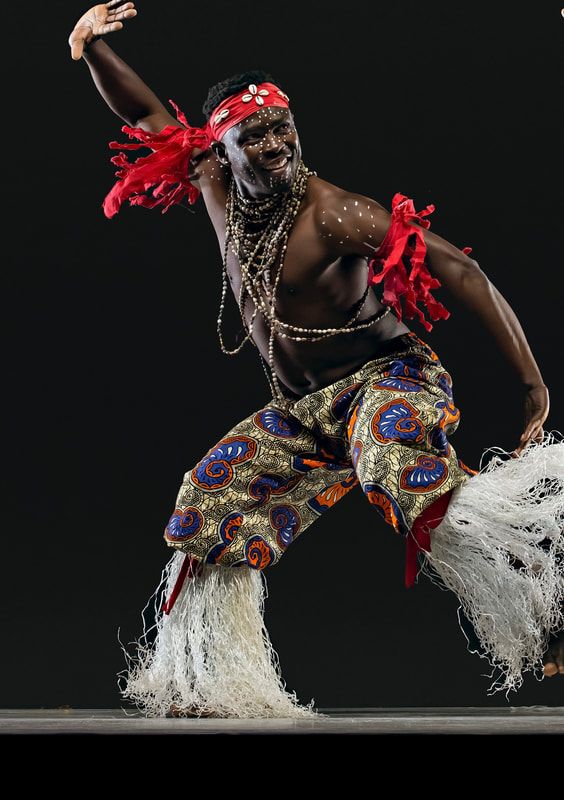
The Intore costume is a sartorial communication system in which every element carries both functional and symbolic weight. The sisal or grass wigs, long and flowing, are worn to frame the face and amplify head movements during the performance: as the dancer leaps, the wig becomes a visual extension of the movement, magnifying scale and intensity for the audience watching from a distance. The wigs are not decorative. They are optical instruments.
Animal skins and colourful fabric wraps around the waist signal warrior status and royal favour. In pre-colonial Great Lakes kingdoms, leopard skin was a mark of prestige available only to those with the specific social standing to wear it: the Intore’s access to these skins was a declaration of their position within the royal hierarchy. Beaded neckpieces and collars, made from ivory or bone, marked ceremonial rank. Ankle bells, metal or wooden, created rhythmic sound with every step, adding an auditory layer to the performance that the drums alone did not produce: the dancers themselves became part of the percussion.
The spears and shields were real weapons in the pre-colonial period, carried into the ceremonial context directly from the military function. Contemporary Intore performances use replicas rather than live weapons. Still, the choreography preserves the logic of their original use: the spear gesture that mimics a throw, the shield movement that mirrors defensive positioning, the formation that recreates the battlefield rank. The regalia does not merely refer to the warrior tradition. It embodies it.
Movement, Rhythm, and the Choreography of Victory
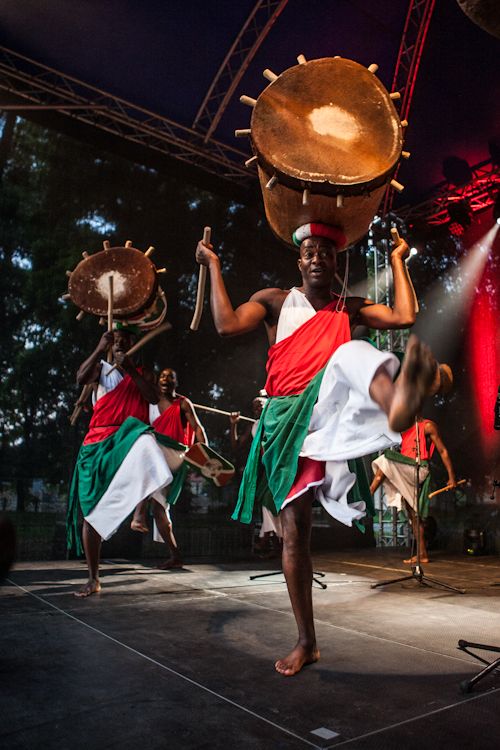
The Intore dance is characterised by high leaps, rapid footwork, and coordinated spear movements that mimic combat. Dancers move in tight formations, responding to the leader’s calls and the rhythms of drums, whistles, and antelope horns. The tempo shifts according to the content of the recited poem: faster sections represent battle intensity, slower sections allow for dramatic pauses or individual displays of skill. Every kick, jump, and turn is meant to echo a victory over an enemy, turning the performance space into a symbolic battlefield.
The choreography is not improvised. It is a rehearsed sequence that encodes specific military actions, hunting techniques, and royal praises, transmitted through the Itorero training institution across generations. The formation of the dancers in lines mirroring battlefield ranks is not a stylistic choice. It is a preservation of the military logic that produced the dance in the first place. The performance is a simulation of the thing it commemorates, made precise enough that the audience could read exactly what was being remembered.
Burundi’s Royal Drum Tradition: The Parallel UNESCO Heritage
The Intore ceremonial should be understood alongside Burundi’s separate and equally ancient royal drum tradition, the ingoma, which UNESCO inscribed on its Representative List of Intangible Cultural Heritage of Humanity in 2014. As Africanews and AFP reporting on the Burundian drumming tradition confirms, the drumming tradition known locally as ingoma dates back to the 17th century and honoured the eternal rule of the royal family when Burundi was a monarchy. Upon assuming the throne, a king was said to have ascended the drum, which was considered the source of his power. The most hallowed drums, Ruciteme and Murimirwa, are enshrined in a traditional straw hut in Gishora.
The karyenda was the most important royal drum, closely associated with the Mwami. As Young Pioneer Tours’ documentation of the Gishora tradition confirms, messages transmitted through drumming patterns could signal military mobilisation, agricultural cycles, or royal decisions. Control over the drums meant control over political legitimacy. Drummers were not entertainers: they were state functionaries. The Gishora Drum Sanctuary, established in the 19th century under Mwami Gisabo following his military victory over Chief Ntibirangwa, remains the primary centre for preserving this tradition. It is managed by the Abatimbo, hereditary drum keepers who are descendants of the original royal ritualists.
Both the Intore warrior ceremony and the royal drum tradition emerge from the same political logic: the monarchy used performance as governance. The Intore staged military achievement before the king. The ingoma announced royal authority to the kingdom. Both systems encoded power in sound and movement, making the political order legible to everyone present at a ceremony, not through written decree but through the embodied performance of the state.
From Royal Court to National Heritage
With the end of Burundi’s monarchy and the arrival of colonial and post-colonial governments, the Intore lost its original function as a royal warrior ceremony but retained its cultural authority. Today the dance is performed at national ceremonies, independence celebrations, cultural festivals, and tourism events, often by troupes that trace their lineage to the original royal guards. In Rwanda, the Ballet National, created in 1973 and directed for many years by Jean-Marie Muyango, became the institutional home for the highest level of Intore performance, representing the country at international events. On December 2, 2024, at the 19th session of the UNESCO Intergovernmental Committee held in Asuncion, Paraguay, the Intore was inscribed as a Rwandan intangible cultural heritage, the first Rwandan performance tradition to receive this recognition.
In Burundi, the Intore continues to be performed as part of the country’s cultural heritage calendar, alongside the separately inscribed royal drum tradition. Regions including Kirundo, Muyinga, and Karuzi maintain active Intore performance communities. The transition from military unit to cultural ambassador is not unique to the Great Lakes: across Africa, royal traditions have been repurposed as national heritage. What distinguishes the Intore in this process is how explicitly it retains its martial character. The movements, costumes, and musical structure still evoke warfare, even when the context is peaceful.
Gender, Exclusion, and the Performance of Royal Authority
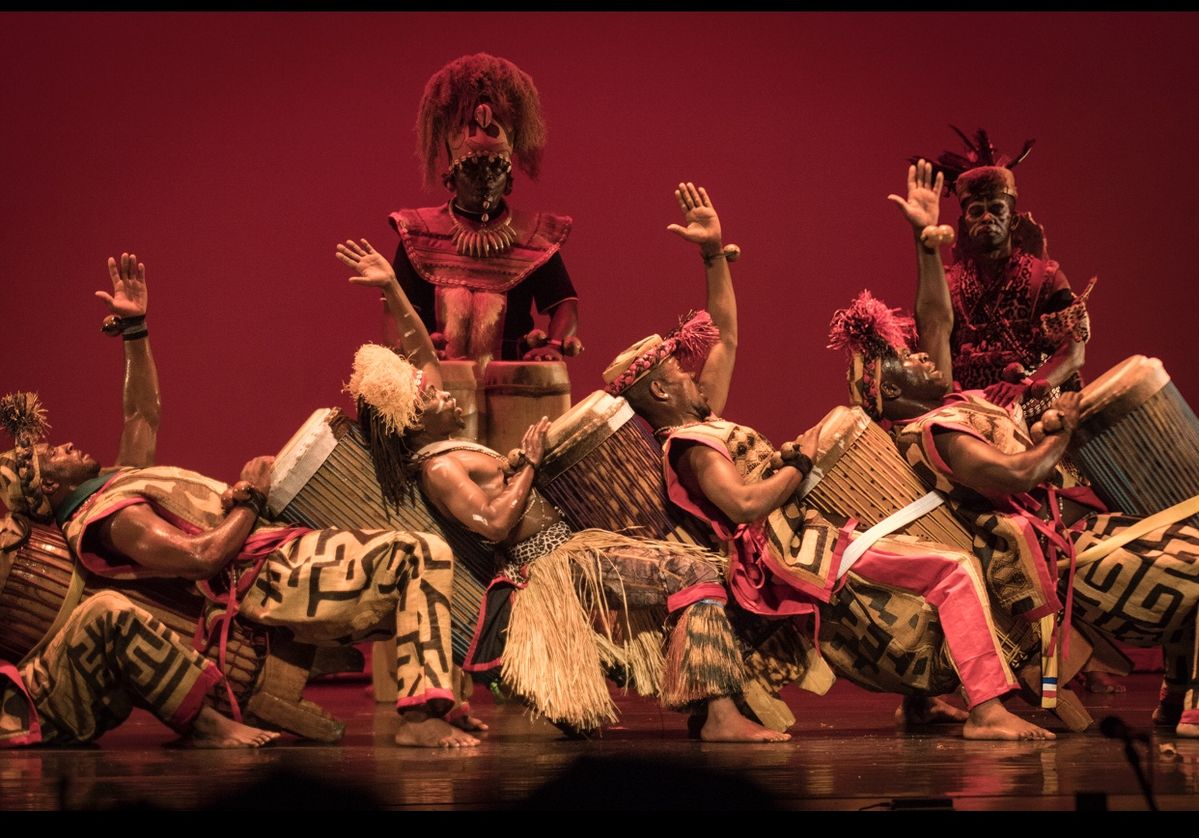
The Intore tradition is performed only by men, reflecting its origin in a military system where warfare and royal guard service were male domains. That exclusion is not incidental: it is built into the performance’s identity as a declaration of the specific form of authority the Mwami’s warriors held. In contemporary performances, the male-only convention is maintained, reinforcing the dance’s association with masculine military service and royal hierarchy.
The gender politics of the tradition extend to Burundi’s royal drum tradition as well. A 2017 presidential decree restricted drum performance to male performers only, formalising a gendered practice that had previously been maintained by custom rather than law. Both the Intore and the royal drum tradition carry the mark of the pre-colonial political system that produced them: hierarchical, martial, and organised around a specific model of masculine authority in service of the king. That is part of what these traditions preserve, and it is part of what makes them politically interesting rather than simply historically significant.
The Omiren Argument
The Burundi Intore ceremonial is a warrior tradition that became Great Lakes heritage without losing its martial grammar. Its origin is the Burundian royal court, from which it crossed into Rwanda in the 1830s, and both nations maintain living performance communities rooted in the same tradition of elite warriors trained in the Itorero institution to move between combat and ceremony as a single discipline. The African fashion market is worth 31 billion dollars. The regalia of the Intore, sisal wigs that amplify movement, leopard skins that declare rank, ankle bells that make the dancer part of the percussion, spears and shields that preserve the battlefield logic in ceremonial form, represent African dress at its most precisely governed: a sartorial system in which every element is a functional statement about power, hierarchy, and historical memory. UNESCO’s December 2024 inscription of the Intore as a Rwandan intangible cultural heritage formalised what the performance has always been doing: encoding the memory of a royal military system in the bodies of dancers trained to carry it forward. Burundi’s separately inscribed royal drum tradition, the ingoma, carries the same political logic in a different medium. Together they are the most complete surviving documentation of how the Great Lakes monarchies staged their authority in performance, and Omiren Styles documents both as the dress and ceremonial heritage they are.
Also Read:
- Kaba, The Royal Cloak of Ethiopia
- The Reed Dance and What Eswatini’s Umhlanga Ceremony Tells the Fashion World About Collective Dress
- The African Origins of Carnival Costume: Feathers, Beads, and the Masquerade Tradition
Frequently Asked Questions
What does the word Intore mean and who were the Intore warriors?
Intore means “chosen ones” or “selected” in both Kinyarwanda and Kirundi. In pre-colonial Burundi and Rwanda, the Intore were elite royal warriors chosen for their physical and moral qualities, trained from youth in the Itorero institution, and educated in military discipline, cultural values, governance principles, poetry, and ceremonial performance. Their training was designed to produce warriors who could move between combat and court ceremony as a single discipline.
Did the Intore originate in Burundi or Rwanda?
The Intore originated in the royal courts of the Burundian kingdom. It crossed into Rwanda in the 1830s when the royal Muyange fled fighting in Burundi and was granted asylum by the King of Rwanda. The tradition is now shared across both nations. UNESCO’s December 2024 inscription recognised it as a Rwandan intangible cultural heritage. Burundi maintains its own separately inscribed UNESCO cultural heritage in the Royal Drum tradition (ingoma), recognised in 2014.
What does the Intore costume and regalia encode?
The Intore regalia is a sartorial communication system in which every element has functional and symbolic weight. Sisal wigs amplify head movements and magnify scale for distant audiences. Leopard skins and fabric wraps signal warrior status and royal favour. Beaded neckpieces and collars mark ceremonial rank. Ankle bells make the dancers part of the percussion. Spear and shield replicas preserve the battlefield logic of the original warrior function. Together they declare the rank, function, and historical authority of the Intore within the royal military hierarchy.
What is the difference between the Intore and Burundi’s royal drum tradition?
The Intore is a warrior dance ceremony in which dancers arranged in battlefield formations mimic combat, recite praise poetry, and perform for a seated authority in a call-and-response structure. The royal drum tradition (ingoma) is a drumming practice in which the sacred drums, including the karyenda associated directly with the Mwami, were used as instruments of governance: announcing coronations, funerals, agricultural cycles, and royal decisions. Both encode the authority of the Burundian monarchy, one in movement and costume, the other in percussion and rhythm.
Is the Intore still performed today?
Yes. The Intore is performed at national ceremonies, cultural festivals, and tourism events in both Burundi and Rwanda. In Rwanda, the Ballet National, created in 1973, institutionalised the highest level of Intore performance for international representation. In Burundi, active performance communities exist in regions including Kirundo, Muyinga, and Karuzi. UNESCO inscribed the Intore on its Representative List of Intangible Cultural Heritage of Humanity in December 2024, the first Rwandan performance tradition to receive this recognition.
Explore More
Read the full Culture > Heritage & Identity series for Omiren Styles’ documentation of African ceremonial traditions, royal dress systems, and the performance practices through which pre-colonial kingdoms encoded their authority in movement, costume, and rhythm.