There is no shortage of platforms for African fashion.
Industrie Africa, The Folklore, and Raise Fashion have built curated, international-facing platforms that give African designers global market visibility without requiring designers to physically attend the trade fairs and buyer events that generate wholesale relationships in conventional fashion markets. ADJOAA, founded in 2021, is addressing the logistical and market-access barriers that prevent African designers from scaling globally by building an e-commerce platform specifically oriented around African fashion and lifestyle brands. Fashionomics Africa, the African Development Bank programme, provides a platform connecting designers and entrepreneurs with clients, mentors and financial resources. The CANEX deal room brought together investors who committed over USD 540 million in deals at its 2024 edition, with fashion and textiles production, design and distribution among the eligible sectors.
Each of these platforms is solving a real problem. The visibility problem is real. The market-access problem is real. The capital-connection problem is real. And none of them is the production intelligence problem, which is the one that determines whether a designer who achieves visibility, market access and capital can actually use those advantages to build a scalable fashion business.
There has to be a new innovative shipping company that understands the challenges African designers face. There has to be a more permanent solution. There has to be something better. Every observer of African fashion eventually arrives at the same conclusion: the infrastructure gap is wider than the visibility gap. The platforms are there. The production capacity to meet the demand the platforms generate is not.
As Omiren Styles has established in its analysis of the buyers who should be acting on African fashion in 2026, the designers worth acting on now are those with documented stockist history, major awards, confirmed international market interest, and a trend signal with commercial follow-through. The shortlist is real, and the designers on it are commercially competitive. What it also reveals, by implication, is how short the shortlist is relative to the size of the talent pool. The designers who have achieved the combination of production quality, consistency, commercial infrastructure, and international credibility to appear on a serious buyer shortlist are, at this stage of the African fashion industry, a small fraction of those with the creative capacity to belong there.
Every new platform for African fashion proposes to solve the visibility problem. The production intelligence problem is different and harder: the specific knowledge required to cost, price, package, and deliver to the standards of international retail. That is not what a marketplace provides.
What Production Intelligence Is
Production intelligence is the specific, granular knowledge that converts creative output into a commercially deliverable fashion product at the level of quality and consistency that international retail requires.
It includes costing: the ability to calculate the fully-loaded cost of producing a garment, including materials at their actual unit cost, labour at fair rates, overheads, wastage, packaging and the logistics that will move it from the atelier to the buyer. Without accurate costing, a designer cannot price competitively, cannot identify which elements of the production model are uncompetitive and cannot know whether a wholesale order is profitable or loss-making until after it has been fulfilled.
It includes quality consistency: the ability to produce multiple units of the same garment that meet the same quality standard across the run, with the same construction, the same finishing, the same measurements within agreed tolerance and the same surface quality. A buyer who places a wholesale order for 50 units of a garment does so on the assumption that all 50 units will be identical to the sample they approved. The production knowledge required to deliver that consistency from a small atelier, without the quality control infrastructure of an industrial manufacturer, is substantial and specific.
It includes specification communication: the ability to translate a design into technical documentation that a manufacturer or production team can execute without the designer being present at every stage of production. This requires the ability to write a technical flat, a construction specification, a measurement chart and a materials specification that accurately conveys the design intent in language that production practitioners can use.
It includes packaging and labelling: the ability to present a product in the format that international retailers require, with the correct care labelling, country of origin marking, barcode systems, hangtag formats and packaging specifications that allow the product to enter a buyer’s warehouse and retail floor without requiring any additional preparation on the buyer’s part. A buyer who has to prepare a supplier’s products for their warehouse before they can be sold is not a buyer who will reorder from that supplier.
And it includes delivery management: the ability to commit to a delivery date and meet it, within the tolerance that the buyer’s own inventory planning and seasonal calendar allows. A sample delivered on time and a wholesale order delivered late are two different commercial relationships with a buyer, and a supplier who consistently meets sample deadlines but misses wholesale delivery windows will not keep the buyer relationship beyond one or two seasons.
As Omiren Styles has documented in its analysis of what it takes to scale fashion manufacturing in Africa, the infrastructure gaps that block scale in African fashion manufacturing are identifiable and addressable: power reliability, access to capital, logistics costs, fabric supply, and trade policy. Each of those infrastructure gaps has a corresponding production intelligence gap: a designer who does not know how to factor power interruption costs into their pricing, how to access working capital for fabric procurement, how to navigate export logistics, how to source fabric efficiently, or how to benefit from trade policy frameworks, is carrying the burden of each infrastructure gap without the knowledge to manage it.
Why Platforms Cannot Substitute for Production Knowledge

The platform proposition for African fashion is essentially a distribution solution: it makes African fashion visible to buyers who would not otherwise encounter it and provides a commercial channel through which that encounter can lead to a transaction. The proposition is valuable, and the platforms that execute it well are genuinely useful.
The limit of the platform proposition is that it moves the bottleneck rather than removing it. A platform that successfully generates buyer interest in an African designer’s work has moved the problem from “buyers cannot find this designer” to “the designer cannot reliably produce what the buyer wants to order.” The designer who reaches a buyer through Industrie Africa or The Folklore, and then cannot deliver a wholesale order at the quality, consistency, and timeline the buyer requires, has converted a marketing success into a commercial failure, and the disappointed buyer will share their experience with other buyers in their network.
As the Guzangs Report documented in its Q1 2026 analysis of the African fashion and creative economy, 2026 entered with structural momentum and structural friction in equal measure. Iamisigo and Yoshita 1967 reached the LVMH Prize semi-finals, both producing on the continent, with Kenya represented for the first time. Free The Youth became the first African brand to collaborate with Jordan Brand. Lagos Fashion Week won the Earthshot Prize. The momentum is real, and it is concentrated in the brands that have solved the production intelligence problem for themselves, through individual investment in skills, infrastructure and supply chain relationships, rather than because a sector-wide solution has been built.
The friction is equally real: most African designers remain unable to scale beyond the creative output that first generated their market visibility because the production intelligence needed to convert buyer interest into sustainable wholesale volume is not systematically available in the markets where they operate. The brands that have solved this are exceptional. The investment required to become exceptional as an individual is beyond most designers’ means. That is a structural gap, not an individual capacity failure.
As Fashion Nut’s May 2026 analysis of why African fashion brands produce outside Africa established, the infrastructure problem is the reason African fashion brands manufacture outside Africa rather than a reflection of preference or cultural disconnection. A designer who can produce more consistently, at higher quality and at a more competitive cost by working with manufacturers in Portugal, Turkey, or Morocco than by working with manufacturers in their home country is not making an aesthetic choice. They are making the rational production decision that the infrastructure gap in their home market makes necessary. The production intelligence gap and the manufacturing infrastructure gap are different expressions of the same structural problem.
What the Earthshot Prize Actually Measured
Omiren Styles has established, in its analysis of African fashion weeks and the infrastructure they built faster than criticism, that Lagos Fashion Week won the Earthshot Prize in November 2025 not for producing a fashion show but for building circular fashion infrastructure at scale: mandatory sustainable practice requirements for all runway designers, a circular fashion hub in development and a replication framework targeting other African fashion weeks by 2030. The prize was awarded for infrastructure, not for visibility. That distinction is the most important one in the African fashion development argument: an institution that has been running for fifteen years, that has mandated sustainability standards for its participants, that has built a commercial ecosystem rather than a seasonal event, and that has developed the replication framework to spread that model across the continent is demonstrating what African fashion infrastructure looks like when it works.
The Earthshot Prize did not reward the fashion week that had the best runway photographs or the most international press coverage. It rewarded the fashion week that had done the work of building the production intelligence infrastructure for its participants: the sustainability standards, the supplier relationships, the circular economy frameworks and the measurable commercial outcomes that allow designers to produce better because they are working within a better institutional framework.
That is the model that African fashion needs at the production intelligence level. Not a new platform that gives designers a channel to reach buyers they could not previously access, but an institutional framework that gives designers the production knowledge they need to deliver what buyers want to order once they have found them. The two investments are not mutually exclusive. But the sequence matters: production intelligence before distribution platform, because a platform that generates orders the designer cannot fill is more damaging to a designer’s commercial reputation than no platform at all.
What Production Intelligence Investment Would Look Like
Production intelligence investment for African fashion is not a single intervention. It is a system of overlapping institutional commitments that address the specific knowledge gaps at each stage of the production process.
Skills training at the production level means the practical knowledge of construction, finishing, quality control and specification communication that converts a designer’s creative output into a commercially deliverable product. This is not the curriculum of a fashion design school, which typically focuses on creative development and aesthetic judgement. It is the curriculum of a production training programme that focuses on the technical and commercial knowledge required to make a design producible at scale, with consistent quality, within the cost and timeline constraints buyers require.
Mentorship at the commercial level means sustained access to practitioners who have built the production intelligence the designer needs and who can transmit it through direct engagement with the specific challenges the designer faces. A three-day masterclass on costing is less valuable than three months of working with a mentor who can review specific cost sheets, identify specific pricing problems and provide specific feedback on specific production challenges. The mentorship that has been most effective for African fashion brands has been sustained, specific and commercially grounded rather than general, inspirational and event-based.
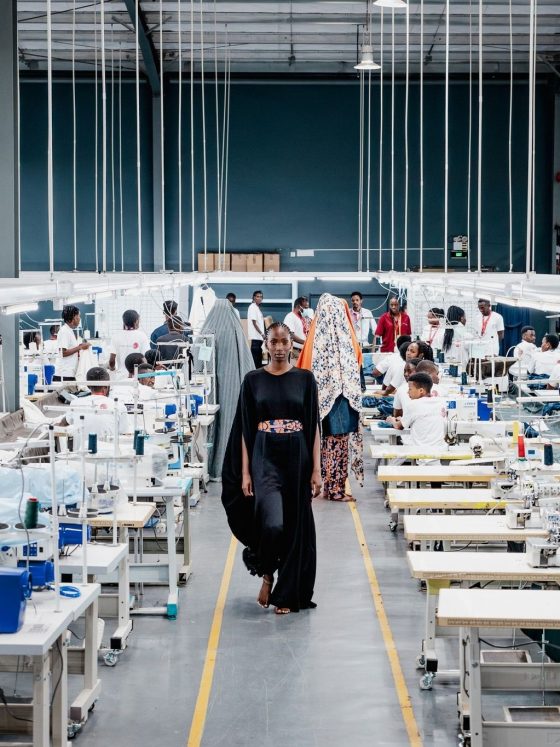
Manufacturing infrastructure investment refers to the physical infrastructure of the production environment: the machines, the power supply, the workspace, the quality control tools, and the production management systems that enable a designer to produce consistently and at scale without having to individually address every infrastructure gap. The industrial park model that has produced results in East Africa and North Africa demonstrates that shared infrastructure investment reduces the per-designer burden of infrastructure development without requiring each designer to reach industrial scale before accessing industrial-grade production conditions.
Data and benchmarking means the production intelligence that allows a designer to compare their costs, quality rates, delivery performance and wholesale margins against appropriate benchmarks and identify specifically where their production model is underperforming. This is the intelligence gap that the Omiren Styles platform is built to address on the editorial side: sector-level data on pricing, costing, production standards, and commercial outcomes that allows individual designers to understand their own performance in context.
As Omiren Styles has established, in its analysis of why serious investor attention has not yet reached a continental African fashion portfolio, the three preconditions for institutional capital in African fashion are governance, scale and predictability. Predictability specifically requires editorial and data infrastructure capable of consistently tracking market performance. Production intelligence is the foundation of predictability: a designer whose costing is accurate, whose quality is consistent, whose delivery is reliable and whose commercial model is understood produces the track record that makes institutional investment possible. Without production intelligence, there is no predictability. Without predictability, there is no institutional capital. The investment sequence runs from production knowledge through commercial credibility to institutional investment, not from investment to knowledge.
The Specific Platforms That Understand This
Not every platform in the African fashion ecosystem is primarily a visibility platform. Some are explicitly building the production intelligence infrastructure that the marketplace model cannot provide.
The Fashion Law Africa Summit 2025 focused on intellectual property, trademarks, copyright, and scaling efficiently, providing legal tools that enable African designers to protect their work when entering international markets. That is not a visibility intervention. It is a production intelligence intervention: the knowledge of how to structure commercial relationships, protect creative output and navigate international market entry in ways that do not expose the designer to exploitation.
Hub of Africa Fashion Week’s 2026 edition centred on Ethiopian manufacturing, featuring its first cross-border sourcing roundtable that explicitly connected runway presentation to manufacturing infrastructure within the same institutional framework. That is the correct sequencing: the platform and the production infrastructure in the same event, so that the visibility generated by the runway is matched by the sourcing intelligence generated by the roundtable.
Ghana’s announcement of three garment factories targeting 27,000 jobs is a manufacturing infrastructure investment that, if designed to support the local fashion design sector as well as the export garment manufacturing sector, could provide the production access that Ghana-based designers need to translate buyer relationships into wholesale orders. The question is whether the factories’ terms, minimum orders and production specifications will be accessible to the small independent labels that need them, or whether they will be calibrated for the large export orders that justify the factories’ capital costs.
The Omiren Argument
African fashion does not need another marketplace. The visibility problem is being addressed by platforms that understand it and are building useful solutions. What African fashion needs is the production intelligence that would allow its designers to use those platforms to build businesses rather than accumulate followers.
The designers who have achieved the combination of creative output, production quality and commercial credibility to reach the LVMH Prize semi-finals, to attract Jordan Brand for a collaboration, to win the Earthshot Prize for circular infrastructure: each has solved the production intelligence problem for themselves, through sustained investment in skills, supply chain relationships and commercial knowledge. They are exceptional not because they are more talented than designers who have not achieved those milestones, but because they had access to the knowledge that made their talent commercially viable.
Making that knowledge systematically available, through production training programmes, sustained mentorship, manufacturing infrastructure investment and the sector-level data that allows designers to benchmark their own practice, is the intervention that would move African fashion from a sector where exceptional individual success stories emerge despite the structural conditions to one where commercial competitiveness is the norm rather than the exception.
As Omiren Styles has argued throughout this series, the Global South made fashion and never got credit. For African fashion specifically, the form of that argument at this stage of the industry’s development is production-specific: the creative output exists, the buyer interest exists, the platform infrastructure is being built, and what remains is the production intelligence that would allow the talent, the demand and the distribution to function as a commercial system rather than as a set of individually impressive but collectively incomplete investments. The marketplace is not the gap. The production knowledge is.
ALSO READ
- From Market Stall to Export Order: What It Takes to Scale Fashion Manufacturing in Africa
- The Fabric Middleman Is Part of the Fashion System
- African Fashion Weeks Built Networks Faster Than Criticism
- African Designers Buyers Should Act On in 2026
- The Global South Made Fashion. It Just Never Got Credit.
Frequently Asked Questions
What is production intelligence and why does African fashion need it?
Production intelligence is the specific, granular knowledge that converts creative output into a commercially deliverable fashion product at the level of quality and consistency that international retail requires. It includes costing, the ability to calculate the fully-loaded cost of producing a garment including materials, labour, overheads, wastage, packaging and logistics; quality consistency, the ability to produce multiple identical units that meet the approved sample standard; specification communication, the ability to write technical documentation that a manufacturer can execute without the designer present; packaging and labelling, the knowledge of the formats international retailers require; and delivery management, the ability to commit to and meet a wholesale delivery date. African fashion needs production intelligence because the visibility platforms that connect African designers to international buyers generate orders that designers without production knowledge cannot reliably fulfil, converting marketing successes into commercial failures.
Why do marketplace platforms not solve the production intelligence problem?
As Fashion Nut’s May 2026 analysis of the African fashion infrastructure problem established, marketplace platforms shift the bottleneck rather than removing it. A platform that generates buyer interest in an African designer’s work moves the problem from ‘buyers cannot find this designer’ to ‘the designer cannot reliably produce what the buyer wants to order.’ The designer who reaches a buyer through a platform but cannot deliver a wholesale order with the required quality, consistency, and timeline has turned a marketing success into a commercial failure. Platforms are distribution solutions. Production intelligence is a knowledge and manufacturing infrastructure problem. The two are complementary but not substitutable: platform access without production knowledge generates unfillable orders; production knowledge without platform access generates unrecognised output. Both are needed, in the right sequence.
Which African fashion brands have solved the production intelligence problem?
As the Guzangs Report documented in its Q1 2026 analysis, the brands that achieved a combination of creative output, production quality, and commercial credibility to reach international milestones in 2025 and 2026 are those that solved the production intelligence problem for themselves. Iamisigo, founded in 2009 by Bubu Ogisi and based in Lagos, Nairobi and Accra, reached the LVMH Prize semi-finals while producing on the continent, received the Zalando Visionary Award in 2025, and has work in the V&A Museum’s permanent collection. Yoshita 1967 also reached the LVMH Prize semi-finals while producing on the continent. Free The Youth became the first African brand to collaborate with Jordan Brand. These brands are exceptional not because their creative talent exceeds that of other African designers, but because they have invested in, or had access to, the production intelligence that made their talent commercially deliverable to international standards.
What does production intelligence investment look like in practice?
Production intelligence investment for African fashion operates at four levels. Skills training: practical knowledge of construction, finishing, quality control and specification communication delivered through production-focused training programmes rather than design school curricula. Mentorship: sustained, specific and commercially grounded engagement with practitioners who have built the production knowledge the designer needs, applied to the specific challenges the designer faces rather than delivered as general inspiration. Manufacturing infrastructure: shared facilities providing the machines, power supply, workspace, quality control tools and production management systems that allow designers to produce consistently without individually solving every infrastructure gap. Data and benchmarking: sector-level information on pricing, costing, production standards and commercial outcomes that allows individual designers to identify specifically where their production model is underperforming relative to market standards. Each level addresses a different component of the production intelligence gap. None alone is sufficient. Together they represent the institutional investment that would make commercial competitiveness the norm rather than the exception for African fashion.
What does the Earthshot Prize reveal about African fashion infrastructure?
As Omiren Styles has established in its analysis of African fashion weeks and the infrastructure they built faster than criticism, that Lagos Fashion Week won the Earthshot Prize in November 2025 not for producing a fashion show but for building circular fashion infrastructure: mandatory sustainable practice requirements for all runway designers, a circular fashion hub in development and a replication framework targeting other African fashion weeks by 2030. The prize was awarded for infrastructure rather than visibility, and the distinction defines the entire African fashion production intelligence argument. An institution that mandates sustainability standards, builds supplier relationships, develops commercial ecosystem frameworks and produces measurable outcomes for its participants has built production intelligence infrastructure. A fashion week that produces a seasonal runway event without those components has built visibility. Lagos Fashion Week demonstrated that the two can coexist in the same institution. The challenge is extending that model across the continent.
EXPLORE MORE
Read the full Industry and Infrastructure, Institutions and Creative Power sections at Omiren Styles for ongoing analysis of African fashion production intelligence, manufacturing infrastructure and the institutional investments that would make commercial competitiveness the norm for African fashion designers. Discover travel and heritage intelligence across Africa at Rex Clarke Adventures.