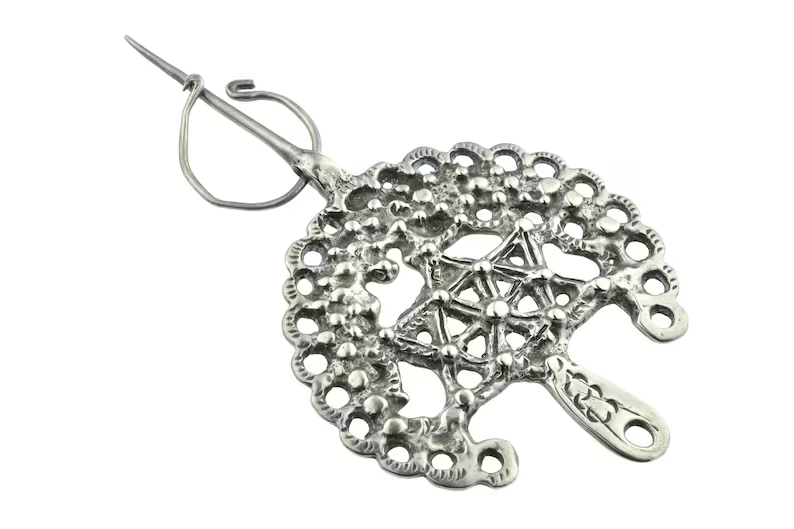
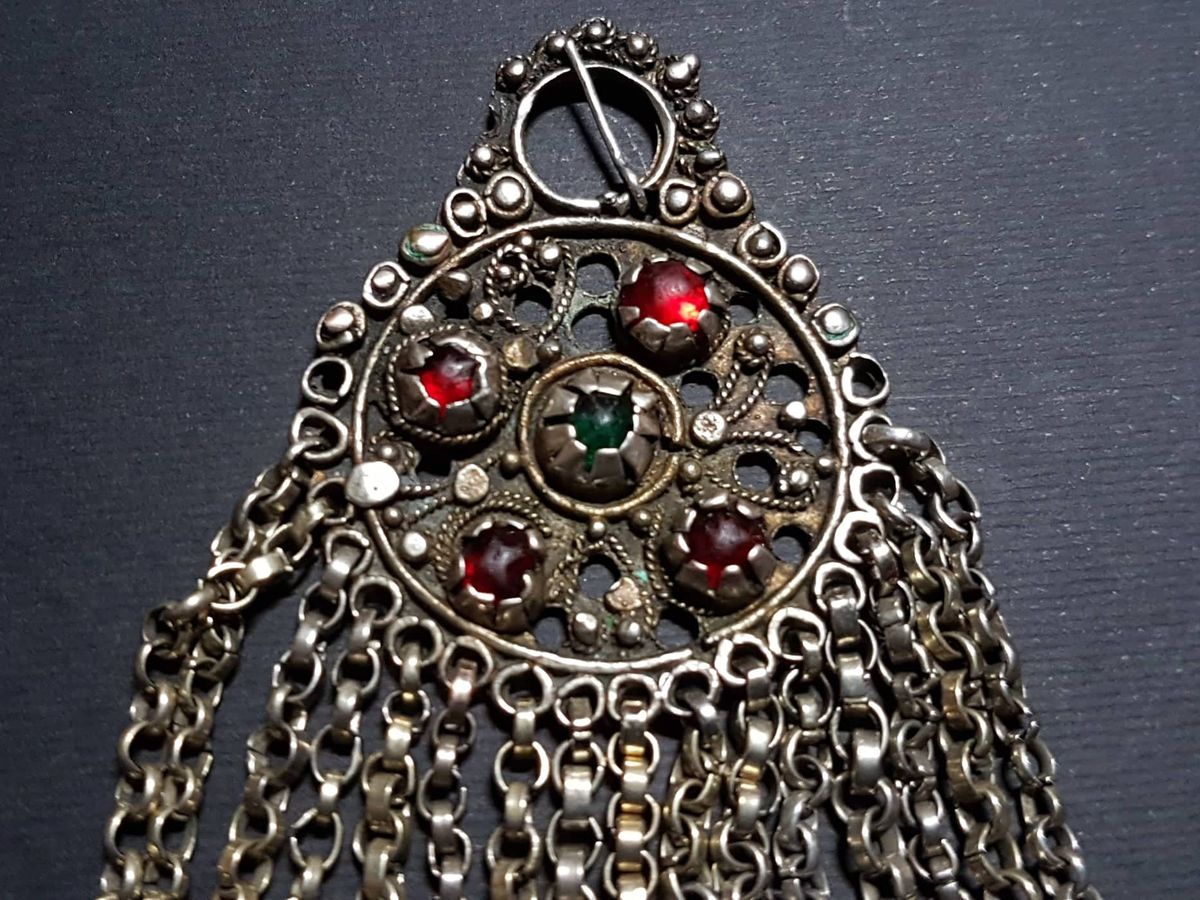
The decorated triangular head was not necessarily the top of the object when worn. In the arrangement described by the V&A, the pin and guard ring sat above it, while the ornamental head hung below. This changes how we should understand the silver fibula: the fastening determined where the decoration appeared, bringing the work of securing cloth into the composition of dress. The central object, accession number 491-1865, is recorded as made in Algeria and worn in the Aurès between its production dates of 1800 and 1855. It consists of a silver pin with a flat, pierced triangular head and a penannular guard ring (an incomplete ring with an opening between its ends). Those ends terminate in coils.
The description establishes a deliberate contrast. Pierced floral ornament occupies the head, while the ring is comparatively plain. Decoration is concentrated in one part of the fastening rather than spread uniformly across it. The result is a design with a hierarchy: different components contribute different kinds of emphasis, and their relationship becomes clearest when the object is returned to its documented wearing orientation.
An Aurès silver fibula places its decorated head below its fastening. Explore how orientation, pierced metal, and paired wearing shape its design.
Head, Pin and Ring
The V&A’s physical description separates the fibula into components that can otherwise be difficult to distinguish. The triangular head forms the decorated end of the pin. A hole through the pin, just below that head, holds the guard ring. The catalogue identifies the ring’s coiled terminals and records the loss of the triangle’s upper portion. This is not simply a triangular pendant with an unrelated pin attached behind it. The decorated area belongs to the pin itself, while the ring is connected through a specified opening. The object’s ornamental and fastening elements are therefore joined structurally, even though their surfaces receive different treatment.
The museum lists cast silver under materials and techniques and pierced floral decoration in its physical description. Those entries identify material, manufacture and ornament without supplying a complete workshop sequence. They support an account of what the object comprises, not a reconstruction of exactly how a silversmith produced every opening, edge or coil.
Ornament Made from Openings
The triangular head’s piercing is central to its character. Rather than treating the head as a solid plate carrying decoration, the catalogue describes floral ornament formed through openings. The distinction brings space into the ornamental area. Its outer shape and internal treatment perform different roles. The triangular outline establishes an overall direction; the pierced decoration articulates the surface within that boundary. The metal does not need additional coloured material for the head to have an organised decorative treatment. The ring provides a contrasting form. Its incomplete circle differs from the head’s angular outline, while its coils draw attention to the ends. The catalogue does not describe those terminals with the same floral vocabulary used for the head. The formal interest lies in that difference: a concentrated ornamental field connects to a simpler curved component rather than repeating across every part.
Orientation Gives the Object Its Place
The V&A describes fibulae of this type as fastenings for women’s dress. They were worn in pairs, usually linked by a long chain, with the pin and plain ring above and the decorated head hanging down. This is the museum’s account of the wearing arrangement, not evidence that a complete pair survives with this particular object. The record calls the position “upside down.” For dress analysis, the wearing orientation is the more useful reference. A detached object may suggest a direction through its shape, but that direction does not take precedence over its documented position on the body. Here, understanding which part hung below makes the relationship between fastening and display intelligible.
The paired arrangement introduces another scale. An individual fibula has its own composition; two fastenings and a connecting chain establish a relationship across the dressed body. The catalogue therefore offers context beyond a single piece of metal. It places the object within an assembly, while leaving the exact original companion, chain and garment unidentified.
The Aurès Is Not a Generic North African Setting
The museum identifies the design with the Aurès region of Algeria. Its record contrasts the object’s treatment with the enamelled and coral jewellery associated with Kabylia. The useful distinction is specific: the central fibula is documented through silver, piercing, a triangular head and coiled ring terminals, not through the coloured materials named in that comparison. This should not be taken as a claim that all Aurès jewellery follows one model. Nor does the absence of recorded enamel or coral make the object unfinished or merely functional. Its ornament is already present in its pierced head, outline and terminal treatment. It works through a different distribution of emphasis.
Keeping the regional attribution precise also prevents a familiar editorial substitution. An image of richly enamelled jewellery from another Algerian context cannot explain this object simply because both are North African. The fibula deserves to be described through its own documented features, rather than used as a token example of an undifferentiated regional style.
A Later Example Changes the Outline
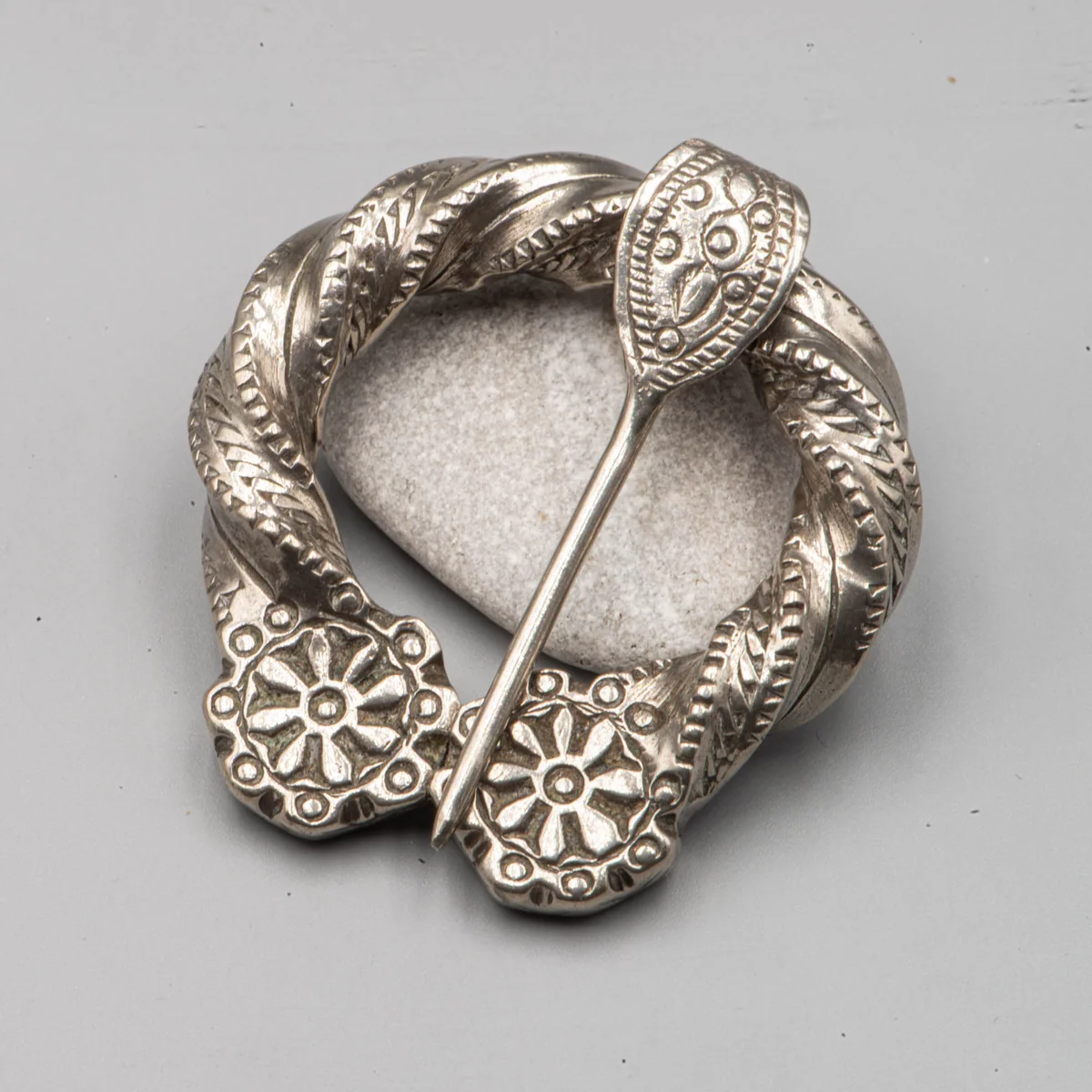
A second V&A object, accession number 671-1893, clarifies variation within the type. Dated 1850–1890 and also recorded as made in Algeria and worn in the Aurès, it has an oval pierced head with side protrusions. The catalogue describes pierced and engraved silver, with a small hole in a tab at the top. Its ring ends differ too. Instead of the coils recorded on the earlier triangular-headed object, this example has a plain wire guard ring flattened at each end to form the terminals. The two objects share a broad arrangement of pin, decorated head and penannular ring, but their outlines and finishing details are not interchangeable.
The latter record places such fastenings on the front of the body, just below the shoulders, holding the wearer’s dress together. That helps explain the type’s relationship with clothing. It does not establish that the two objects once belonged together, that one directly developed from the other, or that their overlapping date ranges describe a simple progression from triangle to oval.
What the Surviving Object Does Not Restore
The missing upper portion of 491-1865 interrupts the triangular head. Its present outline must therefore be read as incomplete. The catalogue does not establish the precise form of the lost area, so it cannot be supplied as an imagined point, loop or other feature. The reverse carries a different kind of fragment: a partial mark of Arabic characters within a circular frame, recorded on the lower right-hand side. The museum identifies it as a silver or maker’s mark used before 1857. That wording distinguishes between identifying a mark’s possible function and naming the person who made the object.
The mark is important without resolving authorship. It adds evidence to the object record but does not yield an individual silversmith’s biography. Likewise, the accession number identifies the collection object; it should not be expanded into an acquisition narrative without the relevant provenance documentation. The fibula remains materially specific even where its personal history is incomplete.
Where the Design Is Most Convincing
The most persuasive relationship is between the concentration of decoration and the fastening’s recorded position. The head receives pierced floral treatment and hangs below the simpler ring. Ornament is not merely added somewhere convenient: its position follows the organisation of the object in dress. The comparison with the later example sharpens that finding. A related fastening arrangement accommodates a different head shape and different terminals. Function does not dictate one decorative outline, but neither is ornament wholly detached from the assembly that supports it. The surviving records show a shared object type with room for particular decisions.
That is enough to sustain a judgement without claiming perfect balance or technical superiority. The fibula’s interest lies in the way a working component establishes an ornamental place on the body. Its design becomes more particular, not less, when the discussion stays with its head, ring, condition and documented use.
The Omiren Argument
The principle is integration. A fastening does not become ornament simply because its surface is decorated. In this Aurès fibula, construction and wearing position determine how that decoration enters the dressed arrangement.
The pierced head, simpler ring and coiled terminals are not interchangeable embellishments. They occupy different roles within one assembly. The recorded orientation then places the decorative emphasis beneath the fastening.
The object’s strongest design lesson is hierarchy: practical and ornamental components can remain distinct while contributing to a coherent whole.
Also Read:
- Kabyle Amazigh Wedding Dress Algeria: Thakandorth, Ath Yenni Silver, and the Kabylia Tradition
- Why European Streetwear Labels Are Drawing Inspiration From Amazigh Silver Jewellery Motifs
- Afar (Adal) Women’s Dress: Danakil Culture and Desert Adornment
- The Dinka Alual Was Never a Bead-Count Code: What Women’s Corsets Could and Could Not Signal
Frequently Asked Questions
What is a fibula in this context?
It is a dress fastening. The V&A records this example as a silver fibula pin with a decorated head and a penannular guard ring, worn to hold dress together. The catalogue also lists the terms “Akhlâlet” and “Abzimt”; this article follows the object’s primary title, “Fibula”.
What does ‘penannular’ mean?
It describes an incomplete ring, with a gap between its ends. On the central object, the guard ring has coiled terminals and is held through a hole in the pin just below the head. The later V&A example instead has a plain wire ring flattened at each end to form its terminals.
Where and when was the central object made?
The museum records Algeria as its place of manufacture, the Aurès as its place of use and 1800–1855 as its production date range. The object is accession 491-1865, recorded as cast silver, with a partial mark on the back read as a silver or maker’s mark used before 1857.
Is it a complete surviving pair?
The record describes one incomplete fibula, with the top of its triangular head missing. The museum’s explanation of paired wearing, usually linked by a long chain, provides context for the type; it does not establish a surviving original partner and chain for this object.