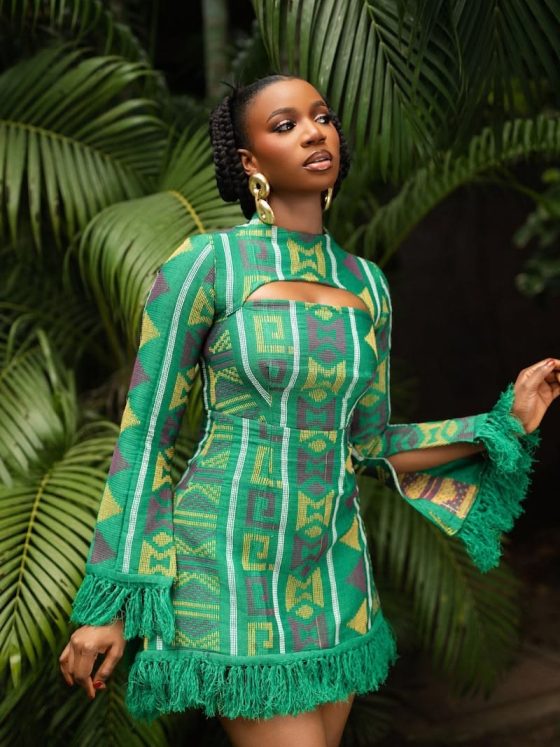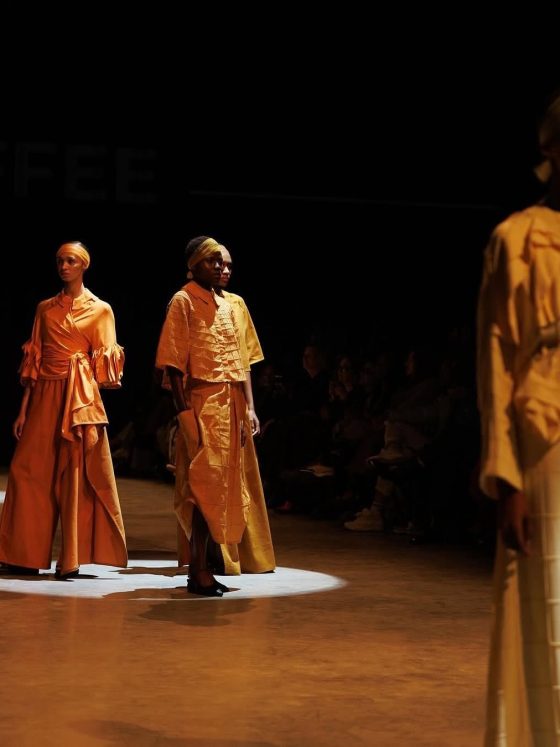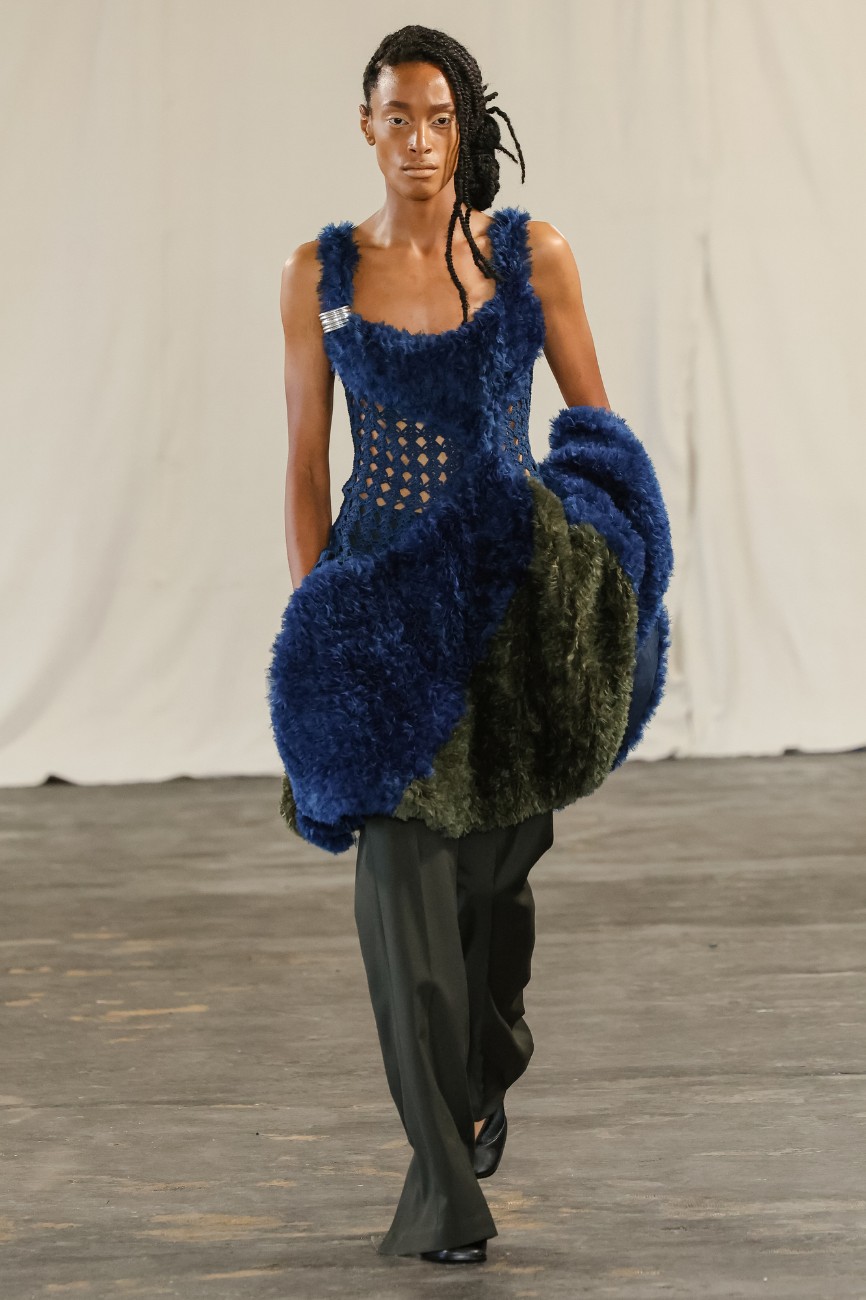
Dark trousers hold the line. Above them, a navy crochet bodice expands around the hips with blue and moss-green volume. That is how Diotima opens its Spring 2027 collection: a clear statement of intent from Rachel Scott, with tension running through the entire season.
The relationship between those two halves makes the opening look worth a closer look. The trousers provide a grounded, controlled base. The upper half pushes outward, occupying space without losing structure. This is not texture for atmosphere. It is texture as a decision about proportion. Applied consistently across the collection, that decision becomes Diotima’s most compelling proposition of the season.
The Caribbean Sea frames the collection, but this is not a show best understood through blue alone. Published descriptions take in muddy browns, earthy greens, sand tones and icy shades alongside reconstructed fabrics, sculptural hips and restrained tailoring. The palette has stated reasons behind each shift, and those reasons are worth understanding before looking at individual pieces.
Rachel Scott’s Diotima Spring 2027 collection turns Caribbean references into sculptural proportions, reconstructed surfaces and a renewed emphasis on tailoring.
A Sea That Refuses the Postcard
Scott opened her research from an unusual angle. Speaking to Fashionista, she described the Caribbean Sea as a burial ground, a body of water carrying history alongside beauty. Her references included Suzanne Césaire, the Martinican writer and anti-colonial thinker, as well as women across different periods from plantation life to the present day.
The show notes built on that by rejecting a single crystalline-blue image of the Caribbean. Warming waters and accumulating sargassum supplied the changing colours, and those environmental shifts connected to communities and living traditions rather than postcard scenery.
What matters critically is how that research reaches the clothes. Omiren has consistently argued, in pieces including The Caribbean Is Not a Mood Board, that cultural references earn their place on the runway only when they generate specific decisions within the garments. The more persuasive translation in this collection is material: surfaces gather, separate, and accumulate; familiar fabrics take on unfamiliar structures. Scott is using the Caribbean as a way of working, not simply as an atmosphere attached to the clothes.
That distinction is meaningful. References that remain conceptual tend to dissolve once you step away from the show notes. References that drive specific decisions, a reconstructed surface, a changed proportion, or a contrast between density and lightness leave marks in the garments themselves.
The Opening Gives the Collection a Problem to Solve
The opening bodice and trousers establish a dynamic that the rest of the collection develops. The crochet remains present, but it is no longer the sole carrier of visual interest. Instead, it becomes part of a larger construction, contributing to a silhouette that expands at a specific point rather than making the whole outfit equally elaborate. WWD’s collection account identifies this as the season’s opening move, and it is a disciplined one.
Goldfoil reads this as a recurring principle across the show. Volume opens away from the hips before returning to longer lines, with dark trousers and lean tailoring grounding the more elaborate pieces. The opening look therefore sets up a question for the rest of the collection to answer: can different materials produce outward movement while retaining a clear garment shape? The answer, across the reported looks, is mostly yes.
The Hip as an Organising Point
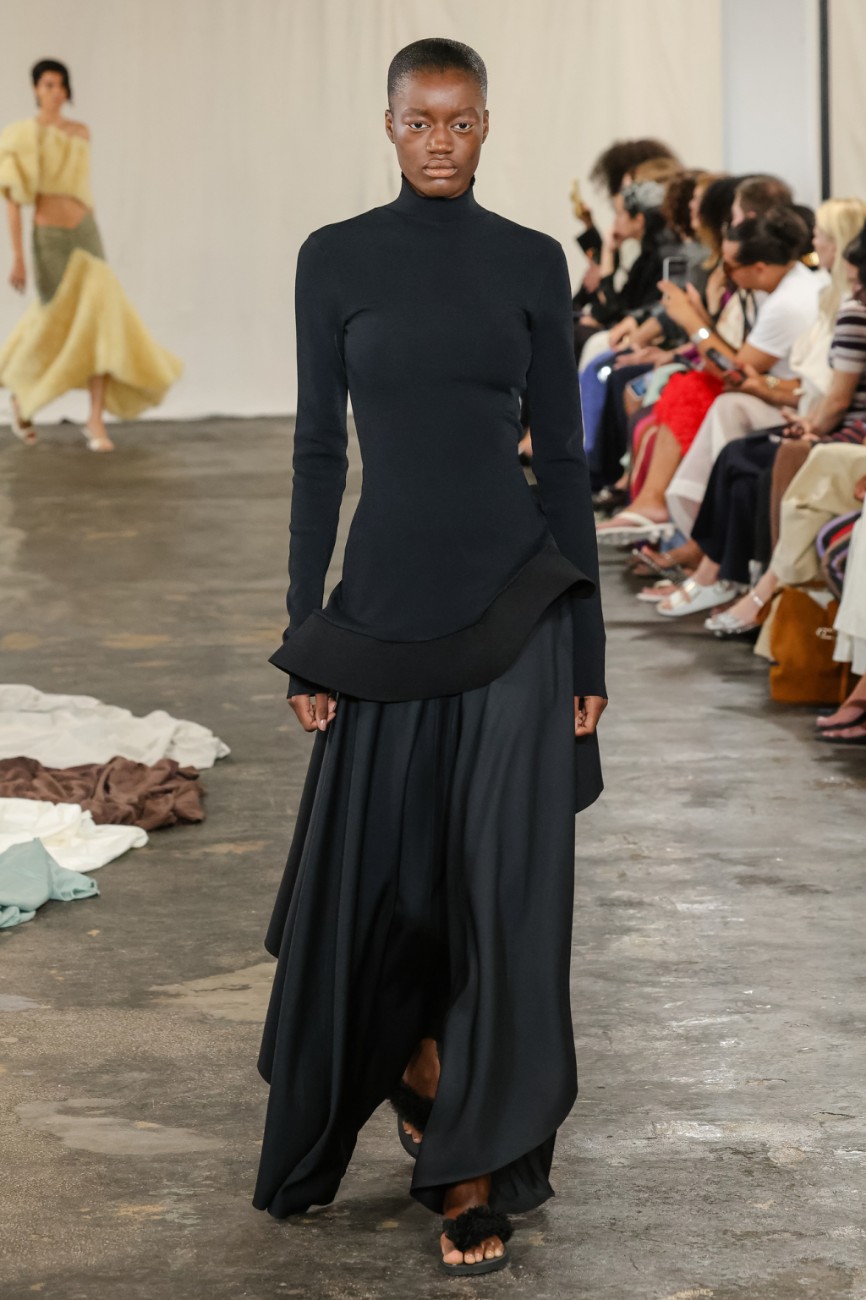
Across the published accounts, the hip is the collection’s most consistent site of transformation. Horsehair-supported flounces, chenille volume, and sculptural sweeps all expand around the pelvis. An icy-blue high-necked dress stays close to the torso before opening at the hip. The pattern feels deliberate, not accidental.
That repetition gives different techniques a shared direction and makes garments across the show feel related without requiring identical decoration. A recurring proportion can hold a collection together in ways that a recurring colour or motif sometimes cannot.
The more important point is the nature of the transition. The controlled move between a close line and an outward gesture makes these pieces interesting, not simply a larger silhouette. Spring 2027 advances beyond a series of individually accomplished surfaces precisely because a spatial logic binds them. This is the kind of design thinking that Omiren has traced in the work of Caribbean diaspora designers: a formal decision rooted in something specific, applied with enough rigour to become legible across multiple garments.
Tailoring as More Than a Quiet Interval
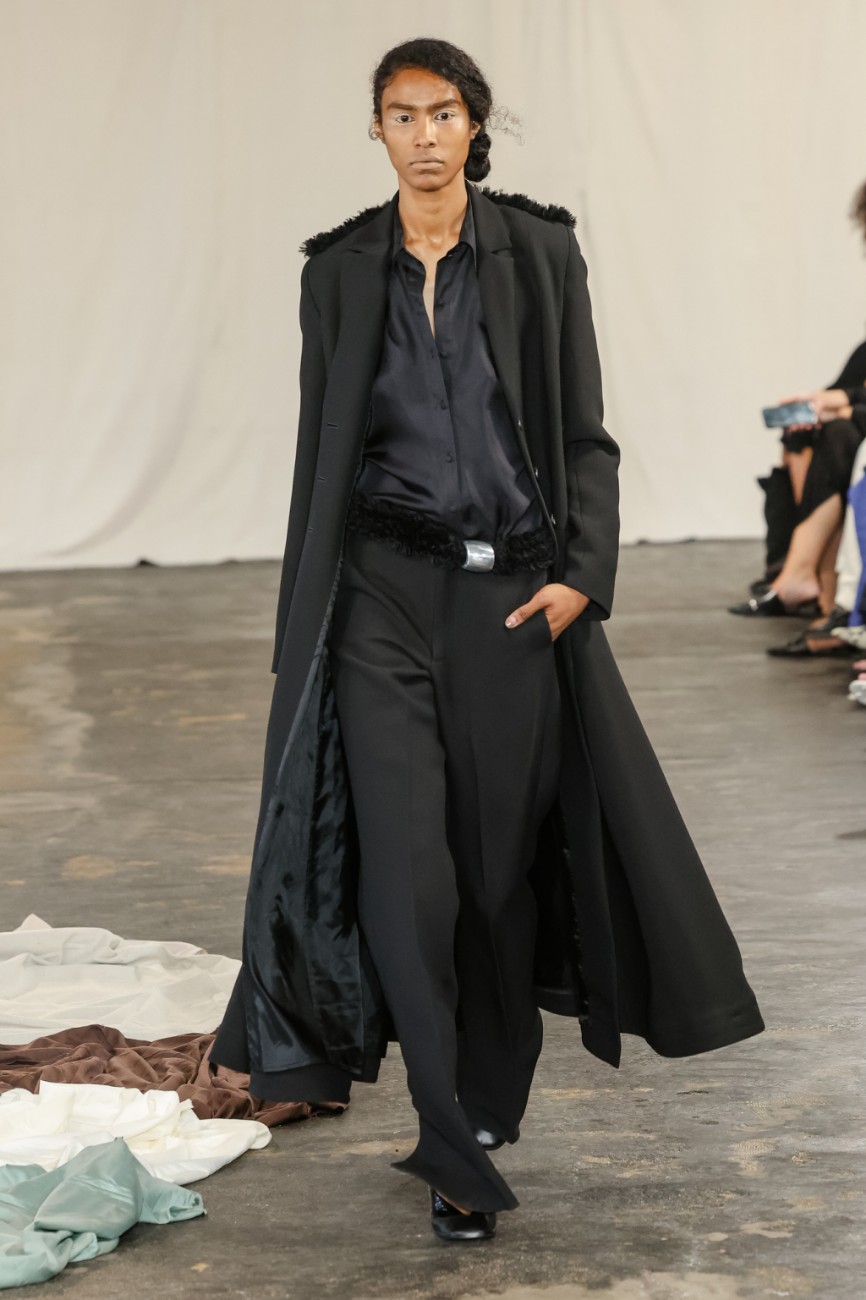
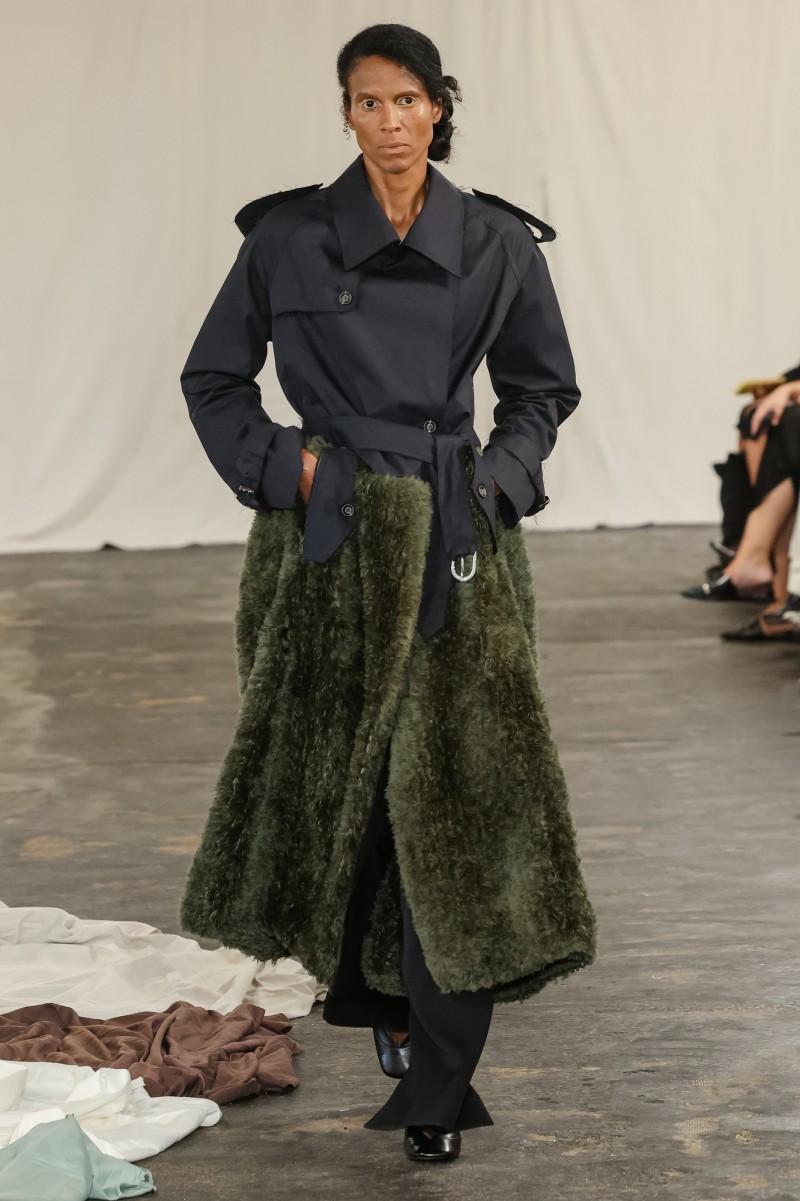
Scott told Fashionista she wanted to resist expectations of an entirely embellished or crochet-led collection and instead focus on form and tailoring. That statement repositions the quieter garments. They are not pauses between the more elaborate pieces; they are part of the same argument. Vogue Runway’s coverage notes three elongated trenches whose skirts carry dense organza ruffles. Gold foil identifies lean tailoring and an understated olive coat.
The trenches are particularly interesting because they bring a recognisable garment structure into contact with the collection’s more active surfaces. A trench coat carries expectations: clean lines, controlled length, and a certain kind of utility. When organza ruffles are applied to its skirt, the question becomes whether those ruffles contribute to the trench’s overall shape or simply provide a dramatic lower section. The distinction matters. Transformation means the ruffles change how the coat reads. ‘Addition’ means they are attached to it without altering its logic.
Based on the published evidence, Scott’s stated interest in tailoring suggests structure works meaningfully alongside texture, rather than serving as a neutral background for embellishment. The season is stronger for having made that distinction. A collection that treats its tailored pieces as functional punctuation between elaborate looks reads as less unified than one in which the quieter garments share the same spatial thinking as the more complex ones. The lean pieces in Spring 2027 appear to serve the latter function.
Ordinary Fabric, Unfamiliar Treatment
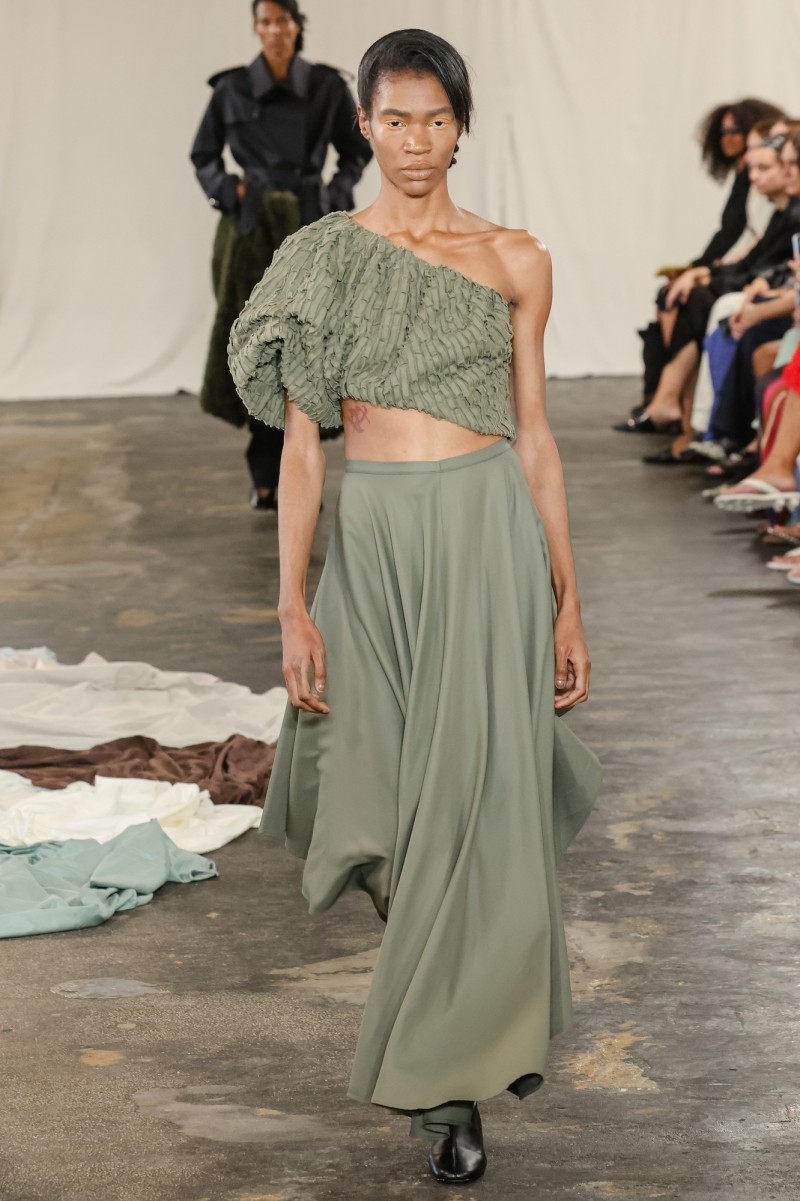
The reconstructed chino twill is one of the clearest expressions of Scott’s material thinking this season. She told Vogue that she cut the fabric into strips and re-sewed it into a surface resembling lattice and sargassum, describing its evening use as out of context. The reference is produced through intervention in the fabric itself rather than printed onto it, which makes the decision more consequential. The familiar material enters another register through cutting and recombination.
Organza provides a different kind of contradiction. Fashionista describes strips cut and reapplied to garments, producing surfaces that appear dense and voluminous while remaining lightweight and airy. These two treatments establish complementary approaches: one changes the associations of an ordinary fabric; the other changes the apparent weight of a delicate one.
Both point towards the same underlying principle. The interest lies not in the fabric’s original properties but in what intervention can make of them. That principle clearly connects to the broader season: a collection about transformation rather than decoration.
Dresses Make the Proposition More Direct
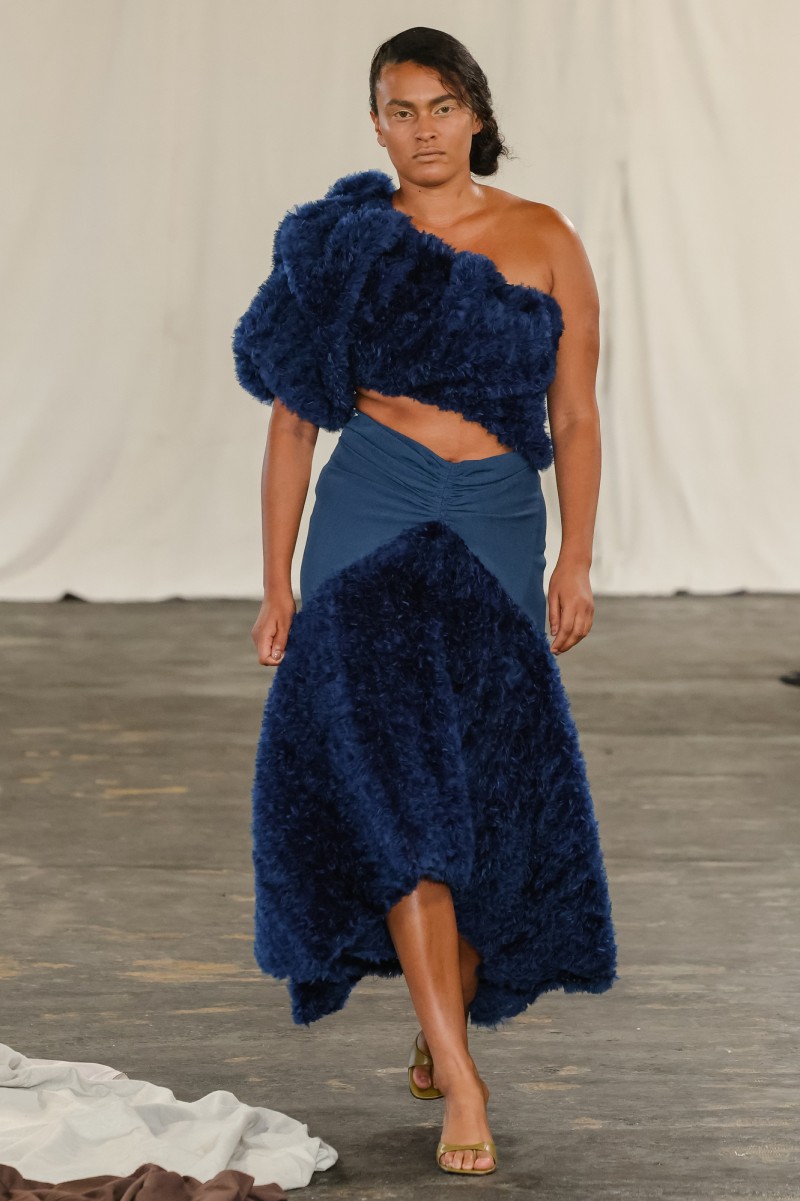
Nicole Phelps’ Vogue review highlights two close-fitting dresses with cascading front ruffles, alongside matte-viscose knit tops, skirts and tube dresses with horsehair ruffle hems. These are some of the collection’s more direct pieces, and they serve an important function.
When a body line is clear, and a ruffle adds interruption and movement, the garment doesn’t need every surface to carry equal complexity. The elaboration becomes specific rather than total. These pieces can connect the collection’s sculptural ambitions to garments whose purpose is immediately understandable, which matters if the season’s ideas are to travel beyond the runway.
The strength of these looks depends on proportion and placement. The question is whether the treatment creates a specific relationship between the body and the surface, one specific to Diotima, or whether the ruffle operates as a general effect. The former is a signature. The latter is a technique.
Less Crochet Does Not Mean Less Diotima
Vogue’s principal reservation concerns the reduced presence of crochet. Nicole Phelps argues that Scott should not move too quickly away from the technique associated with the label’s early work. The concern is understandable. Crochet has been central to how Diotima built its identity, and readers of Omiren’s Rachel Scott profile will recognise it as the foundation of much of that discussion. But a brand defined by only one technique is weaker than one whose identity extends to a way of thinking about material and form.
Scott’s own explanation makes the reduced emphasis intentional. She wanted to think about form and tailoring rather than deliver what an audience already expected. The opening look suggests that continuity is not being abandoned. Crochet remains part of an outfit whose silhouette is developed by additional volume. The more useful critical question, therefore, is not whether there is enough crochet, but whether the newer vocabulary becomes equally specific. As Omiren notes in its discussion of Caribbean designers and creative authority, a designer’s signature lasts longest when it describes a method rather than a single material.
Earlier Seasons Sharpen the Comparison
Spring 2027’s techniques have relevant precedents. Vogue’s Fall 2026 review describes organza intarsia developed through Scott’s collaboration with Wifredo Lam’s estate, with references drawn from the artist’s work. The Spring 2026 account identifies references to Trinidad Carnival through sailor collars, deep portrait collars, and materials that suggest feathers without directly reproducing costume. Tubular chenille was already tracing the body.
Those comparisons establish continuity in method. Scott repeatedly translates a reference into an outline, a texture or a construction problem. Spring 2027’s contribution is to concentrate these investigations around expansion at the hip and the contrast between active surfaces and controlled lines. The question is not whether the techniques are entirely new. It is whether their organisation advances.
A designer who builds incrementally, returns to a method, deepens its application, and tests it against new materials tends to produce more coherent bodies of work than one who treats each collection as a fresh departure. Omiren’s broader editorial stance on Global South fashion holds that this kind of development deserves the same critical attention as novelty. Scott’s trajectory so far warrants that attention.
What the Framework Leaves Unresolved
WWD’s account identifies spiritual and historical figures in Scott’s research, along with vintage napkin rings used as adornments. These details sit at different distances from the clothes. The napkin rings describe a material decision: an existing object moves into clothing and bodily ornament. The broader references need explanation and cannot automatically be assigned to specific garments.
The collection is at its most resolved where surface and silhouette meet clearly. Where the expansive framework exceeds what the clothes’ descriptions can establish, the explanation risks doing too much, but that doesn’t invalidate the research. It means the garments need to sustain attention without requiring the audience to decode every association.
The strongest work in the season demonstrates that the references have already been absorbed into craft. A viewer who knows nothing about sargassum or Suzanne Césaire can still read what those references have produced in the clothes: a density here, an unexpected opening there, and a surface that behaves differently from what the fabric usually promises. That legibility measures whether research has fully translated into form.
A Developing Vocabulary
WWD and Goldfoil both emphasise a growing silhouette language; Vogue welcomes particular dresses while noting the diminished crochet; Fashionista foregrounds Scott’s experimentation with form and materials. Taken together, the evidence supports a collection in transition rather than a settled formula.
Its strongest contribution is the attempt to make material transformation shape the entire garment. Its continuing challenge is to establish what continuity looks like as the vocabulary expands beyond its original signatures.
The Caribbean references matter most where they drive decisions: a reconstructed surface, changed proportions, and a contrast between density and lightness. That is the direction worth developing. Not more explanation, but clothes that make the research consequential at the level of form.
ALSO READ
- The Caribbean Is Not a Mood Board
- Rachel Scott and the Diotima Identity
- The Global South Made Fashion. It Just Never Got Credit.
- What a Museum Record Can and Cannot Tell Us About Dress
Frequently Asked Questions
What inspired the Diotima Spring 2027 collection?
Rachel Scott drew on the Caribbean Sea, considering beauty, history, and environmental change, including the sea as a burial ground, warming waters, accumulating sargassum, and references to figures such as writer Suzanne Césaire.
Which techniques feature in the collection?
Reconstructed chino twill, organza strip application, crochet, tubular chenille and horsehair-supported ruffles, applied across ready-to-wear and tailoring.
Is crochet still central to Diotima Spring 2027?
Crochet remains present but plays a smaller role than in earlier seasons. Scott has stated that she wanted to develop the label’s vocabulary around form and tailoring. Full collection imagery is available at Vogue Runway and Fashionista.
Where can readers see the full collection?
Vogue Runway, Fashionista and WWD all provide collection galleries.