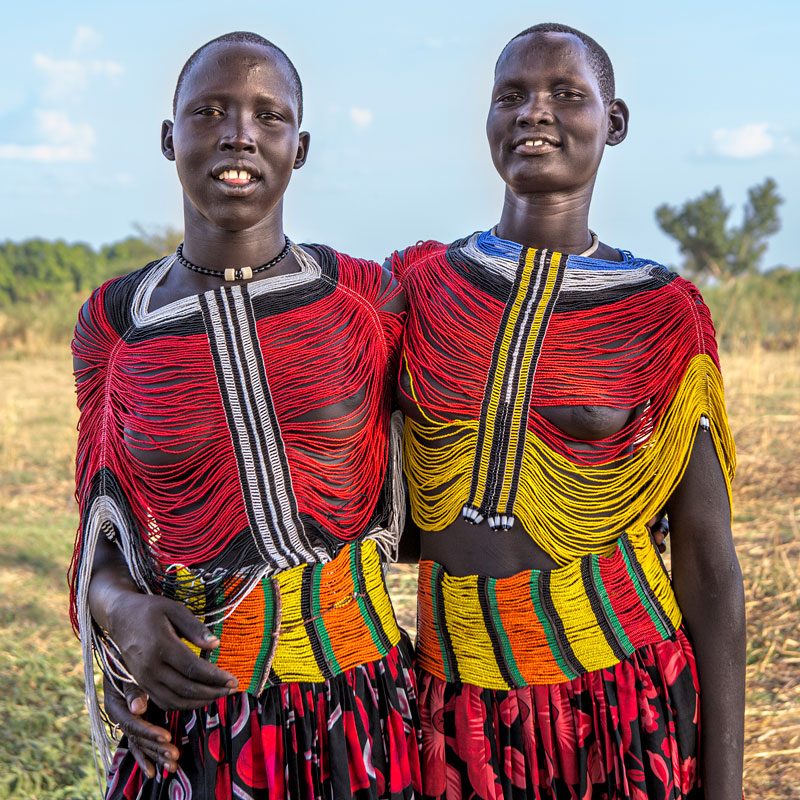
Open the search results for Dinka beaded corset, and within the first five results you will find at least three different colour-to-age tables that contradict each other. One source assigns red and black beads to women between fifteen and twenty-five years old. A community-centred source from March 2026 assigns red to older girls twenty years and above. A different community source assigns yellow to girls who have just reached puberty. A catalogue source assigns yellow to men over thirty. Each of these sources presents its colour table as factual and specific. None of them acknowledges that the others disagree.
The African fashion and beauty market is worth $ 31 billion. The Dinka alual is among the most documented items of South Sudanese material culture in international ethnographic and fashion writing, and among the most consistently misrepresented. The misrepresentation takes a specific form: the reduction of a relational social object to a decoding exercise, in which colour is assigned to age, and the reader is invited to believe that any woman’s alual can be read like a timetable. As the Brooklyn Museum’s institutional documentation of its alual object confirms, the corset can also be an indicator of one’s advancement through age grades, availability for marriage, and bride price. The careful language there can also be doing significant work. It acknowledges function without claiming universal legibility. The secondary literature routinely drops that qualification.
The Dinka alual has been described as a colour code. The published colour tables contradict each other. Here is what the corset actually signalled and how.
What the Alual Is
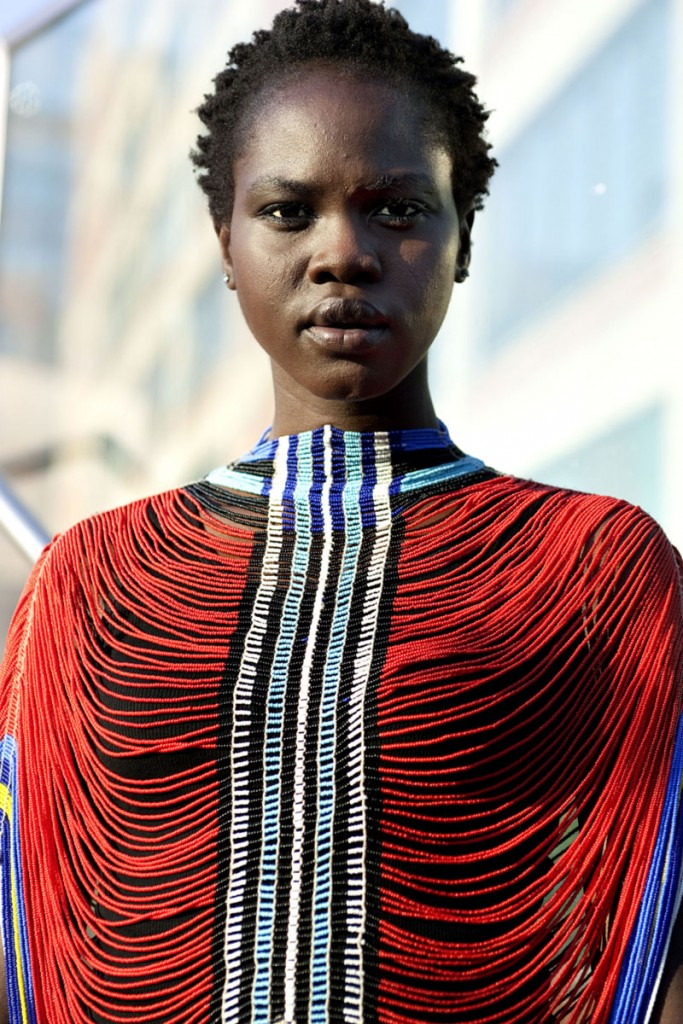
The alual is the Dinka word for the women’s beaded corset, and the word itself means ‘red’ in Dinka, which is the most immediate clue that the garment’s name and its colour are inseparable. The male equivalent is the malual. Both are made from glass beads, natural fibre, fabric, and wire. The Brooklyn Museum’s collection holds an alual from the 20th century measuring 77.5 by 50.8 centimetres, made from glass beads and wire, acquired with the Carll H. de Silver Fund in 1997.
The women’s alual differs from the men’s malual in its construction and how it sits on the body. While men’s corsets are structured with strong wires that hug the body tightly, women’s corsets are more ample and hang from the neck like a large necklace. Some scholars have suggested that these ornaments are extensions of formerly existing belts for men and necklaces for women: the alual retains this necklace character, extending down to cover the torso rather than encircling the waist. The alual is often decorated with cowrie shells, which are associated with fertility. The Gor is a distinct type described as body-hugging rather than hanging.
The Dinka are cattle herders of the Sudd swamplands in South Sudan, and the cattle economy shapes every dimension of the alual’s significance. As herders whose wealth is measured in cattle and who move seasonally between dry-season cattle camps and permanent settlements, the Dinka historically focused on adorning the human form as the primary method of artistic expression. As GenderTalk211’s March 2026 community documentation of South Sudanese dress traditions confirms, the alual and its associated beads are among the most prized possessions among the Dinka, second only to their cattle. Courtship occurs primarily at dry-season cattle camps. The corset communicates in that context, among people who know how to read it.
The colour tables published about the Dinka alual do not agree with each other. One source assigns red to ages 15-25; another assigns red to ages 20 and above. One says yellow marks puberty; another says yellow marks men over 30. These contradictions are not errors in individual sources. They are evidence that the alual’s signalling system is more local, more contextual, and more relational than a universal code table can represent.
What the Colour Tables Get Wrong
The published disagreement over the alual’s colour-to-age correspondence is not primarily a research-quality problem. It is a structural problem with how the object has been described. A colour-to-age table implies that colour is the primary signalling mechanism, that the correspondence is universal across all Dinka communities, and that the information is stable across time. The available evidence does not justify any of those implications.
Colour shade matters as much as hue. The GenderTalk211 community source notes that the red category, the Alual type, corresponds to older girls aged 20 and above, depending on the shade of the beads. That qualifier, depending on the shade, means that two red corsets of different shades may signal different social positions to a community member who knows the distinction. A colour table that uniformly assigns red to an age range without distinguishing shades has already lost the precision the actual signalling system required.
Regional variation is the second problem. The Dinka are not a small homogeneous community with a single dress convention. They are a large and geographically dispersed pastoralist people whose communities span a vast area of South Sudan and whose contact with neighbouring groups, including the Nuer and various Nilotic peoples, has produced local variations in dress practice. As ROOTS of South Sudan’s community documentation confirms, girls of any age wear mixed colours on special occasions. That single entry undermines the entire colour-code framework. If anyone can wear mixed colours for celebrations, then colour alone cannot be read as a fixed age indicator without knowing the occasion.
The third problem is the collapse of multiple signalling dimensions into a single dimension. The value was communicated not only through colour but also through the design’s complexity and beauty, the corset’s length, the bead pattern, and the specific materials used. The pattern of the beads indicates the wealth of the girl’s family as well as the bride price expected to be paid in cattle by the successful suitor. The height of the corset’s back indicates status. The presence of cowrie shells indicates association with fertility. These are not one code but several overlapping communicative registers that a community member reads simultaneously. A colour table captures one register and presents it as the whole system.
What the Alual Could Signal: The Correct Account
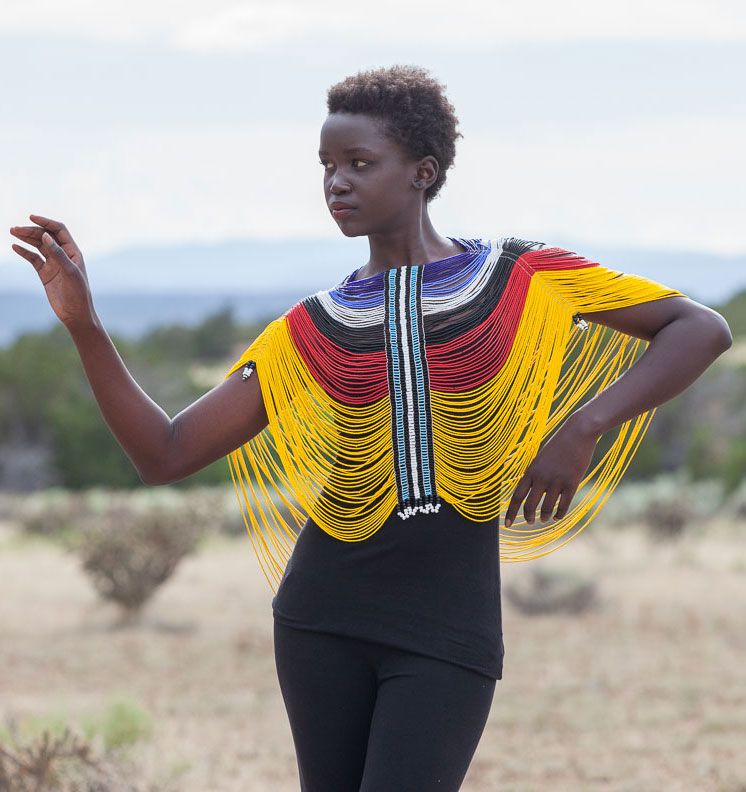
What the Dinka alual could genuinely signal, within its community of use, was a complex of social information about the wearer that required community knowledge to read correctly. The most academically careful summary is the Brooklyn Museum’s: the corset was a marker of wealth and status, and could also indicate the wearer’s advancement through age grades, availability for marriage, and bride price.
The alual was worn at all times and removed only upon marriage or upon transition to the corset of the next age grade. It therefore marked a continuous social state rather than a special-occasion performance: the woman wearing an alual was visibly, at every moment of her day, a woman in a specific social position within the Dinka life course. That position was legible to other community members who shared the knowledge system within which the corset operated. It was not necessarily legible to outsiders who were seeing the object for the first time without that knowledge.
The ajouh beads, which are family heirlooms passed across generations, add a further dimension. Some beads in a corset may be inherited rather than newly acquired, carrying the social memory of previous generations within the family into the current wearer’s presentation. The corset is therefore not only a signal of the wearer’s current social position but also, potentially, of her family’s generational accumulation of wealth and social standing. This dimension cannot be read from colour alone.
The Roots Project and the Contemporary Alual
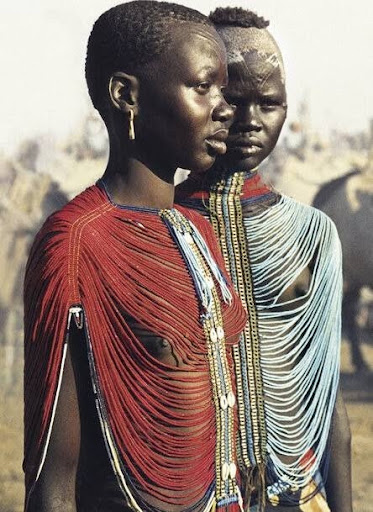
The most significant contemporary institutional engagement with the production of the Dinka corset is the Roots Project, founded in 2009 by Anyieth D’Awol in Juba, South Sudan. As Atelier 55’s documentation of the Roots Project confirms, the Roots Project provides a platform and a secure environment to help women gain economic independence by creating and selling traditional crafts, including beaded Dinka corsets. The corsets produced through the project are described as taking a few weeks to make, confirming the significant labour investment that the alual’s production represents. The project, based in Nimra Talata, Juba, connects traditional craft knowledge to economic opportunities for women in the post-independence context of South Sudan.
The Roots Project’s work is significant for this article’s argument because it demonstrates that the alual is not a fixed historical object whose signalling system has been preserved unchanged. It is a living craft tradition whose makers are actively negotiating between traditional knowledge and contemporary economic conditions. The corsets produced for the international market may carry different or modified signalling conventions from those used within traditional Dinka communities. Women may also make them from families whose beadwork knowledge spans generations. The contemporary alual cannot be read with the same interpretive framework as the 20th-century example in the Brooklyn Museum’s collection, and neither of those can be reduced to a colour table from a secondary source.
The Omiren Argument
The Dinka alual was never a bead-count code legible to anyone who encountered it. It was a socially embedded object whose communicative capacity depended on shared community knowledge about colour, shade, pattern, length, material, family wealth, bride price conventions, and the specific occasion on which it was worn. The African fashion and beauty market is worth $ 31 billion. The fashion and ethnographic literature that reduces the alual to a colour table is not describing the object. It is replacing the object’s actual signalling system with a simplified version that can be published without requiring cultural knowledge. The colour tables that result from this substitution contradict each other because no universal system exists to be described. Red means different things in different Dinka communities, at different shades of intensity, and on different occasions. The mixed-colour corset worn for celebrations breaks every table that assigns mixed colours to specific ages. The ajouh heirloom beads that carry generational family memory cannot be read at all from colour. What the alual could signal, within its community of use, was the wearer’s current social position in a complex system of age grades, family wealth, cattle wealth, bridal eligibility, and community belonging. That system required community membership to read. Fashion writing that describes it as a colour table has not decoded the corset. It has replaced it.
Also Read:
- Southern African Beadwork Deserves Runway Recognition: An Opinion on Fashion’s Editorial Blind Spot
- How a Gaborone Beadwork Jewellery Label Turns Heritage Into Contemporary Design
- Botswana’s Tswana Beadwork Cooperatives and the Push Into Export Markets
Frequently Asked Questions
What is the Dinka alual?
The Dinka alual is a women’s beaded corset worn by Dinka women of South Sudan. The word alual means red in the Dinka language, reflecting the dominant colour of the most commonly depicted type. Unlike the male malual, which hugs the body tightly with structured wire, the alual is more ample and hangs from the neck like a large necklace extending to cover the torso. It is made from glass beads, natural fibre, fabric, and wire, and is often decorated with cowrie shells, which are associated with fertility. The alual was traditionally worn continuously and removed only upon marriage or transition to a new age grade.
What does the alual colour mean?
The published literature on the alual’s colour system presents several contradictory tables. Different sources assign red to different age ranges, with some beginning at 15-25 years and others at 20 and above. Community documentation notes that red’s correspondence to age depends on the bead’s shade, introducing a level of precision that the general tables do not capture. Mixed colours are documented as worn by girls of any age for special occasions, which contradicts any fixed age-to-colour system. The most accurate statement is that colour communicated social information within a specific community context, alongside pattern, length, material, and occasion, and that no universal colour table reliably describes the system across all Dinka communities.
What is the difference between alual and malual?
The alual is the women’s Dinka beaded corset, and the malual is the men’s equivalent. The male malual is characterised by strong wires that hug the body tightly and typically features a high back projection that indicates the wealth of the wearer’s family. The female alual is more ample and hangs from the neck like a large necklace rather than hugging the body as a traditional corset would. Some scholars suggest the alual developed from a necklace form and the malual from a belt form. Both are made from glass beads and wire and communicate social information through colour, pattern, and construction, though the specific dimensions of each communication differ.
What did the Dinka alual signal?
The Dinka alual signalled a complex of social information about the wearer within her community. The Brooklyn Museum’s careful institutional description notes that it could indicate advancement through age grades, availability for marriage, and bride price. Additional dimensions included the wealth of the wearer’s family (communicated through pattern complexity and material quality), the presence of ajouh heirloom beads that carried family memory across generations, and the occasion for which it was worn. The alual was worn continuously through an age grade, making it a constant social marker rather than a special-occasion signal. Its full signalling capacity was available to community members who shared the knowledge system within which it operated.
Who makes Dinka corsets today?
Dinka corsets continue to be made by Dinka women and by organisations supporting traditional craft production. The Roots Project, founded in Juba, South Sudan, in 2009 by Anyieth D’Awol, provides a platform for women to gain economic independence through making and selling traditional crafts including beaded Dinka corsets. The corsets take several weeks to make, reflecting the significant labour investment they require. Contemporary corsets may be made for both community use within Dinka practice and for international sale, with the possibility that signalling conventions differ between these contexts.
Explore More
Read the full Culture > Heritage & Identity section for Omiren Styles’ documentation of African dress traditions whose social signalling systems require community knowledge to read accurately, and the editorial standards that fashion writing about those traditions should meet.
Discover travel and heritage intelligence across South Sudan and the Nile Basin at Rex Clarke Adventures.