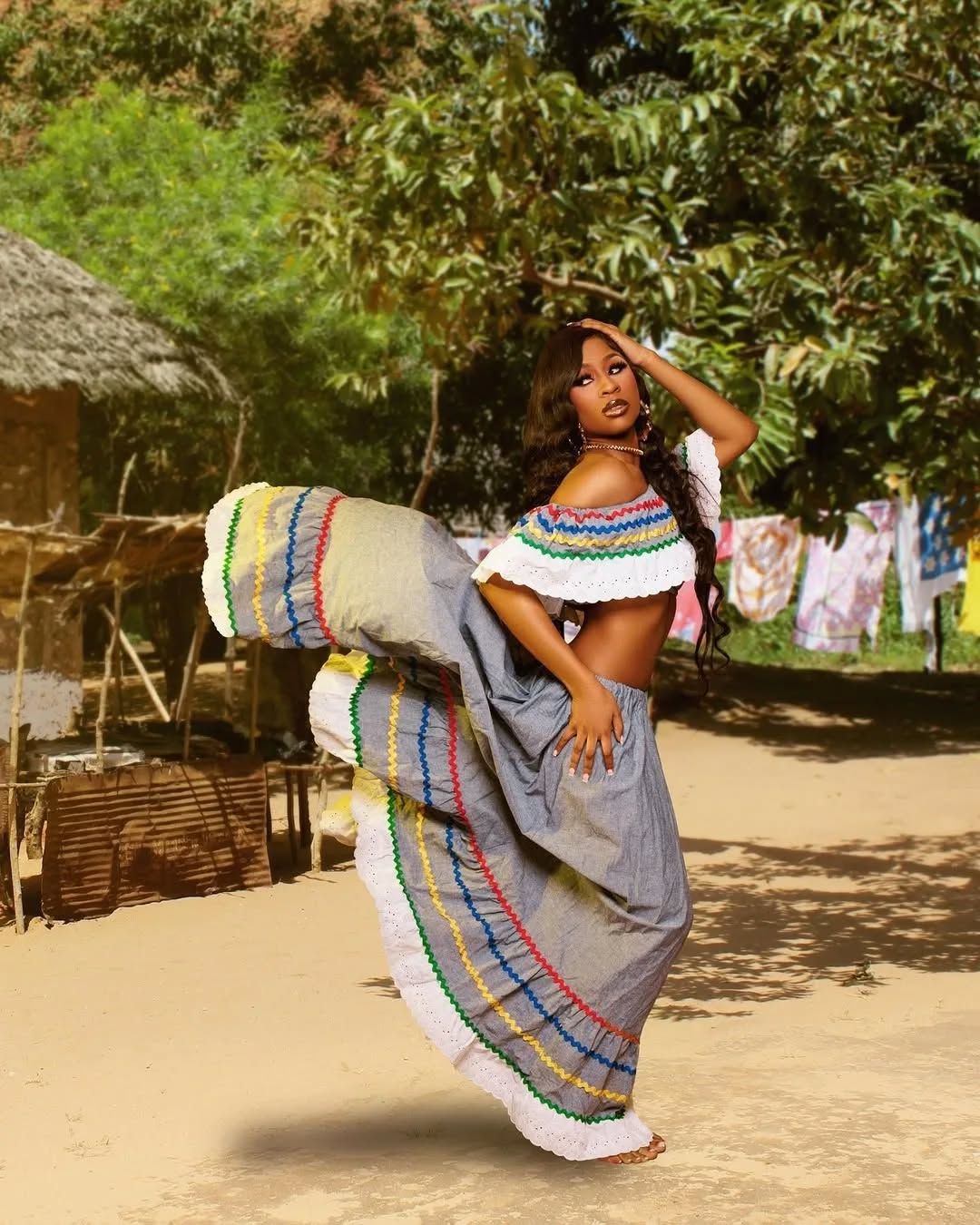
Haitian fashion designers have been producing some of the most culturally layered, technically accomplished work in the Caribbean for over a century. They have done this without a Fashion Week, without sustained international press coverage, and without the institutional infrastructure that European fashion capitals treat as the minimum condition for being taken seriously. What they have had instead is something more durable: a dress culture rooted in the only successful slave revolution in history, a ceremonial tradition that assigned colour, fabric, and silhouette to specific spiritual forces, and a sewing culture so deeply embedded in national identity that, as designer Michel Chataigne has stated directly, in the entire Caribbean, only Haiti has a culture of sewing.
That statement is not self-promotion. It is a documented fact. Haitian school curricula historically required students to pass a sewing examination before completing junior high school. The ateliers of Pétionville produced couture for Haiti’s elite class and for diaspora clients across North America and Europe through the mid-twentieth century. The Karabela, Haiti’s national dress, carries the colours of the Haitian flag sewn directly into its construction. The Vodou ceremonial dress system assigned specific colours, fabrics, and forms to each lwa, the Vodou spirits, creating a liturgical dress code of extraordinary precision. None of this has been named properly by the global fashion industry.
Haiti produced some of the Caribbean’s most sophisticated fashion traditions. Rooted in Vodou ceremony, revolutionary identity, and the Karabela dress. The industry missed all of it.
The Karabela: Haiti’s National Dress and Its Revolutionary Colours
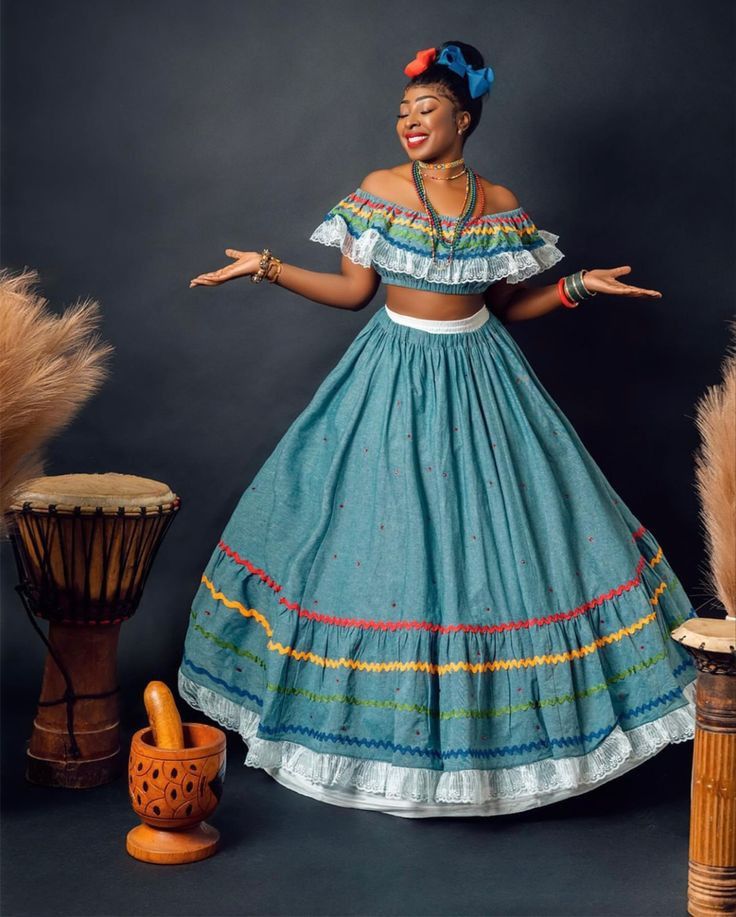
The Karabela dress, also called the Quadrille dress, is Haiti’s national dress for women and one of the most politically loaded garments in the Caribbean. Made from lightweight cotton, linen, or chambray, it is typically worn off-the-shoulder, full-length, and in blue with red lace detailing. Those colours are not decorative choices. They are a direct reference to the Haitian flag, created in 1803 when revolutionary leader Catherine Flon is said to have sewn together the blue and red strips torn from a French tricolour, removing the white centre that represented colonial France. The white was not simply removed from the flag. It was removed from the dress. That is a political act sewn into fabric.
The Karabela became popular as everyday dress in the eighteenth century and has since transitioned into ceremonial and celebratory wear, worn on national holidays, during Kanaval, and at cultural events. Contemporary Haitian designers have been actively reworking it, embedding traditional motifs into current silhouettes, reinterpreting the iconic red and blue in new palettes, and using it as a foundation for couture collections that claim continuity with the revolutionary heritage rather than nostalgia. The dress is not a costume. It is a living argument that what Haitian women wore on the day of independence is worth wearing on every day that follows.
“The white was removed from the flag in 1803. It was removed from the dress at the same moment. That is a political act sewn in cotton.”
Vodou Dress Is a Liturgical System, Not an Aesthetic
The most misunderstood and most undervalued dimension of Haitian fashion is its relationship to Vodou. The global fashion industry, when it engages with Vodou at all, tends to treat it as visual inspiration: skull motifs, dramatic colour, theatrical silhouette. What it consistently fails to document is that Haitian Vodou ceremonial dress is a complete, codified liturgical system in which every colour, fabric weight, and element of silhouette is assigned to a specific lwa.
Danbala, the serpent spirit and creator of life, is honoured in white and silver. Ezili Dantor, the Black Madonna, wears blue and gold. Bawon Samedi, father of the dead, is dressed in black and purple. Kouzin Azaka, the agricultural spirit, wears denim and straw. These are not suggestions. They are requirements.
What this means for fashion is that Vodou produced a colour and fabric vocabulary of extraordinary specificity that predates and underlies the entire Haitian aesthetic tradition. When Haitian-American designer Glavidia Alexis developed her Genin Pa Presse collection, she worked directly from this liturgical system, assigning each look to a specific lwa and sourcing its colour and texture from that spirit’s ceremonial requirements. Her lemon-yellow dress honoured Kouzin Azaka. Her ornate green-and-gold priestess dress honoured Danbala. The collection was not Vodou-inspired. It was Vodou-structured, built from the inside of the tradition outward. That is a fundamentally different creative methodology, and it produces a fundamentally different kind of garment.
Sapology and the Annual Ceremony of Dress
Vodou ceremony in Haiti is an annual practice that photographer Pierre Michel Jean has described as Haitian sapology: the expectation that, for each year’s feast days, practitioners will commission and wear new ceremonial dress in the colours and forms appropriate to the lwa being honoured. This is not occasional dressing. It is a recurring creative commission that produces new garments annually from the ateliers of Haitian tailors and couturiers who specialise in ceremonial work. The economic and creative infrastructure this practice sustains has never been studied or documented by the global fashion industry. It operates entirely within the Haitian cultural space, invisible to the press that looks only outward.
The drapé, or draping tradition, is central to this ceremonial practice. Rooted in African textile traditions, the Haitian draping technique creates flowing silhouettes that centre on the body’s movement in ceremony and dance. The technique has been a consistent feature of Haitian fashion design in both ceremonial and contemporary contexts, appearing in the collections of diaspora designers who trained in or draw on knowledge from Haiti’s atelier culture. It is a technique with a specific cultural genealogy that connects contemporary Haitian fashion directly to West African dress traditions carried across the Middle Passage and sustained by Vodou’s preservation of ancestral cultural practice.
Michel Chataigne: Forty Years of Haitian Couture
Michel Chataigne is the figure whose work most directly embodies the claim that Haiti has a couture tradition. Over four decades, Chataigne has built a practice that operates at the intersection of Haitian cultural heritage, ceremonial dress, and contemporary high fashion construction. His work has been shown internationally and has consistently used the visual language of Haitian history, Vodou symbolism, and the specific aesthetics of Pétionville’s elite atelier culture as its foundation. In 2025, as the HXNY artist-in-residence at Haiti Cultural Exchange in Brooklyn, Chataigne brought his practice directly to the diaspora community, running a fashion and cultural identity workshop in Crown Heights in March.
At that workshop, Chataigne’s statement about Haiti’s unique sewing culture was not anecdotal. It reflects a documented historical reality: the Pétionville atelier tradition, the schoolroom sewing examination, the annual ceremonial commissions, and the specific craft knowledge that distinguishes Haitian fashion production from that of its Caribbean neighbours. Chataigne has said his focus, after forty years, is shifting toward production, wealth creation, and sustaining the ateliers and artisans who continue to embody Haiti’s creative spirit. That is the language of institution-building, applied to a creative tradition that the global fashion press has persistently treated as peripheral.
Stella Jean and the Olympics: When Haitian Heritage Reached the World Stage

Stella Jean is the most internationally visible Haitian fashion designer working today. Born in Rome to a Haitian mother and an Italian father, Jean has spent her career developing a design philosophy she calls her ‘miscegenation-made philosophy’, using the intersection of Haitian and Italian cultural heritage as the structural logic of her collections. She won the Who’s on Next contest in 2011, was acclaimed by Giorgio Armani, and has shown on international runways while maintaining Haiti as the cultural heart of her practice. She was the guest of honour at Haiti Fashion Week 2015.
In 2024, Jean designed Haiti’s Olympic uniform, which debuted at the opening ceremony on the Seine on July 26, 2024. In collaboration with Haitian artist Philippe Dodard, she incorporated Dodard’s artwork, Passage, into the uniform design, blending Haitian cultural heritage with contemporary fashion before a global audience of billions. The Parsons School of Design’s Revolisyon Toupatou exhibition, on view January to February 2025 at the Anna-Maria and Stephen Kellen Gallery in New York, featured the Olympic uniform alongside the work of 19 Haitian artists, exploring the enduring legacy of the Haitian Revolution in contemporary art and fashion. The exhibition was co-curated by Professor Jonathan Square and Professor Siobhan Meï of the University of Massachusetts Amherst. Haiti’s fashion tradition reached the world’s most-watched ceremony. The question is whether the world was paying attention to where it came from.
Azède Jean-Pierre, Victor Glemaud, and the Diaspora Network
The Haitian fashion diaspora extends well beyond Stella Jean. Azède Jean-Pierre, whose label Azède has shown at both New York Fashion Week and Paris Fashion Week, was worn by First Lady Michelle Obama, a visibility milestone that received less sustained press attention than equivalent moments for non-Haitian designers. Victor Glemaud, born in Port-au-Prince and based in New York, has built a knitwear label known for its inclusive sizing and joyful colour palette, consistently referencing the chromatic boldness of Haitian visual culture. Prajje Jr. Oscar Baptiste, who trained in the US after leaving Haiti at thirteen, produces work that pays explicit homage to 1950s classic couture while dressing celebrities including Wyclef Jean and Alex Wek. Jean Ralph Thurin, a Haitian-born haute couture wedding designer, was featured in People magazine for designing the wedding dress worn by singer Ne-Yo’s wife, Crystal Renay.
What connects these designers is not a shared aesthetic. It is a shared foundation: the understanding that Haitian cultural identity is a design resource of extraordinary depth, that the Vodou colour system, the revolutionary politics of the Karabela, the draping tradition, and the atelier culture of Pétionville are not background context but primary creative material. The diaspora network that carries this knowledge across Brooklyn, New York, Rome, and Miami is maintaining a fashion tradition amid severe institutional neglect. The work is being done. The documentation has not kept up.
Read Also:
- Afro-Caribbean Fashion in Haiti: History, Identity, and the Politics of Dress
- Meet the Afro-Latino Designers Bridging West Africa and the Caribbean on the Runway
Revolisyn Toupatou: The Exhibition That Made The Argument
The Parsons School of Design’s Revolisyon The Toupatou exhibition, from January to February 2025, is the most significant institutional engagement with Haitian fashion history in recent years. Titled after the Haitian Creole phrase meaning “revolution everywhere,” the exhibition brought together 19 Haitian artists. It was presented bilingually in English and Haitian Creole, a language choice that is itself a cultural argument about whose knowledge counts and in whose language it should be held. At its centre was Stella Jean’s Olympic uniform and Philippe Dodard’s Passage, placed in direct conversation with Haiti’s revolutionary heritage and its contemporary creative expression.
The exhibition’s curatorial argument, that the Haitian Revolution’s legacy is not a historical artefact but an active force in contemporary Haitian art and fashion, is precisely the argument Omiren makes in this article. Haiti produced the first successful slave revolution in history in 1804. It paid economically for that revolution for over a century through the debt imposed by France in 1825, a sum that scholars estimate was not fully repaid until 1947. The fashion tradition that developed in that context, building beauty, ceremony, and cultural identity in the face of deliberate external impoverishment, is not a minor regional variation on Caribbean dress. It is one of the most politically significant clothing cultures on the planet. Revolisyon Toupatou named that. This article carries it further.
OMIREN ARGUMENT
The global fashion industry has a category for Haiti. It is called an emerging-market crisis context or artisan fashion. None of these categories describes what Haiti actually produced in cloth. A country that embedded political revolution into its national dress, that developed a liturgical colour system precise enough to dress each of its spiritual forces in specific fabric and silhouette, that maintained a sewing culture so foundational it was examined in schools, that produced couture ateliers in Pétionville that dressed an elite class with full technical sophistication, that sent designers to Milan, Paris, and New York who built internationally recognised practices from Haitian cultural foundations, is not an emerging market.
It is a fashion tradition that the global industry failed to name. The failure is not Haiti’s. It is the industry’s, and it reflects the same structural bias that has kept every Black Caribbean fashion tradition at the margins of editorial coverage, regardless of what those traditions actually contain. This article does not solve that problem. It insists it exists, documents what has been missed, and refuses to describe what Haiti built as anything less than what it is: a complete, sophisticated, politically significant couture system that deserves primary coverage, primary archival attention, and primary critical literature. The revolution was in 1804. The fashion documentation starts now.
Frequently Asked Questions
- Who are the most influential Haitian fashion designers?
The most internationally recognised Haitian fashion designers include Stella Jean, born in Rome to a Haitian mother and Italian father, who designed Haiti’s 2024 Olympic uniform and has shown at international fashion weeks; Azède Jean-Pierre, whose designs were worn by Michelle Obama and have shown at NYFW and Paris Fashion Week; Victor Glemaud, a Port-au-Prince-born New York-based knitwear designer known for inclusive sizing and vibrant colour; Michel Chataigne, a forty-year veteran of Haitian couture whose practice centres ceremonial and cultural heritage; and Prajje Jr. Oscar Baptiste, who dresses international celebrities with collections rooted in 1950s couture technique. The broader Haitian fashion diaspora also includes Jean-Ralph Thurin, Glavidia Alexis, and Marie Jean-Baptiste of Rue107.
- What is Haitian couture, and what makes it distinct?
Haitian couture refers to the tradition of high-end, custom-made fashion production that developed in the ateliers of Pétionville and other Haitian centres, serving the country’s elite class and diaspora clients. It is distinct from other Caribbean fashion traditions in several ways: Haiti’s sewing culture was so fundamental that students historically sat a sewing examination before completing junior high school; the Vodou ceremonial dress system produced a liturgical colour and fabric code that gives Haitian fashion design a spiritual as well as aesthetic foundation; and the country’s status as the first Black republic shaped its national dress, the Karabela, with explicit political meaning embedded in its colours and construction.
- What is the Karabela dress, and what does it symbolise?
The Karabela, also called the Quadrille dress, is Haiti’s national dress for women. Made from lightweight cotton, linen, or chambray, it is typically worn off-the-shoulder and full-length in blue with red lace detailing. The colours directly reference the Haitian flag, created when revolutionary leader Catherine Flon sewed together the blue and red strips of a French tricolour in 1803, removing the white that represented colonial France. The Karabela became popular as everyday dress in the eighteenth century and is now worn on national holidays, during Kanaval, and at cultural celebrations. Contemporary designers actively rework it as a couture foundation.
- How does Vodou influence Haitian fashion?
Haitian Vodou is not merely an aesthetic influence on Haitian fashion. It constitutes a complete liturgical dress system in which specific colours, fabrics, and silhouettes are assigned to each lwa, the Vodou spirits. Danbala, the creator of life, is honoured in white and silver; Ezili Dantor in blue and gold; Bawon Samedi in black and purple; Kouzin Azaka in denim and straw. Ceremonial practitioners commission a new dress annually for each spirit’s feast day. This creates a recurring system of couture commissions that sustains Haitian tailors and designers. The draping tradition central to Vodou ceremony, rooted in African textile practices, also runs through contemporary Haitian fashion as a connecting thread.
- What was the Revolisyon Toupatou exhibition?
Revolisyon Toupatou was an exhibition presented by Parsons School of Design at the Anna-Maria and Stephen Kellen Gallery in New York, on view from January 1 to February 15, 2025. Curated by Professor Jonathan Square and Professor Siobhan Meï, the bilingual exhibition in English and Haitian Creole brought together 19 Haitian artists to explore the enduring legacy of the Haitian Revolution in contemporary art and fashion. Its centrepiece was Stella Jean’s 2024 Olympic uniform for Haiti, created in collaboration with artist Philippe Dodard. The exhibition argued that the Haitian Revolution’s legacy is an active force in contemporary Haitian creative practice, not a historical artefact.