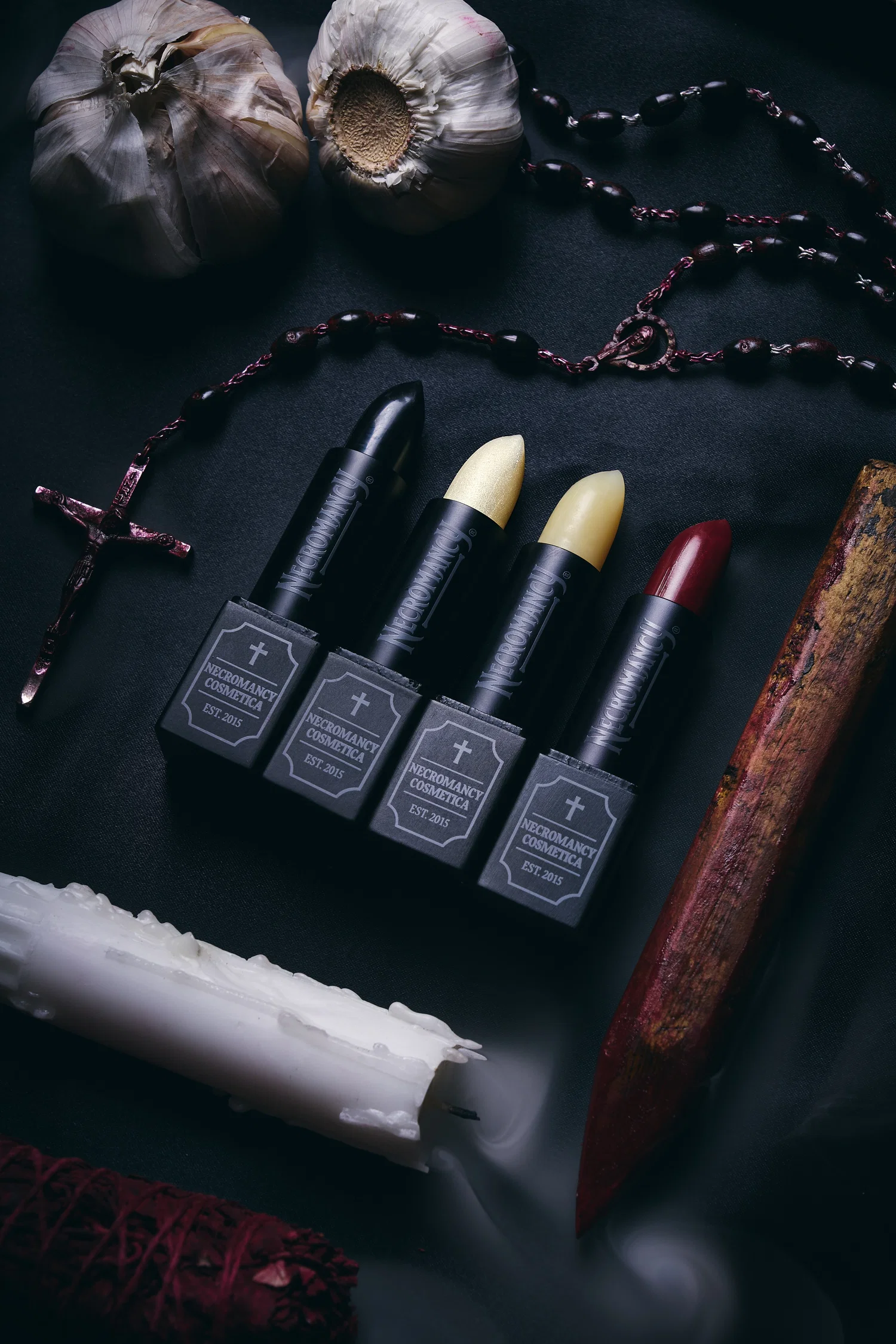
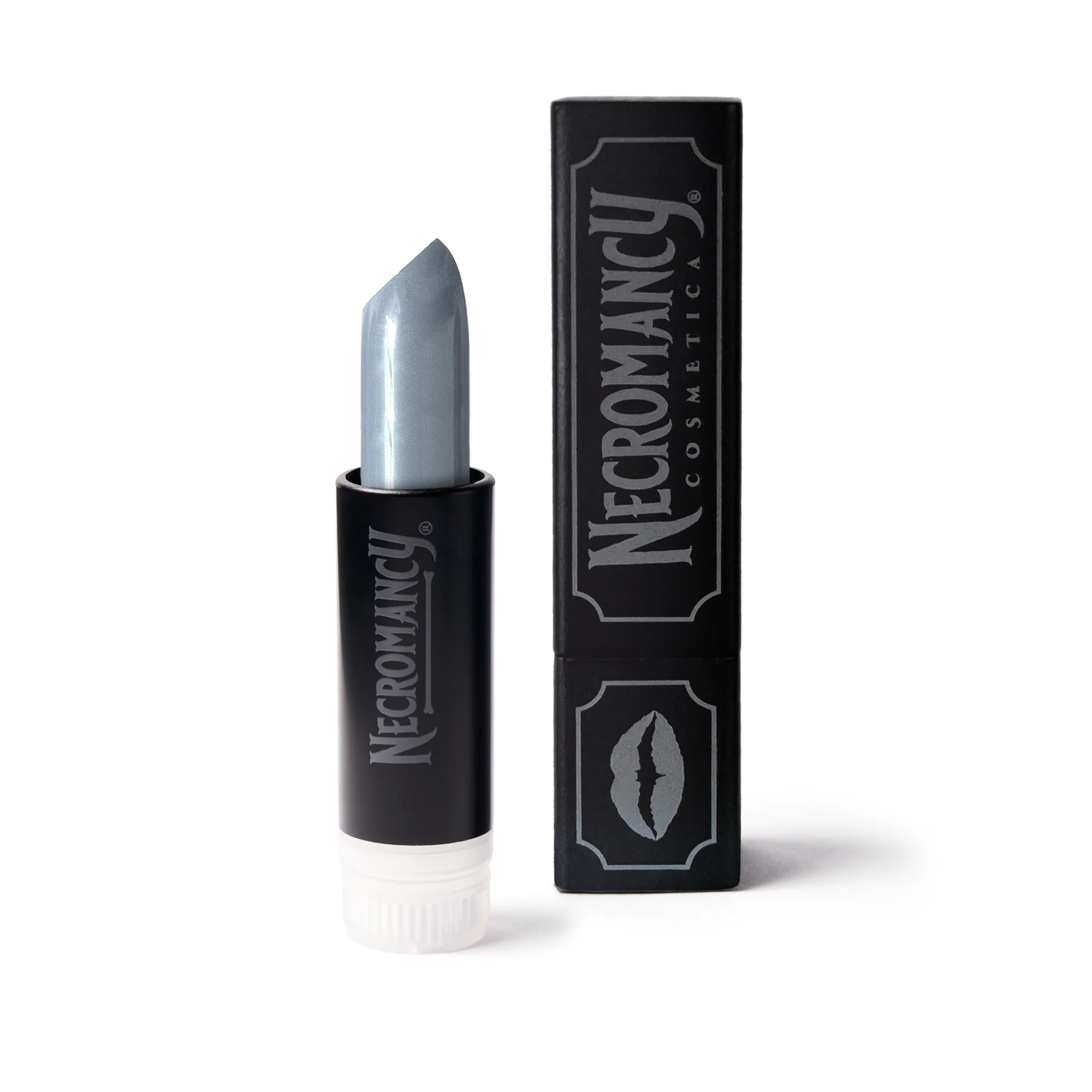
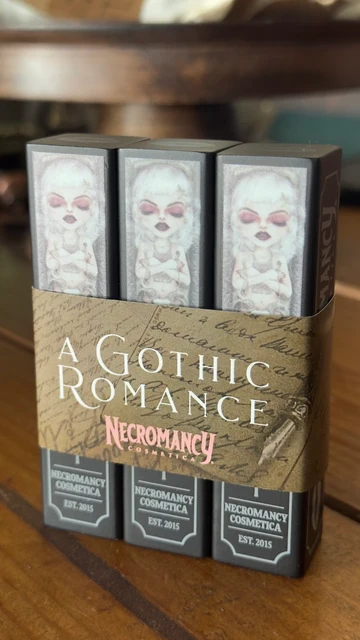
Necromancy Cosmetica is a dark and avant-garde cosmetics brand founded in 2015 in Rio Piedras, Puerto Rico. Its lipstick system is built around refillable cases: customers buy a case once, then purchase refill inserts in the shades they want, replacing only the product rather than the full packaging unit each time. The brand describes this as eco-friendly and reusable packaging. Those are design decisions, and they are real ones. Whether they constitute a sustainability verdict is a separate question and one that requires more information than a packaging decision alone provides.
This article examines what Necromancy Cosmetica’s refillable system actually does, what it cannot claim without additional evidence, and why the brand’s wider story, which extends considerably beyond its lipstick cases, is worth understanding on its own terms.
Necromancy Cosmetica is a Puerto Rican avant-garde beauty brand whose refillable lipstick system is a genuine packaging decision. This article examines what that decision does and does not establish – and what makes the brand’s wider story worth reading alongside its products.
What the Brand Is
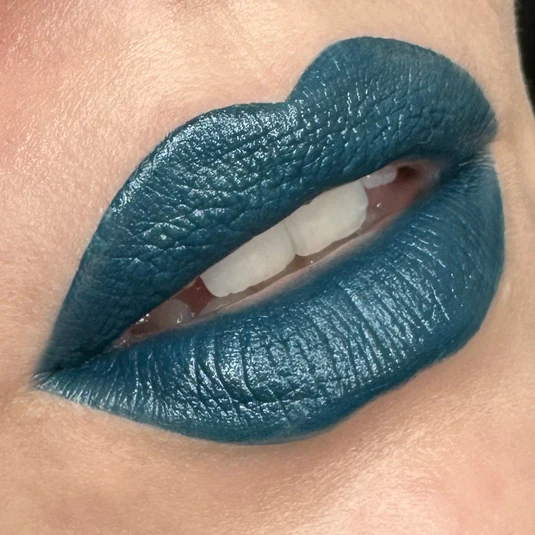
Necromancy Cosmetica describes itself as a dark, avant-garde cosmetics brand inspired by the mystical and eerie. Its physical home is at 59 Calle Arzuaga, on El Calejón del Carmen in Rio Piedras, San Juan, where it has operated since 2016. The brand has sold products to customers in more than 51 countries. Its range includes 32 lipstick shades handcrafted in small batches, 16 eyeshadow and pigment offerings in a magnetic, foldable book-palette design, and a product line the brand calls embalming sticks, each available in refillable configurations.
Des and Zal lead the brand, and their roles extend well beyond product development. They are active on the Rio Piedras community board, members of the Cultural Committee, and organisers of a monthly market every second Saturday on El Callejón del Carmen that has grown to include more than 100 vendors and artisans. They run a trap-neuter-release programme for the neighbourhood’s street cat population, have TNR’d over 200 cats, and have facilitated the adoption of more than 30. More recently, they acquired the building they have occupied since 2016, an act the brand frames explicitly as resistance against displacement in Puerto Rico. The building now houses a small sanctuary for more than 20 resident cats.
This is a significant amount of context to place alongside a lipstick refill system, and it matters for how the brand’s sustainability framing should be read. Necromancy Cosmetica is making a specific argument: that a cosmetics brand can be commercially viable, aesthetically specific, deeply community-embedded, and committed to operational choices that reduce packaging waste. The argument is about what kind of business can be built from Rio Piedras and what it looks like when that business treats the neighbourhood it occupies as a community to serve rather than a location to extract from.
What the Refillable System Actually Does

The refillable lipstick system separates the outer case from the product insert. A customer who buys a refillable case and then purchases refill inserts for subsequent shades is generating less primary packaging waste per unit of product consumed than a customer who buys a new full lipstick each time. This is a real, measurable packaging reduction at the product-use level. It is also the correct unit to evaluate the claim at: the comparison is between a refillable system and a conventional single-unit system for the same product category and usage pattern.
The packaging reduction claim does not require a lifecycle assessment to be directionally accurate. If a customer uses the same outer case across four shade purchases rather than buying four complete lipstick units, four units of outer-case manufacturing, shipping weight, and end-of-life packaging have been avoided relative to the conventional alternative. That is a packaging decision whose direction is correct regardless of the precise magnitude.
The packaging decision is real. What it cannot establish without further evidence: the lifecycle impact of the case material itself, the refill insert’s material composition and recyclability, the carbon intensity of manufacturing the cases in their specific production context, and the net environmental comparison against the full range of conventional alternatives available to the same customer.
The distinction matters for the same reason it matters when a textile brand says its fabric is ‘eco-friendly’ or a beauty brand says its formula is ‘natural’. The direction of the claim can be accurate while the magnitude and scope remain unverified. Necromancy Cosmetica’s refillable system reduces packaging units per product use. It is not certified to a lifecycle environmental standard, and the brand’s about page does not claim that it is. The brand says it uses eco-friendly, reusable packaging. That is a more modest claim than ‘this product has been independently certified to have a lower lifecycle environmental impact than the category average,’ and it is also more defensible at the level of what the brand can actually demonstrate.
What Vegan and Cruelty-Free Mean Here
The brand states that every product is 100% vegan and cruelty-free. These are the brand’s own stated claims. As this series has established, vegan and cruelty-free are not legally defined terms in cosmetics in most markets, and substantiation depends on which definition and verification mechanism the brand applies.
For vegan: a vegan lipstick contains no animal-derived ingredients. The most commonly excluded ingredients in conventional lipstick include carmine (derived from cochineal insects, discussed in an earlier article in this series), beeswax and lanolin. A formulator committed to vegan status must substitute these with plant-derived or synthetic alternatives. For cruelty-free, the claim typically means the brand did not test the finished product or its ingredients on animals, or on its behalf. The scope of this claim varies depending on whether it covers the brand’s own testing only or extends to ingredient suppliers and third-party testing requirements in specific markets.
Necromancy Cosmetica also operates in a market context where it has stated its products are sold in 51 countries. Some international markets, including mainland China, have historically required animal testing for imported cosmetics as a condition of market access (though this has been changing for certain product categories). A cruelty-free claim alongside a 51-country international market presence invites the question of which markets the brand serves and whether the cruelty-free status covers distribution in markets with mandatory testing requirements. This is not an accusation; it is the question that a thorough reading of the claim suggests asking, and one that a brand committed to cruelty-free practices would typically address in its public documentation.
Small Batches, Handcrafted, Puerto Rico
The brand’s production model includes an important operational characteristic that its sustainability framing does not foreground as prominently as its packaging: lipsticks are handcrafted in small batches. Small-batch production has a distinct environmental and quality profile compared with mass production. It typically means shorter production runs, lower inventory risk, fresher product at the point of sale, and a production model more adaptable to reformulation than large-scale industrial production.
Small-batch production also means higher per-unit production costs, which the brand absorbs or passes to customers. The brand restocks out-of-stock lipsticks every five to fourteen days, a restocking cadence consistent with small-batch production rather than large inventory holdings. This production choice has commercial and operational implications that the packaging story is only one part of.
Production in Puerto Rico is itself a dimension of the brand’s sustainability argument that deserves direct acknowledgement. A beauty brand manufacturing in Puerto Rico and selling internationally is not externalising its production to a lower-cost manufacturing environment while retaining the narrative and brand equity of its Caribbean identity. Production is in the same place as the community, the store, the market, and the cat sanctuary. This coherence between brand story and operational reality is something many beauty brands with geographic heritage claims cannot demonstrate.
The Questions for the Packaging Decision Cannot Answer.
Treating the refillable lipstick system as a brand decision rather than a sustainability verdict is not a criticism. It describes what the evidence supports and what it does not. A brand decision in favour of refillable packaging is a meaningful commitment that shapes product design, customer behaviour and per-unit waste generation. It is not a lifecycle-certified sustainability outcome, which would require assessment of the case material’s production and end-of-life impact, the refill insert’s material composition, the shipping weight comparison over multiple refill purchases versus multiple conventional units, and the manufacturing energy intensity of small-batch production in Puerto Rico.
None of those assessments is on Necromancy Cosmetica’s About page, and their absence does not make the brand’s packaging decision less real or less meaningful. It makes the packaging claim directionally accurate and scope-limited, as this series has established for all material and sustainability claims: the claim is accurate at the level it makes. The refillable format reduces primary packaging units per product use. That is what it does. It does not resolve the full lifecycle question, and a customer making a purchasing decision based on the full lifecycle question needs more information than the packaging design provides.
As Omiren Styles has established in its consumer guide to what the words ‘natural’, ‘tested’ and ‘proven’ actually require in beauty, a claim is accurate only at the level it makes. The question a customer brings to it determines how informative it is. A customer who wants to know whether a lipstick case is made from recycled materials has a different question from a customer who wants to know whether the brand’s production uses renewable energy. The refillable format answers neither of those questions; it answers the narrower and real question of whether primary packaging accumulates with each subsequent purchase of the same product.
The Wider Story
Necromancy Cosmetica’s about page is unusually specific about what the brand does beyond its products. Most cosmetic brand pages describe aesthetic vision and ingredient philosophy. Necromancy Cosmetica’s about page describes community board participation, a monthly market with a hundred vendors, a decade of trap-neuter-release cat welfare work, and the acquisition of its own building as an act of resistance against the displacement reshaping Puerto Rico’s urban communities.
These are not sustainability credentials in the sense that a lifecycle assessment or a COSMOS certification is. They are a different kind of claim: that the brand’s presence in Río Piedras makes that neighbourhood more active, more economically diverse and more resilient than it would be without it. That claim is supported by specific numbers (200 cats TNR’d, 30 adopted, 100+ vendors in the market) and a material decision (buying the building) that runs counter to the absentee landlord model that accelerates gentrification.
A brand can make products whose packaging reduces per-unit waste while also running a cat sanctuary and organising a neighbourhood market. Those things are not in tension, and the refillable lipstick system does not need to carry the full weight of the brand’s community practice. The two are separate contributions, and their combination is part of what makes Necromancy Cosmetica a specific kind of Puerto Rican business rather than simply a dark aesthetic brand with a refillable case.
The Omiren Argument
Necromancy Cosmetica’s refillable lipstick is a genuine packaging decision that reduces primary packaging waste per product use. It is also a design choice that is consistent with the brand’s wider commitment to operating differently in Rio Piedras: reducing accumulation, extending the life of what already exists, and treating the neighbourhood as a place to contribute to rather than simply a location to occupy.
This is not a lifecycle-certified sustainability verdict, and this series has been consistent about the distinction between a real brand decision and a verified environmental outcome. The distinction is not a demotion. A brand decision is what the brand controls. A sustainability verdict requires third-party verification of the entire product system. Necromancy Cosmetica has made a specific and coherent set of brand decisions. Verifying its environmental scope, if the brand ever seeks it, would quantify what the decisions have already begun.
As Omiren Styles has argued throughout its coverage of beauty, ingredients and ownership, the Global South made fashion and never got credit. A Puerto Rican beauty brand that has sold its handcrafted, small-batch, refillable lipsticks in 51 countries since 2015, whose owners sit on their neighbourhood’s community board and have TNR’d over 200 cats and organised a market for 100 vendors, and who bought their building to resist displacement, has built something whose commercial success and community rootedness are both worth acknowledging. The refillable lipstick is one of the decisions that make it possible to acknowledge both.
ALSO READ
- The Distribution Gap: Where Independent Puerto Rican Beauty Brands Sell and What Gets in the Way
- The ‘Ethical’ Label Is Not a Business Model
- The Global South Made Fashion. It Just Never Got Credit.
Frequently Asked Questions
What is Necromancy Cosmetica?
Necromancy Cosmetica is a dark and avant-garde cosmetics brand founded in 2015 in Río Piedras, Puerto Rico, by Des and Zal. The brand sells lipsticks, eyeshadows and embalming sticks, all in refillable configurations where applicable. It describes its products as 100% vegan and cruelty-free and its packaging as eco-friendly and reusable. It sells its products in more than 51 countries. It operates a physical store at 59 Calle Arzuaga, San Juan, Puerto Rico, and organises a monthly market on the same street.
What does the refillable lipstick system do?
The system separates the outer lipstick case from the product insert. A customer who buys a case once and then purchases refill inserts for subsequent shade choices generates less primary packaging per unit of product consumed than a customer who buys a new complete lipstick each time. The reduction in per-use packaging is real and measurable in the direction the brand claims. What the refillable system does not establish, without a lifecycle assessment, is the comparative environmental impact of the case material over its full production and end-of-life cycle, or the refill insert’s material composition and recyclability.
Is Necromancy Cosmetica certified sustainable?
No third-party environmental certification, lifecycle assessment or sustainability audit was found on the brand’s about page at the time of writing. The brand’s sustainability-related claims are its own stated positions: eco-friendly, reusable packaging; vegan formulas; cruelty-free production; and small-batch, handcrafted manufacturing in Puerto Rico. These are brand decisions, not independently certified environmental outcomes. The distinction matters for a customer whose purchasing decision rests on a verified lifecycle claim rather than a directionally accurate packaging choice.
What else does the brand do beyond its products?
Des and Zal, who lead the brand, are active members of the Rio Piedras Community Board and the Cultural Committee. They organise a monthly market every second Saturday on El Callejón del Carmen that has grown to include more than 100 vendors and artisans from the surrounding area. They have run a trap-neuter-release programme for the neighbourhood’s street cat population, TNR-ing over 200 cats and facilitating the adoption of more than 30. They have also acquired the building where the brand has operated since 2016, framing it as an act of resistance against displacement in Puerto Rico. The building houses a small sanctuary for more than 20 resident cats.
Why does this article say ‘brand decision’ rather than ‘sustainable brand’?
Because ‘brand decision’ is the most accurate description of what can be confirmed. A refillable packaging system is a design decision the brand controls. Its direction is real: fewer primary packaging units per product use. Its magnitude in lifecycle terms requires third-party assessment of the full production, use and end-of-life system to be stated as a verified environmental outcome. Necromancy Cosmetica has made specific, coherent decisions about packaging, production, and community. Calling those decisions sustainable in the full lifecycle sense would require evidence the brand has not yet publicly provided. The distinction is not a criticism; it is the same standard this series applies to every beauty claim it examines.
EXPLORE MORE
Read the full Beauty and Caribbean Beauty coverage at Omiren Styles for ongoing analysis of Caribbean beauty brands, product claims and the evidence standards that allow brand decisions to be read accurately. Discover travel and heritage intelligence across Puerto Rico, the Caribbean and the wider African diaspora at Rex Clarke Adventures.