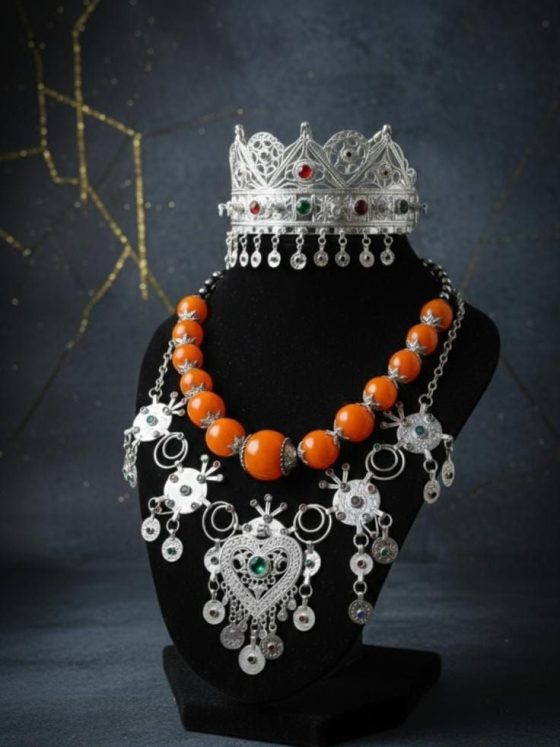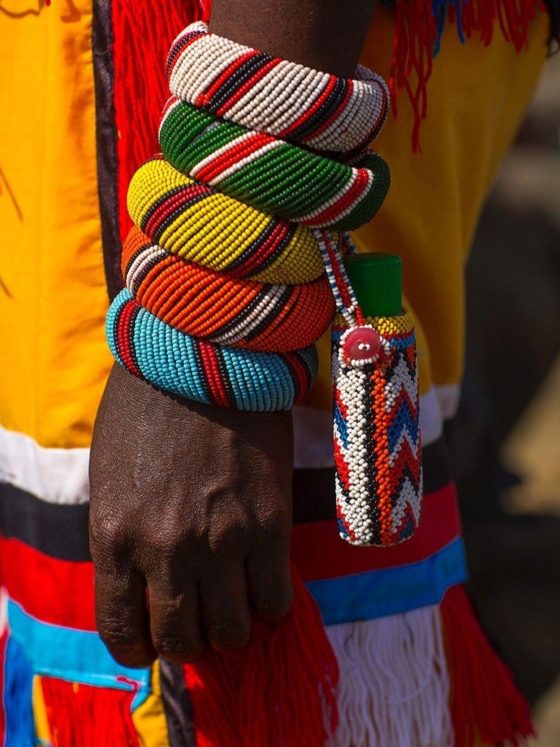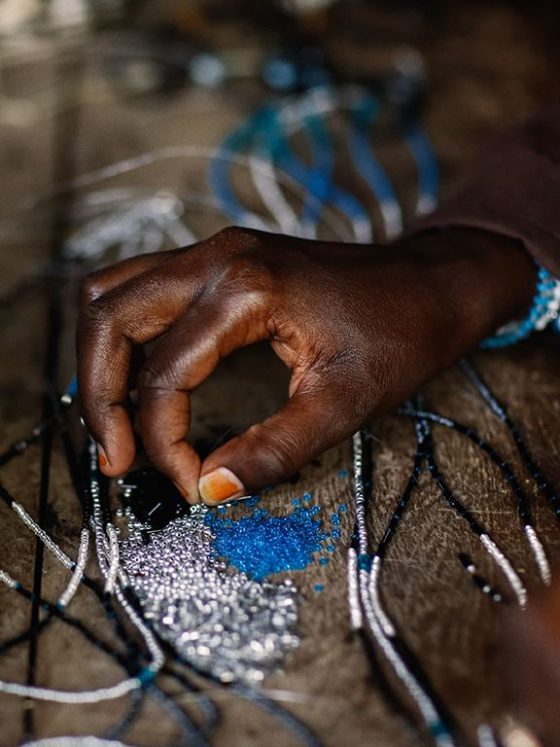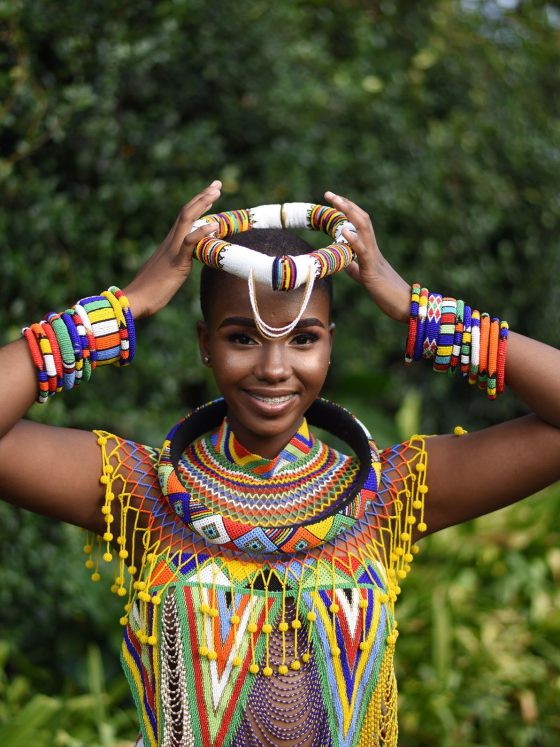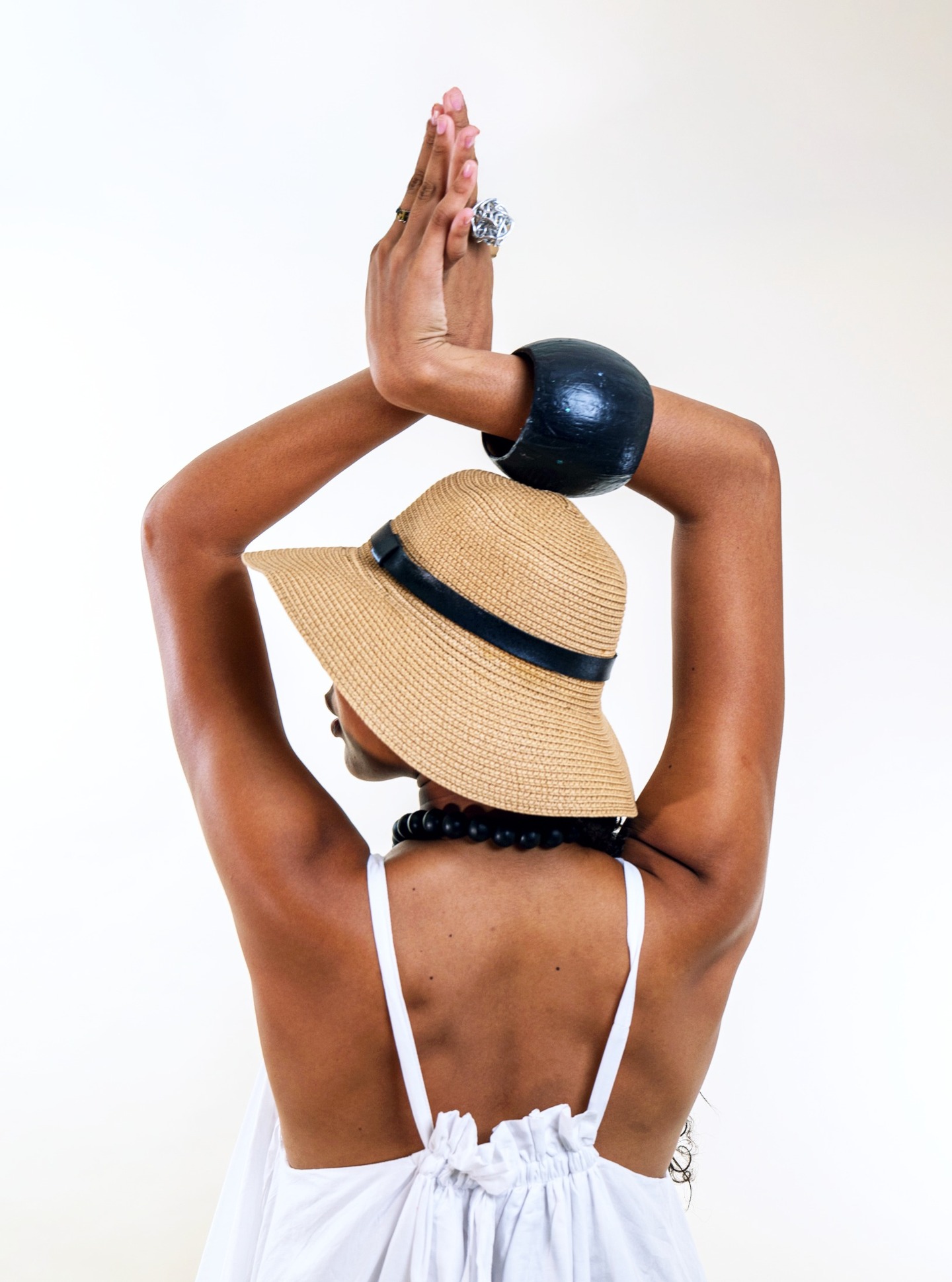
Miranda Askie’s statement “I like asymmetrical” gives her design approach a clear direction without pretending to explain every piece she makes. In Joanne C. Hillhouse’s 2021 interview, that preference appears alongside the journalist’s note that half-necklaces are a signature. The combination suggests an interest in jewellery that does not depend on an evenly centred arrangement. Before discussing an outfit, the decision about how attention might be distributed is already made. That is a firmer starting point than the familiar claim that an accessory “transforms” whatever accompanies it. Transformation needs to be demonstrated through an actual relationship between object and clothing. Askie’s practice is especially relevant to that question because she designs across categories—hillhouse documents wearing both a necklace and jacket by Askie at the Brooklyn Book Fair in 2015. Jewellery and garments were therefore not necessarily separate purchases brought together after the main decisions had been made.
The useful proposition is not that every Askie necklace must dominate. It is that the accessory can help establish the outfit’s direction from the beginning. Her published account also leaves room for the wearer to influence that decision.
Explore Miranda Askie’s approach to asymmetrical jewellery, clothing and client dialogue through a published interview and documented wearer accounts.
Dominica and Antigua Are Distinct Parts of the Story
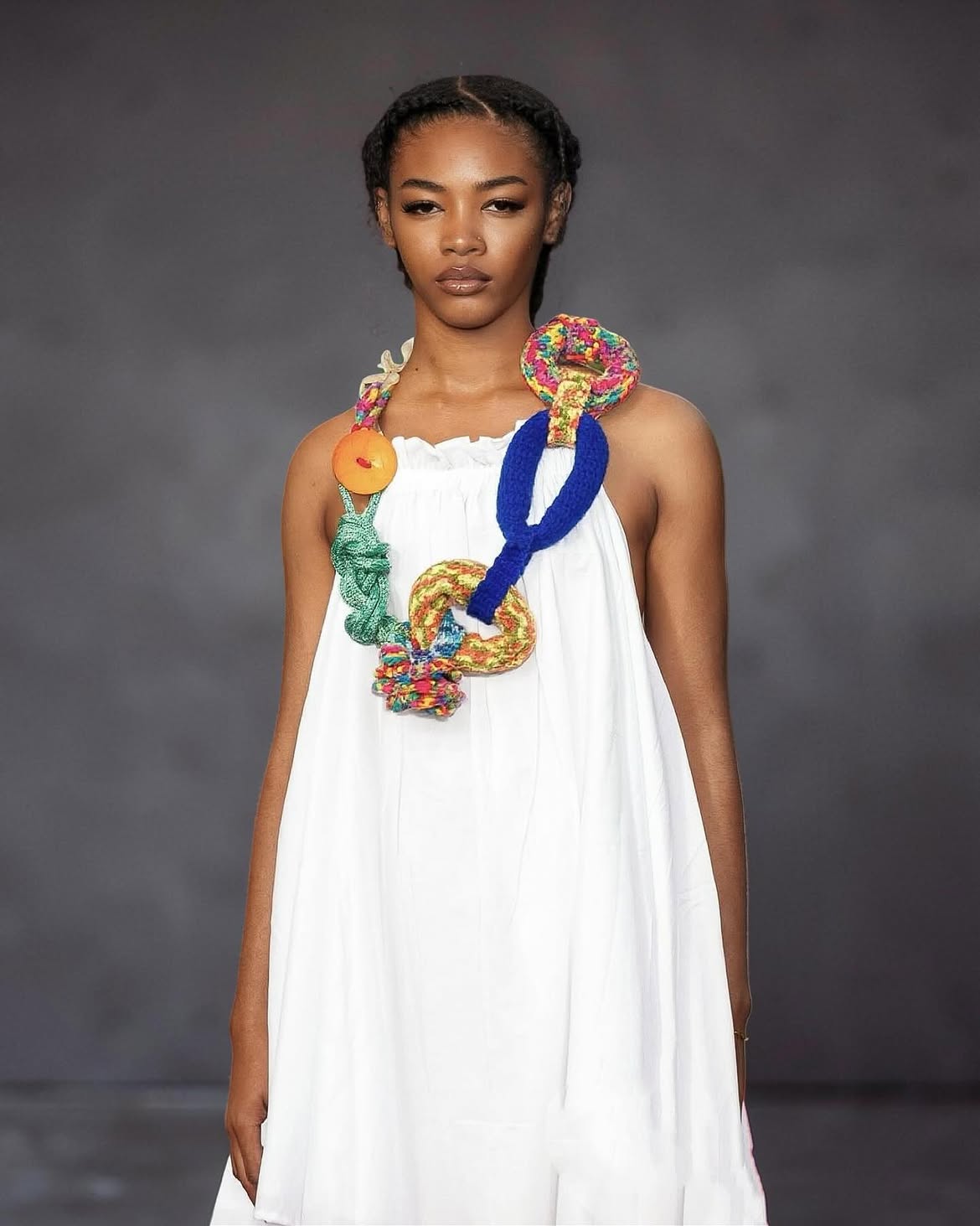
Askie is originally from Dominica and later settled in Antigua and Barbuda. Hillhouse records that Miranda and her sister and business partner, Marleen, spent their early years in Portsmouth, Dominica, where their seamstress mother encouraged their fashion games. They also grew up in Antigua, their father’s birthplace. These are connected parts of a family history, not interchangeable location labels. The distinction gives the biography sufficient precision without requiring it to explain every design. Antigua and Barbuda’s cultural directory connects Askie’s influences with nature, music and Caribbean surroundings. Those are the profile’s descriptions of her creative background. They do not establish that a particular necklace depicts a landscape or that a colour carries a specific island reference.
Her mother’s work provides another relevant context. A childhood around sewing places clothing within a practical family activity, while Askie’s later practice spans jewellery, garments and bags. It would be speculative to draw a straight technical line between those experiences. The interview establishes a background in which making, dressing, and responding to other people’s preferences were already related concerns.
Asymmetry Is More Specific Than “Bold”
Hillhouse describes Askie’s aesthetic as bold, citing her half-necklaces, colourful fabrics, and treatment of white clothing. That is the journalist’s assessment, informed by her experience of the work. Askie’s own statement about asymmetry is more precise: it identifies a preference for arrangements that need not mirror themselves across a central line. For outfit analysis, that preference directs attention towards placement. A centred necklace can reinforce the middle of a neckline; an asymmetrical arrangement raises a different question about how the eye moves around it. This is an analytical distinction, not a description of the construction of an unexamined Askie piece. “Half-necklace” alone does not tell us how an object fastens, where its weight sits or how it behaves on the body.
The term should therefore open a closer enquiry rather than stand in for one. The appropriate next question is what a particular piece does beside a particular garment. Does it create a new emphasis? Does the neckline repeat or resist that direction? The answer belongs to the complete outfit, not to the adjective “statement.”
Jewellery and Clothing Belong in the Same Conversation
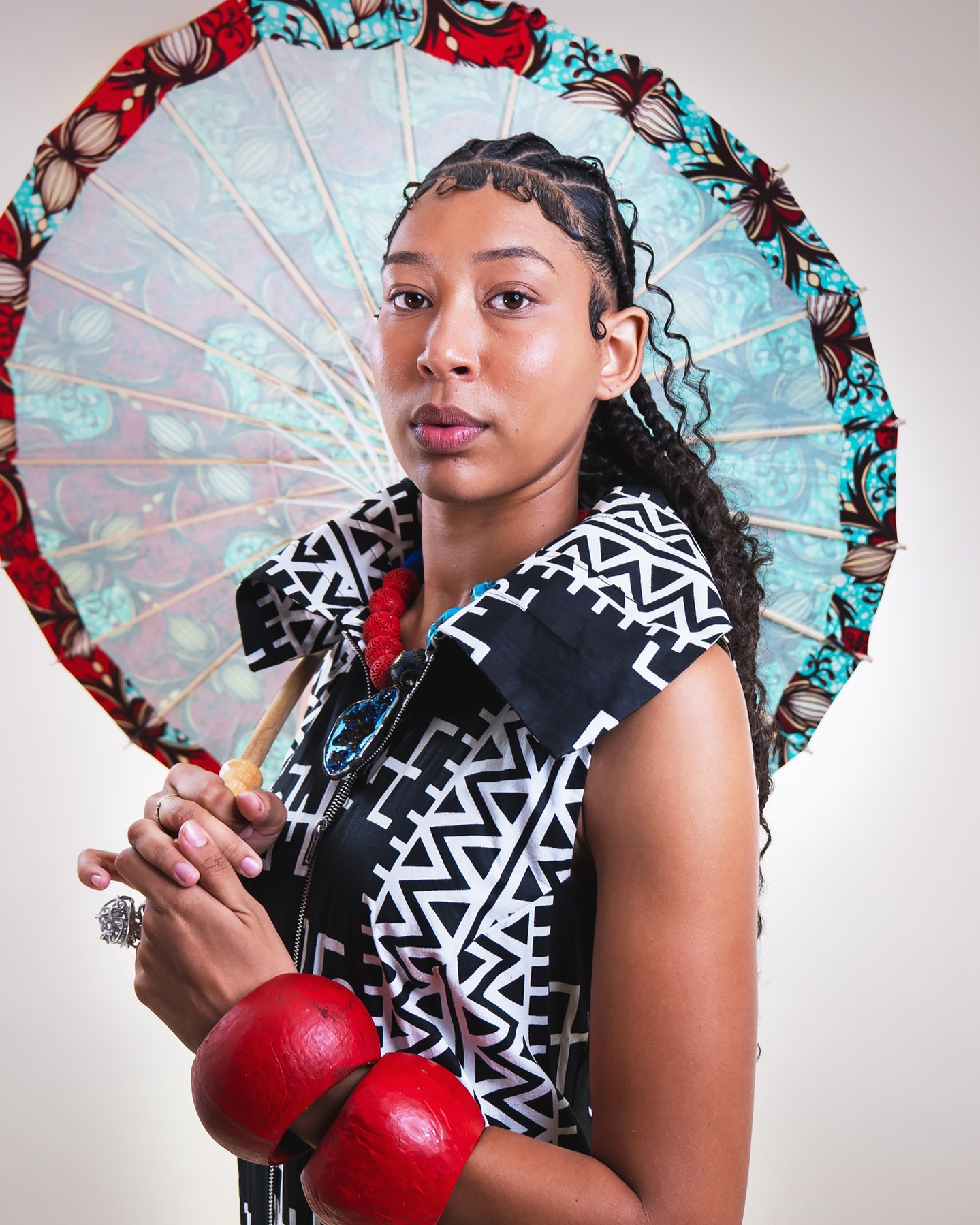
The Brooklyn Book Fair example is valuable because Hillhouse explicitly credits both the necklace and jacket to Askie. It provides a documented instance of the designer’s clothing and jewellery being worn together. The caption does not name the pieces or specify materials, and it should not be expanded into an account of their construction. It does establish an approach to dressing across categories. A designer making both elements can consider their relationship, while the wearer can choose whether to keep them paired or separate them. The outfit is not necessarily organised around a dress first and an accessory second. A necklace and jacket can be selected as a conversation between forms.
For Omiren’s purposes, this is the strongest direction the available evidence supports. It shifts attention away from generic instructions to “keep everything else simple.” Simplicity may be one successful choice, but it is not the only one. The more interesting question is whether the garment and jewellery establish a deliberate relationship, rather than whether one is sufficiently quiet to let the other lead.
A Book Launch Supplies a Different Wearer Context
Hillhouse also identifies an Askie necklace worn at the 2014 launch of her book Musical Youth. This is a second historical wearer reference, attached to a named occasion rather than a hypothetical styling scenario. It confirms the designer’s choice for that event; it does not, by itself, explain why the necklace was selected or establish the wearer’s comfort. That boundary is useful. A journalist’s enthusiasm for a designer can be genuine without becoming an independent test of every product claim. Hillhouse writes warmly about the power of Askie’s work to make women feel elegant and bold. Those observations belong to her account. They should not be converted into a universal promise that a necklace produces confidence.
The more grounded contribution is the relationship over time. Hillhouse’s examples place Askie’s work in a wearer’s public life across different occasions. That is a valuable counterweight to campaign-only presentation. Jewellery is being chosen and worn, not merely displayed as an isolated object.
The Client Is Not Absent From the Design
Askie’s interview contains two statements that are productive together: “I’m just doing me” and “I design what I think they will like.” Hillhouse reports that she sent clients photographs of new designs for feedback. The account presents a designer with a recognisable preference who is also willing to respond to the people wearing her work. Those positions need not cancel each other out. A strong aesthetic does not require every client to accept an identical scale, arrangement or combination. Equally, responsiveness does not mean that every request becomes technically possible or appropriate to the practice. The interview establishes a dialogue, not an unlimited customisation service.
This is where jewellery-led dressing becomes more useful than the idea of an accessory dictating terms. A piece can establish a starting point while the wearer determines what it must work with. The discussion might begin with an existing garment, a public appearance or an attraction to a particular form. Those are potential subjects for a commission conversation, not services confirmed by the historical interview.
Materials Must Be Attached to Particular Pieces
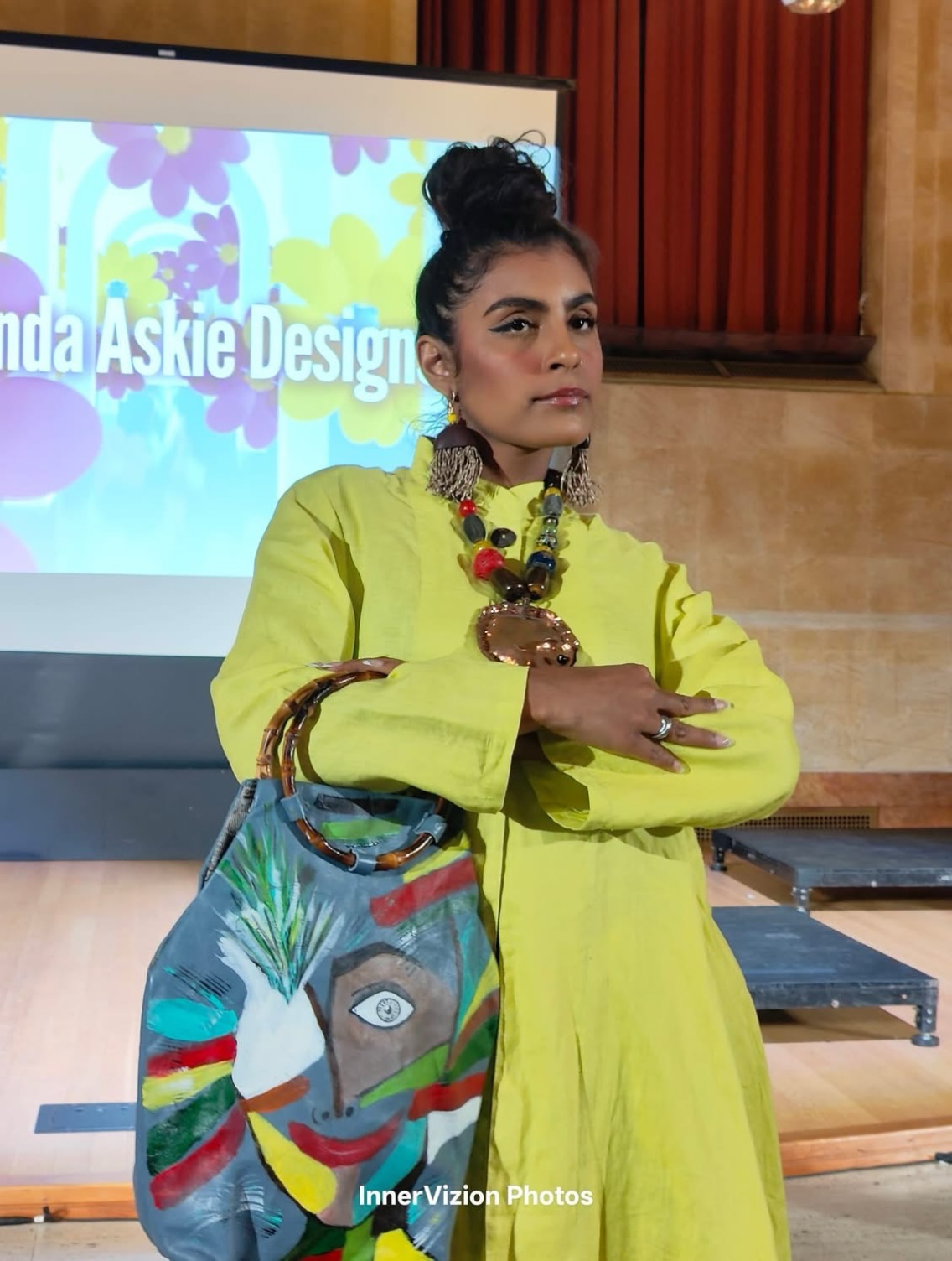
Antigua and Barbuda’s cultural-directory profile identifies off-loom beading, Precious Metal Clay and mixed media among Askie’s areas of experience. This describes the range of her practice. It does not establish the composition of the necklaces documented in Hillhouse’s photographs. The distinction should remain visible in any future piece-led review. A metallic appearance is not a verified metal specification. A bead’s colour does not establish whether it is stone, glass or another material. Likewise, a technique mentioned in a designer’s biography cannot automatically be assigned to an object without a connected source.
For a wearer or commissioner, the practical implication is specific: ask for the material, dimensions, fastening and care information for the piece under consideration. Those details support a decision about use. They should not be guessed from the word “sculptural” or from a close-up photograph.
What Askie’s Published Approach Establishes
The available evidence supports a clear account of Askie’s interests: asymmetry, work across jewellery and clothing, and a willingness to engage with client preferences. It also supplies historical examples of a writer wearing her pieces at public events. Together, those sources establish more than a promotional assertion that her accessories are distinctive. They do not yet support a full judgement of individual necklaces through verified scale, materials and construction. That assessment would require closer object documentation. The distinction matters because the strongest feature of the current record is the relationship between designer, clothing and wearer, not a catalogue of technically examined pieces.
Within that scope, Askie’s proposition remains worthwhile. Jewellery need not wait until the rest of the outfit is finished. It can set the direction for other choices. But the wearer remains part of the composition, and the most useful design relationship is negotiated rather than simply imposed.
The Omiren Argument
The principle is relationship. Jewellery determines an outfit most meaningfully when it helps establish a deliberate arrangement between object, garment and wearer, not when it is praised as an automatic finishing touch.
Askie’s preference for asymmetry and her work across clothing and accessories offer a specific route into that question. The necklace can begin the conversation. The outfit is resolved through what answers it.
Also Read:
- The Wob Dwiyet: Dominica’s National Dress and the French Creole Tradition Behind It
- How Stylists Turn One Garment into Multiple Visual Narratives
- Why Your Jewellery Should Have A Provenance, Not Just A Price
- Accessories That Carry Our History: Bags and Jewellery as Living Heritage
Frequently Asked Questions
Is Miranda Askie from Dominica or Antigua and Barbuda?
She is originally from Dominica and later settled in Antigua and Barbuda. Hillhouse’s account connects her family history and upbringing with both places: she and her sister Marleen spent early years in Portsmouth, Dominica, and also grew up in Antigua, their father’s birthplace.
Does she design clothing as well as jewellery?
Yes. The 2021 interview describes work across jewellery, clothing and bags. Its accompanying notes identify an occasion when Hillhouse wore both an Askie necklace and jacket at the Brooklyn Book Fair in 2015, documenting the two being worn together.
Does the interview establish her current services?
Not by itself. The interview was originally published in January 2021 and later republished. Current commissions, visiting arrangements and product availability require direct confirmation rather than assumptions from that historical account, which does not describe a verified current collection. Treat any current offer as unconfirmed.
Which materials does the record attach to her work?
Antigua and Barbuda’s cultural-directory profile identifies off-loom beading, Precious Metal Clay and mixed media among her areas of experience. That describes the range of her practice, not the composition of any particular necklace, so request material, dimensions, fastening, and care details for the piece under consideration.