In May 2025, the guayabera reached 100 on Google Trends, its highest recorded global search interest. The coverage that followed treated it as a seasonal fashion moment: a resort shirt having a good summer. What almost none of that coverage mentioned is that in Cuba, the guayabera is not a resort shirt. It has not been a resort shirt since at least 2010, when Fidel Castro formally reinstated it as the official formal dress garment of the Cuban state, requiring government officials to wear it in place of the Western suit. A shirt that the global fashion press discovered in May 2025 has been doing serious political and cultural work for well over a century. The discovery is the problem, not the solution.
The guayabera is a men’s shirt worn outside the trousers, distinguished by two or four patch pockets and vertical rows of alforzas, fine pleats sewn closely together, running the length of the front and back. Typically made from linen, silk, or cotton, it is the standard formal dress in Cuba, the Dominican Republic, Puerto Rico, and Mexico for occasions that in Europe or North America would require a suit and tie. Weddings, funerals, business meetings, state functions, and presidential summits have all been conducted in guayaberas by heads of state and heads of families alike. The garment is not casual. It is the alternative to casualness that an entire cultural region was built specifically because the Western suit was never designed for this climate, this history, or these people.
The Guayabera peaked at 100 on Google Trends in May 2025. The world calls it resort wear. Cuba made it an official formal dress in 2010. This article explains the difference.
A Shirt Worn Outside the Trousers, and Why That Matters
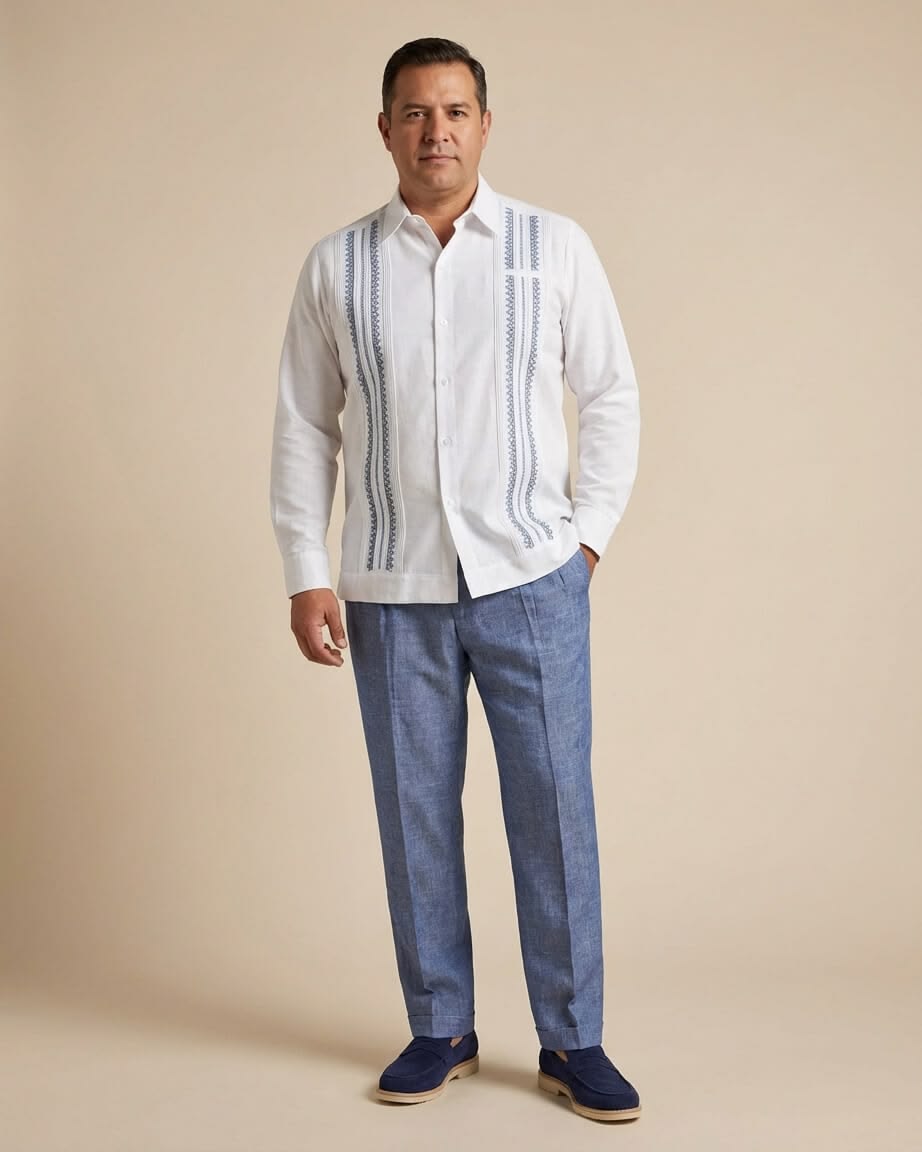
The guayabera’s defining construction decision is that it is worn untucked. The straight hem and side vents are designed specifically for this: tucking it in hides the alforzas detail at the shirt’s hem and eliminates the airflow the garment was built to provide. This is not casualness. It is a climate-specific formal convention that the Caribbean developed in direct response to conditions that the European dress code was not designed for. The tropical humidity of Havana, San Juan, and Santo Domingo makes the wool suit a form of institutional punishment. The guayabera is what formal dress looks like when it is designed by and for the people who actually live where it will be worn.
The alforzas themselves are the garment’s primary marker of quality and occasion. Fine, pin-tucked pleats that stretch like an accordion distinguish a properly made guayabera from an imitation. Long-sleeved guayaberas are considered more formal than short-sleeved ones and are worn for evening weddings and official functions. The pockets, typically four, arranged as two at the chest and two at the hip, carry the garment’s most contested origin story: that a Cuban farmer’s wife sewed them onto her husband’s shirt so he could carry guavas from the field. Whether or not that story is accurate, the pockets became a design signature serious enough that they appear on the guayaberas worn by presidents at international summits. The utility is still there. The formality grew around it.
“The guayabera is what formal dress looks like when formal dress is designed by and for the people who actually live in the place where it will be worn. That is not a minor distinction.”
Cuba, 2010: When a Shirt Became State Policy
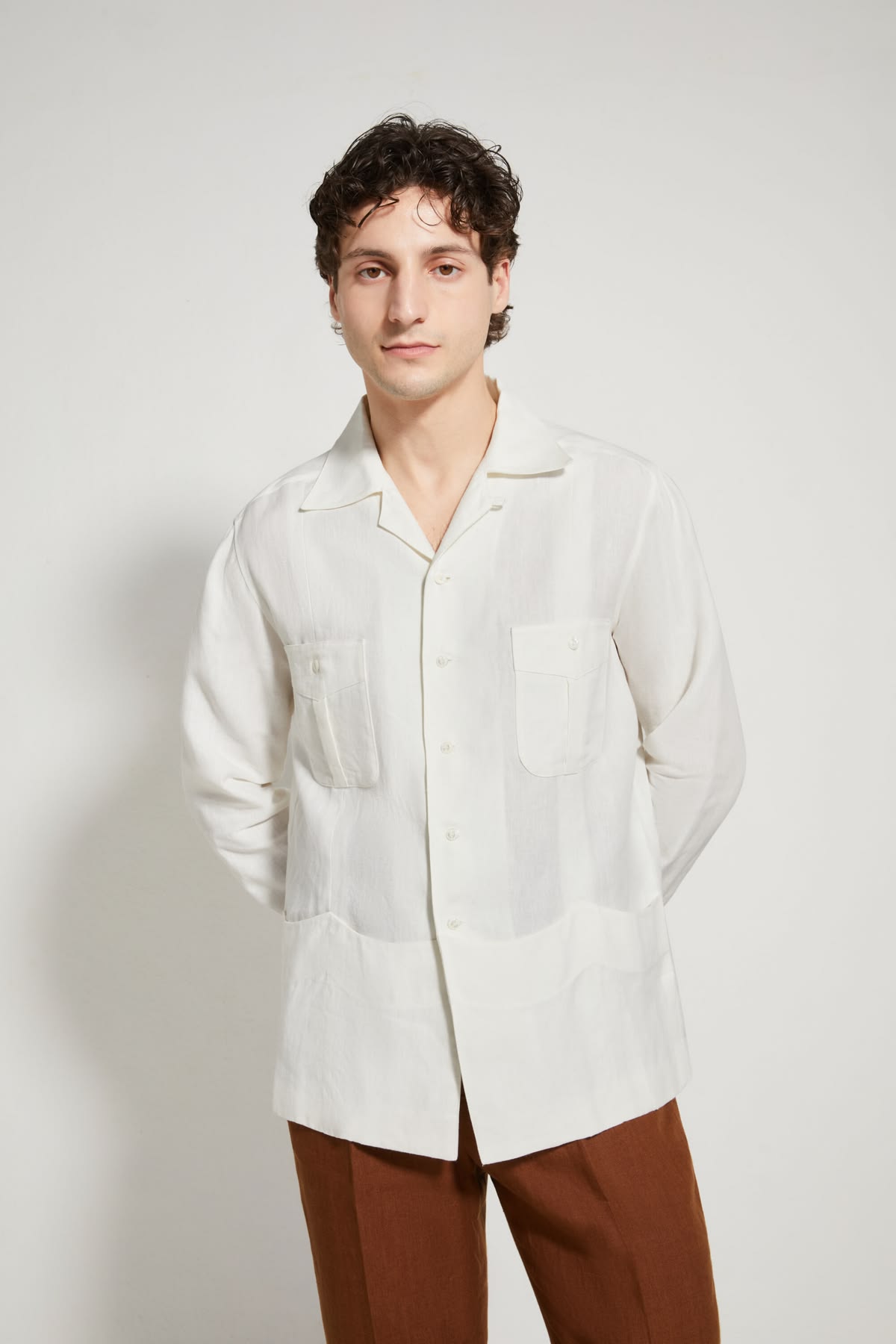
In 2010, Fidel Castro reinstated the guayabera as Cuba’s official formal dress garment. Government officials were required to wear it in place of the Western business suit at official functions. The reinstatement was not a nostalgic gesture. It was a political statement, continuous with a long history of the guayabera being used as a tool of ideological positioning. Castro himself wore guayaberas throughout his public life as a deliberate statement about Cuban identity and his rejection of European sartorial conventions. The shirt he wore was not the tropical casualwear version sold by the global fashion market. It was a formal garment worn in formal contexts, with the full cultural weight of its occasion-specific tradition intact.
Cuba’s official reinstatement of the guayabera as state dress sits within a broader pattern of Latin American leaders using the shirt as a political instrument. Andrés Manuel López Obrador, César Chávez, and Carlos Prío Socarrás all wore guayaberas as signals of populist affiliation and of connection to Caribbean and Latin American identity rather than to European dress conventions. The shirt, in these contexts, reads as a rejection of the suit-and-tie as the uniform of institutional authority. When Barack Obama wore a guayabera at a Latin American summit, and when Ronald Reagan wore one visiting the Cuban-American community in Miami in 1983, both were reading the garment’s political vocabulary and using it deliberately. The resort industry that markets the guayabera as tropical casualwear has stripped that vocabulary out entirely.
The Chacabana: How the Dominican Republic Made It Its Own
In the Dominican Republic, the guayabera is called the chacabana, and it is worn for black-tie events: weddings, business meetings, political functions, and funerals. The distinction between a casual shirt and a formal garment does not exist in the way it does in North American or European dress culture. The chacabana is formal by definition. A Dominican man wearing a chacabana to a wedding is not dressing down. He is dressed correctly, by the standard of his own culture’s dress code, for the occasion. The fact that a Northern European or American observer might read the same garment as informal reflects a failure of the observer’s cultural literacy, not a deficiency in the garment’s formality.
The Dominican liberator Máximo Gómez is said to have brought the guayabera from the Dominican Republic to Cuba when he went to support the Cubans in the War of Independence in 1868, a claim that sits alongside the Cuban and Yucatán origin stories in what is frankly a hotly contested and unresolved historical debate. What is not contested is that the chacabana has been embedded in Dominican formal dress culture for generations, worn at the country’s most significant personal and political occasions. The global fashion coverage that treats the guayabera as a summer trend does not mention the Dominican state funeral at which chacabanas were worn. It mentions the resort collection that referenced the pleats.
Michael Manley wore it as an anti-colonial dress. The JLP banned it.
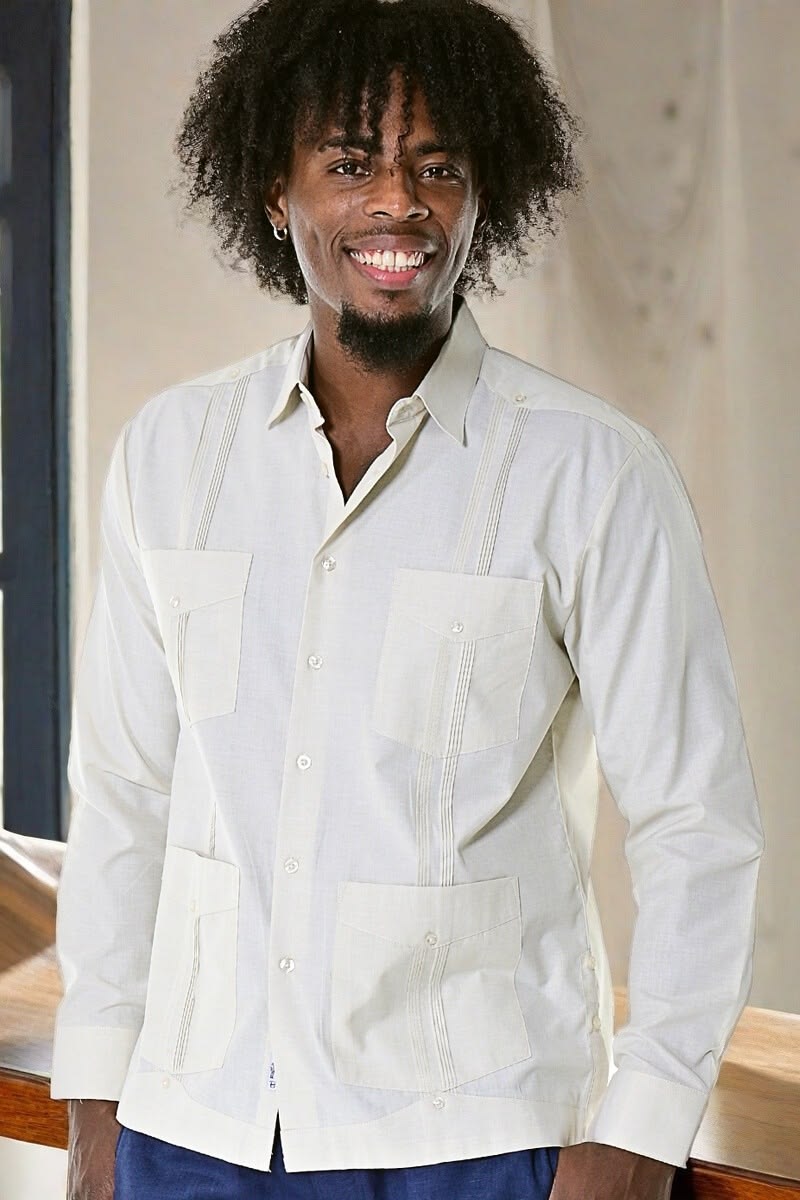
The most direct political use of the guayabera outside Cuba came from Jamaican Prime Minister Michael Manley, the democratic socialist leader who served from 1972 to 1980 and again from 1989 to 1992. Manley specifically advocated for the guayabera as an anti-colonialist mode of dress, positioning it as a deliberate rejection of the British suit that colonial governance had imposed as the standard for Caribbean professional life. For Manley, wearing a guayabera was a statement about whose dress conventions Caribbean men were obligated to follow, and the answer was their own.
The conservative Jamaica Labour Party, which succeeded Manley’s People’s National Party in government, banned the guayabera from Parliament. The political reading of the garment was explicit enough that its prohibition was understood as a rejection of what Manley had used it to represent. A shirt was banned from the legislature because of its message. That is not a garment that functions as resort wear. That is a garment that carries enough political charge to require legislative suppression. The resort industry that sells the guayabera as a beach holiday purchase has never once engaged with this history. It would considerably complicate the.
Also Read:
- West African Menswear: The Tailoring Tradition That Preceded Savile Row
- How African Men Are Reclaiming the Suit — And Redefining Global Tailoring
The Origin Story the Tourism Industry Prefers
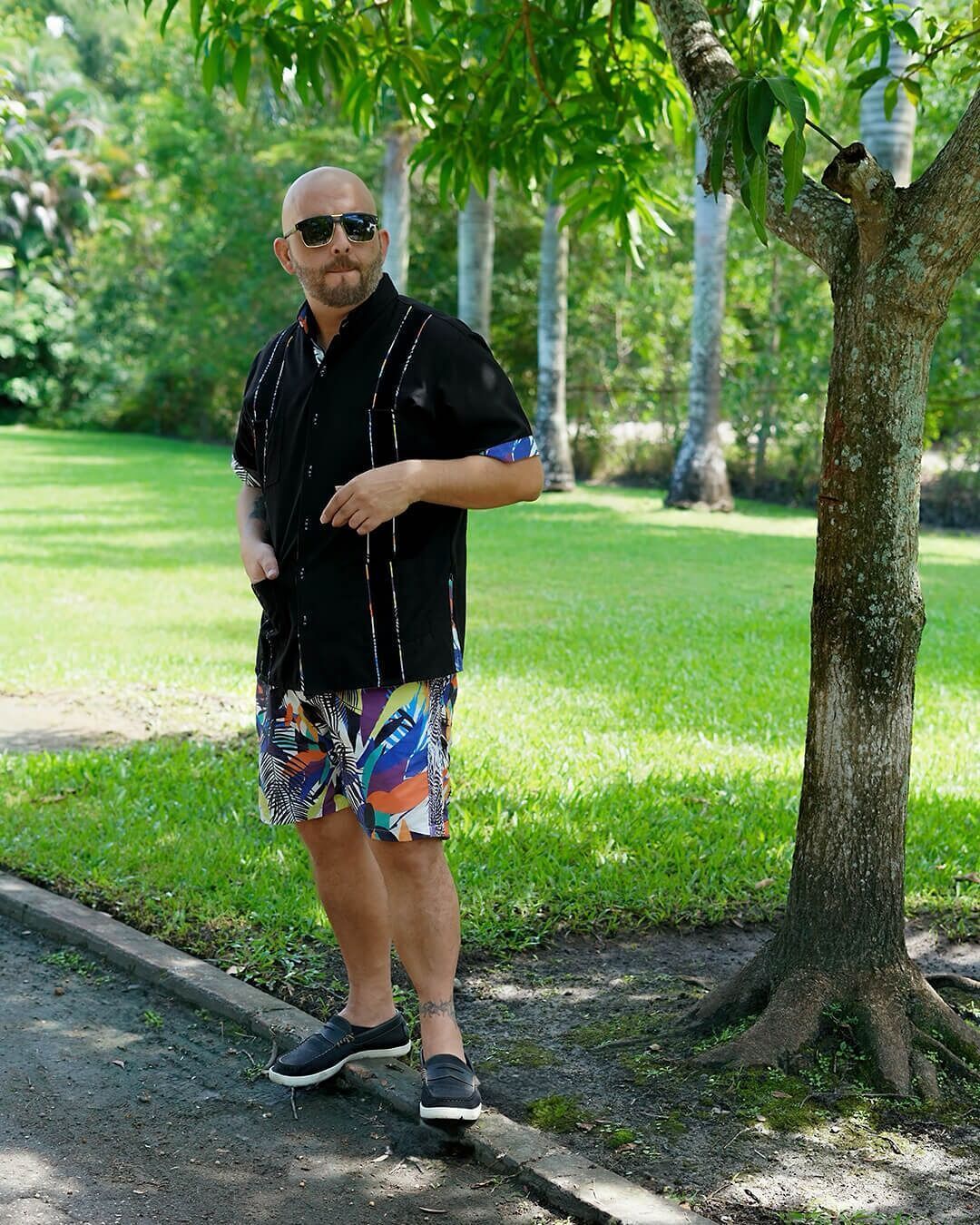
The most widely circulated origin story for the guayabera involves a Spanish immigrant farmer in eighteenth-century Sancti Spiritus, Cuba, whose wife sewed four pockets onto his work shirt so he could carry guavas from the field. The shirt spread from there because of its practicality and elegance. This story is appealing, repeatable, and positions the garment’s inventors as rural, white, and Spanish, a configuration that historian Marilyn Miller, writing in The Latin American Fashion Reader, and the Calle Ocho News have both identified as reflecting the post-independence Cuban policy of blanqueamiento, a deliberate political project of racial whitening that included the legal prohibition of Black immigration to Cuba in 1902 and the romanticisation of the white Cuban guajiro farmer as a cultural symbol.
The guayabera’s actual cultural history is considerably more complex. Cuba claims it; Mexico’s Yucatán Peninsula and Veracruz; the Dominican Republic; the Philippines (where the barong tagalog shares structural similarities); and several other countries. The HistoryMiami Museum’s 2019 exhibition, The Guayabera: A Shirt’s Story, addressed these contested origins directly, concluding that no single person invented the guayabera but that it evolved across multiple communities and trade networks. The tourist-friendly Cuban farmer origin story is one layer of that history. It is not the whole of it, and presenting it as such performs the same erasure that blanqueamiento was designed to achieve.
What the 2025 Trend Cycle Missed
When the guayabera peaked at 100 on Google Trends in May 2025, the fashion coverage that followed was almost uniformly contextless. Resort collections referenced the alforzas pleating as a texture detail. Menswear publications ran buying guides positioning the shirt as a summer holiday essential. None of this coverage mentioned that Cuba had reinstated the guayabera as official state dress in 2010. None of it mentioned Michael Manley or the JLP ban. None of it engaged with the chacabana’s status as formal wear at Dominican Republic black-tie events. The coverage treated the garment as an aesthetic object that had arrived in fashion from nowhere in particular, available for seasonal use and summer wardrobing.
That treatment is the specific problem this article names. A garment with a documented political history, a state-level formal status in multiple countries, a role in anti-colonial dress advocacy, and a legislative ban on its record does not become resort wear when the global fashion press discovers it. It remains what it has always been: formal dress, political dress, professional dress, occasion-specific dress, built by and for the Caribbean and Latin American cultures that have been using it on their own terms for two centuries. The resort industry’s discovery of the guayabera in May 2025 changed nothing about what the guayabera actually is. It only added another layer of misrepresentation that needs to be corrected.
OMIREN ARGUMENT
The guayabera is a case study in what happens when the global fashion industry encounters a garment it cannot locate within its own reference system. It does not recognise the guayabera as formal dress, because in the industry’s dominant vocabulary, formal dress means the Western suit. It does not recognise the guayabera as political dress, because political dress in that vocabulary means European state ceremony. So the industry places the guayabera in the only category it can find for a lightweight shirt worn outside the trousers in a warm climate: resort wear.
This categorisation is not neutral. It strips the garment of its function, its history, and its political charge, and it positions Caribbean and Latin American dress conventions as a relaxed version of the formal conventions that actually matter, which are understood to belong elsewhere. The guayabera is not the Caribbean’s version of casual. It is the Caribbean’s version of formal, built on the Caribbean’s own terms, for the Caribbean’s own climate, carrying the Caribbean’s own political history. Cuba reinstated it as an official state dress in 2010. Jamaica banned it from Parliament because it said something the government did not want said. Dominican presidents wear it to funerals. The resort industry is the last institution that should be telling this garment what it means.
Frequently Asked Questions
- What is a guayabera?
A guayabera is a men’s shirt worn outside the trousers, distinguished by two or four patch pockets and vertical rows of alforzas, fine pleats sewn closely together, running the length of the front and back. Typically made from linen, cotton, or silk, it is the standard formal attire in Cuba, the Dominican Republic, Puerto Rico, and Mexico for occasions that, in Western contexts, would require a suit and tie. In Cuba, it was reinstated as the official formal dress in 2010. It is also known as the chacabana in the Dominican Republic, the camisa de Yucatán in Mexico, and the bush jacket in Jamaica.
- Where does the guayabera shirt originate?
The guayabera’s origin is contested across multiple countries. The most widely circulated story traces it to eighteenth-century Sancti Spiritus, Cuba, where a Spanish immigrant farmer’s wife is said to have added four pockets to his work shirt for carrying guavas. Mexico’s Yucatán Peninsula and Veracruz make competing claims, and structural similarities to the Philippine barong tagalog suggest possible connections via the Manila-Acapulco galleon trade. The Dominican Republic’s claim includes the story that the liberator Máximo Gómez brought the shirt from the Dominican Republic to Cuba during the War of Independence in 1868. The HistoryMiami Museum’s 2019 exhibition concluded that no single inventor existed and that the garment evolved across multiple communities and trade networks.
- Is the guayabera formal or casual dress?
In Cuba, the Dominican Republic, Puerto Rico, and Mexico, the guayabera is formal dress. Cuba reinstated it as the official formal dress garment of the state in 2010. In the Dominican Republic, where it is called the chacabana, it is worn at weddings, funerals, business meetings, and political events that elsewhere would require a suit and tie. A long-sleeved guayabera is considered more formal than a short-sleeved version and is worn for evening occasions and official functions. The categorisation of the guayabera as casual or resort wear is a North American and European market convention that does not reflect the garment’s function in the cultures that built it.
- Why did Fidel Castro wear the guayabera and make it Cuba’s official shirt?
Castro wore guayaberas throughout his public life as a deliberate rejection of the Western business suit as the standard of institutional authority. In 2010, he formally reinstated the guayabera as Cuba’s official formal dress garment, requiring government officials to wear it in place of the Western suit at official functions. The decision was continuous with a long tradition of Caribbean and Latin American leaders using the guayabera as a statement of cultural and political identity. Other leaders who wore guayaberas as political signals include Andrés Manuel López Obrador, César Chávez, and Michael Manley of Jamaica, who explicitly described it as anti-colonialist dress.
- Why was the guayabera banned from Jamaica’s Parliament?
Jamaican Prime Minister Michael Manley, who served from 1972 to 1980 and again from 1989 to 1992, specifically advocated for the guayabera as anti-colonialist dress, positioning it as a rejection of the British suit that colonial governance had imposed as the standard for Caribbean professional life. When the conservative Jamaica Labour Party came to power, it banned the guayabera from Parliament. The ban was a direct political response to what Manley had used the garment to represent: Caribbean cultural autonomy and rejection of European dress as the standard of authority. The political charge was explicit enough to warrant legislative suppression.
- What are alforzas and why do they matter?
Alforzas are the fine vertical pleats, typically ten sewn closely together, that run down the front and back of a guayabera. They are the garment’s primary quality marker and its most distinctive visual feature. Properly made alforzas stretch like an accordion, a characteristic that distinguishes a genuine guayabera from an imitation. The pockets of a well-made guayabera feature alforzas identical to those on the body of the shirt and aligned with them, requiring precision in construction. Long-sleeved guayaberas with fine alforzas in white or ivory linen are considered the most formal version of the garment and are worn for the most significant ceremonial occasions.