In Montevideo’s Barrio Sur, Palermo, and Cordón neighbourhoods, the llamada begins before you see it. The chico, repique, and piano drums of the cuerda de tambores are audible from streets away. One rhythm answers another. One comparsa calls; another responds. The sound pulls people toward the route along Isla de Flores. When the procession arrives, it is a complete visual system: flag bearers opening the march, ancestral character figures behind them, the vedette catching the light, the drummers in coordinated attire, the Escobero clearing the path with his broom. The drum is the centre. The wardrobe is the drum’s argument made visible.
The African fashion and beauty market is part of the continent’s 31-billion-dollar economy. The Afro-Uruguayan Candombe tradition belongs to a different category of fashion documentation: not luxury or ready-to-wear but the dress of a community that survived enslavement and built its most significant cultural institution through public, embodied, intergenerational practice. As the Candombeando. u y primary documentation of the llamada de tambores confirms, the llamada is the most important and representative manifestation of Candombe drumming: a large group of drummers playing the characteristic ritmo de llamada while marching through the streets. The costume that surrounds and accompanies those drums is not decoration. It is argument. Each character figure makes a specific historical claim about Afro-Uruguayan identity.
The Gramillero’s coat, the Mama Vieja’s fan, the Escobero’s broom: each Candombe character carries a historical argument about Afro-Uruguayan public life.
The Comparsa as Costume System
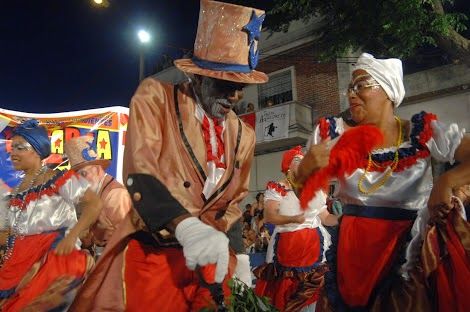
A Candombe comparsa is a coordinated social and visual system. Drummers, dancers, flags, banners, character figures, organisers, designers, and musicians form a collective body. The wardrobe helps distinguish each role while creating the overall band identity that the comparsa presents to the street and to its audience. As documented in Uruguay’s Ministry of Tourism’s Candombe, each comparsa opens with a banner symbolising the emblem of the tribe or ethnic group, featuring stars and crescent moons; the dance troupe and ancestral characters follow. There are 80 to 90 comparsas in existence. Each presents its own coordinated visual language. The costume system holds multiple decisions simultaneously: which colours identify the band, which materials respond to the drum’s rhythm, which character figures appear and in what sequence, and how the full visual composition reads from the road.
Candombe’s three mother rhythms are associated with three specific neighbourhoods: toque de cuareim from Barrio Sur (slower), toque de ansina from Palermo, and toque de cordón from Barrio Cordón (faster, developed by the Pintos brothers in the mid-20th century). The costume tradition that has developed within these neighbourhoods reflects the specific social histories of each community. Costume is not applied from outside to a neighbourhood that was already doing something else. It emerged from the same social world as the drums, the characters, and the routes.
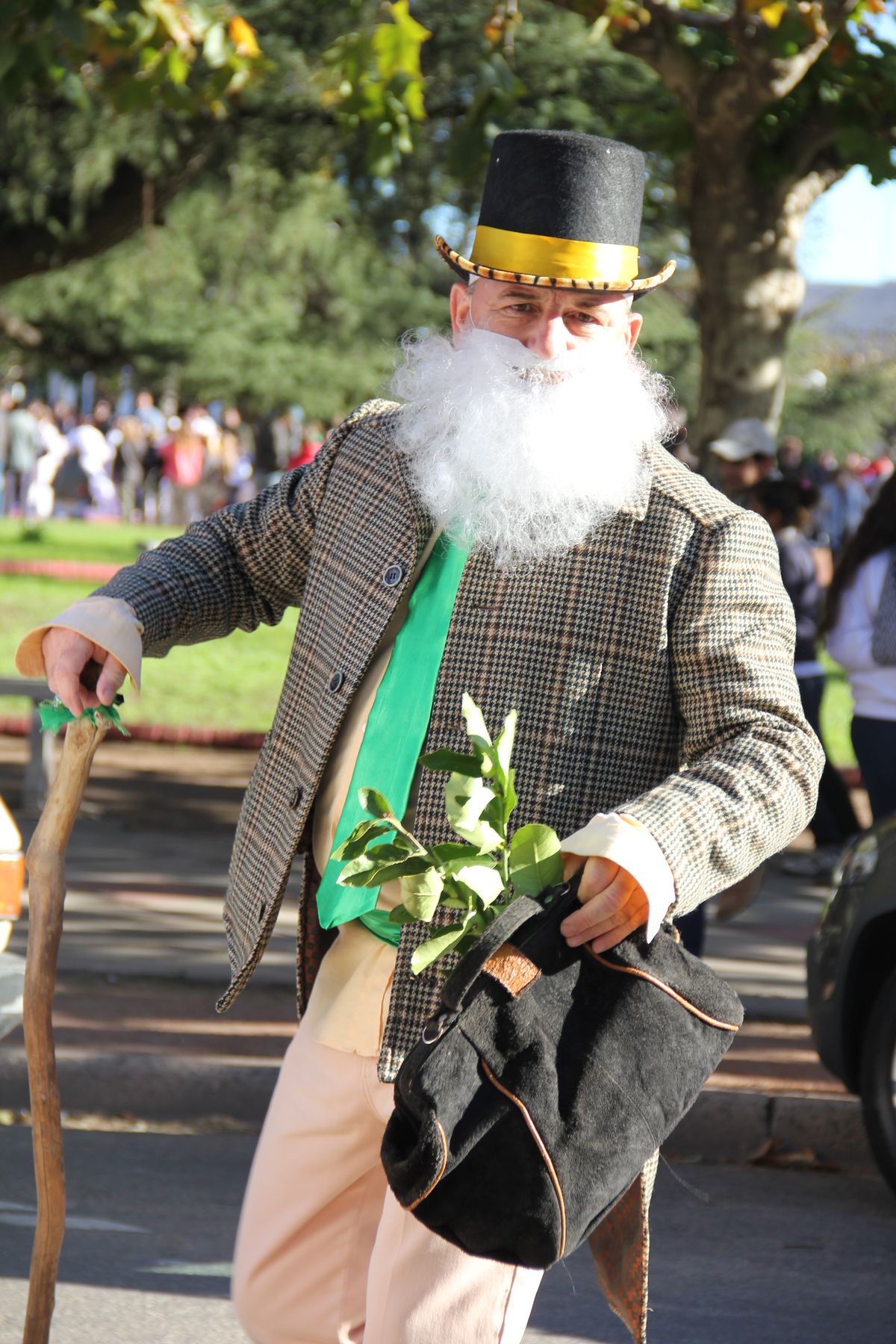
The Gramillero wears a frock coat and a top hat. He carries a cane. He has a white beard and glasses. This is the visual language of colonial authority. He also carries herbs in a case. He wobbles, bent over his cane. He heals. The formal dress does not make him a colonial gentleman. It makes him an argument: African-descended healing knowledge wearing the coloniser’s aesthetic and using it to carry something the coloniser spent centuries trying to erase.
The Gramillero: Formal Dress as Reoccupation
The Gramillero is among the most precisely documented character figures in Candombe. As the World Music Central documentation of Afro-Uruguayan Candombe confirms, the gramillero (herb man) represents the healer of the African peoples, carrying weeds in a bag or briefcase. His cane or baton, traditionally used by male elders, represents a commanding role. Additionally, the gramillero traditionally wears a top hat. What WFMT’s documentation adds is the bodily performance: the Gramillero wobbles, bent over his cane, while the Mama Vieja dances gracefully beside him. The Uruguayan Ministry of Tourism confirms the full costume: frock coat, top hat, cane, glasses, and white beard with a suitcase full of healing herbs.
The formal clothes carry a contradiction. The frock coat and top hat evoke European respectability, colonial authority, and the social image of the respectable elderly gentleman. But the Gramillero does not simply reproduce that figure. He redirects it. The herbs establish a different authority: the authority of healing, plant knowledge, elderhood, and African-descended community memory. His theatrical wobble and bent posture add another layer: the performance knowingly plays with the figure of colonial respectability rather than straightforwardly inhabiting it. The costume is formal. The performance is subversive. What colonial society tried to dismiss as primitive healing, the Gramillero brings into the most public space possible, dressed in the clothes colonial society reserved for its most respectable men.
The Mama Vieja: Elder Authority and Community Memory
The Mama Vieja is the matriarchal figure of the Candombe procession: the elder spiritual guide and the wisest woman in the community, as described by World Music Central. Her costume, confirmed across multiple sources, includes brightly coloured clothes, a fan, a parasol, and sometimes a headscarf and apron. She dances slowly, almost flirtatiously, with the Gramillero. Her fan draws him away from younger dancers. Her parasol extends her gestural vocabulary, making the hands the instruments of both performance and character.
One of the most significant documented facts about the Mama Vieja is that young female dancers have played this elder woman character for over half a century. The character’s elderhood and the performer’s age are therefore not the same thing. A young woman playing the Mama Vieja learns the character’s movement vocabulary, her relationship to the Gramillero, her role in the procession’s social architecture. That intergenerational transmission of the character across a half-century of young female performers is itself a form of community memory in practice: younger women learning what elder women carry, through the body and the costume.
The Mama Vieja should not be reduced to a comic older woman. As WFMT’s documentation of Candombe’s history confirms, the Mama Vieja was the matron in elite homes during colonial times, dancing gracefully while fanning herself. That colonial domestic position is what the character carries into the public space of the llamada: the elder woman whose labour sustained elite colonial households, reclaimed as a figure of community matriarchal authority in the African-descended neighbourhood’s most significant public ceremony.
The Escobero: The Broom That Clears the Road
The Escobero is the figure who leads the drums down the street. His instrument is not a drum or a fan but a broom: a small broom or decorated staff that he uses in acrobatic, sweeping, and spinning movements as he guides the cuerda de tambores along the route. The Uruguayan Ministry of Tourism’s documentation explains that the Escobero originally guided the drums during the parade with a cane; today he dances with a small broom, moving in time with the rhythm of the drums. The Upscape documentation adds another dimension: the Escobero sweeps away evil.
The broom is one of the most significant costume props in Afro-diasporic performance traditions because it transforms the most ordinary domestic labour tool into an instrument of spiritual preparation, ritual authority, and public performance. The Escobero does not simply walk ahead of the drums. He transforms the street. The road that the broom touches is no longer an ordinary city street. It is the prepared ground for the llamada. The costume that accompanies this work must allow the body to bend, spin, throw the broom, catch it, and maintain rhythm with the drums advancing behind. Leather, flexible materials, and costume elements that emphasise movement rather than restrict it are the functional requirements of a successful Escobero costume.
The Vedette: Visibility and Labour
The vedette is a later addition to the Candombe procession than the three ancestral character figures. The Uruguayan Ministry of Tourism documentation describes striking vedettes as part of the contemporary comparsa. Her costume typically includes feathers, rhinestones, sequins, decorated bodices, headpieces, and elements designed to catch light and make the dancer’s movement legible across a crowded street.
The vedette’s role developed partly through entertainment traditions shaped by external cultural influences and by the male gaze on the female dancer’s body. Contemporary vedettes are not passive displays. They are skilled performers managing rhythm, stamina, balance, choreography, costume weight, and public attention simultaneously. Wearing feathers and rhinestones does not reduce the work to beauty. The body in a vedette costume is labouring: maintaining balance with the significant weight of the headpiece, managing the physical demands of an extended performance in a heavy costume, and sustaining the visual impact the comparsa’s presentation requires. The question of creative authority, professional recognition, and fair payment for this labour is the question the vedette’s presence raises that the most spectacular costume photographs do not answer.
Drummers: The Functional Wardrobe
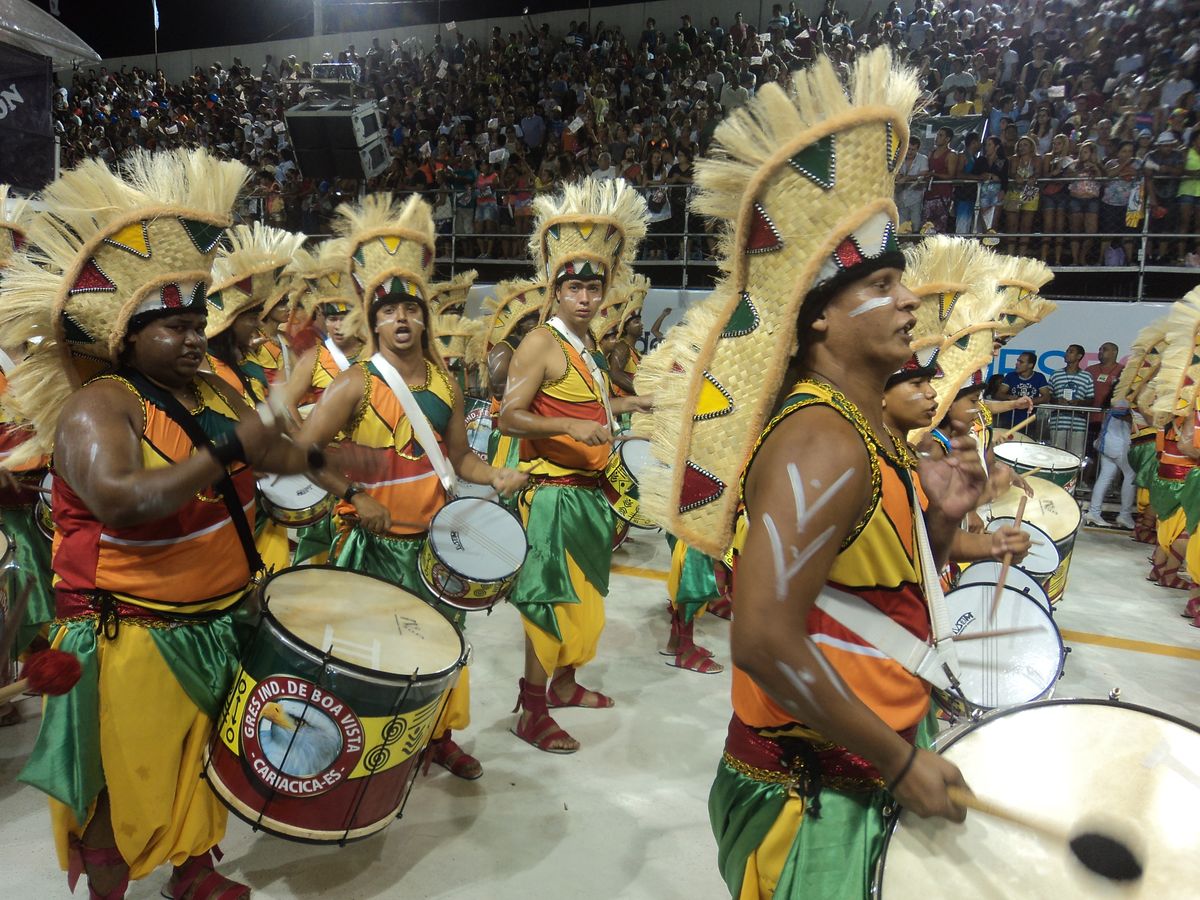
The drummers who form the cuerda de tambores wear less visually elaborate costumes than the ancestral character figures, but their wardrobe is no less specifically designed. The drum sits against the body. Playing requires continuous use of the shoulders, arms, chest, back, and legs. Clothing must allow this motion while identifying the wearer’s comparsa. As Omiren Styles’ documentation of the African origins of carnival costume confirms, across African diasporic festival traditions, the drum and the dressed body function as a single instrument: the player’s visual identity is inseparable from the sound they produce. A Candombe drummer in coordinated comparsa attire is not wearing a uniform that was designed separately from the musical performance. The vest, hat, neckerchief, and band-specific colours that identify the drummer are part of the same design system that gives the llamada its collective visual coherence.
The drummer’s wardrobe proves that Candombe dress is not only about spectacle. A garment that prevents a drummer from playing is not a successful Candombe garment, regardless of how striking it looks in a photograph. The functional constraint is the design brief. The vest that allows freedom of shoulder movement, the hat that does not obstruct peripheral vision, the trousers that permit the full range of leg and hip engagement required for hours of continuous drumming: these are the performance requirements that the Candombe drummer’s costume must meet before it meets any aesthetic requirement.
The Llamada as Public Historical Statement
The Desfile de Llamadas is more than an annual Carnival event. It is a public historical statement about Afro-Uruguayan presence in Montevideo. As the MercoPres UNESCO inscription coverage confirms, all comparsas, of which there are 80 to 90, participate in the massive Carnival parade called Las Llamadas. These comparsas march through the historically Afro-descendant neighbourhoods of Sur, Palermo, and Cordón. The route is not incidental. Candombe was developed in these specific neighbourhoods by specific communities. The llamada’s route reclaims those streets as public Afro-Uruguayan cultural territory in the same moment that it demonstrates the continuing vitality of the tradition to a city that has sometimes treated Candombe as a colourful national asset while providing its originating communities with inadequate housing, economic opportunity, and institutional recognition.
The costume that appears on that route carries the weight of that history. The Gramillero’s herbs are not a neutral accessory. They document a healing knowledge tradition that colonialism tried to suppress. The Mama Vieja’s fan is not a theatrical prop. It is a matriarchal authority claiming public space. The Escobero’s broom is not a comic device. It is the transformation of domestic labour into ritual preparation for the most sacred public expression of an African-descended community’s cultural identity. UNESCO’s 2009 inscription recognising Candombe as part of the Representative List of the Intangible Cultural Heritage of Humanity acknowledged this. The community was already there.
The Omiren Argument
The llamada is a wardrobe of memory because each of its costumes carries a historical argument that has no other available form. The African fashion market is part of a 331-billion-dollarcontinental economy. Afro-Uruguayan Candombe dress belongs to that economy’s deeper layer: the dress of communities who survived enslavement and built their most significant cultural institution through public, embodied, collective practice, with costumes that have been refined and transmitted across generations by people who understood that the Gramillero’s frock coat was not simply a costume choice but a claim about whose knowledge deserves public authority, that the Mama Vieja’s fan was not simply a theatrical prop but a claim about whose elder women belong in the public square, and that the Escobero’s broom was not simply a performance object but a claim about whose community has the right to transform a city street into a ceremonial space. The vedette’s feathers and rhinestones make the visible body a site of glamour, labour, and contested power. The drummer’s coordinated vest proves that Candombe clothing must serve rhythm as much as appearance. The llamada needs every part of this wardrobe. Remove the Gramillero, and you remove the community’s public claim to healing authority. Remove the Mama Vieja, and you remove the elder women from the community’s most visible public moment. Remove the Escobero and the drums have no one to prepare the road. Remove the drums and the costumes have no reason to move. Candombe is not Carnival decoration. It is Afro-Uruguayan history fitted to the body and activated by the drum.
Also Read:
Frequently Asked Questions
What is a Llamada in Candombe?
A llamada, meaning ” call, “refers to the call of drums across neighbourhood space in the Afro-Uruguayan Candombe tradition: one group answering another, one rhythm pulling people toward another. The Desfile de Llamadas is the major Carnival parade held in Montevideo, where 80 to 90 comparsas (Candombe groups) march through the historically Afro-descendant neighbourhoods of Sur, Palermo, and Cordón. It takes its name from the llamada del tambor (call of the drum) that Afro-Uruguayans used to gather in their communities. Candombe was inscribed on UNESCO’s Representative List of the Intangible Cultural Heritage of Humanity in 2009.
Who are the Gramillero and Mama Vieja?
The Gramillero and Mama Vieja are two of the three ancestral character figures at the heart of the Candombe comparsa. The Gramillero represents the healer or medicine man of the African community: dressed in a frock coat, top hat, glasses, white beard, and carrying a cane and a case full of healing herbs. His cane represents the commanding role of male elders. The Mama Vieja is the matriarch and elder spiritual guide: dressed in brightly coloured clothes, carrying a fan and parasol, and dancing slowly with the Gramillero. Young female dancers have played this elder woman character for more than half a century, transmitting the character’s knowledge and movement vocabulary across generations.
What does the Escobero carry in Candombe?
The Escobero carries a broom or decorated staff that he uses in acrobatic, sweeping, and spinning movements as he leads the cuerda de tambores (drum line) through the streets. Originally, the Escobero guided the drums with a cane; today he uses a small broom, giving movement that follows the drums’ rhythm. The Escobero sweeps the path ahead of the drums, transforming the street from ordinary public space into the prepared ground for the llamada. His costume must allow maximum physical mobility for bending, spinning, and throwing the broom, making flexibility the primary design requirement.
When did UNESCO inscribe Candombe?
UNESCO inscribed Candombe and its socio-cultural space on the Representative List of the Intangible Cultural Heritage of Humanity in 2009, at its 4th session. The inscription recognises Candombe as a community practice rooted in Afro-Uruguayan life, with the llamada de tambores as its most important and representative manifestation. The Uruguayan government declared 3 December the National Day of Candombe, the Afro-Uruguayan culture, and racial equality in 2006, three years before the UNESCO inscription.
What is a comparsa in Candombe?
A comparsa is a Candombe group: a coordinated social and visual system comprising the cuerda de tambores (drum line with chico, repique, and piano drums), ancestral character figures (Gramillero, Mama Vieja, Escobero), dancers including the vedette, flag bearers, banner carriers, and other participants. There are 80 to 90 comparsas in existence. Each comparsa maintains a coordinated costume palette identifying its band, with the character figures carrying their specific historical roles through specific costume elements. The full comparsa represents one Afro-Uruguayan community’s public expression of Candombe heritage.
Explore More
Read the full Culture > Heritage & Identity section for Omiren Styles’ documentation of Afro-Latin American and Afro-Caribbean dress traditions, festival costume systems, and the communities whose wardrobe choices constitute historical arguments rather than aesthetic performances.
Discover travel and heritage intelligence across South America, including Montevideo’s Candombe neighbourhoods, at Rex Clarke Adventures.