The name itself is the argument. Aso-oke: cloth from the upland, cloth of the hinterland, cloth from above. Not cloth for special occasions, though it is worn at those. Not cloth for royalty, though royalty wears it. The name claims a geography and a relationship to it: this is the fabric that the Yoruba people of the hinterland towns Iseyin and Oyo, Ede and Ogbomosho, wove on horizontal looms for centuries before the rest of the world learnt to listen. When a Yoruba woman wears Aso-oke, she carries that entire history with her. Every strip of handwoven cloth, every fold of the gele, every drape of the Ipele across the shoulder is a line in a biographical statement that her community can read before she has opened her mouth.
Aso-oke has survived colonialism, the cheap industrial textiles that flooded Nigerian markets in the 19th century, and every subsequent wave of fashion that has attempted to replace it. It survived because the Yoruba understood, and continue to understand, that this cloth is not a garment. It is a civilisational record. An Aso-oke wedding ensemble costs between ₦15,000 and ₦40,000 per yard, with complete high-society outfits running into hundreds of thousands of naira, because its prestige is not manufactured by a brand or a season. It is built into the fabric itself by the hands of the weavers of Iseyin and by the five hundred years of Yoruba ceremonial life through which it has been worn.
Five styles carry that record into 2026. Each has a Yoruba name, a specific cultural weight, and an occasion at which it makes its fullest argument.
Discover the top 5 Aso-oke styles for Yoruba women in 2026, from the classical Iro Ati Buba with Gele to the Komole bridal gown and the Oleku. A cultural guide to Etu, Sanyan, and Alaari, the Yoruba naming ceremonies, and the fabrics that have defined Yoruba women’s identity for over five hundred years.
Aso-oke and Its Three Founding Fabrics
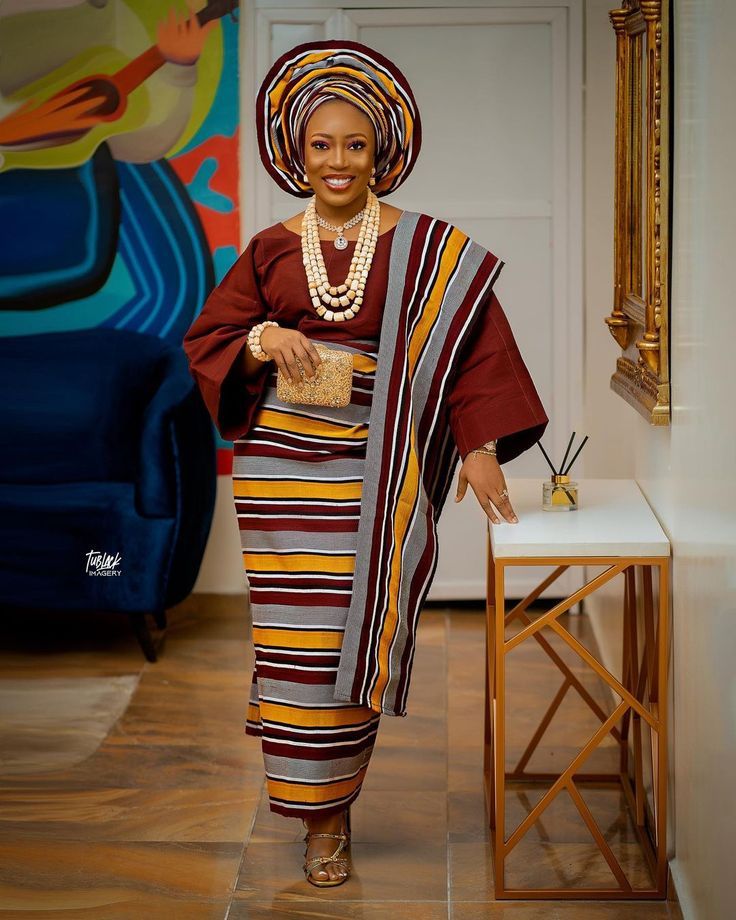
Before the styles, the fabrics. Aso-oke comes in three classical types, each with its own colour, material origin, and social register, and each named in Yoruba with a specificity that reflects how seriously the culture has always taken the distinction between them. As Wikipedia’s entry on Aso-oke documents, the three are Etu, Alaari, and Sanyan.
Etu is deep indigo, almost blue-black, woven with fine light-blue stripes. Its name comes from the Yoruba word for guinea fowl, the bird whose plumage the cloth recalls. Etu is the fabric of gravity, of seniority, and of peace. It communicates that the wearer has reached a point in life where spectacle is no longer required: the depth of the colour speaks for itself.
Alaari is the magenta and crimson fabric, woven from waste silk originally imported through trans-Saharan and trans-Atlantic trade routes. Its name is sometimes given as signifying power, energy, and celebration. At weddings, naming ceremonies, and festivals, Alaari is the Aso-oke that announces itself across a room. A woman in Alaari has decided on the occasion of her entering.
Sanyan is the softest of the three: a beige-to-tan fabric woven from threads of the Anaphe moth cocoon, a wild silk found across West Africa. Sanyan was, in its original form, among the most expensive of the three types because the raw silk had to be gathered from forest moths rather than being cultivated. It represents wealth and is associated with royalty and chiefs. A woman who wears authentic Sanyan at a ceremony is wearing one of Nigeria’s rarest traditional fabrics.
Together, these three are the classical foundation. Modern Aso-oke production has added dozens of variations, new colourways, metallic lurex threads, and contemporary pattern innovations. Still, Etu, Alaari, and Sanyan remain the fabric vocabulary against which everything else is measured. As River and Mara’s account of Aso-oke’s cultural significance notes, the Yoruba narrow-strip weaving culture that produced these fabrics dates back over five hundred years, possibly earlier, in towns like Iseyin, Oyo, Ilorin, and Ogbomosho.
Aso-oke is not mass-produced. Each piece required time, skill, and focus. The slow rhythm of weaving mirrored the Yoruba idea of time: not rushed, not extractive, but intentional. That intentionality is still in the cloth. You can feel it when you hold it.
Explore Aso-oke-Inspired Textiles
For readers interested in bringing some of this textile tradition into their own wardrobe or creative projects, exploring contemporary African textiles can be a useful place to begin. While not every fabric marketed as “African” carries the same cultural history as handwoven Aso-oke, independent textile makers offer an increasingly wide range of Nigerian and West African-inspired fabrics.
Explore selected African textiles and fabrics on Etsy
The 5 Aso-oke Styles Defining Yoruba Women’s Fashion in 2026
1. Iro Ati Buba With Gele and Ipele (The Classical Full Ensemble)
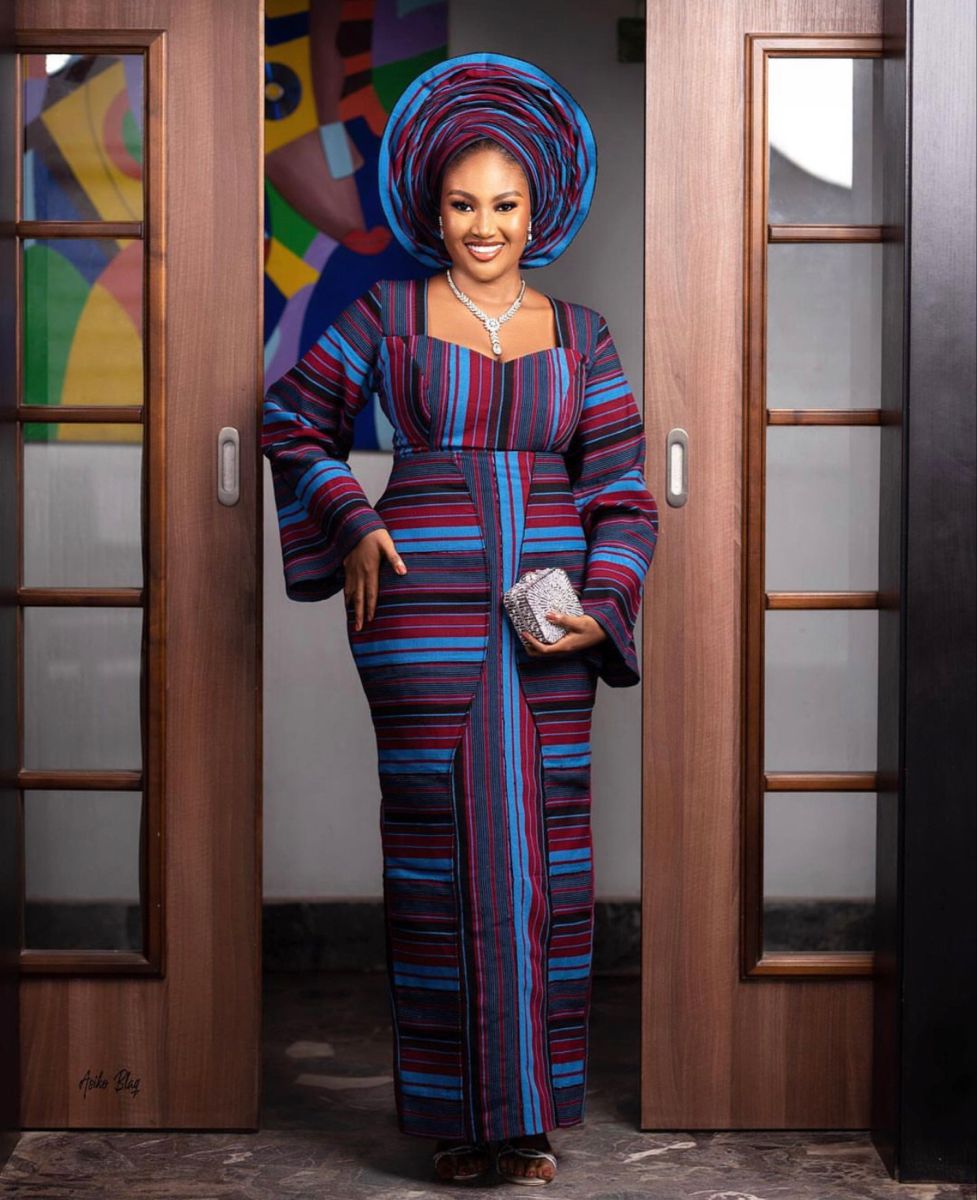
The Iro Ati Buba are the foundational forms of Yoruba women’s dress, and in Aso-oke, they carry the full weight of the tradition. ‘Iro’ means ‘wrapper’, and ‘buba’ means ‘blouse’. Together with the gele tied at the crown and the Ipele draped across the shoulder, this four-piece ensemble is the standard ceremonial look for Yoruba women at every significant occasion, from weddings to funerals, from naming ceremonies to chieftaincy installations. As Discover Yoruba’s guide to traditional Yoruba clothing records, it is the most important component of Yoruba women’s dress and the form against which every other style is calibrated.
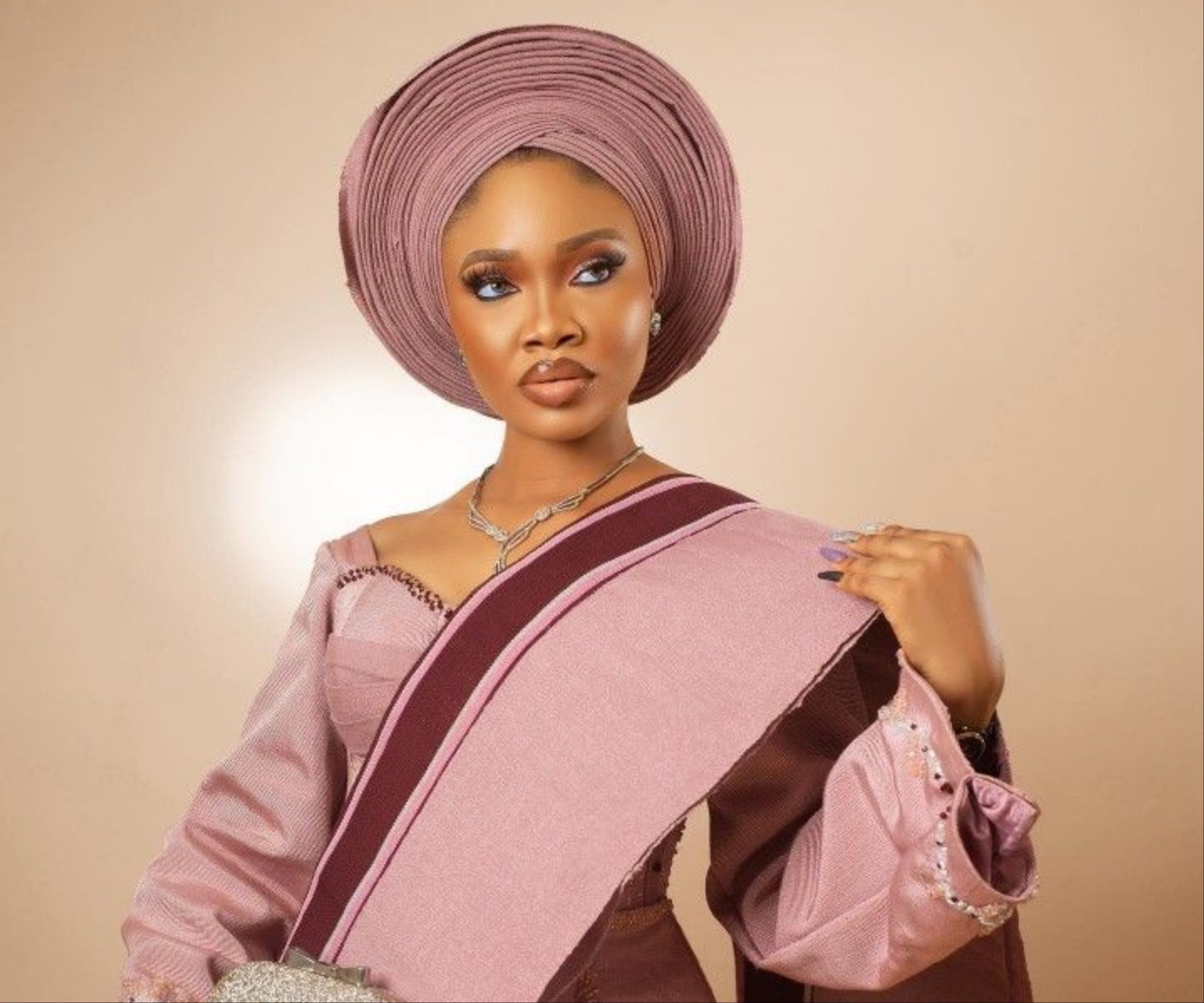
The Iro is a large rectangular wrapper tied at the waist and falling to the feet. The Buba, the loose-fitted blouse, sits above it with its neckline and sleeve configuration varying by occasion and the wearer’s preference: a formal wedding demands a more structured Buba than an evening family gathering. The Ipele is the shoulder shawl, draped over the left shoulder or across both, sometimes held in the hand or across the forearm as a statement of composure. And the Gele is the architectural crown of the entire look.
The Gele is not an accessory. It is a structural element of Yoruba women’s dress, as the African Arts with Taj account of the Gele’s evolution documents, tracing its growing elaborateness through the post-independence period as Lagos social life expanded and the competitive artistry of Gele tying became a cultural institution in its own right. A professionally tied Gele at a high-society Yoruba wedding takes 30-45 minutes and costs ₦5,000-₦20,000. Its size, shape, and the precision of its folds communicate the occasion’s significance and the wearer’s investment in it. The three-piece ensemble without the Gele is, by Yoruba cultural consensus, incomplete.
In 2026, the classical Iro Ati Buba in Aso-oke is experiencing a renewed intentionality among Yoruba women across Nigeria and the diaspora. The Etu indigo ensemble is worn to a senior elder’s ceremony, the Alaari full set at a wedding where the entire family coordinates in the same cloth, and the Sanyan for a chieftaincy installation: the choice of which of the three classical fabrics to wear, and at which occasion, remains one of the most considered decisions in Yoruba women’s cultural dressing.
For Readers Exploring the Aso-oke Look
The beauty of Aso-oke extends beyond the fabric itself. The complete look comes together through the Gele, jewellery, accessories and the way each piece is styled for the occasion. For readers exploring Yoruba-inspired fashion, contemporary makers offer pieces that draw from these visual traditions while interpreting them for modern wardrobes.
Explore African-inspired fashion and accessories on Etsy
2. The Komole (The Bridal Gown Form)
The Komole is the long-gown form of Yoruba women’s traditional dress, fashioned after the Iro Ati Buba but sewn into a continuous floor-length silhouette rather than as a separate wrapper and blouse. It is, as Wikipedia’s entry on Yoruba clothing documents, popular as wedding wear for Yoruba brides and for women who want to look their best at major celebrations. In Aso-oke, the Komole is the most structurally ambitious of the five styles: a garment that must carry the handwoven fabric’s weight and pattern across a continuous silhouette without losing its ceremonial authority.
Designer Deola Sagoe’s internationally recognised Komole series, as Discover Yoruba notes, has redefined luxury bridal wear in Nigeria, producing intricately designed Komole gowns that blend traditional Aso-oke craftsmanship with modern construction. The result is a silhouette that is entirely Yoruba in its fabric and cultural register, yet architecturally contemporary in its cut and finish. The Yoruba bride (Iyawo) who wears a Komole in Alaari Aso-oke, embroidered at the neckline and hem and paired with a matching Gele, is making a statement that no imported fabric can replicate: she is dressed in a cloth that her own people have woven for five centuries, tailored into a form that is worthy of the most significant day of her life.
The Komole in 2026 is being cut with increasing architectural confidence: structured bodices, modest off-shoulder or high necklines, sweeping floor-length skirts, and sleeves ranging from full puff to fitted long sleeves, depending on the season and the setting. The Gele remains essential. The Ipele is sometimes incorporated as a trailing panel at the back of the gown rather than a separate shoulder drape. Iyun coral beads at the neck complete the ensemble. Nothing about this look is an afterthought.
3. Etu Iro Ati Buba (The Elder Woman’s Statement)
The Etu ensemble deserves its own entry in this series because it carries a cultural argument that no other Aso-oke colour makes in the same way. Deep indigo, almost blue-black, with fine light-blue stripes that run through the weave: Etu is the colour of achieved seniority, of the woman who no longer needs to announce her presence because her cloth does it quietly and completely. As Indigo Arts’ documentation of Aso-oke notes, Etu is specifically associated with the Egungun masquerade and is worn closest to the masker’s skin, in a role that connects it to ancestral presence and the boundary between the living and the dead. Among the three classical fabrics, it is the one most explicitly connected to the spiritual dimension of Yoruba dress.
A senior Yoruba woman at a chieftaincy installation in a full Etu Iro Ati Buba, the Gele shaped to a moderate rather than towering height, the Ipele draped with the specific practised ease that comes from having tied it at hundreds of ceremonies, and Iyun beads of a weight and quality that communicate decades of accumulation – this is Yoruba dress at its most authoritative. It does not compete. It does not seek attention. It simply arrives, and the room understands.
In 2026, younger Yoruba women are also choosing Etu as a deliberate statement of cultural depth rather than waiting for the seniority the fabric traditionally connotes. The choice is being read, correctly, as a declaration: this woman knows what she is wearing, and she is wearing it with knowledge rather than fashion sense. That reading is the highest compliment the fabric tradition can offer.
4. The Oleku (The Modern Yoruba Classic)
The Oleku is the Iro Ati Buba in its shortened form: the Iro cut to the knee rather than the floor, paired with a fitted Buba, and worn with a Gele whose scale is moderated to match the look’s lighter register. It became popular in the 1960s as a youthful departure from the full-length formal ensemble. As Discover Yoruba documents, it was brought back into the cultural conversation by the 1997 Tunde Kelani film O Le Ku, whose title character wore the style with such visibility that it became part of the mainstream Yoruba fashion vocabulary again. The Oleku is not a compromise between tradition and the contemporary. It is a tradition in its own right.
In Aso-oke, the Oleku works because the handwoven fabric’s pattern and weight carry the abbreviated silhouette without losing authority. An Oleku in Alaari Aso-oke, worn with a modest gele and Iyun beads at a naming ceremony or a family celebration, is a complete cultural statement in a form that allows more ease of movement and a slightly less formal register than the full Iro Ati Buba. It is the style that bridges the gap between the classical ceremonial look and the social occasion where the full ceremonial ensemble would be too much, and no traditional attire would be too little.
In 2026, the Oleku is worn across the full range of Yoruba community occasions and at owanbe celebrations, where the energy of the gathering demands a style that can move. The Aso-oke Oleku in new colour combinations, bright reds and creamy whites, and emerald and gold, is one of the most dynamic looks in Yoruba women’s fashion at the moment, and the Gele tied at a moderate height to match keeps the cultural grammar intact even as the silhouette takes the look into the contemporary.
5. The Aso Ebi Aso-oke Ensemble (The Collective Statement)
Aso ebi, meaning “family cloth” in Yoruba, is the practice of coordinating fabric among the invited community at a celebration, with the shared cloth marking collective belonging to the occasion. It is one of the most powerful social institutions in Yoruba cultural life, and, as Bellafricana’s account of Aso-oke history, the beauty of Aso-oke comes out most fully when it is worn as Aso Ebi: the visual impact of an assembled gathering in matching handwoven cloth, each woman’s Gele tied to her own height and shape, each Ipele draped in her own style, the room unified by fabric and individual within it, is one of the defining aesthetic experiences of Yoruba celebration culture.
The Aso Ebi Aso-oke ensemble is the fifth style in this series because it is, in a meaningful sense, the culmination of all the others. An Aso Ebi gathering might include women wearing the full Iro Ati Buba, others in the Komole gown, some in the Oleku, and a senior woman in Etu: all in the same Aso-oke fabric, each in the silhouette appropriate to her age, her role in the occasion, and her own cultural knowledge. The fabric unifies. The individual form declares. Together, they make the argument that Yoruba dress culture has always made: that community and individual identity are not in tension. They are woven together, strip by strip, into the same cloth.
At Yoruba weddings in 2026, Aso Ebi Aso-oke is being commissioned in increasingly sophisticated colour combinations and with increasingly specific pattern requests. Families coordinate with the weavers of Iseyin or specialist Aso-oke houses in Lagos and Ibadan months before the ceremony. The choice of fabric type (Etu, Alaari, Sanyan, or a modern variation), the specific pattern, and the colour combination are made collectively and communicated to the guests in time for tailoring. The gele is typically tied professionally on the day. The whole system is, as it has always been, a community investing in an occasion rather than an individual dressing for one.
When Aso-oke Speaks: The Fabric Across Yoruba Ceremonies
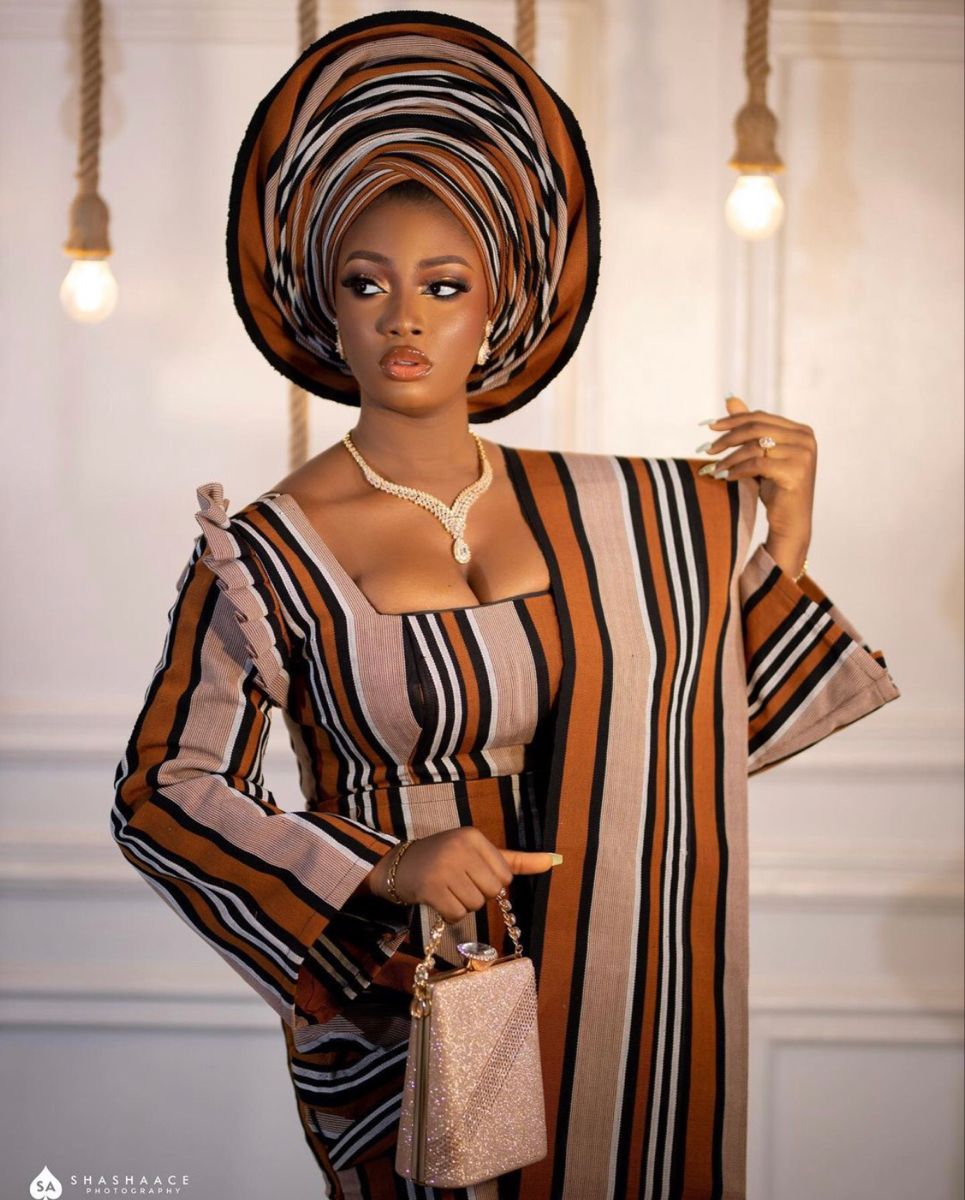
Aso-oke is worn at every occasion that matters in Yoruba life. The fabric does not have a narrow range. It has a grammar, and every occasion has its reading of that grammar.
Igbeyawo (The Traditional Engagement and Wedding)
The Igbeyawo is the Yoruba engagement ceremony, considered in traditional culture to be the actual wedding, with the church event a later addition influenced by colonial rule. The bride (Iyawo) wears Aso-oke in the full Iro Ati Buba with Gele and Ipele. As documented in Discover Yoruba’s engagement ceremony guide, both the bride and groom wear matching Aso-oke specially commissioned for the day. Traditionally, the pattern chosen by the bride’s mother at the weaver’s store is unique and never repeated for anyone else. A woman who understands this tradition commissions her wedding Aso-oke with that uniqueness in mind. Iyun red coral beads at the neck complete the bridal ensemble.
Naming Ceremony (Isomoloruko)
The naming ceremony, held seven days after birth, is among the most joyful gatherings in Yoruba life and one of the most consistent occasions for Aso Ebi. The women assembled in coordinated Aso-oke, the Gele at moderate heights, the Ipele draped with the ease of women who have dressed for this occasion many times: this is the visual grammar of Yoruba communal celebration at its most everyday and its most culturally complete. Alaari is dominant in naming ceremonies; the fabric’s energy and warmth are well-suited to welcoming new life.
Funeral (Isinku)
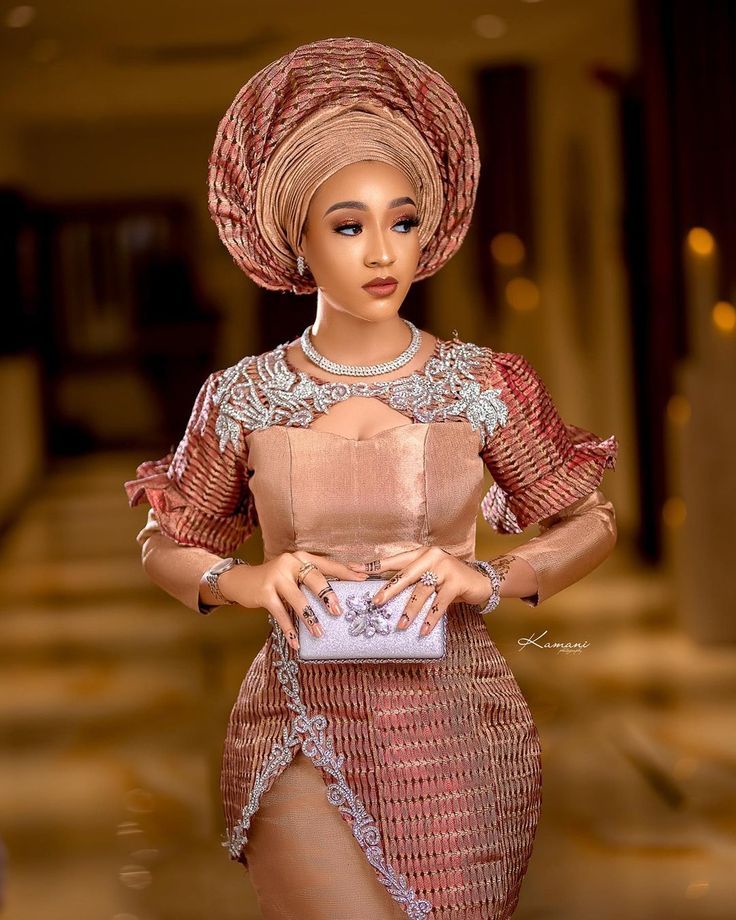
Yoruba funerals, particularly those of elders who have lived well and long, are not muted occasions. They are celebrations of a life completed, and the dress reflects that. White Aso-oke is the standard for Yoruba funerals, communicating purity and the passage to ancestral status. Senior women attended in full Iro Ati Buba in white, the Gele tied at a formal height, and the community assembled in the visual grammar of collective farewell. Etu, with its indigo depth and ancestral associations, is also worn at funerals of the highest seniority.
Ojude Oba Festival
The Ojude Oba festival at Ijebu-Ode, held on the third day after Eid al-Kabir (Ileya) each year, is one of the most spectacular displays of Yoruba dress culture in the calendar. Families, age groups, and societies parade before the Awujale of Ijebuland in their finest matching Aso-oke, the Gele tied to impressive heights, and the men’s Agbadas flowing alongside. As Discover Yoruba’s account of the 2025 Ojude Oba records, the festival draws large crowds and showcases regal fashion at its most public and competitive. The Aso Ebi Aso-oke ensemble is the dominant form: community identity through coordinated fabric and individual expression through Gele and silhouette.
Chieftaincy Installations and Title Ceremonies
The conferral of a chieftaincy title in Yoruba society is among the most formally dressed occasions in the culture. Sanyan is the fabric most directly associated with chiefly authority: its beige wild silk, rare and expensive, communicates a standing that the more commonly worn Alaari or even Etu does not claim in the same register. The women of a titled man’s household attend in their finest Aso-oke, the Etu Iro Ati Buba for senior women, the Komole for the family’s most formal participants, the full ceremonial Gele, and the heaviest Iyun coral beads the household can assemble. At a chieftaincy installation, there is no such thing as overdressing in Aso-oke.
A Yoruba woman who walks into a room in full Aso-oke is not dressed for the occasion. She is part of it. The fabric is not what she is wearing. It is what she is saying.
ALSO READ:
- Top 5 Igbo Traditional Bridal Looks for Igba Nkwu in 2026
- When Dressing Becomes Declaration: Clothing as Cultural Identity
- Roots in Full Colour: The Cultural Renaissance of Afro-Latino Identity
The Omiren Argument
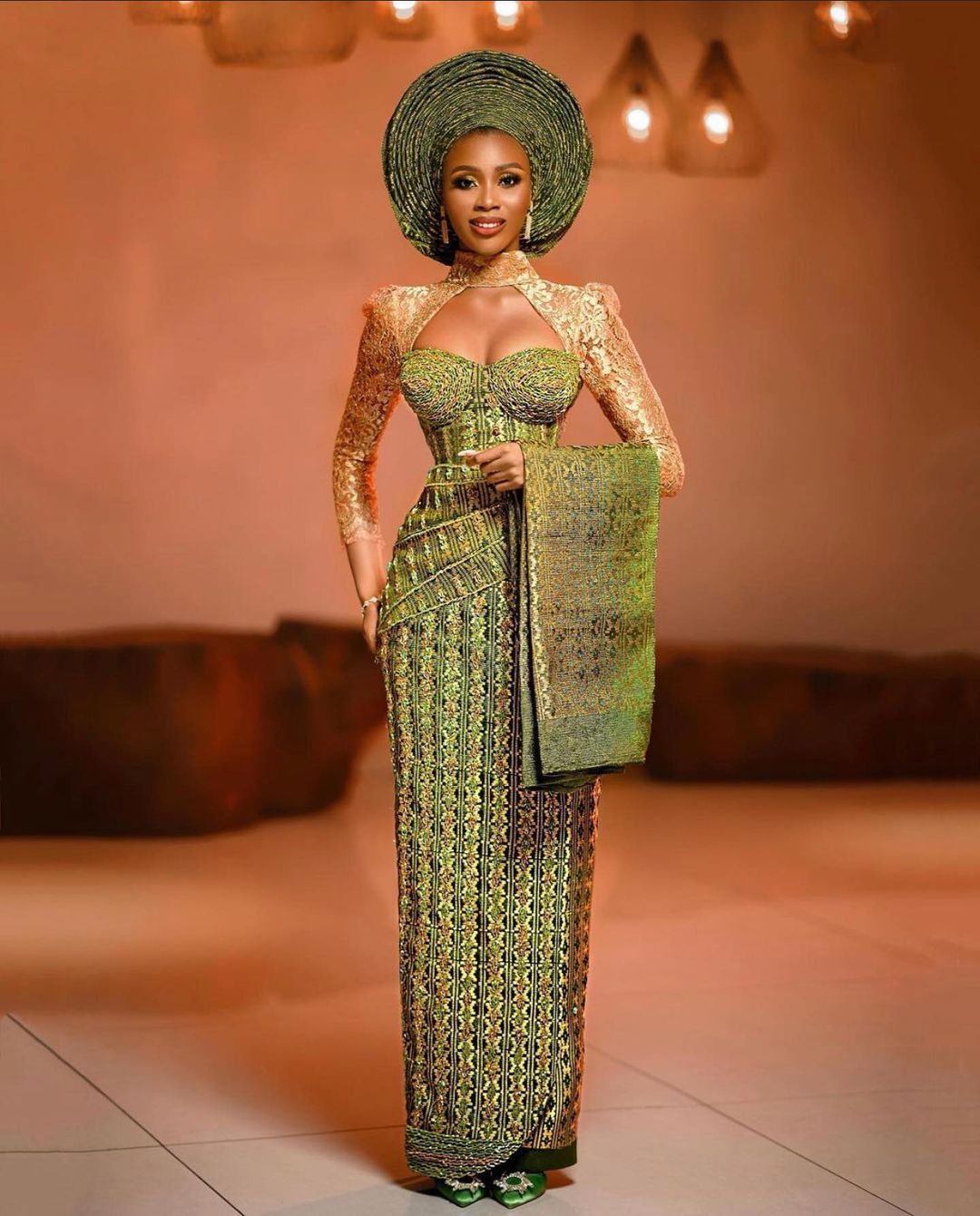
The Yoruba weaving towns of Iseyin, Oyo, Ede, and Ogbomosho have been producing Aso-oke for over five hundred years. The loom they use is horizontal and narrow, the same design refined across generations, portable enough for a weaver to carry and specific enough to produce strips of cloth so precisely patterned that each one is, as Modexmag’s history of Aso-oke records, a slow act of intentional creation rather than production. The weaving itself was understood as a spiritual act. Certain patterns carried spiritual power. The loom was more than a tool: it was, in the language of the Yoruba weaving tradition, an altar of sorts.
The five styles in this article are not the full range of what Aso-oke can do. They are an entry point into a fabric tradition that has survived everything the 19th and 20th centuries put in its path, not because it was preserved in a museum but because Yoruba women kept wearing it to the occasions that mattered. They wore it to weddings, funerals, naming ceremonies, chieftaincy installations, and the Ojude Oba parade. They wore it with the full seriousness of people who understood that cloth is a civilisational record and that putting it on correctly is an act of cultural participation, not a costume choice.
In 2026, young Nigerian designers are adding neon colours and experimental textures to Aso-oke on Lagos Fashion Week runways. The diaspora is commissioning Aso Ebi for celebrations in London, Atlanta, and Toronto. Social media connects weavers in Iseyin directly to buyers in Houston. The cloth is absorbing the present without forgetting the past. That is what five hundred years of cultural confidence looks like.
Aso-oke is not a trend that arrived. It is a civilisation that has been dressing itself, deliberately and beautifully, for longer than most fashion systems have existed.
Browse the full African Style collection at Omiren Styles.
Frequently Asked Questions
1. What are the three classical types of Aso-oke?
The three classical Aso-oke types are Etu, Alaari, and Sanyan. Etu is a deep indigo fabric with fine light-blue stripes, associated with seniority, peace, and ancestral connection. Alaari is a magenta-to-crimson fabric woven from waste silk, associated with power, energy, and celebration. Sanyan is a beige-to-tan fabric woven from threads of the Anaphe moth cocoon, a wild silk, and represents wealth and royalty. These three remain the foundation of the Aso-oke tradition. A comprehensive account of their history and cultural significance is available at Wikipedia’s entry on Aso-oke.
2. What is the Gele, and why is it essential to the Aso-oke look?
The Gele is the elaborate Yoruba head tie, wrapped and shaped around the head in a style specific to the wearer and the occasion. It is not an accessory in the conventional sense: it is a structural element of the Aso-oke ensemble, and a full Iro Ati Buba without a Gele is culturally considered incomplete. Professional Gele tying takes between 30 and 45 minutes and is a skilled art form in its own right. The history of the Gele’s evolution, from a modest head covering in 19th-century Yoruba life to the architectural ceremonial statement it is today, is documented in African Arts with Taj.
3. What is Aso Ebi, and how does it work at Yoruba ceremonies?
Aso Ebi, meaning “family cloth”, is the Yoruba practice of coordinating fabric among the guests at a celebration. The host family selects a fabric and distributes or sells it to guests, who each have it tailored into their own silhouette and wear it to the occasion. The shared fabric visually unifies the gathering, while each woman’s tailoring and Gele style express her personal cultural identity within that unity. At major Yoruba weddings and celebrations, Aso Ebi Aso-oke is commissioned months in advance, and the pattern chosen for the occasion is typically unique to that specific celebration.
4. Where is Aso-oke woven, and how long does it take to produce?
Aso-oke is produced primarily in the Yoruba weaving towns of Iseyin in Oyo State, Ede in Osun State and, to a lesser extent, in Okene, Kogi State. The cloth is woven on horizontal narrow-strip looms by specialist male weavers, in a craft that has been practised in these towns for over five hundred years. Each strip is approximately four to nine inches wide, and multiple strips are sewn together to produce the full cloth width required for a garment. The production of a complete outfit requires significant time and skill. A full account of the weaving process is available at Google Arts and Culture’s documentation of Aso-oke.
For readers exploring ready to wear Aso-oke woven fashion, contemporary makers offer pieces that draw from these visual traditions. view here
Read More About African Textile Traditions
Aso-oke makes more sense when placed within the wider history of Yoruba weaving, African textiles and the cultural systems that give cloth its meaning. For readers who want to explore these subjects further, we’ve selected books that examine African fashion, textile traditions, craftsmanship and cultural history. Explore books on African fashion, textiles and cultural history here