A straw bag does not become a design object only when a recognised name is attached. The decisions are already there: selecting and preparing material, organising a surface, establishing a form and making something that can be carried. Harl Taylor’s place in Bahamian fashion history is better understood as a change in the recognition and positioning of straw accessories, not as the invention of design within a previously uncreative practice.
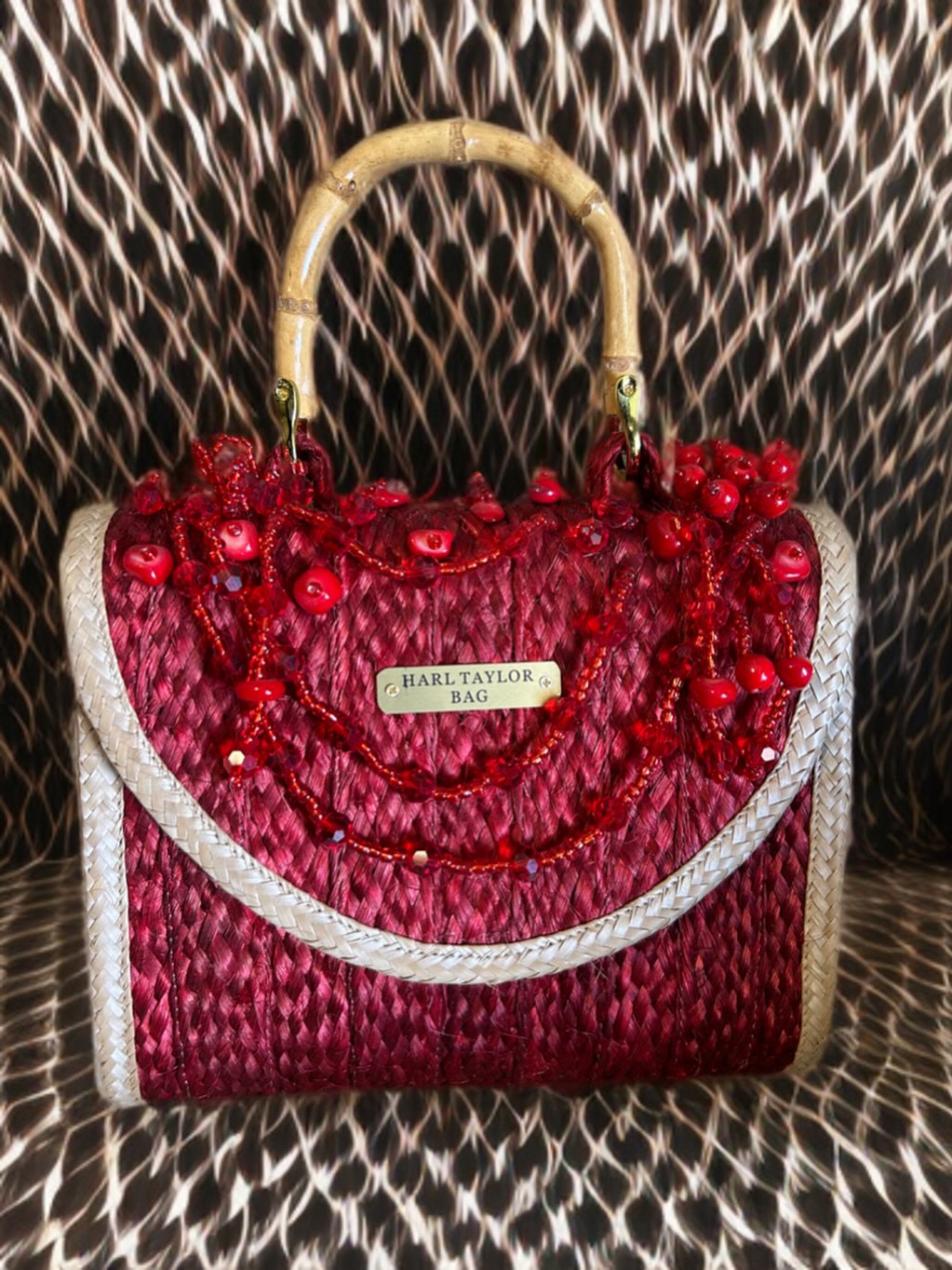
One object makes that distinction worth examining. In Doongalik Studios’ airport exhibition archive, a “Straw/Sisal Embellished Heart BAG” appears under the Harl Taylor BAG label.
It was included in Love Is in the Air, a Valentine-themed installation featuring work in straw, sisal, fabric, handmade paper and jewellery. The bag entered the record as a named fashion accessory among a wider group of Bahamian creative products.
A documented Harl Taylor Heart BAG opens a history of Bahamian strawcraft, fashion recognition and the people who continued the designer’s label.
A Named Bag Within a Shared Exhibition
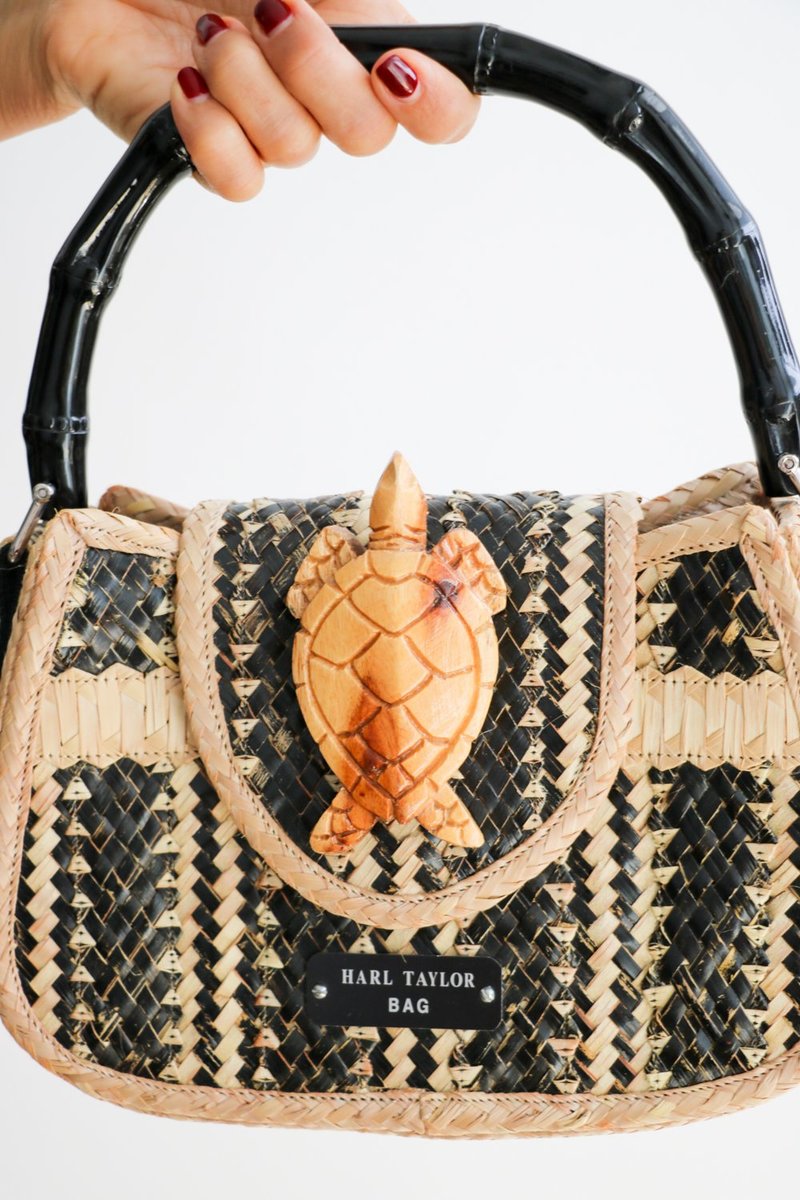
The exhibition inventory distinguishes the Heart BAG from other items credited to the label, including an Apple BAG, a belt and a straw clutch. That specificity matters. “Harl Taylor bag” is not one object or one silhouette; it encompasses different products.
The Heart BAG should therefore be discussed through its own record rather than assembled imaginatively from features found on other examples. Its description identifies straw, sisal and embellishment, but does not specify dimensions, handle construction, closure or the precise relationship between its name and its shape.
The installation placed it alongside work credited to Elsie Fraser, Del Foxton, Nancy’s Fancies, ILAND, Bernadette Bannister and Margaret Finlayson. This was not a retrospective devoted exclusively to Taylor.
It was a collective presentation in which bags, footwear, jewellery, paper art and textiles shared the exhibition space. The setting makes the object’s identity relational: it belonged to a recognisable label while also participating in a broader account of Bahamian making.
What “Straw” Leaves Unsaid
The phrase “straw bag” can make a complex object sound materially simple. Simone Cambridge’s 2022 article, “‘It has just begun’: Strawcraft in Bahamian Visual Culture”, describes a practice involving gathering and processing raw materials, plaiting, design, and construction.
She explains that woven palm fronds produce material used across bags, mats, hats and shoes. “Straw” is therefore not merely a surface appearance; it belongs to a sequence of skilled operations.
The Heart BAG’s straw-and-sisal description is a starting point within that vocabulary, not a complete account of its making. It does not establish a particular plant species, island of production or plait pattern. Nor does “embellished” identify the decoration.
Preserving those distinctions prevents a familiar category from swallowing the object’s particularity. The appropriate question is not simply whether the bag is handmade, but which operations, materials and people contributed to this example.
Design Knowledge Before the Designer Label
Cambridge’s research centres on her grandmother, Thelma Eula Cambridge’s 1968 study, Growing Functional Arts in the Bahamas. Completed at Bahamas Teachers’ Training College, it combined handwritten discussion, illustrations, samples and examples of strawwork.
It documented techniques while also demonstrating them. The work treated craft as something that could be analysed through material, pattern and design, not merely collected as evidence of local custom.
One example is especially revealing. The study’s “Crab Design” combined undyed sisal with orange and yellow embroidered raffia and green and red shells. Simone Cambridge reads the relationship between drawing and material as evidence of a sophisticated understanding of form, texture and colour.
This does not describe the Heart BAG or establish its construction. It establishes something more fundamental to the history around it: Bahamian strawcraft already contained deliberate visual invention. Taylor’s recognition belongs within that history, not at its beginning.
Recognition Changed the Context
Contemporary evidence shows Taylor’s handbags were positioned within an international leisure market during his lifetime. In its May 2006 travel feature “Winter Escapes,” Boston Magazine directed visitors to his Nassau shop for straw beach totes.
The recommendation appeared among hotels, restaurants and other attractions. It documents how the business was presented to that readership at the time; it does not establish sales, production volume, or the history of the Heart BAG.
Cambridge’s later scholarship places Harl Taylor BAG among Bahamian fashion houses that branded straw products differently from their market-vendor counterparts. She also records that Taylor’s designs entered Bergdorf Goodman. That is a meaningful change in retail context.
But the critical distinction is between increased recognition and newly acquired creative worth. A department store can introduce a design to another audience without being the source of the knowledge that made it possible.
The Label and the Labour Are Different Credits
The Heart BAG’s exhibition attribution identifies the label under which it appeared. It does not name the individual who prepared its material, made its plait, assembled its body or completed its embellishment. Those are separate questions, and the surviving exhibition description should not be made to answer them by implication.
Equally, the absence of those names in this record does not prove they were uncredited elsewhere. It establishes the limits of this particular source.
This distinction is central to Omiren’s Maker-Credit Test: naming a heritage-associated product is not the same as explaining its production relationships. For the Heart BAG, the useful next step is specific rather than rhetorical: recovering the design attribution and maker information from company or exhibition records. That would make it possible to discuss how authorship was distributed without erasing either the label’s role or the contribution of fabrication.
Beverly Taylor’s Work of Continuation
Doongalik’s account of a separate airport installation, Bahamian Celebrations, provides a dated part of the label’s continuation history. Scheduled for November 2016 to February 2017, that display featured Harl Taylor BAG’s Rays of Light Forever in tribute to Harl Joseph Taylor, whose dates it gives as 1970–2007. The text records that his mother, Beverly J. T. Taylor, established Forever…Harl Taylor Limited in June 2008.
She stated that its purpose was to keep his legacy alive by continuing to create his designs. That testimony identifies an active undertaking: legacy was being maintained through an organisation and further production, not only through remembrance. It does not authenticate the Heart BAG as one of those designs.
Keeping the two exhibition entries separate is essential. One documents a named object; the other states the company’s purpose and the founder’s continuation.
A Later Creative History Must Remain Visible
The continuation also involved later creative leadership. A Creative Nassau announcement dated 16 July 2014 identified David D. Rolle as Forever Harl Taylor Limited’s creative director, appointed in 2013.
It announced a forthcoming partnership between the company and his House of Raphelita for a resort showcase. As an announcement, it establishes the proposed event and stated roles; it should not be treated as proof of everything subsequently presented.
This matters because a founder’s name can make later work appear historically seamless. In reality, a label may contain original designs, later realisations, adaptations and new contributions. The available sources do not locate the Heart BAG securely within those categories.
A responsible history keeps that question open without implying that Beverly Taylor or Rolle designed this particular object. Their documented roles explain why the label’s post-2007 history deserves attention in its own right.
More Than a Tourist Purchase
The airport programme gave the bag another context beyond retail. Doongalik states that Nassau Airport Development Company commissioned it to curate twelve showcases in departure and arrival areas.
The overall theme was “more than sun, sand and sea.” The first rotation ran from April to June 2016, with subsequent displays expanding the range of participating artists and artisans. Owner Pam Burnside described the programme as serving both visitors and local travellers.
The distinction is not that the exhibition made the objects more authentic than items sold elsewhere. Instead, the programme explicitly presented creative production as part of the country’s public identity. A bag could be encountered alongside literature, visual art, textiles and other forms of making.
Doongalik also stated that displayed work was available for purchase at the time. That historical invitation should not be converted into a claim that the Heart BAG is available now.
What This Object’s Record Can Preserve
The Heart BAG’s surviving description preserves several things: a name, material attribution, exhibition context and association with the Harl Taylor label. Those are useful historical facts. They do not yet support a close judgement about its proportions or ornament.
A stronger record would link them to a securely identified photograph, dimensions, date, and production credits. The aim would be to deepen the object’s history, not replace it with a more confident story than the evidence permits.
Thelma Eula Cambridge’s study offers a model of what such preservation can achieve. By combining samples, drawings and instructions, it recorded relationships between appearance and technique.
It made knowledge available for later examination rather than relying solely on an object’s reputation. Applied to the Heart BAG, that approach would preserve both its visual identity and the work behind it: the difference between remembering a brand and understanding a designed thing.
The Omiren Argument
The principle is continuity. A design legacy survives through more than recognition of its founder.
It depends on the people who continue production, the craft knowledge available to them and the records that distinguish one object from another. Taylor’s name is an important part of this history, but it should not erase those relationships.
The Heart BAG’s exhibition record places the label within a collective presentation of Bahamian creativity. That is its clearest documented contribution here. A fuller object history remains to be recovered; what already emerges is that the legacy belongs neither to a name alone nor to an anonymous tradition, but to the relationship between design, making and continued care.
Also Read:
- How Is Ecuador’s Toquilla Weaving Described at the Point of Sale?
- Accessories That Carry Our History: Bags and Jewellery as Living Heritage
- Why Accessories Are Cultural Signifiers in Modern Women’s Style
- The Rise of Caribbean Luxury Fashion Brands
Frequently Asked Questions
Which bag does this article examine?
It examines the item listed by Doongalik Studios as a “straw/sisal embellished heart bag” under the Harl Taylor BAG label in its Valentine-themed airport display. The retrieved entry does not establish its manufacture date or individual designer. It should not be described as a confirmed lifetime work by Taylor.
Who continued the label after Taylor’s death?
Doongalik records that Harl Taylor’s mother, Beverly J. T. Taylor, established Forever…Harl Taylor Limited in June 2008 to keep his legacy alive. Creative Nassau later identified David Rolle as creative director, appointed in 2013. Neither source supplies an individual attribution for the Heart BAG.
Does this article establish current availability?
No. Exhibition inventories and historical business coverage document particular moments. They are not live stock records. Doongalik stated that the displayed work was available for purchase at the time, which should not be read as a claim that the Heart BAG is available now. Readers should also distinguish the documented straw-and-sisal attribution from more specific material and technique claims.
Why does the article separate the label from the makers?
The exhibition attribution identifies the label under which the Heart BAG appeared, not the people who prepared its material, made its plait, assembled its body or completed its embellishment. Recovering design attribution and maker information from company or exhibition records would allow more precise discussion of authorship.