In 1957, during her final year at the Royal College of Art, Althea McNish visited the Essex home of artists Edward and Charlotte Bawden. Walking through the nearby countryside, she came across a wheat field. What she saw in that field was not simply English grain; it reminded her of the sugarcane plantations she grew up with in Trinidad. That moment of recognition, one landscape reading through the memory of another, became the starting point for Golden Harvest. This printed furnishing textile would become one of the defining designs of her career. The V&A preserves an example as printed heavy cotton satin in four colours, designed for Hull Traders and made in Great Britain during the 1960s. That object is the material evidence around which this account is built.
“Everything I did, I saw it through a tropical eye.” ― Althea McNish, 2015, as quoted by the V&A.
That statement, recorded by the V&A in 2015, is the clearest description McNish gave of how her background shaped her practice. It does not require every design she made to depict a plant or landscape found in Trinidad. Golden Harvest documents that distinction: the subject was an English wheat field, the perspective was formed elsewhere, and the result belonged exclusively to neither place. Following the design’s history means following all three at once.
Explore Althea McNish’s Golden Harvest, from an Essex wheat field and memories of Trinidad to printed cotton satin and commercial production.
The Essex Field and the Trinidadian Recollection
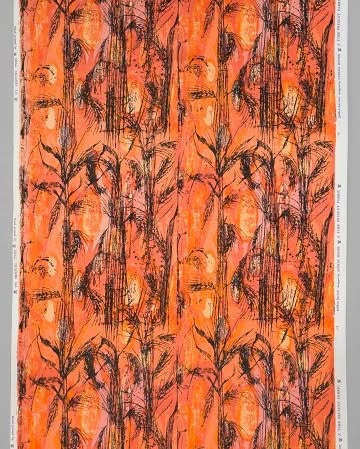
The connection between the two landscapes is not something later writers invented. The V&A’s introduction to McNish’s work places the Essex visit in 1957 and records that the wheat field recalled Trinidad’s sugarcane plantations. That is the museum’s own language, establishing the link rather than leaving the reader to speculate. The object record adds another detail: Golden Harvest was inspired by the early morning sun on the field. Cooper Hewitt, which holds a related example, also identifies Essex wheat rather than tropical vegetation as the design’s immediate source. Both accounts describe an English encounter interpreted through a designer whose visual experience extended beyond England.
The distinction between the remembered landscape and the observed landscape is worth holding onto. They are related, but not identical. Calling Golden Harvest simply tropical would flatten that relationship and lose what makes the design historically interesting. A new view became legible through an earlier experience without ceasing to be new. That is the specific mechanism behind the design, and it is the one the museum documentation supports.
Cooper Hewitt describes the wheat fields in the design as receiving a fiery glow not usually associated with the English countryside. That is the museum author’s interpretation of how the pattern treats its subject. Read alongside McNish’s statement about the tropical eye, it suggests that colour and treatment could carry her perspective even when the subject itself came from the British landscape she was working within. The design’s warmth is not an accident of printing: it reflects how a specific person saw a specific field on a specific morning.
A Tropical Eye, Not a Fixed Catalogue of Motifs
The phrase “tropical eye” works because it describes a mode of seeing rather than a list of subjects. It means that McNish’s Caribbean background shaped how she approached any visual material, not that she was limited to depicting the plants and landscapes of Trinidad. Golden Harvest is the clearest documented example of that principle at work: a design whose subject is entirely English but whose character, in the assessment of those who have studied it closely, carries something that does not read as conventionally English.
For Omiren’s coverage of Caribbean design heritage, that distinction matters. Reading Caribbean influence in design through specific motifs, bright colour alone, particular floral forms, or references to tropical vegetation misses the more fundamental contribution McNish’s career represents. Influence operates at the level of perception and training, not just subject matter. Golden Harvest is a particularly legible example of that argument because the subject is so clearly documented as English.
What the Surviving Fabric Establishes

The V&A’s Golden Harvest is catalogued as a furnishing fabric: printed heavy cotton satin in four colours, accession number T.178:1 to 3-1989, with three parts in the record. The date field identifies the surviving material as made in the 1960s. That date describes the museum example, not the first appearance of the pattern. Keeping those two things separate matters for the chronology, which the sources handle slightly differently and discuss further below.
The furnishing classification is also worth retaining accurately. A furnishing fabric is not automatically a dress fabric, even when its designer also worked for fashion clients, which McNish did. The documented object belongs to an interior-textile context. The V&A record does not establish that the museum’s length was cut into clothing or worn by any identifiable person. McNish’s career encompassed both furnishing and fashion textiles, but that broader practice does not change what the object record says about this piece.
The material description identifies printed cotton satin and the number of recorded colours. It does not provide a complete printing specification, colour recipe or history of every colourway in which the pattern was produced over its commercial life. That is enough to discuss the object accurately. Adding manufacturing detail that the sources do not supply would not make the account more useful; it would make it less reliable.
From Student Design to Commercial Pattern
According to the V&A object history, Golden Harvest was designed during McNish’s final Royal College year. Tofos Prints, based behind the college, first produced it for school use. The pattern then entered the Tofos collection, which Hull Traders later incorporated into its Time Present collection. That sequence is worth following carefully because it reveals more than a simple transition from artist to manufacturer.
There is an intermediate production context and an early intended setting. A design first produced for a school, then absorbed into a commercial collection, then carried by a textile company as its bestselling pattern for more than a decade, doesn’t follow a simple or predictable path. Each stage represents a decision by someone, and the design survived all of them. The V&A record describes it as Hull Traders’ overall bestselling design and notes that it remained in production until the 1970s. Those statements document success and duration without providing sales quantities or a full account of how and where the fabric was distributed.
Why the Dates Need Separating
The institutional sources do not present a single, identical commercial chronology for Golden Harvest, and that difference should be made visible rather than silently resolved. Cooper Hewitt dates Hull Traders’ production to 1959 and suggests the first Tofos trial prints were most likely made in 1958. The V&A introduction describes McNish using the wheat motif in 1959 and the fabric being released the following year. Both accounts place the design’s development around the end of the 1950s, but they differ over the production and release sequence.
The museum object’s separate 1960s date describes the surviving fabric, not a correction to those earlier milestones. A reader can therefore distinguish four distinct events: the Essex field visit in 1957, early prints in 1958 or 1959, commercial production or release around 1959 to 1960, and the manufacture of the V&A example during the 1960s. Keeping them separate allows the article to explain what is documented while acknowledging where the institutional accounts do not fully align.
The Printing Knowledge Behind the Colour

Golden Harvest did not move from sketch to factory without the designer’s active involvement in how it was printed. McNish had trained specifically to understand industrial textile production. After moving from Port of Spain to London in 1951, she studied at the London School of Printing and Graphic Arts, took classes at the Central School and completed postgraduate study at the Royal College of Art. The V&A describes the expertise in printing, repeats, and colourways that training gave her, and that gave her control over industrial processes.
The V&A reproduces her account of that relationship with the industry, drawn from Libby Sellers’s Women Design: “Whenever printers told me it couldn’t be done, I would show them how to do it. Before long the impossible became possible.” That statement speaks to her practice more generally than to a documented dispute specific to Golden Harvest. Its relevance here is technical authority. The colour that Cooper Hewitt describes as a fiery glow was not only an artistic preference. McNish was trained and positioned to negotiate that through the production process, a different kind of contribution from simply supplying a finished design and leaving technical decisions to someone else.
For a pattern that stayed in commercial production until the 1970s, that relationship with manufacturing would have mattered repeatedly. Colourways change, production runs end and restart, printing processes develop. A designer with McNish’s technical knowledge could stay involved in how her work was produced, not only how it was initially designed. The sources do not document every instance of that involvement for Golden Harvest specifically, but the training and the attitude it produced are part of the design’s history.
Heritage in a Manufactured Surface
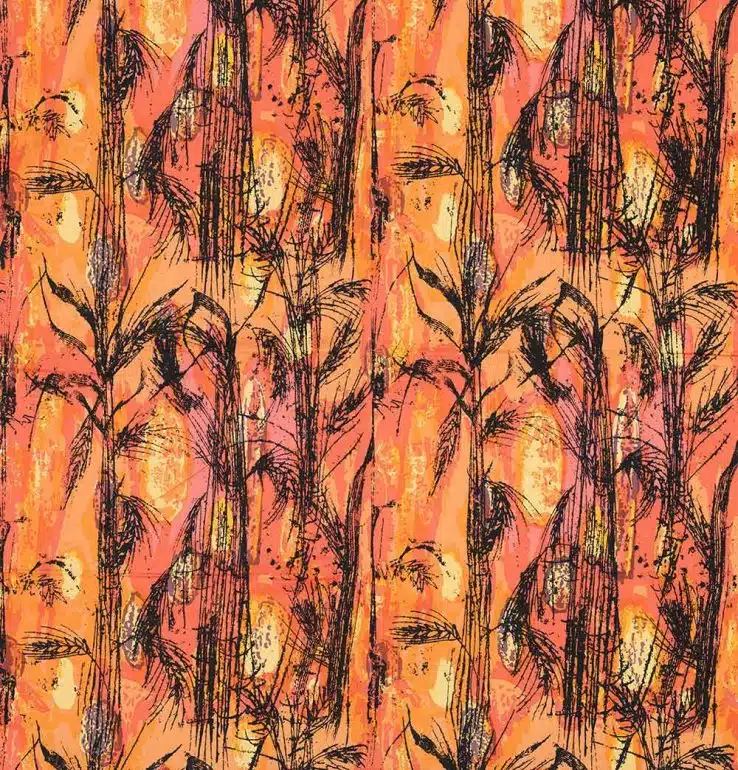
Golden Harvest connects Trinidad and Britain through a documented act of recognition, not through a metaphor or an invented family narrative. Its immediate subject was Essex wheat. The V&A records that the encounter recalled Trinidadian sugarcane. The design’s development and eventual manufacture then placed that visual interpretation within Britain’s commercial textile industry, where it became the bestselling design of one of the period’s significant fabric companies.
The heritage argument here is specific rather than general. McNish supplied the design. Tofos Prints produced the first examples. Hull Traders carried it commercially and distributed it across more than a decade. The V&A preserves a later material example. Naming those roles allows artistic authorship and manufacturing context to coexist without treating them as equivalent or interchangeable contributions. The design is McNish’s. Its commercial life depended on decisions and investments that went beyond her individual practice.
A carries this heritage storyA manufactured surface carries this heritage story, and it is not wholly recoverable from that surface alone. The catalogue entries and museum essays explain the landscape association and the production sequence. Without them, the pattern could still be admired as a design object, but the particular relationship between observation, recollection, and manufacture would be less visible. Documentation makes a full account possible, which is why institutions like the V&A and Cooper Hewitt matter for understanding Caribbean design contributions to British material culture.
Omiren Argument
What Golden Harvest illustrates for Omiren’s coverage of Caribbean fashion and textile heritage is that Caribbean designers’ contributions to British design history often show up less in explicit references to Caribbean subjects than in the less obvious ways that background shapes practice. McNish’s tropical eye was not a signature or a marketing position. She brought it to every encounter, including an encounter with an English wheat field on an Essex morning in 1957.
The commercial success of Golden Harvest, the longevity of its production run and its presence in two major museum collections on two continents are not incidental to this argument. They show that the design held up across many years and contexts. A pattern produced for a school in the late 1950s and still in production into the 1970s had to earn that duration. The tropical eye McNish brought to an English field produced something that proved useful and compelling to people who were mostly not thinking about Trinidad when they chose a furnishing fabric.
For Omiren, that is the kind of contribution the global south fashion credit question asks about: influence that operates at the level of practice rather than iconography and that requires careful documentation to become visible. Golden Harvest is a well-documented case. The wheat field is in Essex. The sugarcane is in Trinidad. The textile is in the V&A. All three are true at once, and none cancels the others out.
Also Read:
- Althea McNish’s Tomee: Designing Colour for Everyday Life
- Global South Fashion: Why Credit Matters
- Caribbean Diaspora Designers on the Runway
FAQs
Was Golden Harvest inspired by Trinidad?
Its immediate source was an Essex wheat field, visited in 1957. The V&A records that the encounter reminded McNish of Trinidad’s sugarcane plantations, linking observation with recollection. Both places therefore belong to the design’s history. Describing the pattern solely as a depiction of tropical vegetation would obscure the documented English source and the more precise relationship between the two landscapes that the museum sources establish.
Is the V&A object a clothing textile?
The V&A catalogues it as furnishing fabric: printed heavy cotton satin in four colours, made in Great Britain during the 1960s. That classification should be retained. McNish also designed fashion fabrics throughout her career, but her broader practice does not establish clothing use for this object. The article does not assign an undocumented wearer or domestic setting to the museum example.
Why Do the Sources Give Different Dates for Golden Harvest?
Cooper Hewitt dates Hull Traders’ production to 1959 and places the first Tofos trial prints in approximately 1958. The V&A introduction describes the wheat motif appearing in 1959 and the fabric being released the following year. Both institutions place development around the end of the 1950s; they differ on the precise production and release sequence. The V&A object’s separate 1960s date describes the surviving museum example, not a correction to those earlier milestones. This article keeps the accounts distinct rather than resolving them into a single chronology the sources do not support.