Meiling’s Capsule 23 presents three garments worth a closer look: an Asymmetrical Shirt, a funnel neck, and a jumpsuit 2023. Each one is listed as cotton and made in Trinidad and Tobago. That shared foundation makes a genuine comparison possible, because fibre content alone can’t explain the differences between them. You have to look at structure, at where the designer places the point of interest, and at what happens when that point moves.
“I always want to work in cottons or linens because of where we live.” ― Meiling, Designer Island interview, 2017
That statement, from a Designer Island interview published in January 2017, explains something without overstating it. Material choice is one way location enters her practice. It is not a decorative reference added to a garment after the fact. The three pieces considered here express that principle in three different ways.
A close reading of three Meiling Capsule 23 garments explores cotton, asymmetrical sleeves, a funnel neckline and the relationship between restraint and contrast.
Cotton and the Context of Place

Starting with cotton does not mean ending with cotton. The shared specification is a baseline, not a conclusion. Fibre content cannot tell you a garment’s weight, surface, drape or behaviour on the body. It does, however, let you shift the comparison toward the decisions made within that material category: how the sleeve sits, how the neckline is drawn, and how a silhouette comes together when combined with contrasting components.
Meiling’s relationship to the Caribbean as context, not decoration, is also worth holding onto as you read the three pieces. A Caribbean fashion background has too often been framed as a source of colour and pattern references rather than a shaping influence on practice. Her preference for cottons and linens resists that framing. It is practical, environmental and quietly specific to working in Trinidad.
The Asymmetrical Shirt: Difference Within a Familiar Form
The Asymmetrical Shirt is the easiest of the three to describe in terms of what sets it apart. Its product description says the cotton shirt echoes the Kite 23 with its asymmetrical sleeves. That’s specific and useful information because it shows the sleeves aren’t a peripheral feature. The label uses them to explain the garment’s relationship to another piece in the collection.
When a familiar category, the shirt, is distinguished by a single intervention, that intervention carries significant weight. The asymmetrical sleeve relationship changes how the garment reads without requiring several competing additions to make its case. There is a difference worth naming here between limited detail and limited expression. Restraint, understood as concentration rather than disappearance, is what makes the shirt interesting rather than merely quiet.
The reference to Kite 23 is also worth noting without overstating it. It suggests continuity within Meiling’s design practice, a conversation between pieces in the same collection rather than a series of unrelated ideas. But the shirt page doesn’t provide enough information to fully reconstruct that earlier garment. The supported connection is the one the label names: asymmetrical sleeves. Keeping that reference specific is more honest than turning a product description into an invented design genealogy.
A Reference That Should Remain Specific
When reading a garment described through its relationship to another piece, it’s tempting to fill in what the brand doesn’t say. The stronger editorial position is to hold the reference at its stated scope. The shirt enters an existing conversation, and that is worth acknowledging. The current product description doesn’t include what the conversation contains beyond asymmetrical sleeves, and speculation about it wouldn’t serve the garment or the reader.
Funnel Neck: Moving the Emphasis Upwards
The funnel neck changes where the point of attention lands. The official listing identifies a funnel-neck shirt in 100% cotton, made in Trinidad and Tobago. Its description is shorter than the asymmetrical shirt’s, but the name does the work: it foregrounds the neckline rather than the relationship between sleeves. It directs your eye upward, toward the garment’s upper boundary, rather than laterally toward an unequal sleeve arrangement.
That distinction reveals two ways to differentiate a shirt within the same material and production context. One intervention works across the garment’s width; the other works at its top edge. These are not stylistic preferences that happen to coexist. They represent distinct structural decisions, and they produce different reading experiences even when both pieces might reasonably be described as restrained.
Read alongside the Asymmetrical Shirt, the Funnel Neck makes a simple description of quietness or minimalism feel insufficient. Both pieces rely on a limited set of stated features, yet those features occupy different places and create different shapes. Cotton keeps the comparison grounded; the naming directs you toward form, not merely material, as the source of distinction. That is the useful comparison, and it is the one the selection makes possible.
Jumpsuit 2023: A More Complicated Proposition
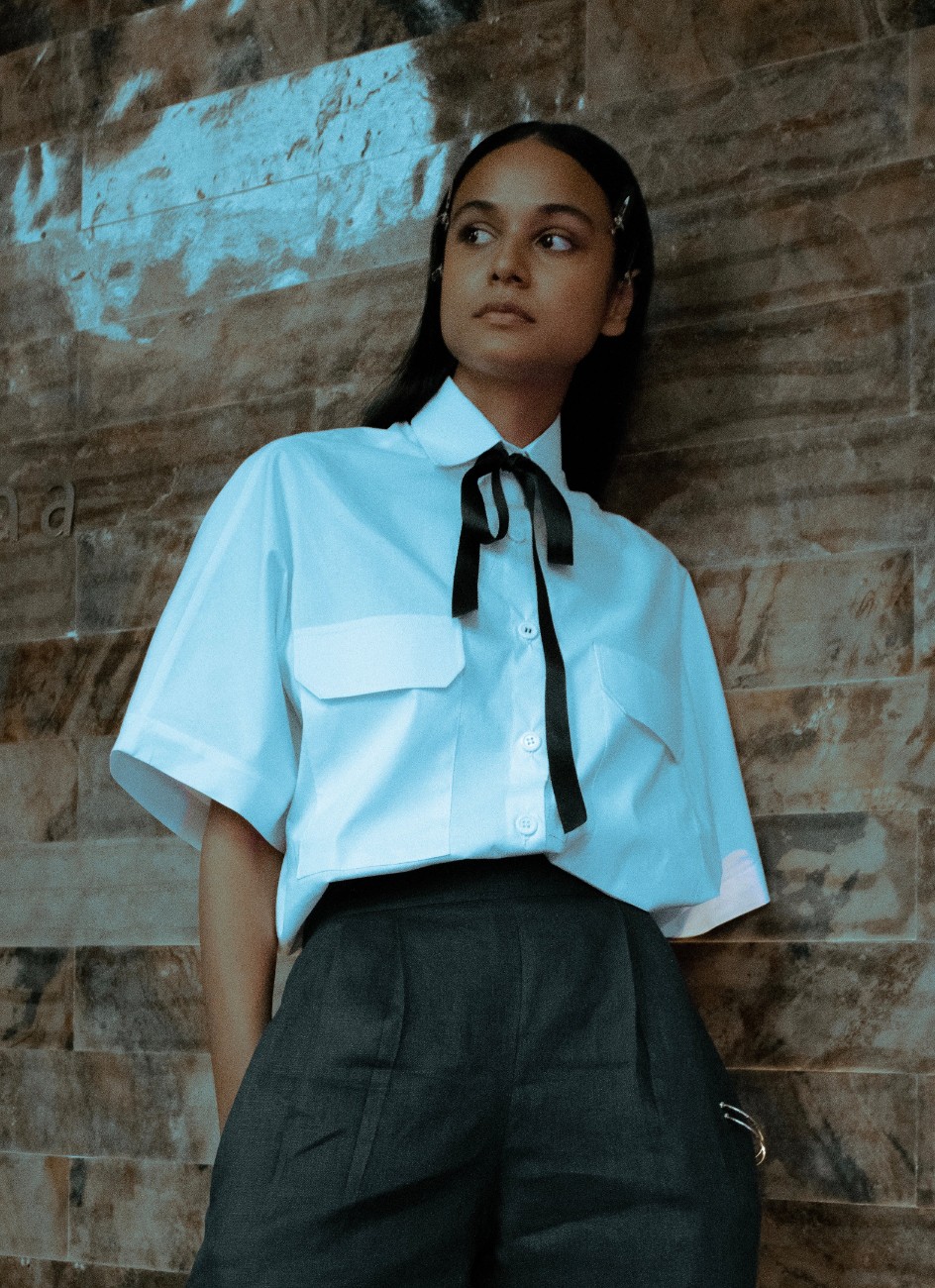
The Jumpsuit 2023 changes the terms of the conversation. Its official description calls it a cotton slouch jumpsuit with an industrial zip and contrasting print ties. Unlike the shirts, which are introduced through a single distinguishing feature each, the jumpsuit is named through a silhouette, a fastening and a patterned component. Those elements coexist rather than compete, and the result is a garment whose description already contains more than one kind of difference.
“Slouch” describes the intended silhouette. “Industrial” characterises the zip in a way that registers a particular aesthetic register, functional and hardware-forward, without making large claims about the garment’s meaning. The contrasting print ties introduce pattern at a specific point rather than distributing it across the whole piece. These are deliberate choices, and collapsing them into a single impression of understatement would misread what the label is actually describing.
The jumpsuit consequently tests the framework the shirts set up. If restraint means removing visible detail, the jumpsuit fits that account awkwardly. If restraint means selecting and organising points of emphasis, then the jumpsuit becomes a more interesting case to consider, not a departure from the collection’s approach. The available description supports that question without settling how the components work together when worn. A physical examination would do more, but the description does enough to distinguish the piece from the shirts.
Contrast Without Invented Symbolism
The printed ties matter because the label explicitly describes them as contrasting. That establishes their relationship to the garment. It does not establish the print’s origin, cultural meaning, or symbolic purpose, and those gaps should remain gaps rather than be filled with assumptions. Similarly, describing the zip as industrial tells you something about the fastening’s aesthetic register. It is not sufficient evidence of a workwear narrative or a reference to a specific industrial context.
A close reading can acknowledge the jumpsuit’s different registers without assigning undocumented intentions. The piece is described through looseness, hardware and print. That combination exists in the garment. The interpretation of what it means in full belongs to the person wearing it, not to a reading made from a catalogue listing alone.
What the Selection Reveals
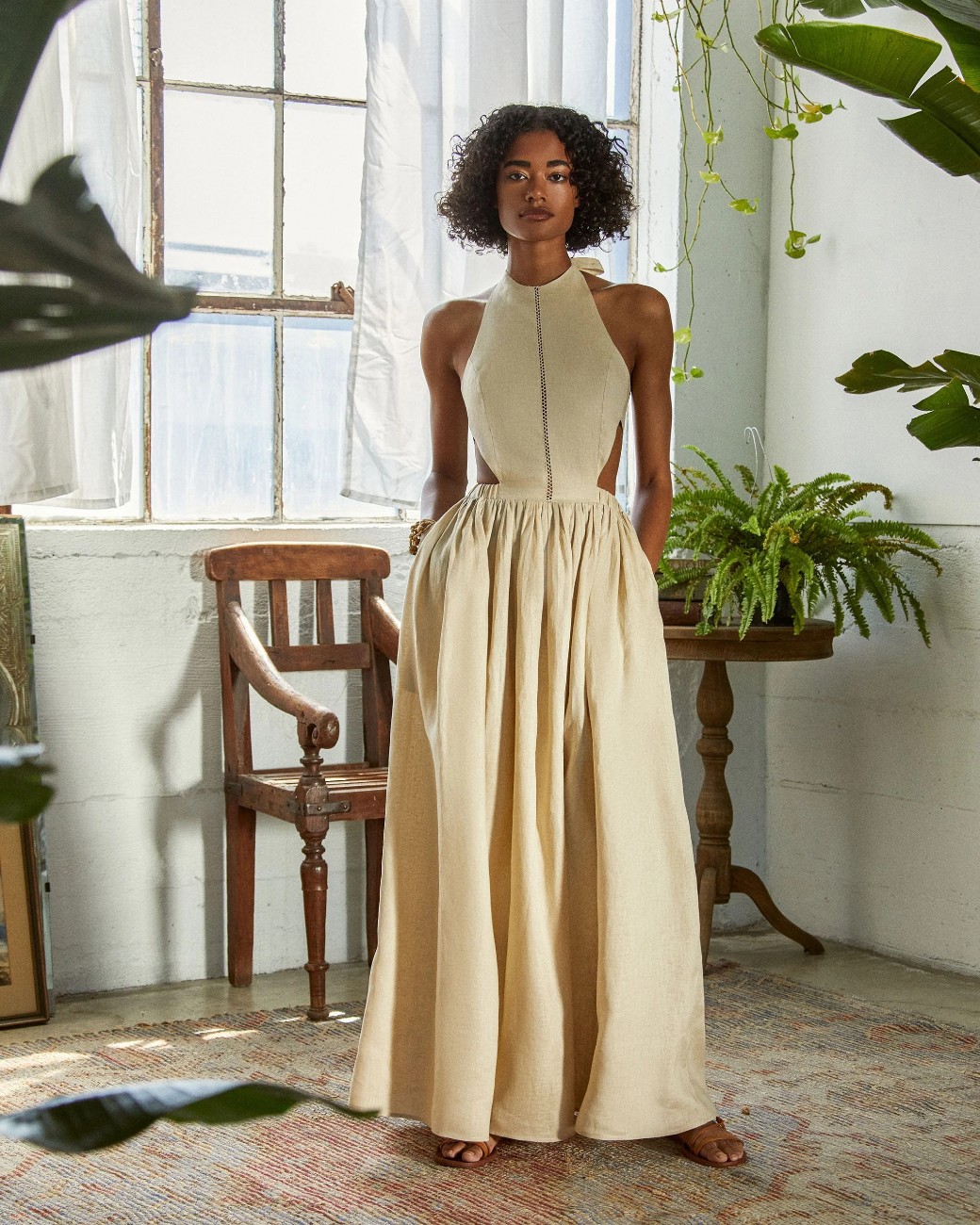
The most convincing shared principle across the three pieces is selectivity. Each garment is introduced through particular decisions rather than an exhaustive description of every component. Yet the decisions differ: sleeves establish asymmetry, a neckline defines an upper edge, and a jumpsuit combines silhouette with contrasting components. The comparison becomes useful when those differences remain visible rather than being smoothed into a single account of the collection.
Meiling’s 2017 interview offers a second, related idea. She notes that a visitor to Trinidad should be able to return to another city wearing her garments and have them admired for what they are. That is a specific aspiration: clothing informed by where it is made, but not dependent on that context for its value. Location shapes the practice; the individual garment should stand on its own. Capsule 23, checked against that aspiration, gives you three pieces made in Trinidad and Tobago from cotton, each differentiated through a specific structural or compositional decision.
Whether each piece meets that aspiration requires seeing them worn. As a reading exercise, the selection makes comparison possible without flattening the differences that make comparison interesting. Cotton provides continuity. The three garments provide variation. That is the structure of a collection worth paying attention to.
Omiren Argument
The question Meiling’s Capsule 23 raises for Omiren is not whether the collection is minimalist. It is whether the editorial habit of reaching for minimalism as a descriptor serves Caribbean designers well. Minimalism as a category carries a specific art-historical and commercial weight, developed largely outside the Caribbean context. Applying it to Meiling’s practice without first asking where each garment places its stated interest risks subordinating design decisions to a pre-existing label.
Selectivity better describes what the three pieces demonstrate. Each one identifies a point of emphasis and organises the garment around it. That is a design discipline, and it deserves its own terms. The relationship between Caribbean fashion and the language used to describe it is one of Omiren’s ongoing concerns. Capsule 23 is a useful case study in how that language can either open or close a reading.
For a fuller account of Meiling’s career and practice, Omiren’s companion piece Meiling: The Trinidad Designer Who Built a Minimalist Language From the Caribbean Sensibility provides the career context this close reading does not attempt. The two pieces are meant to be read together, not as substitutes for one another.
Also Read:
- Meiling: The Trinidad Designer Who Built a Minimalist Language From Caribbean Sensibility
- A Cooler-Weather Wardrobe for Caribbean-Diaspora Occasion Wear
- Global South Fashion: Why Credit Matters
FAQs
Does Capsule 23 Establish a 2023 Release Date for Every Piece?
Not for every piece. Capsule 23 is the collection name used in the current catalogue. Jumpsuit 2023 includes an explicit year in its product name; the other pieces don’t carry the same date marker. This article dates the catalogue check, 12 October 2026, rather than assigning unverified launch dates to individual garments.
What Does Restraint Mean in This Reading?
Here, restraint is selective emphasis: the discipline of identifying a point of interest and organising a garment around it, rather than the absence of detail. It is an editorial interpretation of the catalogue descriptions, not a quoted intention from Meiling herself, and not an assessment based on wearing the garments.
Where Can the Garments Be Viewed?
The Asymmetrical Shirt is listed at meilinginclimited.com. The Funnel Neck and Jumpsuit 2023 are part of the same catalogue. Meiling’s full range and commission or query contact details are available on the official website.