In 2021, Lukhanyo Mdingi from Cape Town won the LVMH Karl Lagerfeld Prize, an award worth €150,000 distributed by one of the world’s largest luxury groups after a multi-stage international competition. His work was included in the V&A Africa Fashion exhibition the following year, a show that travelled from London to Brooklyn, Portland, Melbourne, Chicago and Montreal between 2022 and 2026. By the time of writing, Mdingi has not received a sustained profile in Vogue, the New York Times Style section or Business of Fashion at the depth that the 2021 prize might lead you to anticipate.
This is not a criticism of those publications. It is the opening case for a claim this article intends to test rather than assert: that institutional recognition – from the V&A, from major design awards and from flagship appointments at heritage luxury houses – is a distinct signal layer in African fashion, one that identifies something about a designer that mainstream fashion press criteria are calibrated to find more slowly, or sometimes not at all.
The claim requires testing because the evidence does not consistently support its simplest version. Thebe Magugu won the LVMH Prize in 2019, the first African designer to do so, and the international fashion press arrived within months. Tolu Coker and Torishéju Dumi received Vogue covers in the same editorial cycle as their institutional placements. Grace Wales Bonner’s institutional and press records have run parallel and mutually reinforced over a decade. The article must acknowledge these counterexamples.
The institutional signal does not always precede press attention, nor does it create a designer’s value. What it may do is name a different kind of value – the depth of a designer’s cultural argument, the rigour of their methodology, the durability of their craft – at a moment when the dominant press criteria are looking for something else.
Museum placements, major awards, and flagship appointments are a distinct signal layer in African fashion – one that identifies craft, methodology, and cultural argument before press coverage shows. This pillar examines the evidence, the counterexamples and what the institutional signal actually tells us.
What the Institutional Record Actually Shows
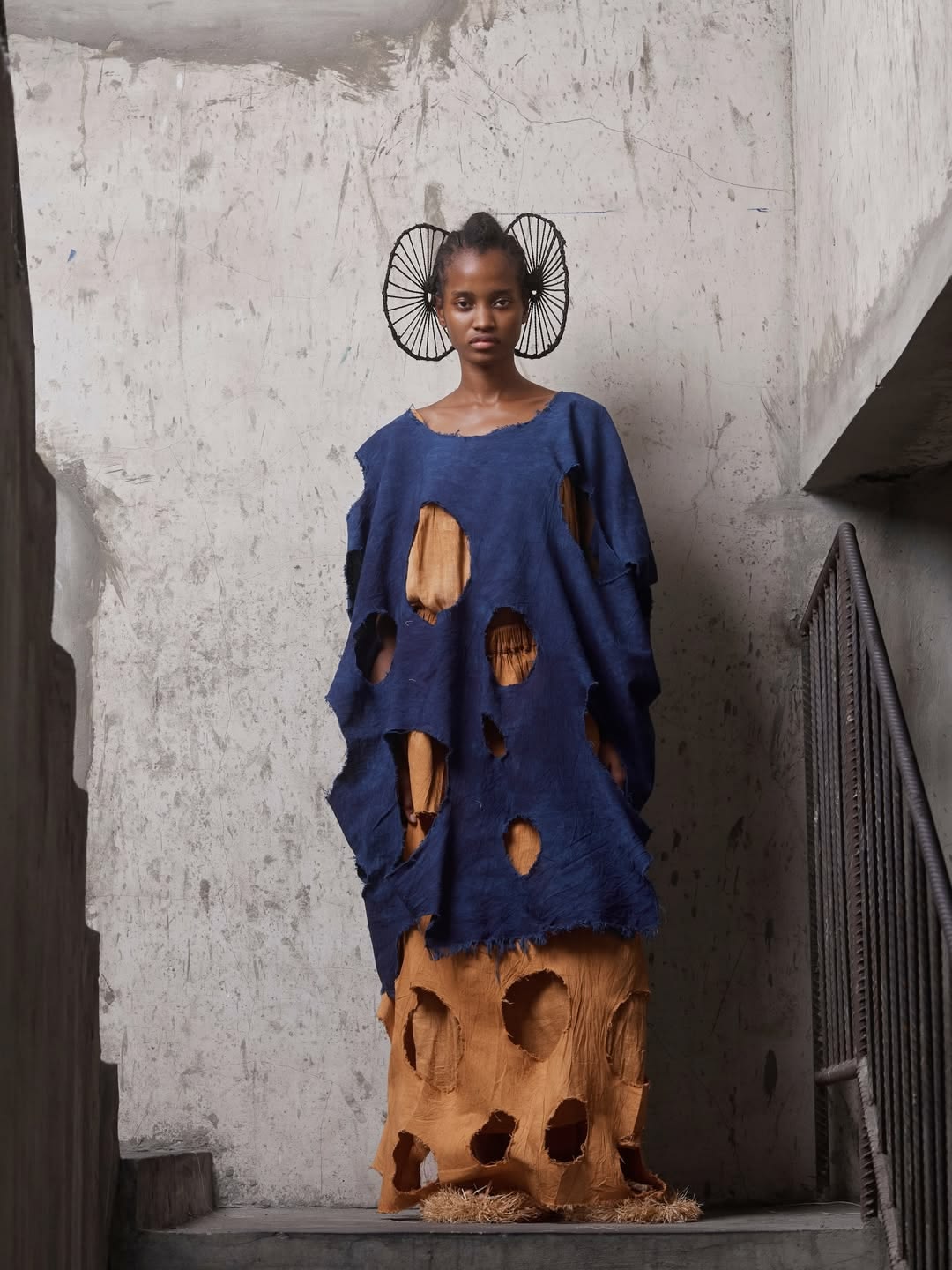
Between 2019 and 2025, the LVMH Prize and its subsidiary awards went to African designers, or designers of African heritage, at a rate that reflects a documented shift in the prize’s geographic distribution.
The LVMH Prize records confirm: Thebe Magugu (South Africa) won the main prize in 2019; Priya Ahluwalia, of British Indian Nigerian heritage, was a joint winner in 2020; Lukhanyo Mdingi (South Africa) won the Karl Lagerfeld Prize in 2021; and Mmuso Maxwell (South Africa) won the Karl Lagerfeld Prize in 2022. In 2025, Tolu Coker and Torishéju Dumi were finalists, with Dumi winning the Savoir-Faire Prize. In the same 2025 cycle, David Boyedoe (Ghanaian) and Yasmin Mansour (Egyptian) were among the semi-finalists.
That is eight prize or shortlist placements in six years. The rate of African or African-heritage representation in the prize’s finalist cohort is higher in this period than in any preceding period since the prize’s establishment in 2014. The comparable shift in the volume of sustained Tier 1 international fashion press coverage of African designers over the same period is harder to measure with comparable precision, because the press’s criteria for what constitutes a sustained profile are not published.
The V&A Africa Fashion exhibition, curated by Dr Christine Checinska, Senior Curator of Africa and Diaspora Textiles and Fashion, presented work from over 20 African countries, comprising 250 objects, designs, photographs, and films. The exhibition confirmed permanent and significant collection holdings, including NKWO’s DAKALA CLOTH from the ‘Who Knew’ collection; IAMISIGO’s ‘Chasing Evil’ collection (AW2020); work by Thebe Magugu, Imane Ayissi, Lagos Space Programme, Lisa Folawiyo and Sindiso Khumalo, among others.
A museum placement and an LVMH Prize shortlist represent different institutional judgements evaluated by different criteria. criteria. Luxury industry figures, fashion editors, and former prize recipients adjudicate the prizes. Curators make the museum acquisition decision based on cultural significance, craftsmanship, and the work’s relationship to the collection’s existing holdings. Both are institutional rather than market signals. Both are worth examining for what they reveal: that retail heat, celebrity adjacency, and trend coverage do not.
The Counterexamples and What They Reveal
The three strongest counterexamples to the ‘institutional precedes press’ claim are also the three most important cases for understanding what the institutional signal actually is.
Thebe Magugu’s LVMH Prize win in 2019 was itself a press event. The New York Times, Vogue and Business of Fashion covered the prize result within weeks, and the profile pieces followed within months. The prize did not precede the press; it generated the press. This is because the LVMH Prize is structured partly as a media event: it has a jury composed in part of fashion editors, generates press releases, and attracts fashion media to its final presentation. The gap between institutional recognition and press coverage, if it exists, is not evident at the LVMH Prize main award level because the prize itself is part of the press ecosystem.
Grace Wales Bonner is the strongest single case for institutional career architecture in this evidence base and also the strongest counterexample to a simple institutional-precedes-press reading. Wales Bonner won the LVMH Prize in 2016, exhibited at MoMA in 2023, contributed work to the Met Costume Institute’s ‘Superfine: Tailoring Black Style’ exhibition in 2025, and was appointed Menswear Creative Director at Hermès in October 2025, with her debut collection scheduled for January 2027. Her British Fashion Award for Menswear Designer of the Year, her MBE for services to fashion and her sustained adidas Originals collaborations are all documented. Her press coverage has been substantial throughout. Institutional and press recognition have not been sequential. They have run in parallel and reinforced each other.
Tolu Coker and Torishéju Dumi appear together in a December 2023 British Vogue cover story on sustainable British design, alongside Priya Ahluwalia. Both were named in the Vanguard category at the 2025 British Fashion Awards. Dumi won the LVMH Savoir-Faire Prize in 2025. The press and the institutional cycle arrived in the same two-year window, not in a sequence with a meaningful gap between them.
The counterexamples reveal that the institutional signal is most visible as a distinct layer where the institution doing the recognising is not itself a press event: the quiet V&A collection acquisition, the award whose press coverage is limited to specialist publications, the museum group show that does not generate a standalone profile. For those recognition events, a gap between institutional and press timing is plausible, and, in cases like Mdingi and Mmuso Maxwell, the research brief for this article found evidence consistent with that gap.
What Institutions Know That Press Criteria Do Not Always Reach
The more defensible version of this article’s opening claim is not that the press lags behind institutions, but that institutions and the fashion press measure different things, and that what institutions measure may be more durable.
Museum curators evaluating work for acquisition or exhibition ask: what cultural argument does this work make, how does it engage with the collection’s existing holdings, what craft tradition does it sit within and extend, and will this work remain significant when its commercial moment has passed? Award juries – at least at the level of the LVMH Prize and the British Fashion Awards – are asking similar questions, alongside assessments of commercial viability.
Fashion press, including the publications this article treats as ‘Tier 1,’ works within an editorial frame that prioritises commercial heat, celebrity association, trend relevance, and how quickly a designer generates excitement in the specific markets the publication serves. These are legitimate editorial criteria. They also differ from institutional criteria, and they produce different discovery timelines for designers whose primary strength is cultural argument rather than commercial excitement.
As Omiren Styles documents in its profile of African menswear designers, Kenneth Ize’s statement about what his practice means names the community of weavers in Ilorin, south-west Nigeria, whose work generates every collection. That community relationship is the cultural argument. A fashion press profile whose primary angle is ‘the next big thing from Lagos’ will include the community as context; a museum acquisition decision about an ensemble that carries those weavers’ labour directly into its surface will assess the community relationship as the primary criterion for significance. These are the same garments being read by different instruments.
This is not an argument that institutions are right and the press is wrong, or that institutional recognition is more valuable than press coverage. Commercial visibility matters to makers, and press coverage is one of the most direct routes to commercial visibility. The argument is that the institutional signal conveys something specific and that reading it alongside the press record provides a more complete picture of a designer’s trajectory than reading either one alone.
The Question in the Title
‘Who gets to name Africa’s next fashion houses’ is not a question with a clean answer, and the evidence this article has assembled does not produce one.
The institutions – the V&A, the LVMH Prize jury, the British Fashion Awards, the museum curators who build collections and the appointment committees at legacy houses – are naming designers in specific, documented ways that have consequences for those designers’ careers. Grace Wales Bonner at Hermès is the most commercially significant recent example: an institutional and critical trajectory that arrived at one of the most consequential appointments in contemporary fashion. The institutional record preceding that appointment shows the institution knew before the appointment was announced.
As Omiren Styles has established in its analysis of how African fashion brands can expand without flattening their design language, the commercial infrastructure gap lies between visibility and sustainable commerce. The institutional signal addresses the visibility end of that gap in a specific way: it makes a designer visible to the buyers, curators, appointment committees and collectors whose decisions shape long-term trajectories rather than seasonal commercial cycles. For the designers whose institutional recognition has not yet translated into sustained international press coverage – Lukhanyo Mdingi and Mmuso Maxwell are the most clearly documented cases in this evidence base – the institutional record is the most complete available public account of what the work is doing.
[Tracker link: The Omiren Institutional Tracker – a regularly updated reference documenting African designers with confirmed museum placements, major award placements and flagship appointments, with dated institutional records and commercial trajectory notes – will be published as a companion cluster piece. Link to be inserted here on publication.]
The question of who gets to name is also a question about whose naming carries what consequences. A V&A acquisition signals to a specific audience – curators, collectors, institutions – that the work meets a particular standard. An LVMH Prize generates a specific commercial and financial outcome for the winner. A Hermès appointment is a different kind of naming entirely: it puts the designer’s methodology at the centre of a house that will build collections from it. These are three different kinds of naming with three different kinds of consequence, and reading them as a single category called ‘institutional recognition’ flattens what makes the comparison interesting.
The Omiren Argument
The institutional signal is worth reading. It is not a proxy for the designer’s value – the designer’s value was built through the designer’s work in communities, studios, and ateliers that the institutional record may not fully capture. What the institutional signal does is confirm that value for an audience that the press has not yet fully reached, in a language – acquisition, award, appointment – that carries specific consequences.
For African fashion specifically, the institutional signal is currently doing work that the international press infrastructure has not fully calibrated to do. The V&A exhibition that placed NKWO, IAMISIGO and Lukhanyo Mdingi in the same institution, whose collection their work now permanently inhabits, was making a statement about what African fashion is and has been, one that is different in kind from a trend piece or a seasonal preview. The statement is more durable, more specific and more consequential for the designers’ long-term trajectories than most of what the press cycle generates.
This article does not settle the question of who gets to name. It remains a live question, worked out in real time through the decisions of curators, award juries, appointment committees, fashion editors, and, most importantly, the designers themselves whose work generates all of the above. The institutional record is the most durable part of that conversation’s public archive. Reading it alongside the press record and the commercial record begins a more complete account of what African fashion is becoming.
As Omiren Styles has argued throughout this series, the Global South made fashion and never got credit. The institutional signal – the LVMH Prize shortlist, the V&A acquisition, the Hermès appointment – is credit in one of the forms the industry produces. It is not the only form, and it is not always the most commercially immediate. But it is the most durable, and for designers whose work is built on cultural argument and craft depth rather than commercial heat, it is the signal that most accurately reflects what the work is worth.
[Tracker link: Quarterly Evidence Update – new institutional placements, corrections to existing records and evidence that changes the analysis of this essay – will be published as a companion cluster piece. Link to be inserted here on first update.]
ALSO READ
- Meet the African Menswear Designers You Should Know Before the Rest of the World Does
- Afro-modernism in Fashion: The African Designers Defining a New Design Language
- Nkwo Onwuka and the Dakala Cloth That Changed What Nigerian Fashion Could Be
- African and Diaspora Fashion in London: Designers, Institutions and Community Style
- The Global South Made Fashion. It Just Never Got Credit.
Frequently Asked Questions
What is the ‘institutional signal’ in African fashion?
The institutional signal refers to a specific layer of recognition that is distinct from fashion press coverage: permanent museum acquisitions, major design award placements (the LVMH Prize, the Karl Lagerfeld Prize, the International Woolmark Prize, the British Fashion Awards), significant public collection placements (V&A, Met Costume Institute, NGV Melbourne) and flagship appointments at heritage luxury houses (such as Grace Wales Bonner’s appointment as Menswear Creative Director at Hermès, announced in October 2025). These recognitions are evaluated by criteria – cultural significance, craft argument, methodological depth – that differ from the commercial and trend-relevance criteria that shape mainstream fashion press coverage, and they may identify different aspects of a designer’s value at different points in their career.
Does institutional recognition always precede fashion press coverage for African designers?
No. The evidence does not consistently support that claim, and this article explicitly names the counterexamples. Thebe Magugu’s LVMH Prize win in 2019 generated immediate international press coverage in the same cycle. Grace Wales Bonner’s institutional and press records have been parallel throughout her career. Tolu Coker and Torishéju Dumi received major press and institutional recognition in the same two-year window. Where the gap is most visible is in the quieter tier of institutional recognition – V&A collection acquisitions, Karl Lagerfeld Prize placements – for designers like Lukhanyo Mdingi and Mmuso Maxwell whose international press profile has not expanded at the same rate as their institutional record. That gap is real and documented; the claim that it represents a general rule is not.
Why does the distinction between institutional and press recognition matter specifically for African fashion?
As Omiren Styles has established, in its analysis of how African fashion brands can expand without flattening their design language, the international press infrastructure for African fashion is still calibrating its discovery and coverage timelines. In that context, the institutional record – the V&A acquisition, the award shortlist, the appointment committee’s decision – may be the most complete available public account of what a designer’s work is doing before mainstream press attention arrives. For the designers, curators, collectors and appointment committees who read institutional signals as primary evidence of a designer’s trajectory, this is a practically significant distinction. For the designers whose work is being evaluated, understanding that different audiences are reading different signals helps explain why their career is tracking differently than their press profile might suggest.
What does the LVMH Prize tell us about a designer’s trajectory?
The LVMH Prize records show eight African or African-heritage prize or shortlist placements between 2019 and 2025. The main prize, worth €300,000 to €400,000 plus a year of LVMH mentorship, has been won by Thebe Magugu (2019) and, at the subsidiary prize level, by Lukhanyo Mdingi (2021), Mmuso Maxwell (2022), and Torishéju Dumi (2025). The prize is worth reading as an institutional signal for several reasons: its jury combines luxury industry figures with fashion editors and former prize recipients; it evaluates designers across multiple stages before the final; and its track record of identifying designers who go on to significant careers is documented across its eleven years. Its limitation as a signal is that the prize itself is a press event, which means that for main prize winners, institutional recognition and press coverage arrive in the same moment rather than in sequence.
EXPLORE MORE
Read the full Opinion and The Omiren Argument sections at Omiren Styles for ongoing editorial analysis of African fashion’s institutional recognition, evidence of how designers are identified and validated by different systems, and quarterly updates that track new placements and correct the record. Discover travel and heritage intelligence across Africa, the Caribbean and Latin America at Rex Clarke Adventures.