British fashion has a documented tailoring debt to the Caribbean.
The passenger list of the SS Windrush records 34 tailors, 11 dressmakers and 10 shoemakers among those who arrived in 1948. The London Museum’s documentation of this history names individuals: Winston, the Jamaican tailor who set up in a Camberwell garden shed and whose suits, by the account of those who wore them, surpassed anything available on the high street. Clifford Fullerton, who became the first Black associate member of the City of London Master and Foreman Tailors Society. These are not anecdotes. They are part of the structural history of how British tailoring developed, and major institutions now acknowledge them.
As Omiren Styles has documented in its analysis of African and diaspora fashion in London, London’s tailoring tradition was shaped by Caribbean migrant cutters who worked on Savile Row from the Windrush era. Its nightlife-to-runway pipeline ran through reggae, jungle, garage, grime and Afrobeats scenes built by Black British communities. That credit has begun to arrive. Exhibitions, institutional histories and fashion journalism have started to acknowledge what the passenger records and community memory have always known.
The East African dimension of the same story has not received equivalent attention.
When UK fashion and heritage institutions acknowledge the African contribution to British tailoring, they have primarily documented the Caribbean lineage. East Africa’s tailoring traditions, the East African communities that settled in the UK, and the specific garment cultures they carried remain in the research gap rather than in the record.
This is not an accusation. It is a research problem. The record is incomplete because the documentation has not been done with the same specificity. This article sets out what that documentation requires: what East African tailoring traditions actually exist, what the diaspora connection looks like, what the UK fashion debt might involve, and why research precision matters as much as the acknowledgement itself.
UK fashion has begun to acknowledge its Caribbean tailoring debt. The East African dimension remains underdocumented. Omiren sets out what the research requires and why precision matters.
What East African Tailoring Traditions Actually Exist

Before any attribution argument can be credible, the traditions themselves must be accurately named. East Africa is not a single tailoring culture. Kenya, Tanzania, Uganda, Ethiopia, Somalia, Rwanda, Burundi, Eritrea and Djibouti each have distinct dress systems, textile histories and garment construction traditions. Treating them as one thing is an attribution error in the opposite direction: it replaces an erasure with a generalisation.
The traditions most relevant to a UK tailoring credit conversation are those carried by communities that settled in Britain during the post-colonial migration period from the 1960s onward. That migration included East Africans of South Asian descent, expelled from Uganda in 1972, who brought with them tailoring cultures shaped by the intersection of South Asian textile knowledge and East African dress practice. It included Kenyan, Tanzanian and Ugandan settlers who carried the dress culture of their home communities into British cities. It also included the Swahili coast tradition that has shaped dress in coastal East Africa for centuries.
The kanzu is the most architecturally significant garment in the East African coastal tailoring tradition. A full-length white robe worn by men along the Swahili coast from Mombasa to Dar es Salaam, it represents a sophisticated construction tradition that blends Arab, Indian Ocean and local East African design influences. As Omiren Styles has documented in its full analysis of the East African kanzu, the kanzu is not a simple garment. Its construction, fit, fabric selection, and the social knowledge of when and how to wear it form a complete tailoring system sustained across generations. People wear it with the kofia, a small embroidered cap, in contexts ranging from daily dress to ceremony. The kanzu is not historically confined to Kenya or Tanzania: it appears across the Swahili coast and its diaspora, including among East African communities in the UK.
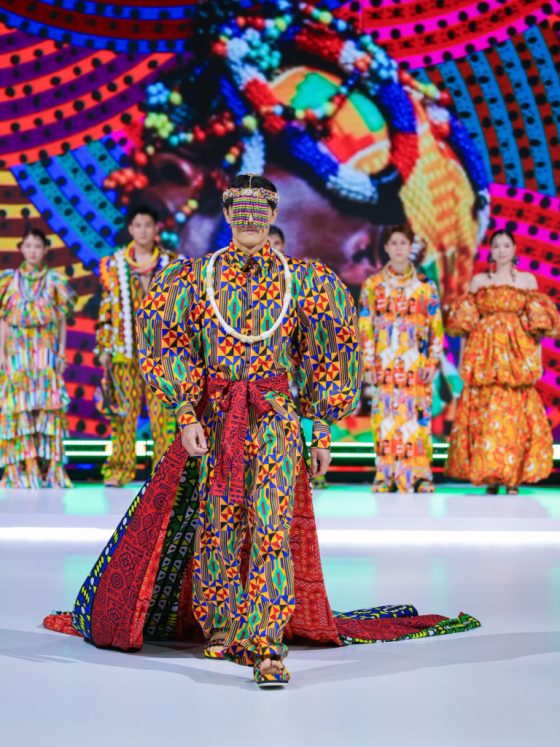
The kitenge is the most widely recognised everyday textile across Kenya, Tanzania and Uganda. As Rex Clarke Adventures has documented in its analysis of African fabrics as identity markers, kitenge is a vibrant, 100% cotton wax-printed fabric originating from East and Central Africa, traditionally used across Kenya, Tanzania, Uganda and parts of the Congo for skirts, dresses and everyday garments. The tailoring traditions that have developed around kitenge in each of these countries are distinct: Ugandan tailors work with kitenge differently from Kenyan tailors, who work differently from Tanzanians. The generalisation “East African fabric” misses those distinctions.
The kanga, documented in depth in Omiren Styles’ full analysis of the kanga as a living language of East African culture, operates as a printed cotton textile whose social function is inseparable from the Swahili inscriptions it carries. Its message-bearing dimension is what makes kanga more than a fabric: it is a form of communication that operates through dress. The tailoring decisions around kanga, how to fold, wrap, display and layer it, constitute a form of knowledge that is transmitted through community practice rather than through pattern documentation.
The Swahili coast’s broader dress system, documented in Omiren Styles’ analysis of Swahili coast influence on Kenyan design, also includes the buibui, a full-length modesty dress for women, and the dirac, worn by coastal women including those of Somali heritage. The Somali garment traditions of the Horn of Africa, documented in Omiren Styles’ analysis of the Somali Sadex Qayd, include the gorfo, the guntiino and the garbasaar: a full women’s dress system with its own construction vocabulary, fabric knowledge and ceremonial logic.
Each of these traditions is specific. None of them is interchangeable. The research task is to identify which of these traditions were carried by communities that settled in the UK, how those traditions manifested in British tailoring practice, and whether specific influences on UK fashion can be traced with the same precision applied to the Caribbean tailoring lineage.
The East African Diaspora in the UK and Its Tailoring Context

East African communities arrived in the UK through multiple migration routes, each with its own timeline, dress culture, and relationship to the region’s tailoring traditions.
The most significant single migration event for East African dress culture in the UK was the expulsion of South Asian Ugandans in 1972. Approximately 27,000 Ugandan Asians arrived in the UK within months, carrying a dress culture that was itself a layered fusion: South Asian textile knowledge, Muslim dress traditions, the social coding of dress in colonial-era East Africa, and the specific fashions of Kampala’s Indian-heritage communities. These communities settled primarily in Leicester, London, and Birmingham, bringing tailoring knowledge, fabric-sourcing relationships, and dress practices that were East African in formation and South Asian in some of their technical heritage.
Kenyan and Tanzanian settlers arrived across a longer timeline, from the 1960s independence period onward. These communities carried the coastal Swahili tradition, the kitenge tailoring culture of the interior, and the formal dress codes associated with post-independence professional life. In Britain, community dress practice continued in domestic and ceremonial contexts: weddings, religious occasions, cultural events and the everyday choices of people maintaining connection to their home dress cultures in a context where those cultures were not publicly visible.
Ugandan, Rwandan, Burundian and other East African communities arrived through later migration waves, including the refugee settlements of the 1990s and 2000s. Their dress cultures are more recent additions to East African tailoring in the UK. Still, they reflect the same fundamental dynamic: specific garment knowledge, fabric traditions, and tailoring skills carried across migration and sustained in a new environment.
This research must answer: in what specific ways did these communities influence British tailoring? That question has a different texture from the Caribbean tailoring question. Caribbean tailors arrived on the SS Windrush as professionals, immediately entered the British tailoring market, and worked within the established British tailoring industry while shaping it from within. The East African tailoring presence in the UK has operated more within community practice and diaspora commercial tailoring, serving community weddings, providing garments for cultural occasions, and sustaining dress cultures in private and semi-private contexts rather than primarily within the mainstream British fashion industry.
Where the Research Needs to Go

Establishing the East African dimension of UK tailoring credit requires specific research that has not yet been systematically conducted.
The first is oral history documentation. The tailors, dressmakers and fabric merchants in East African diaspora communities across Leicester, London, Birmingham and other cities hold knowledge that is not in any published record. They know the specific garment construction techniques they brought from Nairobi, Kampala, Dar es Salaam, Mombasa or Addis Ababa. They know how those techniques were adapted for British fabrics, British clients and British dress occasions. They know which UK designers or design students have come to them for fabric or construction knowledge. That knowledge will disappear with its holders unless it is recorded.
The second is institutional archive research. The London Museum’s documentation of Windrush tailoring history shows that passenger records, community records, guild records, and institutional archives can be used to establish specific named individuals as part of British tailoring history. Equivalent research in East African community organisations, cultural institutions, immigration records and the archives of tailoring businesses in East African diaspora communities could produce the same kind of specific, named, documentable history.
The third is design history research. When UK designers, particularly those associated with the 1980s and 1990s period of African and multicultural influence in British fashion, reference East African fabrics or construction techniques, can those references be traced to specific community encounters, specific fabric merchants, or specific technical knowledge encountered through diaspora relationships? The answer may sometimes be no. But the question has not been systematically asked.
The fourth is comparative garment analysis. The kanzu’s construction influences, the kitenge tailoring tradition’s approach to drape and silhouette, and the kanga’s wrap-and-display logic all have formal properties that could be traced in UK fashion if the comparison were made systematically. Has anyone looked at whether UK resort fashion of the late twentieth century carries structural echoes of East African wrap traditions? Has anyone examined whether specific tailoring techniques documented in Kenya or Tanzania appear in the work of UK designers who had East African connections?
These are research questions, not established claims. The point is that the research has not been done at the level of specificity that the Caribbean tailoring history has been documented. Omiren Styles identifies that absence as the credit gap, and better documentation would begin to close it.
Why Precision Matters More Than General Acknowledgement

The difference between saying “African tailoring influenced British fashion” and naming specific communities, specific individuals, specific techniques and specific design relationships is the difference between a gesture and a record.
A gesture can be made without research. An acknowledgement in a fashion week programme, a museum caption that mentions “African influence,” a collection note that gestures toward “the global tailoring tradition”: these are gestures. They correct the silence. They do not build the record that changes what future researchers, designers, educators and institutional archives understand about where British tailoring came from.
As Credit Is Not Compensation established across this series, the scorecard for what fashion owes beyond a vague acknowledgement includes documentation: the knowledge system behind a reference must be explained at a level that preserves its meaning and educates rather than merely decorates. A collection note that says “inspired by East African textile traditions” without naming which tradition, which community, which country, which specific garment or textile, and what the actual influence on the collection’s construction is, has not documented anything. It has performed credit without producing it.
Precision also matters for the communities being credited. A Ugandan tailor in Leicester whose family brought kanzu construction knowledge from Kampala in 1972 is not meaningfully credited by a UK fashion institution’s acknowledgement that “African tailoring shaped British dress.” That acknowledgement does not reach them. It does not name their contribution. It does not create the historical record that future researchers could use to trace and build upon. Precision creates the record. Generality creates the impression of a record while leaving the gap intact. As After Attribution: Who Owns the Commercial Life of a Cultural Reference? argued, the commercial life of a reference extends far beyond the moment in which it is credited. The same applies to the historical life of a tailoring influence: it extends through design education, institutional history, commercial positioning and the public understanding of where UK fashion came from. A precise record has a different cultural value than a vague one.
What Omiren Is Documenting and What It Needs

Omiren Styles is building the East African tailoring credit record through the same method it has applied to other attribution questions in this series: naming what exists, documenting it specifically, tracing the commercial and cultural life of the reference, and making the record harder to erase.
The kanzu documentation is in place. The kanga documentation is in place. The Swahili coast dress system documentation is in place. The Somali dress system documentation is in place. What is not yet in place is the specific link between those traditions and their presence in UK tailoring practice: the named individuals, the documented community tailoring businesses, the specific technique transfers, and the design history connections that would allow a UK fashion institution to acknowledge the East African tailoring contribution with the same precision that has been applied to the Caribbean tailoring lineage.
That link requires community research that Omiren is beginning and that this article is inviting. If you are an East African tailor or dressmaker in the UK, or if you know someone who is, and you are willing to speak about the garment traditions you brought from your home country and how they have developed in a British context, this is the research that needs your participation. If you are a UK fashion researcher who has encountered East African tailoring influences in archival material or design history, the record of what you have found should be published. If you are a designer whose work has been influenced by East African dress knowledge encountered through diaspora community relationships, naming that influence specifically is exactly the kind of documentation this series has argued the industry owes.
The work is the same work this series has been doing across every territory it has covered: Global South-made fashion that never got credit. The East African dimension of that argument has been less visible than the West African, Caribbean, and Latin American dimensions that have received more documentation. Making it visible is not a claim about the scale of the influence relative to other contributions. It argues that every contribution deserves specific, named, verifiable documentation. East African tailoring traditions have been carried into the UK by communities that built lives, businesses and cultural practices here. The record should acknowledge them by name.
The Omiren Argument
UK fashion’s acknowledgement of its African tailoring debts has advanced. The Windrush tailoring lineage has been exhibited, documented, published and named. That advance is real and should be recognised as such.
The East African chapter of the same story has not received equivalent research attention. The communities are here. The traditions they carried are specific and documented at the level of the garment systems themselves. The oral history, institutional archive, and design history research needed to connect those traditions to their specific UK tailoring influence has not been done systematically.
What is required is not another general acknowledgement that African tailoring shaped British fashion. What is required is the same precision that the Windrush tailoring documentation achieved: named individuals, documented community tailoring practices, specific technique transfers, verifiable design connections. That precision changes history rather than simply acknowledging the gap in it.
Omiren Styles is committed to building that record. This article begins the research case. The documentation will follow from the research. And as the series has argued from its first article to its most recent: documentation changes the balance of power. This publication will name what the fashion system has left vague.
ALSO READ
- African and Diaspora Fashion in London: Designers, Institutions and Community Style
- The Swahili Coast’s Influence on Kenyan Design: Kanga, Kikoi, and the Fabric of an Ocean Civilisation
- The East African Anchor: The Evolution of the Kanzu
- Kanga Cloth: The Fabric That Speaks
- Credit Is Not Compensation: What Fashion Owes Beyond Naming a Cultural Source
- The Global South Made Fashion. It Just Never Got Credit.
Frequently Asked Questions
What is the East African tailoring tradition and how does it relate to UK fashion?
East Africa contains multiple distinct tailoring and dress traditions across Kenya, Tanzania, Uganda, Ethiopia, Somalia, Rwanda and the Swahili coast. The kanzu, a full-length white robe worn by men across the Swahili coast, represents a sophisticated construction tradition shaped by Arab, Indian Ocean and local East African design influences. The kitenge, a cotton wax-printed fabric worn across Kenya, Tanzania and Uganda, has produced distinct tailoring cultures in each country. The kanga, with its Swahili inscriptions, operates as both a garment and a communication system. East African diaspora communities who settled in the UK from the 1960s onward carried these traditions, including the 27,000 Ugandan Asians who arrived in 1972 and brought a dress culture shaped by the intersection of South Asian textile knowledge and East African dress practice. Their specific influence on UK tailoring remains underdocumented in terms of named individuals and specific technique transfers.
Why has the East African tailoring contribution received less documentation than the Caribbean contribution?
The London Museum’s documentation of Caribbean Windrush tailoring was possible because Caribbean tailors arrived in 1948 as named professionals on a documented passenger list and immediately entered the established British tailoring industry, working within Savile Row, community tailoring businesses and the mainstream fashion market. Their contribution left a record in industry guild memberships, employer histories and community memory that could be traced and documented. East African tailoring communities arrived through later, more dispersed migration routes, often sustaining dress practice within community contexts rather than within the mainstream British tailoring industry. Their contribution is real but less traceable through the same archival methods, requiring oral history documentation, community archive research and design history connections that have not yet been systematically pursued.
What is the kanzu and why is it significant for East African tailoring history?
As Omiren Styles has documented in its full analysis of the East African kanzu, the kanzu is a full-length white robe worn by men across the Swahili coast from Mombasa to Dar es Salaam. Its construction tradition blends Arab, Indian Ocean, and local East African design influences, and the social knowledge of when and how to wear it, what fabric to select, how to fit it, and how to maintain it constitutes a complete tailoring system. The kanzu is worn with the kofia in contexts ranging from daily dress to ceremony, and East African coastal communities have carried it to the UK. Its specific influence on UK tailoring has not been formally documented. Still, the tradition itself is sophisticated enough to have left traces in UK dress practice that a systematic research programme could identify.
What research is needed to document the East African tailoring contribution to UK fashion precisely?
Four forms of research are required. Oral history documentation with East African tailors, dressmakers, and fabric merchants in UK diaspora communities would capture technique transfers, adaptation processes, and community tailoring practice not recorded elsewhere. Institutional archive research in East African community organisations, immigration records and cultural institutions could identify named individuals as part of the British tailoring history. Design history research examining when UK designers referenced East African fabrics or techniques, and whether those references can be traced to specific diaspora community encounters, would establish the credit connection. Comparative garment analysis examining whether UK fashion carries structural echoes of East African wrap traditions or specific construction techniques documented in Kenya, Tanzania or Uganda would create the formal evidence base. No research has systematically done this.
How does the East African tailoring argument connect to the wider series on credit and attribution?
This series has argued throughout that the fashion industry’s habit of acknowledging “African influence” without specifying which communities, traditions, individuals, or specific design connections amounts to a gesture rather than a record. The East African tailoring contribution to UK fashion is an instance of that same problem: a contribution that is real and specific but has not been documented with the precision needed to convert the acknowledgement from a gesture into a record. The argument is not that the East African contribution is the largest or the most commercially significant. The argument is that every contribution deserves specific, named, verifiable documentation, and that the documentation creates a historical record that general acknowledgement cannot.
Where can I find documentation of East African dress traditions that relate to the UK tailoring question?
Omiren Styles has documented the kanzu in The East African Anchor: The Evolution of the Kanzu; the kanga system in Kanga Cloth: The Fabric That Speaks; the full Swahili coast dress system in The Swahili Coast’s Influence on Kenyan Design; and Somali dress traditions in Inside the Somali Sadex Qayd. Rex Clarke Adventures covers the broader geography of East African fabric culture in African Fabrics as Identity: Adire, Kente and Kitenge, and the travel and heritage context in Best Countries to Visit in East Africa.
EXPLORE MORE
Read the full The Lens and Fashion > Power series at Omiren Styles for the complete documentation of cultural attribution, tailoring credit and the specific research the fashion industry owes to African and diaspora communities whose dress knowledge shaped it. Discover travel and heritage intelligence across East Africa at Rex Clarke Adventures.