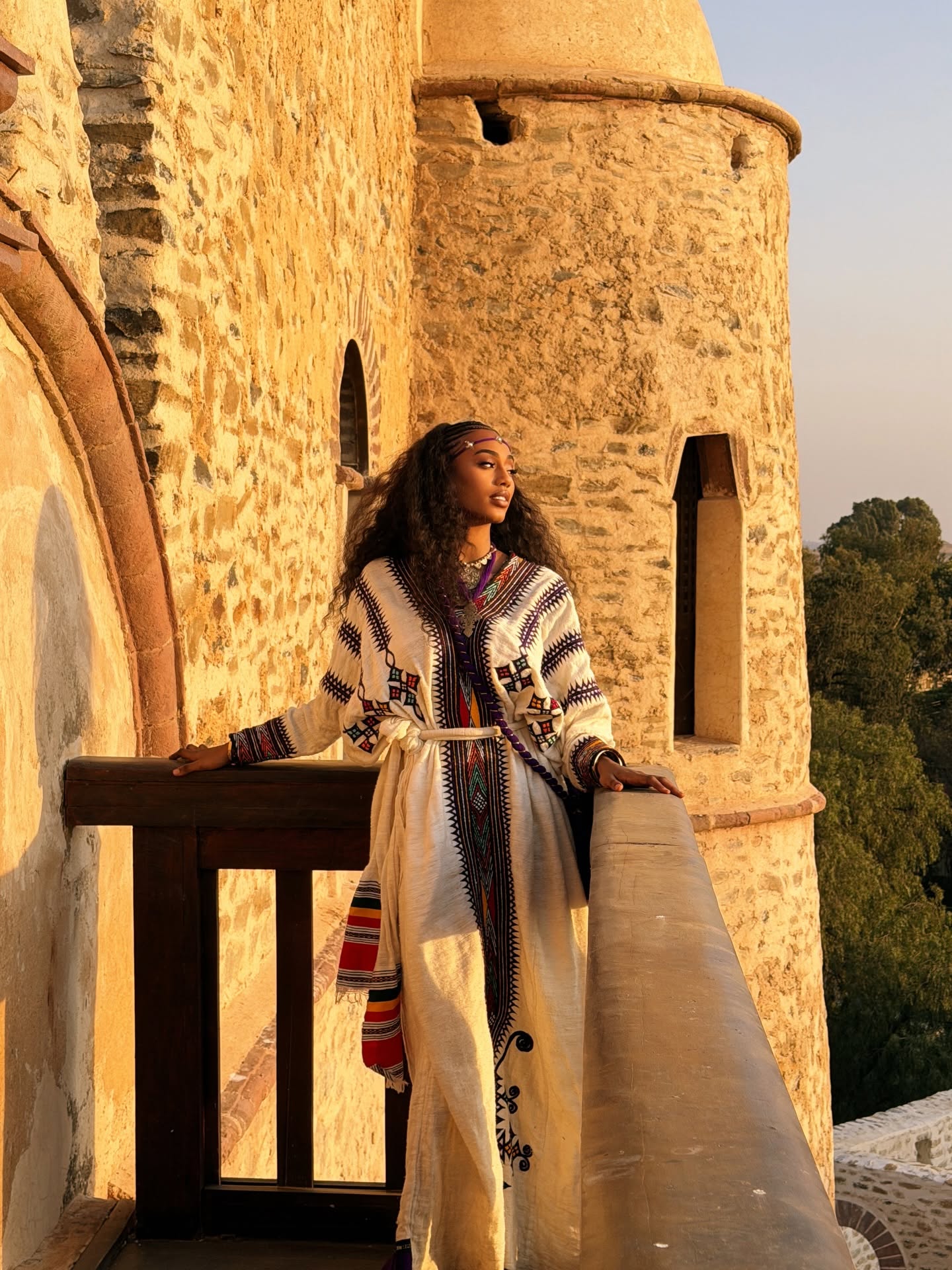
The Gondar Amhara dress does not begin at the loom. It begins in the lowland plains of Welkait, Tegede, Humera, and Metema, where cotton has been grown for export, for processing, and for the highland weaving workshops that turn it into the Habesha kemis. Understanding the garment requires understanding the chain: the cotton belt, the gin processing, the hand-spinning (fetel), the pit-loom, the embroidery, and finally the dress. Each stage is specific. Each stage is Amhara. As Omiren Styles has documented in its analysis of African fashion as a living archive, the traditions that carry the deepest cultural authority are those whose supply chains remain embedded in the communities that produced them.
Gondar is historically known as Begemder and served as the 17th-century capital of the Ethiopian Empire. It sits within a larger Amhara region that includes Shewa, Wollo (historically called Bete Amhara), and Gojjam, each contributing its own harvests, spinning traditions, and textile styles to a shared heritage. The Gondar dress carries the visual signature of that capital history: a restrained elegance, a specific embroidery placement rule, and a garment construction that has not fundamentally changed in centuries.
The Gondar Amhara dress runs from cotton farms in Welkait and Humera through pit-loom weavers to hand-embroidered fetel kemis. Here is the full chain, from raw fibre to finished garment.
The Cotton Belt: Welkait, Tegede, Humera, and Metema
The agricultural foundation of the Gondar dress sits in the wide lowland plains that stretch along the northwestern border of Ethiopia adjacent to Sudan. The Welkait, Tegede, and Setit Humera Zone, alongside the Metema and Quara districts, form what local economists refer to as the “Land of White Gold.” The flat, fertile Humera plains support large-scale, rain-fed farming with heavy machinery and are internationally known for exporting premium sesame. Large portions of the same fields are dedicated to cotton. As Omiren Styles has documented in its analysis of African textile supply chains, the question of who grows the raw material and who captures downstream value is the central economic argument in any craft tradition. In the Gondar case, the cotton origin and the craft destination are both inside Ethiopia.
The Amhara region produces roughly 35% of Ethiopia’s total national cotton output and is home to approximately 76% of all small-scale cotton farmers in the country. Moving south along the border, the fertile strip connects Humera with Metema and Quara, maintaining the continuous agricultural base that supplies both industrial textile mills and the artisan markets of Gondar city. The scale is substantial. The distribution of value along that chain is the argument this piece traces.
Processing: From Seed Cotton to Lint
Raw seed cotton harvested across Humera, Tegede, and Metema cannot go directly to highland weavers. It passes through cotton gins first. The processing facilities in Gondar city separate raw fibre from seeds, converting the harvest into lint cotton. From that point, the material splits: a portion supplies large state textile mills, and a substantial percentage moves directly to the artisan markets of Gondar city, where it enters the hand-spinning stage.
Fabric and Construction: Fetel, Shemma, and the Pit-Loom
The traditional dress of an Amhara woman, the Habesha kemis, is built on a base of handwoven cotton cloth called shemma. High-end Gondar dresses use fetel fabric, a premium material woven from completely hand-spun cotton thread. Unlike machine-made factory cotton, authentic fetel shemma is light, breathable, and fluid. That texture is produced by a slow, multi-step artisan process that has remained consistent for centuries.
Hand-Spinning: Fetel (ፈትል)
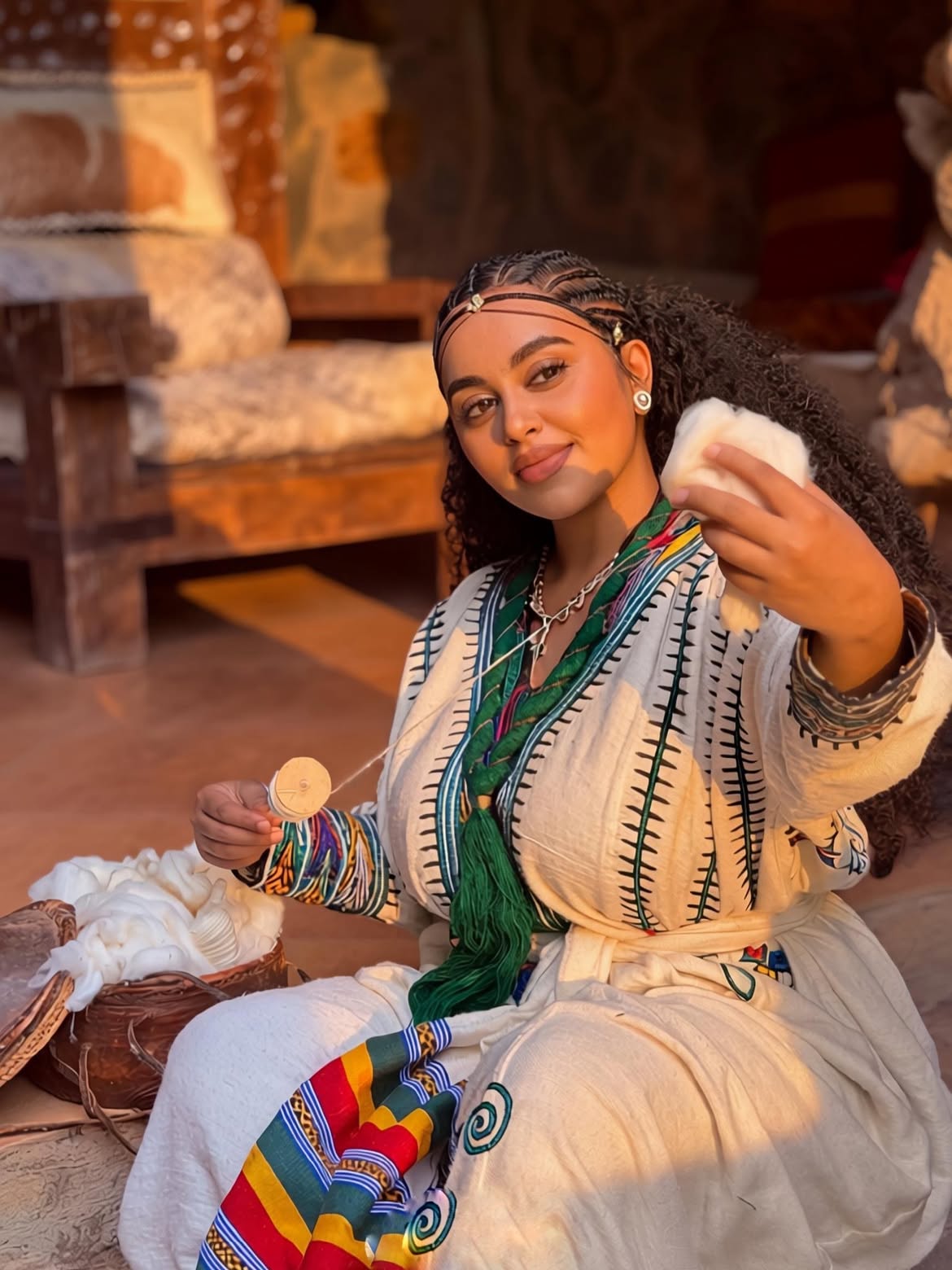
Before a weaver touches a loom, cleaned cotton is spun into thread. This work belongs traditionally to Amhara women, who use a handheld wooden spindle called an inzirt (እንዚርት). Hand-spinning, or fetel, requires sustained precision: feeding raw combed cotton fibres onto the spinning spindle determines the exact thickness of the yarn. Two grades are produced:
- Kechin Fetel (ቀጭን ፈትል): The thinnest, most sheer hand-spun cotton thread. It requires exceptional skill to spin without breaking and is used for high-end, lightweight luxury dresses worn by noble families and modern brides.
- Wofram Fetil (ወፍራም ፈትል): A thicker, sturdier hand-spun thread used to make heavier, warmer dresses suited to the cold evening temperatures of the mountainous Simien highlands.
The Pit-Loom and the Shemane
Once the yarn is ready, it goes to the shemane, the traditional weavers. In Gondar, weavers use pit-looms: wooden frame structures built over a shallow pit dug directly into the ground. The weaver sits at the edge of the pit, using foot pedals inside the pit to control the long warp threads while sliding a wooden shuttle filled with thread back and forth across the frame by hand. To produce a single Habesha kemis, a weaver must produce a continuous strip of shemma cloth roughly 5 to 6 metres long and 60 to 70 centimetres wide. Multiple strips are cut and hand-stitched together by local tailors to form the full flowing skirt and fitted bodice of the finished dress.
The Gondar Dress: Regional Style Markers
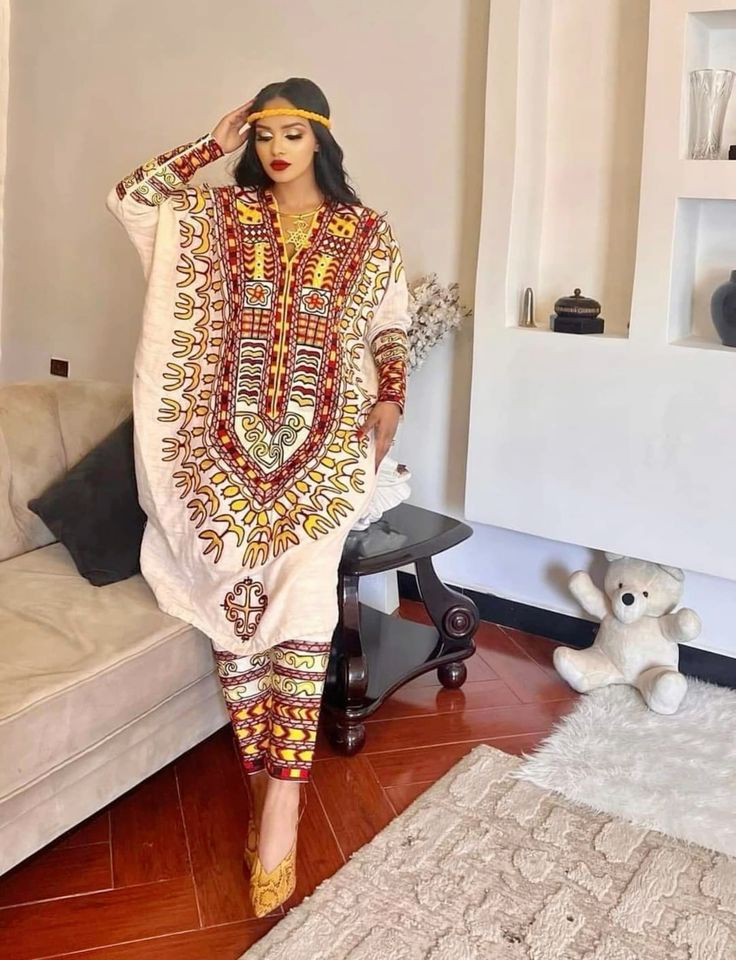
The Habesha kemis is worn across different Amhara provinces, including Shewa, Gojjam, and Wollo. The Gondar version carries distinct markers that reflect the city’s history as a former imperial capital. Gondar dresses are meticulously hand-embroidered, with local artisans spending weeks on fine needlework applied directly to the bodice. The placement of the tilf or tibeb, the hand-woven geometric pattern bands, follows a structural rule specific to the Gondar region:
- The Back Hem Only: Unlike dresses from other provinces where the woven pattern runs around the full circular hem, an authentic Gondar dress restricts the woven tilf or border strictly to the hem on the back of the dress. The front hem remains completely clean, white, and unembellished.
- The Netela Edge: The hand-woven pattern is mirrored exclusively along the outer edge of the matching netela shawl, creating a balanced visual pairing when worn together.
Essential Accessories: Netela, Mekenet, and Heritage Jewellery
A Habesha kemis is not worn in isolation. In Amhara culture, accessories are functional parts of the outfit that communicate social context through how they are worn. The Gondar dress has three core components beyond the kemis itself.
The Netela: The Classic Shawl
The netela is a large, lightweight, two-yard-long scarf made from the same thin cotton as the dress, with a matching hand-woven or hand-embroidered border along its shorter edges. The netela functions as a tool for social communication. The way an Amhara woman drapes her netela communicates her setting, mood, and social posture:
- Celebration Style: For weddings and festive gatherings, the shawl is folded in half and draped evenly over both shoulders with the tilf borders facing forward.
- Church Respect: When entering an Ethiopian Orthodox church, the netela is opened fully, draped softly over the hair as a head covering, and crossed over the shoulders.
- Mourning: In times of grief, one end wraps around the head while the body of the fabric is draped low to signal deep sadness.
The Mekenet: The Shaping Belt
Because a traditional fetel dress is cut loose and full to allow free movement, it requires a mekenet, a wide fabric belt or sash, to be pulled together. Worn tightly around the midsection, the mekenet cinches the pleats of the skirt at the waist, defines the wearer’s silhouette, and creates a contrast against the white folds of the bodice. The mekenet is heavily embroidered with matching patterns or woven with colourful silk threads.
Heritage Jewellery
To complete the traditional Gondar look, a Habesha kemis is paired with heirloom jewellery. Made primarily from 21-karat filigree gold or local silver, these pieces include:
- Ye-Korez Cross (የቅርጸ መስቀል): A detailed cross pendant worn on a thin chain or a traditional black silk cord called a matab (ማቴብ).
- Albo (አልቦ): Gold or silver ankle bracelets that catch the light beneath the moving hem of the skirt.
- Gubagub (ጉባጉብ): Round dome-style earrings and matching rings, part of the wider category of Amhara statement jewellery.
Royal History: Empress Tiruwork and the Global Reach of Tilf
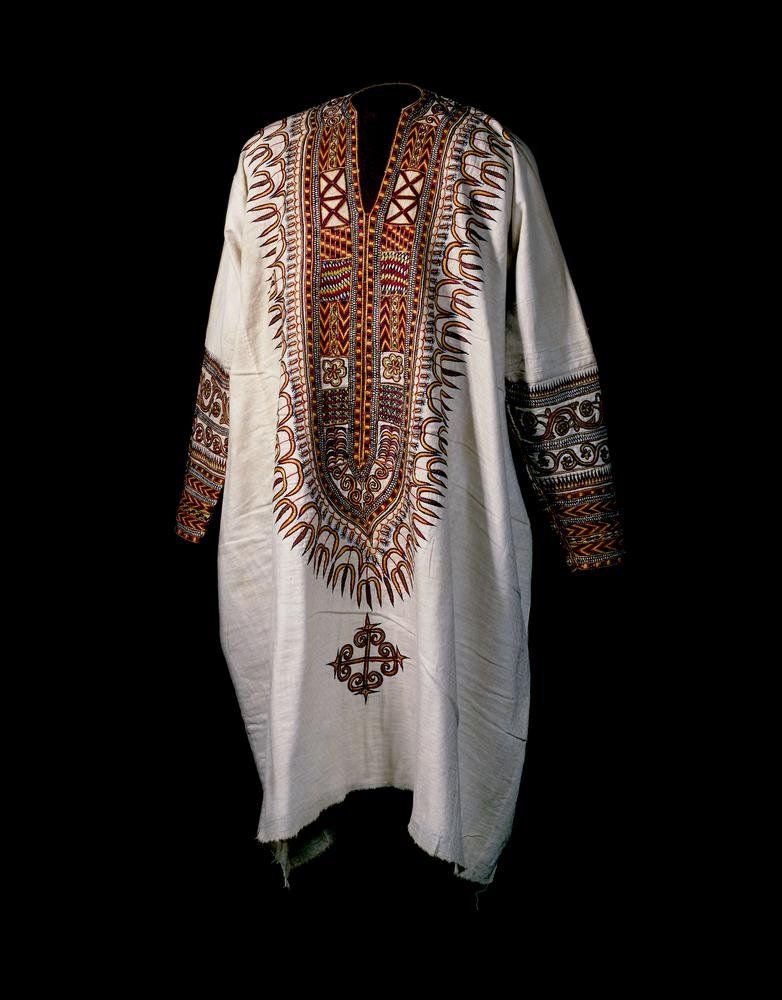
Gondar’s contribution to global fashion extends beyond cotton volume. The imperial capital left a specific mark on how Ethiopian textile geometry entered international design. The clearest evidence is found in the surviving garments of Etege Tiruwork, the 18th-century Empress and wife of Emperor Tewodros II. Kept in the Victoria and Albert Museum in London, these royal dresses demonstrate the technical height of 18th-century Amhara design: complex draping and dense royal needlework that documents the visual vocabulary of the tilf pattern system at its most elaborate. As Omiren Styles has documented in its analysis of African dress and its global influence, the relationship between African textile traditions and their later appearance in global fashion is rarely acknowledged directly. The tilf embroidery case is one of the most specifically documented.
The geometric layout of the Empress’s garments directly influenced the dashiki shirt. In 1962, Dutch textile designer Toon van de Manakker created a wax print pattern for the Netherlands-based clothing company Vlisco, originally sold under the name Angelina print. Van de Manakker’s motif was drawn from the geometric structure and dense tilf embroidery found on silk-embroidered tunics worn by Ethiopian Christian noblewomen, including Empress Tiruwork in the 19th century. This documented connection links Amhara needlework directly to one of the most internationally recognised garments associated with African identity in the 20th century. As Omiren Styles has documented in its analysis of the Ankara economy, the journey from African textile design to internationally distributed garment rarely credits the origin. The tilf-to-dashiki lineage is the same argument made visible in a specific historical record.
Men’s Formal Dress: Eje Tebab and the Jano

While the Habesha kemis represents the full formal system of Amhara women’s dress, men’s formal clothing centres on the eje tebab: a clean white, long-sleeved cotton tunic worn over tight trousers that gather at the ankles. What distinguishes Amhara men’s formal dress across all four provinces is the Jano, a specific wrap worn over the eje tebab.
The Jano: Symbol of Honour Across All Amhara Provinces
The Jano is a heavy, durable cotton wrap made from premium hand-spun yarn, constructed for weight and warmth. It is immediately identified by a bold, wide crimson or deep red stripe running horizontally through its white centre. The Jano functions as a universal marker of honour, respect, and shared Amhara identity across every part of Ethiopia where Amhara communities are present. It is worn primarily by Gondar men in formal contexts. The way a man drapes his Jano communicates his social standing and the nature of the occasion:
- The Courtly Style: For official community meetings, elders and community leaders wrap the Jano tightly across the chest and over the left shoulder, placing the red band across the chest as a mark of judicial authority.
- The Holiday Style: During major religious celebrations such as Timkat (Epiphany) or weddings, the Jano is worn loosely over both shoulders, floating behind the eje tebab as the wearer moves.
The Omiren Argument
The Gondar Amhara dress is not a cultural object that needs international validation to be understood as sophisticated. Its sophistication is documented in the specific technical rules that distinguish it from other Amhara provincial dresses, in the documented lineage from Empress Tiruwork’s tilf embroidery to the global distribution of the dashiki, in the supply chain that runs from Welkait and Humera cotton farms through pit-loom weavers to hand-embroiderers in Gondar city. What the garment needs is not discovery. It needs documentation at the level of specificity its complexity deserves. As Omiren Styles has argued in its analysis of Habesha hairstyling traditions, Ethiopian and Eritrean cultural traditions carry a design intelligence that the mainstream fashion press has consistently filed under ethnography rather than fashion. The Gondar dress is the most complete case study available for why that filing is wrong.
The back-hem-only tilf rule, the three-grade netela draping system that communicates occasion without a word, the distinction between kechin fetel and wofram fetil that matches thread weight to altitude and season, the specific filigree vocabulary of the albo and gubagub, these are not decorative details. They are a design language. As Omiren Styles has documented in its analysis of how African dress functions as political and social communication, the garments that carry the deepest cultural authority are those whose visual grammar is internally logical, specific, and learned. The Gondar dress meets that standard at every level of its construction.
From the cotton fields of Welkait to the pit-looms of Gondar to the hand-embroidered bodice that takes weeks to complete: the Gondar Amhara dress is a manufacturing argument as much as a cultural one. The argument is that this level of specificity, skill, and supply-chain integration is what fashion claims to value. The Gondar tradition has always delivered it.
ALSO READ
- Habesha Hairstyling Traditions and What They Signal in Ethiopian and Eritrean Communities
- The African Origins of Carnival Costume: Feathers, Beads, and the Masquerade Tradition
- How Colonial Law Targeted African Dress and Hair
- The Return: Why the African Influence on Black American Fashion Is Not a Discovery — It Is a Homecoming
Frequently Asked Questions
What is the Gondar Amhara dress and how does it differ from other Habesha kemis styles?
The Gondar Amhara dress is a regional version of the Habesha kemis, the traditional ankle-length cotton dress worn by Amhara women across Ethiopia. The Gondar version is distinguished by two specific structural rules: the hand-woven tilf or tibeb geometric pattern band is restricted strictly to the back hem of the dress, with the front hem remaining completely white, and the matching netela shawl carries the same woven pattern exclusively along its outer edge. Gondar dresses are also heavily hand-embroidered on the bodice. These rules reflect the city’s history as the 17th-century imperial capital of Ethiopia.
What is fetel and why does it matter to Gondar dress production?
Fetel (ፈትል) is the Ethiopian term for hand-spun cotton thread, produced using a handheld wooden spindle called an inzirt (እንዚርት). The quality of fetel determines the quality of the finished dress. Two grades are produced: kechin fetel (ቀጭን ፈትል), the finest and most sheer grade used for high-end luxury dresses, and wofram fetil (ወፍራም ፈትል), a thicker grade suited to the colder highland climate. Premium Gondar dresses are woven from fetel rather than machine-spun thread, which produces the specific lightness and fluid drape that distinguishes authentic fetel shemma. As Omiren Styles has documented in its analysis of African craft knowledge transmission, the knowledge embedded in artisan textile production is the tradition itself, not simply the object it produces.
What is the connection between Amhara tilf embroidery and the dashiki?
In 1962, Dutch textile designer Toon van de Manakker created a wax print pattern for the Vlisco company, originally named the Angelina print, that was directly inspired by the geometric layouts and dense tilf embroidery found on silk-embroidered tunics worn by Ethiopian Christian noblewomen, including Empress Tiruwork of Gondar in the 19th century. Empress Tiruwork’s surviving royal garments are held in the Victoria and Albert Museum in London. That documented design lineage links Gondar Amhara needlework directly to the dashiki, one of the most internationally recognised symbols of African identity in 20th-century global fashion.
What is the Jano and what does it communicate?
The Jano is a heavy, durable cotton wrap worn over the eje tebab tunic as the primary formal garment for Amhara men. It is characterised by a bold crimson or deep red stripe running horizontally through its white centre and serves as a universal symbol of honour, respect, and shared Amhara identity across all provinces. How a man drapes his Jano communicates his social standing and the formality of the occasion. Draped tightly across the chest and over the left shoulder with the red band prominent signals official authority; worn loosely over both shoulders signals celebration. The Jano is worn primarily by Gondar men.
What is the netela and how does it communicate social context?
The netela is a large lightweight cotton shawl worn as part of the complete Habesha kemis outfit. Made from the same fetel cotton as the dress and featuring matching embroidered or woven borders, the netela communicates social context through how it is draped rather than through verbal statement. Folded and draped over both shoulders with the borders facing forward signals celebration. Opening fully and draping it over the hair signals church attendance. Wrapped around the head with the body of the cloth draped low signals mourning. The netela is a functional social communication tool, not simply an accessory.