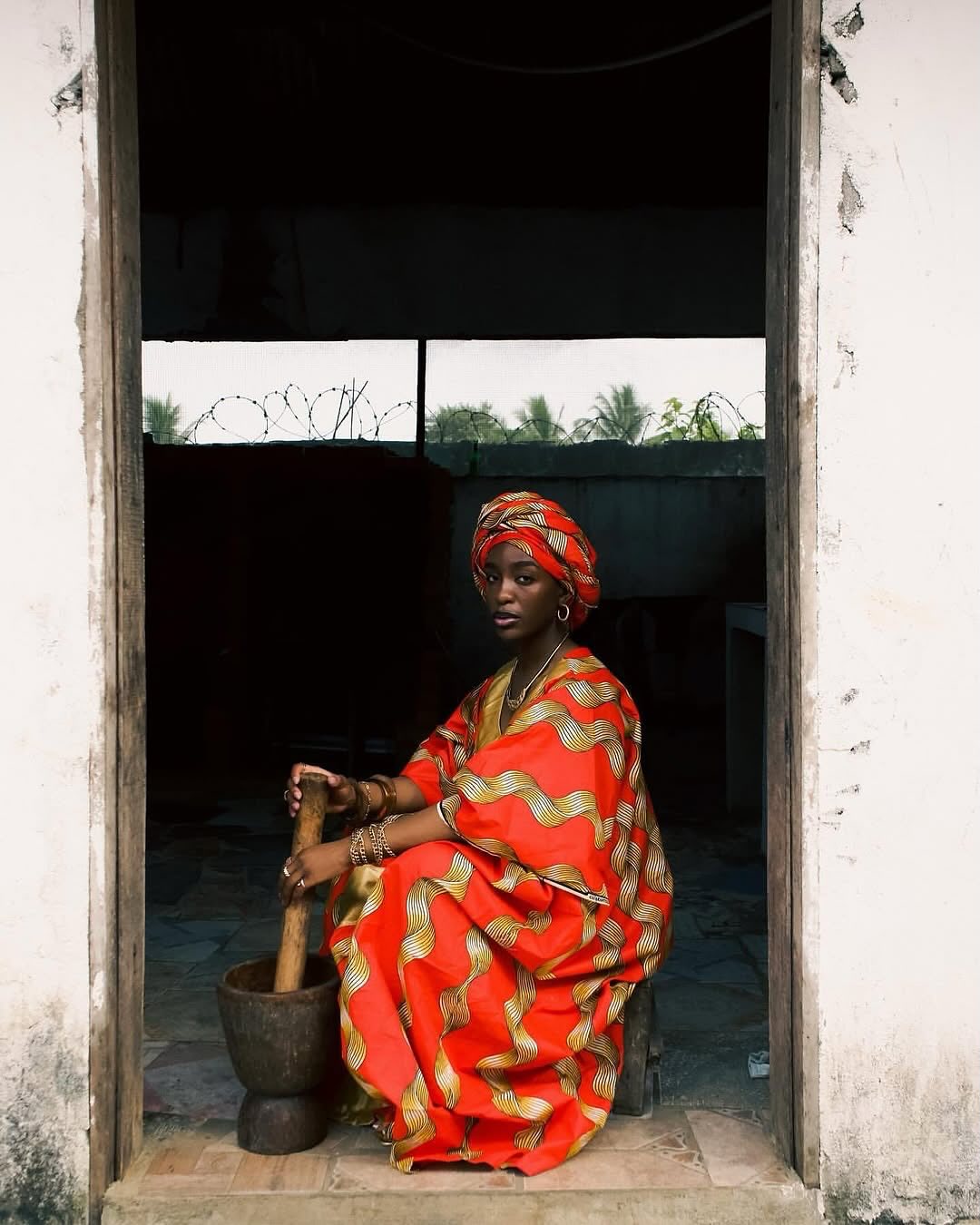
The market in Monrovia opens before the light is fully up. By six in the morning, the women are already at their stalls, seated on low chairs behind folded mountains of cloth. Bolt after bolt of cotton, printed in patterns so dense and deliberate that each one is its own sentence. Reds and golds with the Liberian star. Yellow patterns with birds that signify freedom. Dark blues cut into panels for the lappa skirt, with enough left over for the buppa blouse and the headscarf that will complete the set. The price depends on the brand, the print, and the weave quality. The cheapest comes from China. The finest cloth the grandmother requests for her granddaughter’s wedding carries the Vlisco selvedge.
None of this cloth was made in Liberia. Not the Dutch wax print from Holland, not the English wax from Manchester, not the cheaper imitations that arrived from Asian manufacturers in the 1980s and have never left. The fabric known in Liberia as lappa, worn across the country as everyday dress, formal attire, church clothing, and protest garment, is the product of a Dutch attempt to mechanise Indonesian batik and sell it back to Indonesia. That plan failed. What happened instead is one of the most thoroughly documented textile stories in the world and one of the least honestly told: a foreign industrial product was adopted by West African women, transformed through use, meaning, and collective intelligence into something that now reads as African identity, and then sold back to Europe as a symbol of Africa by the same European companies that introduced it in the first place.
This article tells the Liberian chapter of that story. It names the cloth, its origin, its entry into West African markets, and the specific ways Liberian women have shaped it into a living cultural practice that belongs to them regardless of where it is manufactured.
Wax print was not made in Africa. But Liberian women made it speak Liberian. This is the full story of the lappa, from Java to Monrovia and back to the world.
From Java to West Africa: The Origin of Wax Print
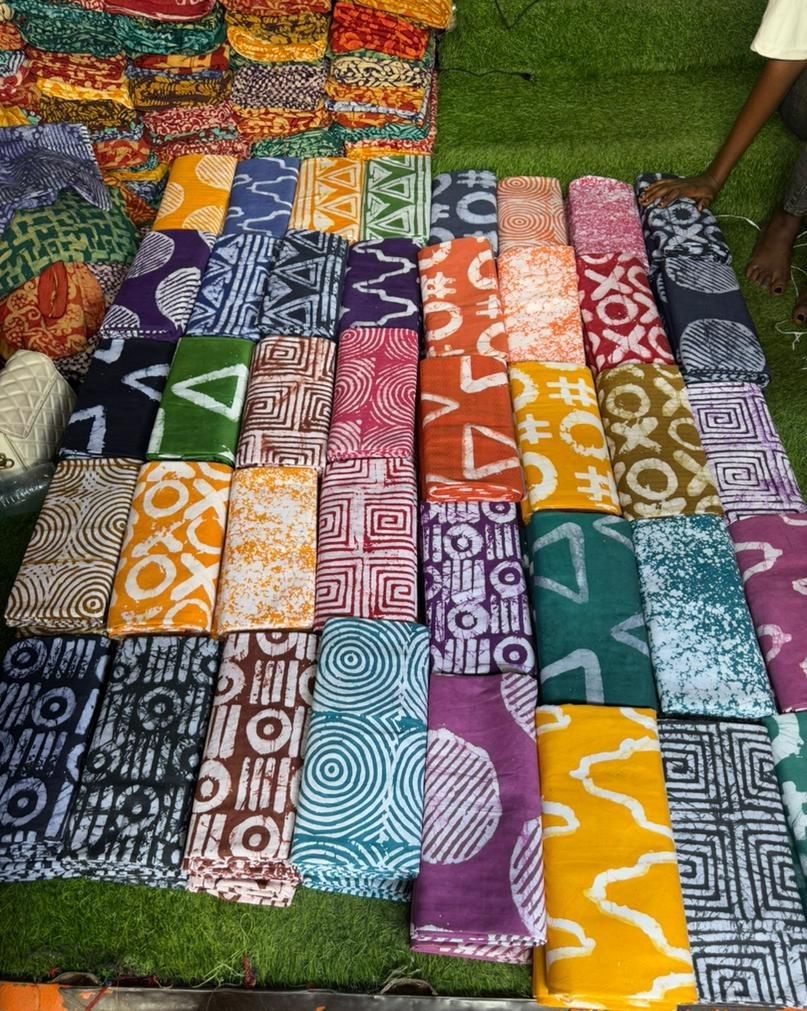
Batik is an Indonesian textile art form that uses wax-resist dyeing to create intricate patterns on cotton. The process involves applying melted wax to cloth in precise designs using a small copper vessel called a tjanting, then dyeing the cloth so that the waxed areas resist the colour. Multiple wax applications and dye baths build up the complex, layered patterns that define the tradition. The United Nations Educational, Scientific and Cultural Organisation recognised Indonesian batik in 2009 as an Intangible Cultural Heritage of Humanity. The technique predates European contact with Indonesia by centuries.
During the Dutch colonisation of what was then called the Dutch East Indies, now Indonesia, Dutch textile manufacturers became familiar with batik by the 1850s and set about mechanising the process. Their goal was to produce cheap imitation batik to undercut the handmade Indonesian original in its own market. By 1854, factory owners, including Jean Baptiste Theodore Prévinaire and Pieter Fentener van Vlissingen, had developed block-printing machines that applied resin to both sides of cloth, reproducing the wax-resist effect industrially. The machine-made cloth had a characteristic crackling or veining effect caused by the resin process, which the Indonesians regarded as a defect. They were not interested. The Dutch needed a different market.
That market found them. From the 1880s, Dutch and Scottish trading vessels calling at West African ports discovered that the cloth they had failed to sell in Indonesia generated immediate and sustained demand on the West African coast. The early connection may have been through the Belanda Hitam, West African soldiers, primarily Ghanaian, recruited to serve in the Dutch colonial army in Indonesia between 1831 and 1872. When they returned home, they brought the fabric with them. West African women did not read the crackling as a defect. They read it as evidence of quality. As the V&A Museum documents in its African Diaspora textile archive, the industrial wax print was light, bright, indigo-based, and visually similar to West African tie-dye traditions. It was also significantly cheaper than handwoven cloth. By the 1930s, Vlisco’s fabrics dominated the West African market. By the mid-20th century, wax print had become, in many communities, the default dress fabric.
What Lappa Actually Is
A critical distinction must be established before this article goes any further, because it is one that Omiren Styles flagged in its initial research and that popular writing on Liberian textiles consistently collapses. Lappa is a garment form. Wax print is a fabric type. A lappa is a wraparound cloth worn as a skirt, tied at the waist. It can be made from wax print, country cloth, tie-dye, or any other fabric. The two terms describe different things: the material and the way the material is worn. In Liberia, the dominant fabric used to make a lappa is wax print, which is why the two terms are often used interchangeably. But the lappa predates wax print by centuries, and the garment form is shared across West Africa under different names: wrapper, pagne, kanga. Wax print is one of many fabrics worn as a lappa.
In Liberia, the standard lappa set for women consists of three pieces: the lappa skirt, a rectangular piece of cloth approximately three by six feet, tied at the waist; the buppa, a loose-fitting blouse made from the same fabric; and a headscarf or head tie that matches both. Indigenous women in Liberia were historically referred to in social stratification literature as lappa women, a term from the Every Culture documentation of Liberian society, to distinguish them from women who had adopted Western-style dress. The term was not neutral: it carried class and colonial coding. The lappa was the garment of the rural, the indigenous, the not-yet-civilised in the colonial taxonomy. Liberian women have spent more than a century reclaiming that designation on their own terms.
How Wax Print Displaced Country Cloth
Country cloth, the handwoven cotton textile produced on narrow tripod looms by the Gola, Lorma, Kpelle, Vai, and related peoples, was Liberia’s primary dress fabric before wax print arrived. Its production was labour-intensive, and its price reflected that. A single full piece took days or weeks to produce. Wax print, manufactured industrially and shipped in volume, was dramatically cheaper. The mathematics of the market was not complicated. By the late 19th century, Dutch and British wax print was undercutting handwoven cloth across West Africa wherever the two fabrics competed. Country cloth retreated to the prestige register: it became the garment of chiefs and elders, the diplomatic gift, the installation cloth. Wax print took over every day.
This displacement is not a story of African consumers being deceived. As the WIPO Intellectual Property Advantage documentation on Vlisco’s history records, from the 1870s, wax print was sold in West African markets through local female distributors, who also relayed vital market and design information to manufacturers. Vlisco and its competitors actively adapted their designs and colour palettes to African preferences, hiring designers with knowledge of local aesthetics and commissioning patterns that referenced African proverbs, social events, and community life. African women were not passive recipients of European cloth. They were the market intelligence that shaped what was produced. The distinction matters: what was displaced was not replaced by something alien. It was replaced by something that African women had actively shaped into a reflection of their own visual world.
The Lappa as Everyday Authority
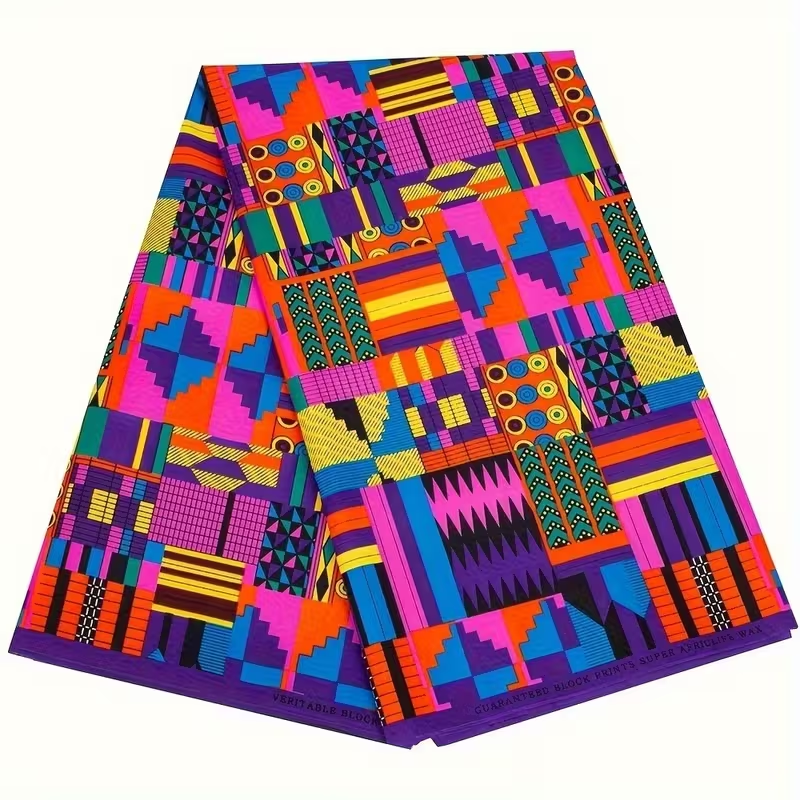
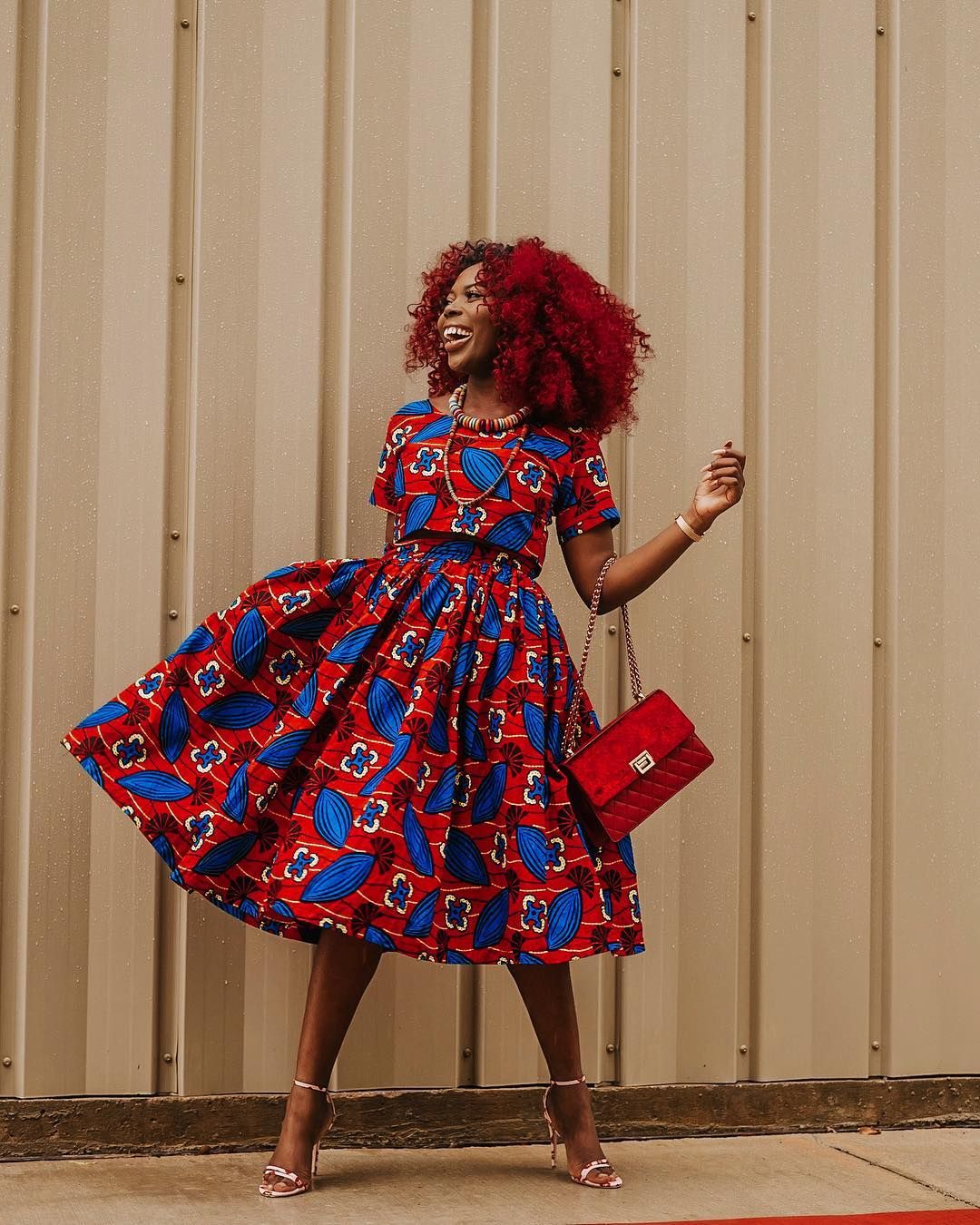
In Liberia, the lappa functions across the full spectrum of daily life. Rural women wear it for farm work, tying it high at the waist for ease of movement and using a second piece as a baby sling across the back. Market women wear it to the stalls, tied firmly, with the pattern facing outward as a visual statement about who they are and where they come from. Church women coordinate lappa sets in patterns that signal not just personal taste but community membership. Wedding parties appear in matching lappa commissioned in the same print, an aso-ebi logic that Liberia shares with the rest of West Africa: the coordinated cloth declares belonging.
The versatility of the lappa in Liberian women’s daily life is documented across diaspora accounts. A Liberian woman who emigrated to the United States recorded in the Tenement Museum oral history project that her great-grandmother wore lappa exclusively, that the garment was passed down through generations, and that in her family, lappa could be styled as a Sari, sewn into trousers, constructed as a bag or hat, or worn as a head tie. She describes wearing a lappa to graduation ceremonies and weddings as a way of showing respect to her tribe: proof that even when wearing regular clothes every day, the tradition remains. This oral account captures exactly what the lappa does in Liberian life. It is not reserved for a ceremony. It is every day, and its everyday presence is the point. The fabric is not pulled out for occasions. It is worn through them.
Lappa as Political Dress
One of the most specific and underreported stories in the history of Liberian dress is the use of the lappa as a form of political speech during the Liberian civil war. Liberian women wore their lappas to public demonstrations and solidarity gatherings as a coordinated visual statement of resistance and the demand for peace. The choice was deliberate: lappa was the garment of ordinary Liberian women, and appearing in it collectively signalled that they were claiming the political space. The cloth that had historically been used to code women as uneducated or low-status was recoded as the uniform of women who were ending a war.
This political use of lappa has continued beyond the civil war period. At a 2017 feminist convening in Liberia, as documented in a first-person account published by Edana Photography, women’s rights activists described being treated as illiterate or as low-level staff at meetings they attended in lappa suits, regardless of the organisations they led. Their response was to wear a lappa deliberately and consistently to national and international events as an act of resistance and reaffirmation of identity. The writer documenting this describes coming full circle: from wearing a lappa in a diaspora college dorm as a costume-like gesture of connection to wearing it as a feminist statement of presence. That arc, from inherited garment to diaspora identity marker to political declaration, is the arc of the lappa in Liberian women’s hands.
Also Read
- African Print as Modern Armour: Identity, Belonging, and Cultural Authority
- Top 5 Ankara Styles for Kanuri Women in 2026
- Country Cloth: How Liberian Men Have Worn Power Since Before the Republic
- Why Culture Is the Foundation of Style in African and Global Fashion
The Scale of the Wax Print Market in Sub-Saharan Africa
The wax print market in sub-Saharan Africa is enormous. According to data cited in the Wikipedia documentation on African wax prints, these textiles had an annual sales volume of 2.1 billion yards in 2016 across the region, with an average production cost of $2.6 billion and a retail value of $4 billion. Vlisco, the dominant European manufacturer, produced 70 million yards of fabric in 2014, generating a turnover of 300 million euros. The company generates 95% of its sales from Africa. By 2013, its annual turnover had reached $378.4 million, a 61% increase from 2009. These figures establish an important point: wax print is not a marginal or declining tradition in West African dress. It is the dominant textile market in the region, and Liberia is part of that market.
The ownership question is live and contested. Most wax print sold in West Africa continues to be produced in Europe, particularly by Vlisco in the Netherlands, or in Asia, where Chinese manufacturers have captured significant market share with cheaper imitations. African-owned or Africa-based manufacturers produce a much smaller volume. The irony is exact and has been noted by critics: the situation mirrors what the Dutch did to the Indonesian batik market two hundred years ago. Cheap mass-produced imitations from outside the region undercut local production. The main difference is that, in the current situation, the locally produced handwoven cloth being undercut is country cloth, not wax print. The imported fabric is now the established tradition.
The Omiren Argument
The question that the entire history of wax print in West Africa forces into focus is this: at what point does a foreign object become a cultural one? Tunde Akinwumi’s 2008 article The African Print Hoax, referenced in the Vlisco Wikipedia entry, argues that producers of African prints mislead consumers by presenting as authentically African a product that is based on Indonesian, Chinese, Indian, Arabic, and European imagery, manufactured in the Netherlands or China, and sold under African names. The argument is structurally correct. The cloth is not African in origin, in production, or in design methodology. What Akinwumi’s argument cannot account for is what African women did with it.
Liberian women did not adopt wax print. They authored it. The fabric arrived foreign. The meaning it carries is entirely their own. When a Liberian woman selects a lappa print for a funeral, she is communicating something specific about grief, belonging, and her relationship to the deceased that no Dutch designer specified. When a Monrovia market trader prices the same bolt of cloth differently depending on the occasion it is purchased, she is operating within a system of value that has nothing to do with Helmond. When Liberian women wore lappa to civil war peace protests, they were not making a statement about the Indonesian batik technique. They were making a statement about who holds authority in Liberia. The V&A Museum’s framing of wax print as a fabric of the African diaspora captures this precisely: the fabric’s designs became a method of communication and expression among African women, with certain patterns used as a shared language with widely understood meanings. That language is African. It is the product of African women’s collective intelligence, not European manufacture. Omiren Styles argues that cultural ownership is not a question of provenance. It is a question of who gives the object its meaning. By that measure, the lappa in Liberian women’s hands has been Liberian for more than a century.
Liberian women did not adopt wax print. They authored it. The fabric arrived foreign. The meaning it carries is entirely their own.
Frequently Asked Questions
1. What is the lappa in Liberian dress culture?
The lappa is a garment form, specifically a wraparound cloth tied at the waist and worn as a skirt. In Liberia, it is typically worn with a matching buppa, a loose-fitting blouse, and a coordinating headscarf. The standard set uses a piece of cloth approximately three by six feet. The dominant fabric used to make a lappa in Liberia today is wax print cotton, though the garment form predates wax print and can be made from country cloth, tie-dye, or any other fabric.
2. Where does wax print fabric actually come from?
Wax print fabric originates in Dutch attempts to mechanise Indonesian batik in the 1850s. Dutch manufacturers produced machine-printed cloth using a resin resist technique that created a batik-like effect on both sides of the cotton. The cloth failed to sell in Indonesia but found a large market in West Africa from the 1880s onwards. The dominant manufacturer, Vlisco, was founded in Helmond, the Netherlands, in 1846 and continues to produce wax print there, generating 95% of its sales from the African market. Chinese manufacturers also produce significant volumes.
3. How did wax print displace country cloth in Liberia?
Country cloth, Liberia’s handwoven cotton textile, was labour-intensive and more expensive than mass-produced wax print. From the late 19th century, industrial wax print was dramatically cheaper and available in volume, making it accessible for everyday dress where handwoven cloth was not. Country cloth retreated to the prestige and ceremonial register, worn by chiefs, elders, and public figures. Wax print took over daily dress. The two fabrics now operate in distinct registers: country cloth declares formal authority; lappa wax print is the fabric of everyday Liberian life.
4. How did Liberian women use lappa as a political garment?
During the Liberian civil war, women wore lappa as coordinated dress at public demonstrations demanding peace, using the everyday garment of ordinary Liberian women as a visual declaration of collective presence and political authority. After the war, Liberian feminist activists deliberately wore lappa suits to national and international meetings as a conscious act of resistance against assumptions that lappa-wearing women were uneducated or without authority. The garment that had historically coded indigenous women as outside the civilised class was reclaimed as a symbol of Liberian identity and feminist statement.
5. Is wax print fabric African?
Wax print is not African in origin. It was invented in the Netherlands, based on Indonesian batik technique, and introduced to West Africa by Dutch and Scottish merchants in the 1880s. Most wax print sold in West Africa today is still manufactured in Europe or Asia. However, the cultural meaning that wax print carries in Liberia and across West Africa is entirely African. African women shaped the designs, patterns, and social language of wax print over more than a century of use. The fabric is foreign in provenance. The culture it embodies is African.