In a mountain valley in South Africa’s Limpopo Province, the only legally recognised female traditional monarch in the country lives under rules of dress and visibility that most modern royals would find unimaginable. She is rarely photographed. Her clothing is not fashionable in any conventional sense. It is regalia understood, within Balobedu tradition, as carrying the weather itself.
Inside the ceremonial dress codes of the Balobedu Rain Queen: leopard skin, ancestral beadwork, and a matrilineal monarchy in Limpopo.
Who the Rain Queen Is
The Rain Queen, known by the ceremonial title Modjadji, is the hereditary ruler of the Balobedu people, a matrilineal kingdom concentrated in the municipalities of Limpopo’s Greater Letaba, Greater Tzaneen, Ba-Phalaborwa, and Greater Giyani. Oral tradition traces the royal line to a Karanga princess named Dzugundini, who fled the Monomotapa kingdom in what is now Zimbabwe after a family scandal and settled in the Molototsi Valley, carrying with her sacred rain-making charms and beads. The first officially recognised Rain Queen, Maselekwane Modjadji I, established matrilineal succession in the early 1800s and lived in complete seclusion in the forest, practising rainmaking rituals largely hidden from public view.
That seclusion is not incidental. It is one of the oldest and most consistent features of the office. Social anthropologist Eileen Jensen Krige and her husband Jack Daniel Krige, a legal scholar and lecturer in Bantu Studies at Rhodes University College, conducted fieldwork with the Balobedu in the 1930s, publishing their findings in 1943 as The Realm of a Rain-Queen: A Study of the Pattern of Lovedu Society (Oxford University Press for the International African Institute). This text remains one of the standard academic references on the kingdom nearly a century later. Their research documented a monarchy built around restricted access: the Queen traditionally communicates with her people only through appointed male and female councillors, never appearing at ordinary public functions.
Regalia, Not Fashion
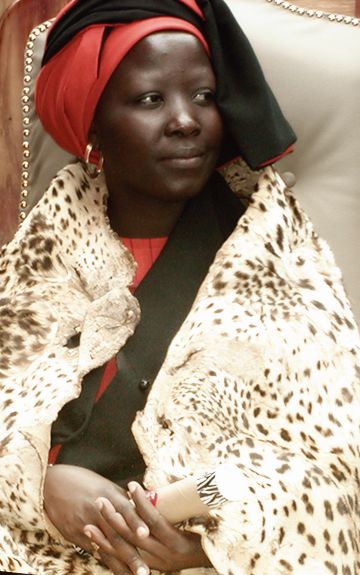
Where the Rain Queen does appear ceremonially, her attire is treated as sacred equipment rather than clothing chosen for effect. At the 2003 coronation of Makobo Modjadji VI, as confirmed by VOA News and IOL, the installation rites included leopard-skin regalia, understood within the tradition to signify the Queen’s connection to ancestral power. Leopard skin recurs across Southern African royal regalia, appearing in Zulu, Swazi, and Venda royal dress as well. Still, among the Balobedu, it is paired specifically with rain-making authority rather than military or political status alone.
Descriptions of the Queen’s ceremonial dress consistently emphasise the same three elements: animal-skin garments, beadwork understood to carry ancestral meaning, and regalia specifically associated with rainmaking rather than general royal wealth. The deliberate lack of public appearances reinforces her role as a sacred figure whose presence is understood through reverence rather than visibility. This is a meaningful distinction from many African royal dress traditions built around maximal public display. The Rain Queen’s power is expressed partly through restricting how much of her dress and person the public is permitted to see at all.
What Balobedu Women Wear
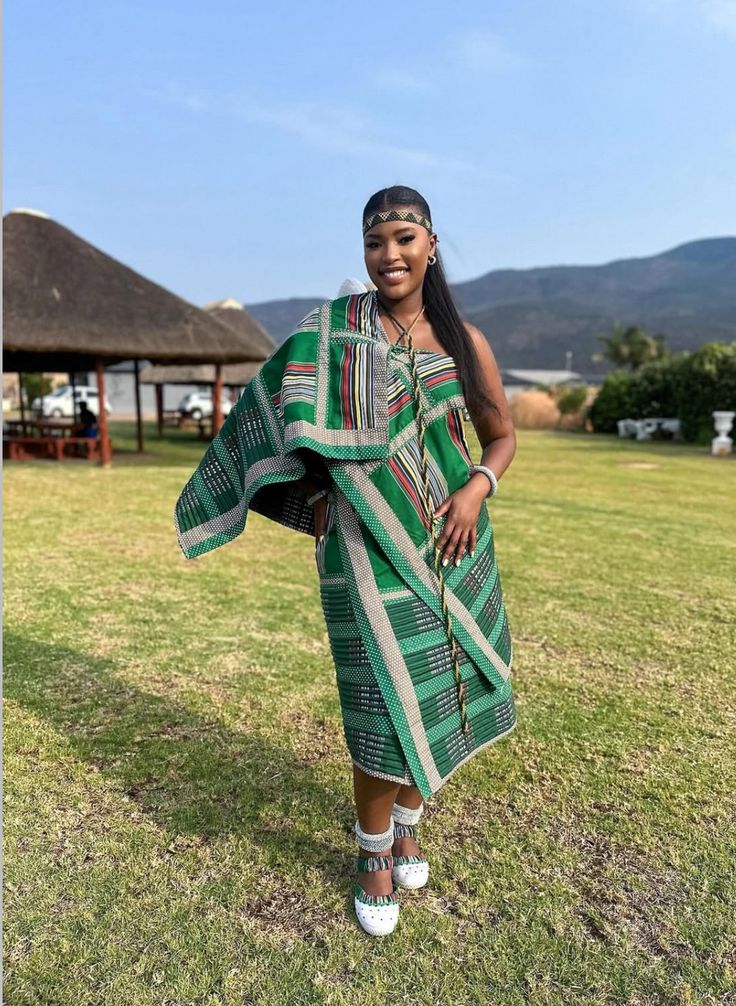
Ceremonial dress among the wider Balobedu community follows its own coded structure, separate from the Queen’s regalia yet symbolically connected to it. As Aesthetic Views Magazine documents, women traditionally wear skirts made from animal skin or grass, worked with beadwork that carries family and clan history, with beaded panels and accessories reserved specifically for ceremonial occasions rather than everyday wear. Initiation rites for young girls, known as Dikhopa, follow their own dress progression: goat-skin skirts worn during the earliest stages of initiation give way to cowhide skirts treated with red ochre as a girl moves toward recognised maturity, a visible, wearable record of where a young woman stands in her passage into adulthood.
A designated women’s regiment, known locally as the Basadi Ba Khekhapa, performs ceremonial dance for the monarch on important occasions, their attire distinct from everyday ceremonial wear and reserved specifically for ritual performance in the Queen’s presence. The structure mirrors what anthropologists have documented across many Southern African royal courts: concentric rings of dress specificity, with the most restricted and symbolically loaded garments reserved for those closest to the monarch and the most sacred occasions.
The Annual Rain Ceremony

The most visible expression of this dress hierarchy occurs during the Balobedu’s annual rain-summoning ceremony at the royal compound, when attendants prepare the grounds with the same formality applied to the ritual itself. The ceremony draws thousands of Balobedu attendees, with rain falling during past royal installations, which is widely interpreted within the community as a sign of ancestral endorsement. At the 2018 ceremony in which Masalanabo Modjadji was confirmed as Queen-elect at age thirteen, President Cyril Ramaphosa addressed the assembled crowd, and the event was blessed with rainfall. Speaking through her guardian, Dr Mathole Motshekga, Masalanabo said there was no better affirmation of the new dawn than witnessing the rainfall.
Journalists who have travelled to witness these events describe a landscape built around the mystique the dress code reinforces: the royal compound sits inside the Modjadji Nature Reserve, home to the world’s largest concentration of cycad trees, thriving under a rain belt that stands in visible contrast to the surrounding parched terrain, a landscape locals treat as physical evidence of the Queen’s ancestral power over rainfall.
Modernity and the Dress Code Under Pressure
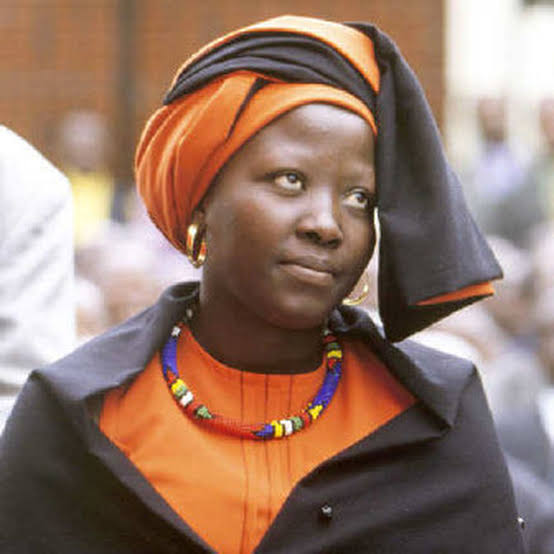
The current Rain Queen, Masalanabo Modjadji VII, represents a marked departure from the strict seclusion of her predecessors. Her official recognition by President Cyril Ramaphosa in December 2024, under Section 8(3)(a) of the Traditional and Khoi-San Leadership Act of 2019, was itself a legal and political event as much as a ceremonial one, closing a succession dispute with a rival male claimant and confirming her as the only legally recognised female traditional monarch in South Africa. Born on 20 January 2005, she ascended to the throne at 18, the youngest Rain Queen in the dynasty’s modern history.
This growing visibility sits uneasily alongside a tradition explicitly built around restricted access. Earlier Rain Queens, including Makobo Modjadji VI, who died in 2005 at 27, and her grandmother Mokope Modjadji V, who maintained a documented friendship with Nelson Mandela, largely avoided the kind of sustained public documentation that now surrounds Masalanabo. Whether the dress code itself evolves alongside this new visibility, or whether the regalia continues to function as sacred equipment regardless of how many cameras are present, remains an open question that the Balobedu royal council will continue to negotiate as Masalanabo’s reign develops.
Why the Balobedu Case Stands Apart
Most ceremonial dress traditions on the continent communicate status through display. The more elaborate the garment, the more it is meant to be seen. The Rain Queen tradition inverts that logic. Its most powerful garments are also its most hidden, worn by a figure whose authority has historically depended on scarcity of access rather than abundance of display. As Omiren Styles has documented in its analysis of the Ndebele dress tradition, Southern African dress systems build meaning through precisely who may wear what and when. The Balobedu offer perhaps the clearest case where that logic reaches its most extreme form: leopard skin and ancestral beadwork are not decorating a monarchy here. In Balobedu tradition, they are understood as part of what makes the monarchy function at all.
ALSO READ
- The Herero Dress of Namibia: How a Colonial Imposition Became a National Symbol
- Top 5 Traditional Styles for Ndebele Women in 2026
- The Geometry of Heritage: Why Shweshwe Still Defines South African Fashion
- The Zulu Reed Dance and the Dress That Carries a Nation’s Dignity
Frequently Asked Questions
Who is the current Rain Queen of the Balobedu?
Queen Masalanabo Modjadji VII, born 20 January 2005, was formally recognised as Queen by President Cyril Ramaphosa under Section 8(3)(a) of the Traditional and Khoi-San Leadership Act of 2019. Her recognition was gazetted on 2 December 2024 and confirmed by the Presidency of South Africa, making her the only legally recognised female traditional monarch in the country. At 18, she is also the youngest Rain Queen in the dynasty’s modern history.
What does the Rain Queen wear during ceremonies?
Ceremonial regalia traditionally includes animal-skin garments, most notably leopard-skin garments, along with ancestral beadwork and items specifically associated with rainmaking authority rather than with general royal wealth. The leopard skin connects the Rain Queen’s regalia to a broader Southern African royal dress tradition. Still, among the Balobedu, it carries specifically meteorological and spiritual significance tied to the office’s rain-making function.
Why is the Rain Queen rarely seen in public?
Balobedu tradition holds that the Queen’s seclusion enhances her spiritual authority and rainmaking powers. As documented by social anthropologist Eileen Jensen Krige in The Realm of a Rain-Queen (Oxford University Press for the International African Institute, 1943), the Queen historically communicated with her people only through appointed councillors rather than appearing at public functions. This restricted visibility is understood within the tradition as a source of power rather than a constraint on it.
What is the Dikhopa initiation, and how does dress mark it?
Dikhopa is a Balobedu initiation rite for young girls, during which goat-skin skirts worn in earlier stages give way to cowhide skirts treated with red ochre as a girl progresses toward recognised maturity. The progression is a visible, wearable record of where a young woman stands in her passage into adulthood, functioning as a garment-based biography of social transition.
Is the Rain Queen tradition still practised today?
Yes. The Balobedu continue to hold rain-summoning ceremonies at the royal compound, and the monarchy received full legal recognition from the South African government as recently as December 2024. The coronation of Masalanabo Modjadji VII, initially scheduled for March 2025 and later postponed to August 2025 to coincide with Women’s Month in South Africa, signals the tradition’s continued observance under new leadership.