There is a line Meiling has said more than once, and it deserves to be taken seriously: “People think, because I’m a Caribbean designer, everything that comes out of me must be bright and tie-dyed. I say, no, I’m just a designer who happens to be in the Caribbean.” That distinction is not a rejection of her home. It is a refusal to be reduced to a tourist’s postcard of it. It is, in miniature, the argument that her entire body of work has been making since she opened her first boutique in Port of Spain in the late 1960s.
Meiling Esau, known professionally simply as Meiling, is the foundational figure of Caribbean fashion. Her label, Meiling Inc., established in 1969, is one of the longest-running luxury fashion practices in the region. Over five decades, she has built a design language rooted in minimalism, organic fabrics, hand-stitched details, and a Caribbean sensibility that does not require external validation. She did not move to London or New York to build her reputation. She built it in Trinidad, from Trinidad, and made the world come to her. That is not a small achievement. In the history of Caribbean fashion, it is the defining one.
Meiling has spent five decades building a minimalist, Caribbean-rooted fashion practice that operates on its own terms. This is the body of work, the philosophy, and the argument it makes.
She Grew Up in the Sewing Room

Meiling’s formation as a designer began before any formal training. Her mother was one of Trinidad’s leading dressmakers, and Meiling grew up in her sewing room in St. Augustine, surrounded by Vogue magazines, paper patterns, bolts of fabric, threads, and the constant whirring of machines. She touched everything. She begged the women who sewed there to teach her. Nobody had time, so she taught herself. By the time she was sent to London to study at the Lucie Clayton School of Fashion on New Bond Street in the 1960s, she was already a step ahead of her class.
London in the 1960s was, in her own words, a wild time. Swinging London, Mary Quant, white boots, the Beatles, the Stones – street fashion changing faster than institutions could document it. She was a flower child in the middle of one of the twentieth century’s great fashion revolutions, and she absorbed it fully. When she returned to Trinidad, she cried for a year. The adjustment from London basement apartments and artist friends to living with her parents in Port of Spain was brutal. But she came back, and she stayed, and everything she had absorbed she brought with her and made Trinidadian.
She went to London in the 1960s and came back with everything she had learned. Then she reached the Caribbean. That is the move that built a legacy.
The First Boutique. The First Industry.
When Meiling opened her boutique in Trinidad, there was one other boutique on the island. The fashion industry she would eventually be credited with building did not yet exist in any recognisable form. The country’s negative list, a colonial-era trade policy that restricted the importation of foreign garments into Trinidad, had created conditions where local production was necessary rather than optional. That constraint, which might have felt like a limitation, became the foundation of something. Local manufacturing was not a compromise. It was the only option, and it produced a discipline- and craft-oriented approach that would permanently define Meiling’s practice.
She produced two collections a year from her studio, first manufacturing at her mother’s home, then from a studio apartment at the top of Abercromby Street near Bishop’s, with three seamstresses working alongside her. The same apartment, she would later learn, had been Carnival designer Peter Minshall’s father’s studio. It was not an accident that these spaces overlapped. Meiling was building on a tradition that was already present in Trinidad’s creative geography, whether she knew it then or not.
Peter Minshall and What Collaboration Taught Her
The most significant creative relationship of Meiling’s early career was with Peter Minshall, Trinidad’s greatest Carnival costume designer and one of the most important artists the Caribbean has produced. The connection came through a mutual friend and deepened when Minshall came to design his 1983 Carnival band, River, and stayed at Meiling’s house while working on it. She would execute the prototypes for his costume designs. He would pull them apart. She would go back and start again.
What she learned from Minshall was not costume-making. She is a fashion designer, not a customer, and that distinction matters to her. What she learned was patience, the ability to listen, and the ability to take criticism without collapsing. She also learned, through the repeated experience of being corrected by someone working at a different register entirely, what it meant to execute someone else’s vision with total fidelity and then return to her own with that discipline intact. The rigour Minshall demanded became a permanent feature of how Meiling approaches her own work. You can see it in every clean line, every considered seam.
Less Is More: The Design Philosophy in Practice
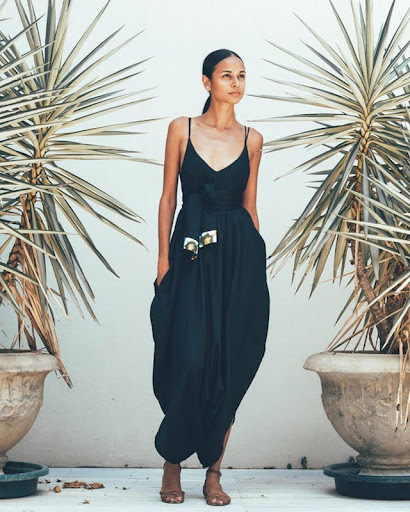
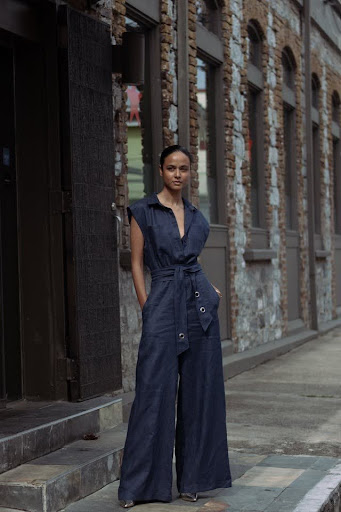
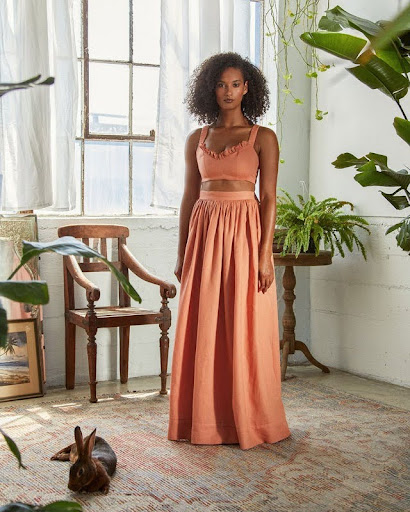
Meiling’s design philosophy can be stated simply: less is more. But that simplicity contains a great deal. Her collections are built around organic and natural fibres; at least 70 per cent of the materials used in production across her decades of operation have been natural. Her signature finishing techniques are hand-stitched details and hand embroidery, applied with the kind of patience that machine production cannot replicate. The silhouettes are architectural and clean, structured to flatter without overstatement, elegant in the way that things are elegant when they have been built with genuine knowledge of the body and genuine respect for the fabric.
What makes this minimalism specifically Caribbean rather than generically international is where it comes from. It does not come from a reaction against European maximalism, or from the influence of Japanese conceptual fashion, or from any of the external references that critics of minimal fashion often reach for. It comes from Meiling’s own eye, shaped by the flora and fauna of Trinidad and Tobago, by the textures and light of the island, by a personal aesthetic formed in the Caribbean and refined over five decades of working there. When she says she is a designer who happens to be in the Caribbean, she is not dismissing the Caribbean as context. She is insisting that the Caribbean has produced something in her that does not need to explain itself in relation to anywhere else.
“Her minimalism is not a reaction to anything. It grew from Trinidad’s light, its textures, its flora. That is a different kind of restraint entirely.”
The Clients Who Understood What She Was Doing
Meiling’s client list has never been built on celebrity dressing as a marketing strategy. But the names attached to her work speak to the range and reach of her reputation. Miss Universe 1998, Wendy Fitzwilliam of Trinidad and Tobago, wore Meiling. Soca icons Machel Montano and David Rudder wore Meiling. Reggae artist Ziggy Marley wore Meiling. Celebrity chef Wolfgang Puck wore Meiling. Early in her career, Hazel Ward, one of Trinidad’s most celebrated public figures of the era, wore and endorsed her work at a time when a single endorsement from the right person could determine whether a new label survived.
What connects this range of clients is not a single shared aesthetic. It is a quality of a garment that communicates to anyone who wears it that the person who made it understood exactly what they were doing. Meiling’s pieces do not require their wearers to adapt to them. They adapt to their wearers, which is the oldest and most demanding standard in fashion and the one that requires the deepest knowledge of both fabric and body to meet consistently.
The Recognitions That Were Always Overdue
Meiling’s formal recognitions have accumulated over the decades, documenting the scope of her influence. In 2012, she received the Ocean Style Award in recognition of tremendous effort, great accomplishments and lasting impact on Caribbean Fashion. In 2013, she was named one of the top five global designers invited to the Women of Purpose Global Summit and received Trinidad and Tobago’s National Icon Award for her work as an iconic designer. In 2017, the University of Trinidad and Tobago conferred an Honorary Distinguished Fellowship in Fine Arts upon her. In 2018, she represented Trinidad and Tobago at the first-ever Commonwealth Fashion Exchange at Buckingham Palace. This event brought together designers and artisans from all 52 Commonwealth countries around the principles of sustainable excellence. She serves as a board member of the Commonwealth Fashion Council.
At the 50th anniversary of Trinidad and Tobago’s independence, a Guardian newspaper online survey placed her among the top ten of the fifty most influential people in the nation’s history. That is not a fashion accolade. That is a statement about what building an industry from nothing, over fifty years, inside a small island nation, without relocating to a larger market or seeking external validation as a prerequisite, actually means to the people who watched it happen.
What She Built Beyond the Collections
Meiling’s studio at 6 Carlos Street has always been, in her own description, an open space for other creatives. Mentoring is a formal pillar of the Meiling Inc sustainability model, documented in the brand’s own statements: the company’s industry knowledge is to be passed on to apprentices who can help ensure the brand and its values endure over time. This is not incidental generosity. It is a deliberate act of institution-building in a region where fashion institutions have historically been fragile, underfunded, and dependent on a single founding figure.
The 2007 monograph Meiling: Fashion Designer, written by journalist Judy Raymond and published by Robert and Christopher Publishers, provided the first sustained documentation of her life and work in book form. It is currently out of print. The gap created by the lack of accessible archival material on the foundational figure of Caribbean fashion is itself an argument about how the region’s fashion history has been valued and preserved. The work Meiling has done over five decades deserves the full institutional support, archival attention, and critical literature that any designer of equivalent stature in Europe or North America receives as a matter of course.
READ ALSO:
- Crop Over Fashion: Barbados Built Its Own Aesthetic System, and It Has Nothing to Do With Trinidad
- Trinidadian Carnival Masquerade Is a Fashion System; It Is Time the World Called It That
The Omiren Argument
The question the global fashion industry has never properly answered about Meiling is not whether her work is good. Anyone who has seen it knows the answer to that. The question is why a designer of this calibre, with this body of work, this length of practice, this range of international recognition, and this foundational role in the development of an entire regional fashion industry, remains largely unknown outside the Caribbean. The answer is structural. The infrastructure of global fashion validation, the press coverage, the institutional retrospectives, the critical literature, the museum collections, and the international distribution flow toward cities that already sit at the top of the fashion hierarchy. It does not flow toward Port of Spain, regardless of what Port of Spain produces.
Meiling spent five decades refusing to move toward that infrastructure. She stayed and built something that is now, irrefutably, worth the infrastructure moving toward her. The question is whether it will. That is not a question about Meiling. That is a question about the global fashion industry and what it is actually willing to recognise as central.
Frequently Asked Questions
- Who is Meiling, and why is she significant in Caribbean fashion?
Meiling Esau, known professionally as Meiling, is a Trinidadian fashion designer whose label, Meiling Inc., was established in 1969, making it one of the longest-running luxury fashion houses in the Caribbean. She is widely regarded as the foundational figure of Caribbean fashion and has been described as the First Lady of Fashion in Trinidad and Tobago.
- What is Meiling’s design philosophy?
Meiling’s design philosophy is built around the principle that less is more. Her collections use natural and organic fabrics, with at least 70 per cent of materials sourced as natural fibres across her production history. Her signature techniques include hand-stitched details and hand embroidery, applied with artisanal precision that distinguishes her work from mass-produced luxury goods. The silhouettes are clean, architectural, and designed to flatter without overstatement.
- Where did Meiling train, and how did she begin her career?
Meiling grew up in her mother’s sewing room in St. Augustine, Trinidad, where her mother was one of the island’s leading dressmakers. She trained formally at the Lucie Clayton School of Fashion on New Bond Street in London in the 1960s, arriving already ahead of her class in technical skill. She returned to Trinidad after her studies and opened her first boutique in Port of Spain, at a time when there were essentially only two boutiques on the island. She produced two collections a year from her studio, initially manufacturing at her mother’s home before moving to a studio at the top of Abercromby Street, where she worked with three sewists.
- What is Meiling’s relationship with Peter Minshall?
Peter Minshall is Trinidad and Tobago’s most celebrated Carnival costume designer and one of the Caribbean’s most significant artists. Meiling and Minshall became close collaborators and friends when he stayed at her home to design his 1983 Carnival band River. Meiling executed the prototype costumes for his designs, and Minshall’s exacting standards, which frequently required her to dismantle and rebuild her work from scratch, taught her a discipline and capacity for critical rigour that she identifies as one of the most important influences on her practice. The two have collaborated on multiple occasions since.
- How does Meiling approach sustainability?
Sustainability has been embedded in Meiling Inc’s operations for over four decades rather than adopted as a recent trend. At least 70 per cent of materials used in design and production are natural fibres. The label incorporates remnants and fabric offcuts as signature trim and embroidery materials, reducing waste by design. The studio relies primarily on hand embroidery and hand-stitched beadwork to finish garments, minimising energy consumption through artisanal techniques. Manufacturing is conducted under ethical conditions at the label’s own design and production studio.