She arrives at Balogun before 8 am. By the time the Lagos heat sets in fully, she has already covered four sections of the market, checked three grades of aso-oke with her hands, rejected one lot of ankara for incorrect weight, and secured the lace she came for at a price that reflects what she knows, not what the vendor assumed she would accept. She is a Lagos fashion designer. She has been doing this since she was fourteen years old, apprenticed to her aunt. The knowledge in her hands is not available on any platform.
That knowledge is what these markets carry. Not just fabric. The institutional memory of a continent’s textile trade is stored in the hands and minds of traders who have sourced, compared, and sold cloth across decades. Africa’s great fabric markets are not tourist attractions. They are the operational infrastructure of African fashion. Every designer on the continent learned to source at a market like this.
This guide maps three of them.
African fashion is not emerging. It is foundational. This guide teaches you how to shop with cultural intelligence, from fabric markets to designer discovery.
Balogun Market, Lagos: West Africa’s Textile Engine
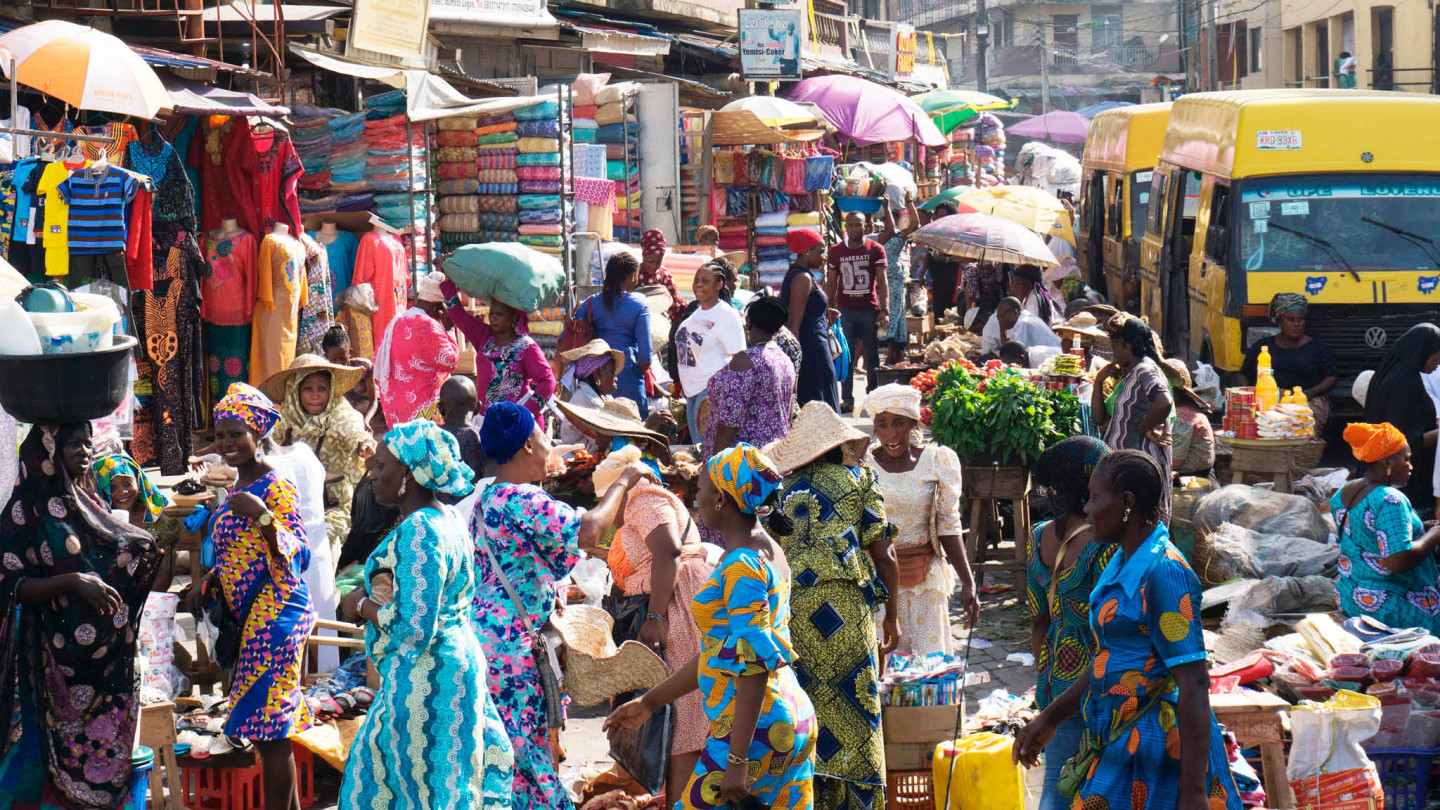
Balogun Market sits on Lagos Island in the commercial heart of Nigeria’s largest city. Established in the early nineteenth century as a trading post by Nupe migrants, it has expanded to include more than 8,000 stalls, shops, and multi-storey buildings, making it widely regarded as one of the largest street markets in West Africa. Its textile sections are the reason most fashion buyers come.
What Balogun Carries
Ankara fabric is the dominant textile in Balogun’s wax-print sections, ranging from economy grades manufactured in China and sold under the “hitarget” category to premium Dutch wax from Vlisco and high-quality Nigerian-produced prints. Aso-oke traders are concentrated along Balogun Street itself, where handwoven ceremonial fabric in Yoruba tradition is available in single-, double-, and triple-weave grades. The price difference between grades is significant and immediately apparent to experienced hands: triple-weave aso-oke carries a weight and density that single-weave cannot replicate. Adire, the indigo-resist cloth of the Yoruba, is available from traders who source directly from producers in Abeokuta. Lace fabric, in grades ranging from Swiss voile to heavy French lace, dominates the Idumota section adjacent to Balogun proper.
How to Navigate Balogun
The market divides into named sections: Ebute Ero, Oke-Arin, Idumota, Dosunmu, Idumagbo, and Balogun Street itself. Each section concentrates on specific fabric types. Arriving before 9 am gives access to calmer trading conditions and a better view of the stock before the crowds thicken. Bring cash. Negotiate from knowledge, not from discomfort: traders read hesitation as inexperience and price accordingly. A first-time buyer who visits with a knowledgeable companion pays significantly less than one who visits alone. The market operates Monday to Saturday.
“Traders read hesitation as inexperience and price accordingly. Enter Balogun with knowledge.”
Makola Market, Accra: Ghana’s Fabric Standard
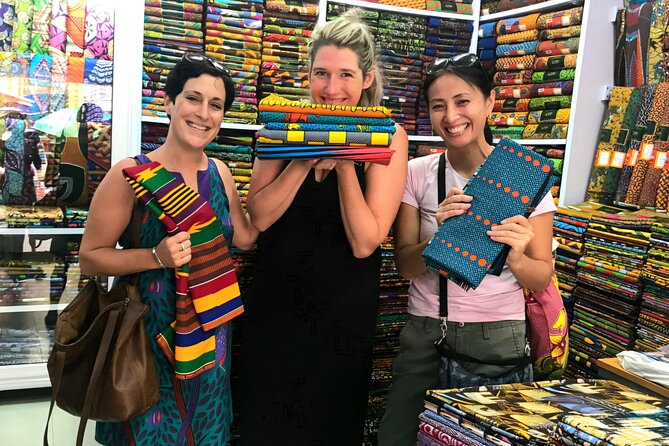
Makola Market was established in Accra in 1924. For over a century, it has served as Ghana’s primary wholesale, distribution, and retail trading centre, located between Tudu, the Accra Ministries, and Kingsway-Jamestown. Its textile section is among the most comprehensive fabric retail environments in West Africa, carrying the full range of Ghanaian textile production alongside imported wax prints and international lace.
What Makola Carries
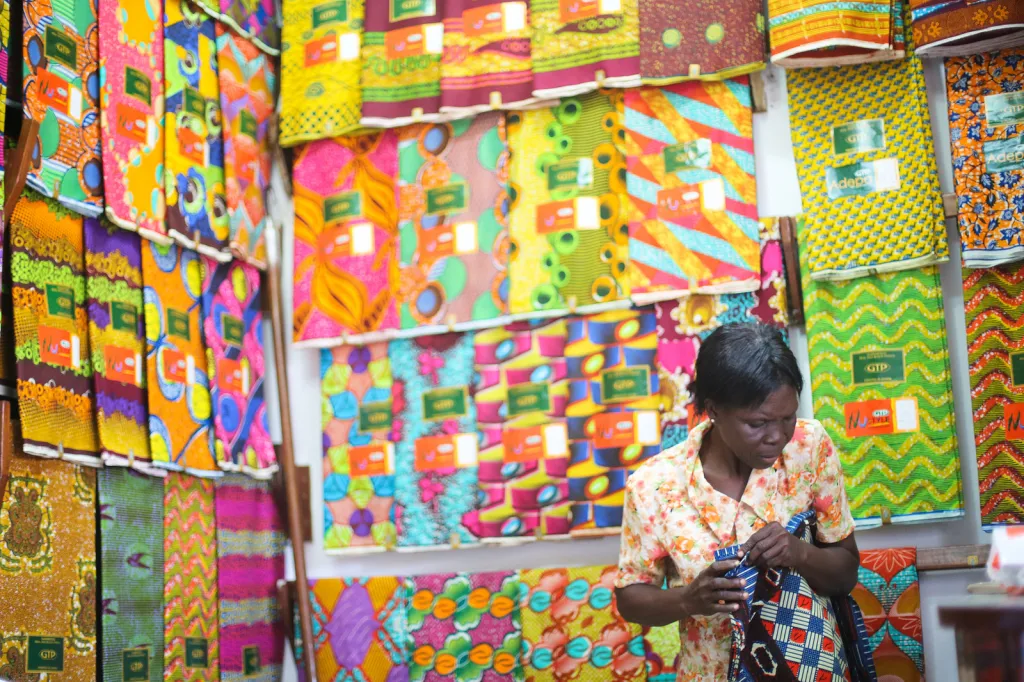
Kente cloth is available at Makola in both printed and handwoven forms. However, buyers seeking certified, authentic handwoven Kente should note that Makola’s stock is predominantly printed Kente from manufacturers including Ghana Textile Printing (GTP), Akosombo Textile Limited (ATL), Woodin, and Vlisco. For genuine handwoven Kente from approved weaving communities, the Bonwire weaving village, 18 kilometres from Kumasi, remains the primary authenticated source. What Makola does carry in exceptional variety is wax-print fabric in hundreds of designs at every price point, alongside batik, lace, hand-dyed cloth, and a range of domestic textiles. The brand sticker on each bolt is the provenance marker: GTP, Woodin, and ATL indicate Ghanaian or Dutch industrial production; “hitarget” indicates Chinese manufacture.
How to Navigate Makola
The market opens from early morning. The best shopping window is between 6 am and 10 am, when the heat is manageable, and the crowd has not yet peaked. The layout is a dense network of interconnected alleys without fixed signage: first-time buyers benefit significantly from arriving with a local companion or guide. Fabric stalls are concentrated in the central sections. Returns are generally not accepted: examine fabric carefully before purchase. Most vendors are women traders who have worked at Makola for years and know their stock inside and out. Engage them with specific questions about grade and origin, not just price.
Kariakoo Market, Dar es Salaam: East Africa’s Commercial Core
Kariakoo Market takes its name from a colonial history that its traders have long since made irrelevant. The British “Carrier Corps” that gave the area its name during the First World War has been replaced by one of East Africa’s most significant commercial markets, spreading across several city blocks in central Dar es Salaam. A fire in 2021 damaged the original structure. Tanzania’s President Samia Suluhu Hassan inaugurated a newly constructed six-storey complex in February 2026. The market continues operating throughout its rebuild as both a commercial and cultural institution.
What Kariakoo Carries
Kitenge and khanga are the dominant textile traditions at Kariakoo. Kitenge is a heavy cotton fabric with bold patterns, used across East and Central Africa for ceremonial and everyday dress. Khanga is a lighter cotton rectangle printed with a Swahili proverb along its border: the proverb is not decorative but communicative, selected by the wearer to express a specific sentiment or social message. Wholesale fabric vendors for both textiles concentrate along Uhuru Street and at the junction of Uhuru Street and Bibi Titi Mohamed Road near the Mnazi Mmoja bus stand. Batik fabric in East African patterns is also available throughout the market. Kikoi, the striped cotton cloth of the Swahili coast, is found in specialist stalls and is one of the most distinctive East African textile traditions on the market.
How to Navigate Kariakoo
Kariakoo is best navigated with a Swahili-speaking companion, particularly for price negotiation. Vendors are accustomed to both local buyers and regional cross-border traders from Zimbabwe, Kenya, and beyond. The market is dense, and the street layout is not intuitive for first-time visitors. The new six-storey structure, inaugurated in 2026, has reorganised some sections, though the surrounding street market continues to operate in its traditional, informal layout. Go in the morning. Carry only what you need. Wholesale prices are available for buyers purchasing significant quantities; retail buyers should expect to negotiate from posted prices.
“The khanga’s proverb is not decorative. It is a sentence the wearer has chosen to say. Buy the fabric knowing that.”
Also Read:
- How to Shop African Fashion: The Complete Guide for the Culturally Literate Consumer
- Where to Buy Kente Cloth Without Funding a Counterfeit Industry
- East African Textile Untold: Kitenge, Kikoi, and the Coastal Cloth
- What the World Lost When Hand-Weaving Gave Way to Mass Production
What All Three Markets Share
Balogun, Makola, and Kariakoo operate on the same fundamental logic: knowledge determines price. The buyer who can identify fabric grade by touch, who knows the difference between a genuine Dutch wax and a Chinese print by feel and label, who can name the specific textile they want rather than describing it vaguely, pays the correct price. The buyer who cannot pay the tourist price. This is not exploitation. It is the market reflecting the buyer’s preparation for them.
All three markets also share a relationship with a ceremony that shapes what they stock and when. Nigeria’s aso-ebi culture drives bulk purchases of ankara and lace at Balogun in the weeks before major wedding seasons. Ghana’s funeral cloth culture, in which specific colours are required for each day of a multi-day funeral, creates consistent demand for particular Makola stocks. Tanzania’s khanga tradition means that fabric selections carry social and interpersonal meaning that a buyer without a Swahili cultural context will miss entirely.
The fuller context for shopping these markets with the intelligence they deserve is laid out in How to Shop African Fashion: The Complete Guide for the Culturally Literate Consumer. Read it before you travel.
The Omiren Argument
The globalisation of African fashion has created a strange paradox: the textiles at the centre of Africa’s fashion identity are easier to find and discuss online than to purchase in person. Platforms surface images of kitenge dresses, aso-oke headwraps, and Kente cloth at scale, but the provenance chain behind those images is rarely visible. The fabric could have come from a master weaver in Bonwire, or from a factory in Guangzhou. The platform does not distinguish. The algorithm does not care.
The context is centuries deep. Balogun Market in Lagos has been a trading post since the early nineteenth century, growing from a Nupe migrant settlement into one of West Africa’s largest commercial centres. Makola Market in Accra was established in 1924 and has remained the primary wholesale and retail hub of Ghana’s capital for over a century. Kariakoo Market in Dar es Salaam takes its name from the British Carrier Corps of the First World War and has been the commercial heart of Tanzania’s largest city since the German colonial administration established it in 1914. These are not new institutions. They predate the fast fashion industry by generations.
The disruption these markets represent to the global online retail logic is straightforward: in all three, the buyer stands in front of the fabric. They feel the weight. They check the weave. They negotiate with a trader who knows every bolt on their shelves by name, grade, and origin. That physical encounter is the provenance check that no digital platform has yet replicated.
The cultural insight is about what is lost when buyers bypass these markets entirely. The African Development Bank estimates that Africa’s creative and cultural industries generate approximately 4.2 billion USD annually, including the textile and garment sector. The traders in Balogun, Makola, and Kariakoo are not peripheral to that economy. They are its foundation. To shop around them is to take value out of the system that sustains African fashion at its source.
Omiren Styles makes the argument directly: if you are buying African fabric, these are the markets that built the standard. Enter them with knowledge, not as a spectator.
Frequently Asked Questions
1. Is Balogun Market the largest fabric market in Nigeria?
Balogun Market on Lagos Island is recognised as one of the largest street markets in West Africa, with over 8,000 stalls and shops across multiple interconnected sections. Its textile sections, which cover Ankara, Aso Oke, Adire, lace, and imported fabrics, offer the most comprehensive fabric retail environment in Nigeria. Aba’s Ariaria Market in Abia State is a significant secondary fabric hub, particularly for cotton and linen, but Balogun remains the primary market for premium and ceremonial fabrics.
2. When was Makola Market established, and who runs it?
Makola Market was established in Accra in 1924. It operates as an informal market dominated by women traders who have held stalls across generations. The market is a primary wholesale, distribution, and retail hub for Ghana’s capital, serving the needs of the city’s residents for fabric, fresh produce, cosmetics, hardware, and household goods. Its textile section is considered one of the most comprehensive in West Africa for wax-print fabric, kente print, lace, and batik.
3. What does “Kariakoo” mean, and where does the name come from?
Kariakoo is the Swahilisation of “Carrier Corps”, the British military logistics unit that conscripted thousands of Tanzanians as war porters after the expulsion of German forces from Dar es Salaam in 1916. The British barracks erected on the site of the present market gave the area its name. Today, Kariakoo is the commercial heart of Dar es Salaam, known for kitenge, khanga, and batik fabrics, as well as food, electronics, and household goods. President Samia Suluhu Hassan inaugurated the new six-storey market complex in February 2026 following a 2021 fire.
4. What is the difference between kitenge and khanga?
Kitenge is a heavy cotton fabric printed with bold patterns, used across East and Central Africa for both ceremonial and everyday dress. It is typically sold by the yard and tailored into garments. Khanga is a lighter cotton rectangle printed with a Swahili proverb along its border. The proverb carries a specific social meaning chosen by the wearer to express a sentiment, and khanga is worn in pairs as a wrap. Both are available in the fabric sections of Kariakoo Market along Uhuru Street and Bibi Titi Mohamed Road.
5. Do I need a guide to shop these markets?
A local guide or companion is strongly recommended for first-time visitors to all three markets. At Balogun, a companion who knows the section layout and can negotiate in Yoruba or Pidgin English significantly improves both the buying experience and the price achieved. At Makola, a companion who speaks Twi or has existing trader relationships speeds navigation of the market’s unmarked alley system. At Kariakoo, a Swahili-speaking companion is particularly valuable for negotiating prices and identifying fabrics. In all three markets, the knowledge held by local traders is the real resource, and engaging with it directly produces the best outcomes.
Know the Market Before You Enter It
Omiren Styles publishes cultural intelligence on African fashion, textiles, and design across all 54 African nations, the Caribbean, and the global diaspora. Our editorial coverage gives buyers the context they need to engage with African markets with knowledge, not speculation.