The phrase on the woman’s clothing supplies the title under which the V&A catalogues the photograph: Everything in My Hand I Bring. The words are printed alongside a repeated image of a hand holding a heart. Below them, the sitter’s actual hands rest in her lap, her right index finger held between the fingers of her left hand. Dress, language and gesture occupy the same portrait. The relationship is specific enough to matter without assigning it an invented intention. The record does not establish that Barnor arranged her hands to echo the textile. It does establish that a garment carrying words and hand imagery is worn by a seated woman whose own hands form part of the pose. Clothing contributes more than a pattern or a dateable style.
Two other Accra portraits make that contribution differently. In Selina Opong, Policewoman #10, a uniform and a salute establish a professional presentation. In Miss Sophia Saloman, Kokomlemle, Accra, a green-and-yellow dress acquires an unexpected relationship with green shapes caused by deterioration of the original negative. Together, the photographs show why dress cannot be understood apart from an image’s pose, setting, and material form.
Three James Barnor portraits connect dress with printed words, a professional gesture and the material history of a colour photograph in Accra.
A Particular Person in a Constructed Room
Everything in My Hand I Bring was photographed around 1953. The V&A’s gelatin silver print was produced in 2011; the date of the sitting and the date of this physical print are separate parts of its history. The photograph belongs to Barnor’s early Accra studio work through Ever Young in Jamestown. The catalogue describes the woman seated at the centre of a low stage, with a small child pressed against her leg. Her clothing carries the repeated hand-and-heart motif and printed phrase; a flower pendant hangs from her necklace. The child wears a floral dress and shoes. The V&A’s contextual article identifies the woman’s clothing more specifically as a kaba-and-wrapper ensemble.
Around them is a constructed interior. Curtains frame a painted drawing-room opening toward a veranda and garden; the painted scene includes French doors, a column, flowers, and furniture. A rose-patterned vinyl mat lies beneath the sitters. This is a studio environment, not documentation of the family’s home or possessions.
The Clothing Carries Language the Backdrop Cannot.
The printed phrase gives the portrait a verbal element attached to the sitter rather than to the painted room. The catalogued title establishes its importance, although the record alone cannot show how easily every word can be read at every reproduction size. The relationship between garment and title is firmer than any claim about the phrase’s immediate visual dominance. The hand motif creates another connection. The cloth repeats an image of giving or presenting through a hand holding a heart, while the sitter’s hands are gathered in her lap. The photograph brings represented hands and actual hands into proximity. That correspondence invites interpretation without claiming to know why the garment was selected or how the pose was negotiated.
The V&A reads the clothing and studio interior through aspirations towards modern, independent life in Ghana. That supplies a historical interpretation, not a transcript of the sitter’s private intentions. The more immediate finding is that her garment individualises a setting built to accommodate many clients: its wording and motifs help distinguish this portrait from the room in which it was made.
Selina Opong: A Uniform Put into Action
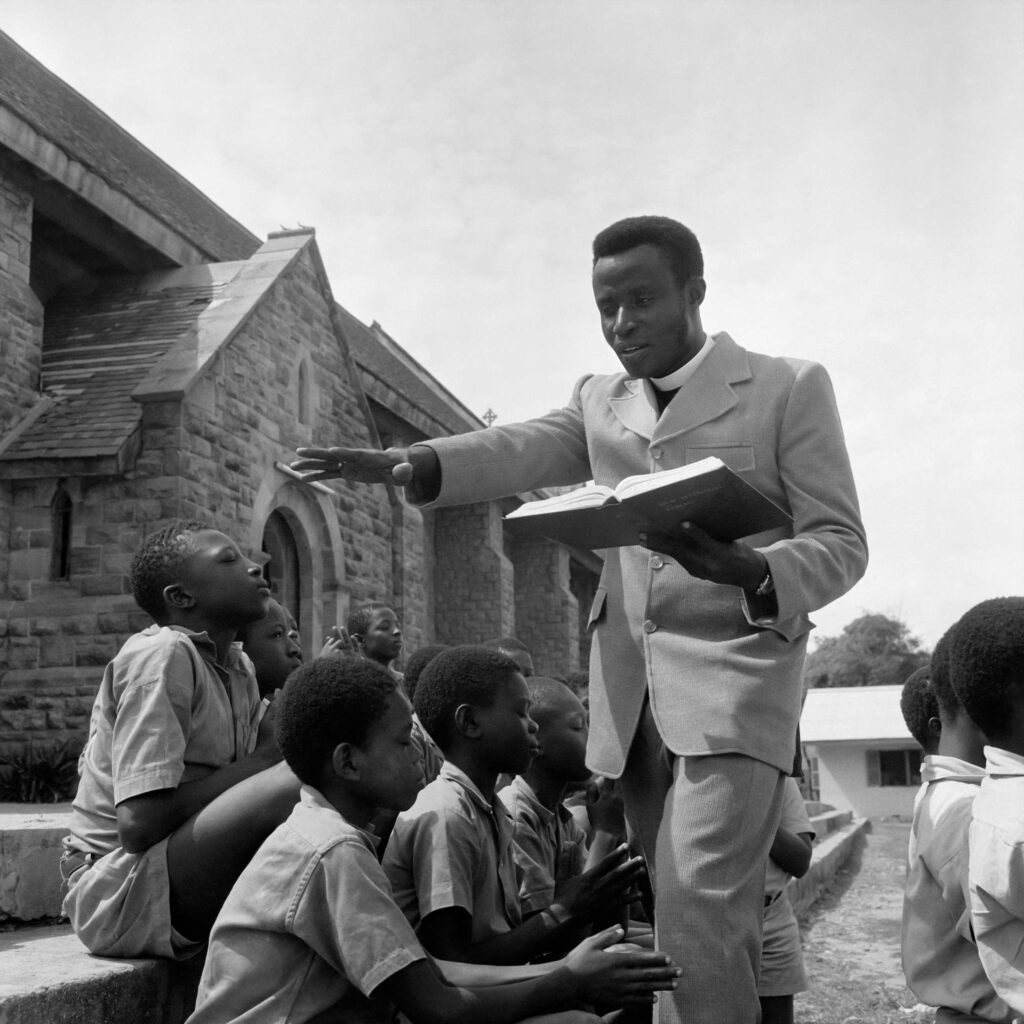
Photographed in 1954 and represented in the V&A by a print made in 2011, Selina Opong, Policewoman #10 places another sitter within a closely related studio vocabulary. The catalogue description mentions curtains, a painted drawing room, a veranda and garden, and a patterned floor mat. The correspondence supports comparison without establishing identical sitting conditions. Opong is standing, turned slightly to her right, smiling and saluting with her right hand. The record describes a three-quarter-length skirt, white socks and black shoes. It identifies her as the tenth woman to graduate as a police officer from the newly established academy in Accra. Clothing and gesture therefore have a documented professional context.
The salute is crucial. The uniform is not simply present as an outfit; it accompanies an action associated with the role. The raised hand changes the portrait from a static record of clothing into a professional presentation. The smile sits alongside that formal gesture, but it should not be converted into certainty about Opong’s emotional state.
Similar Surroundings, Different Relationships
The first portrait and Opong’s do not need a contrast between “traditional” dress and “modern” uniform to become legible. Both depict people in the Accra of the 1950s, photographed through the same studio practice. What changes is the relationship among clothing, body and gesture. In the seated portrait, the child’s proximity and the woman’s gathered hands establish one arrangement. The garment introduces words and repeated imagery. In Opong’s portrait, standing posture and salute give the uniform a more explicitly enacted role. The setting may offer related visual furniture, but it does not determine the same meaning for both people.
The V&A interprets Opong’s portrait through civic pride and the ambitions of urban professionals as Ghana approached independence. That is a useful contextual reading. Its strongest support within the portrait’s description is the conjunction of a named professional identity, uniform and formal gesture, not an assumption that every feature of the painted interior reveals her aspirations.
Sophia Saloman: Dress Meets the Material Photograph
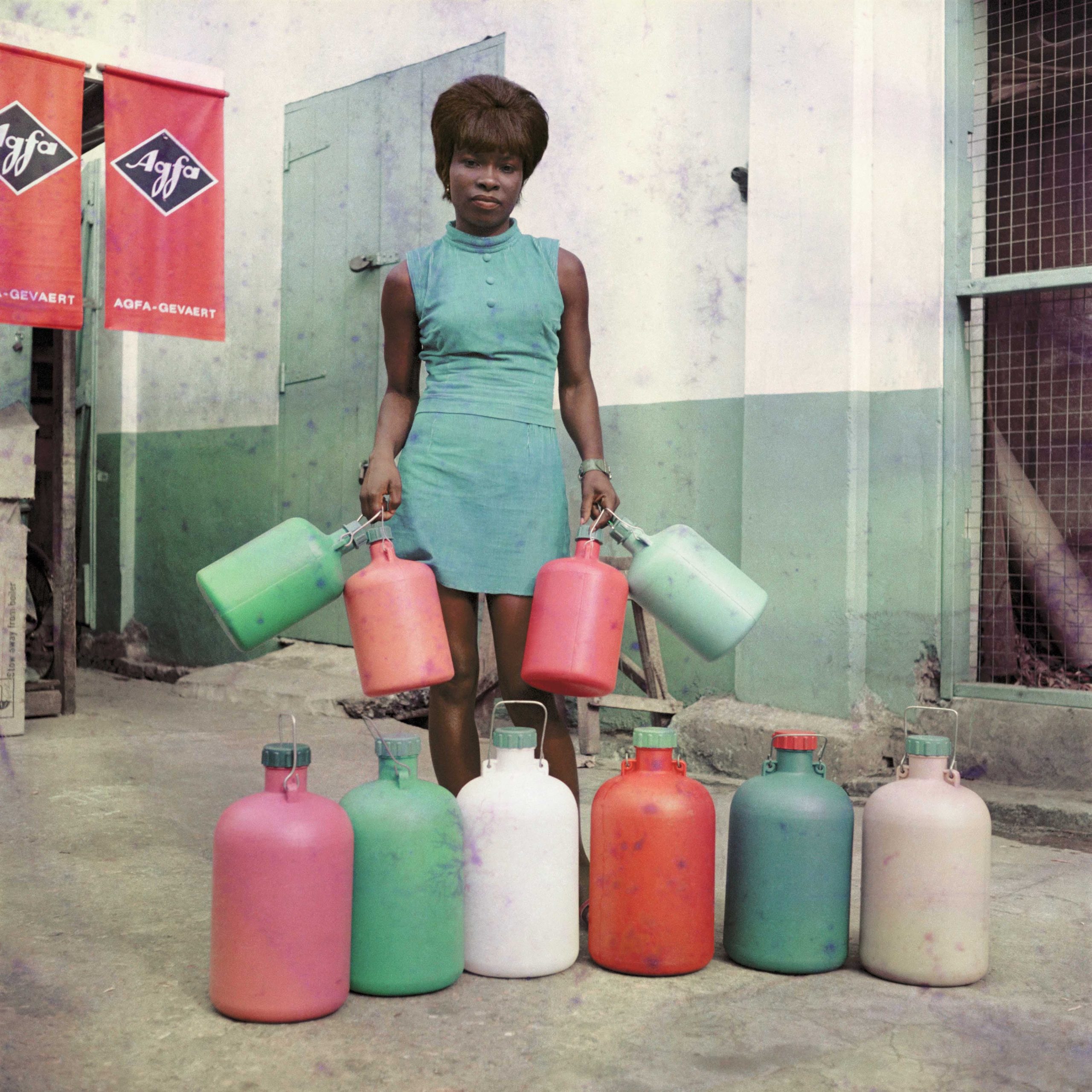
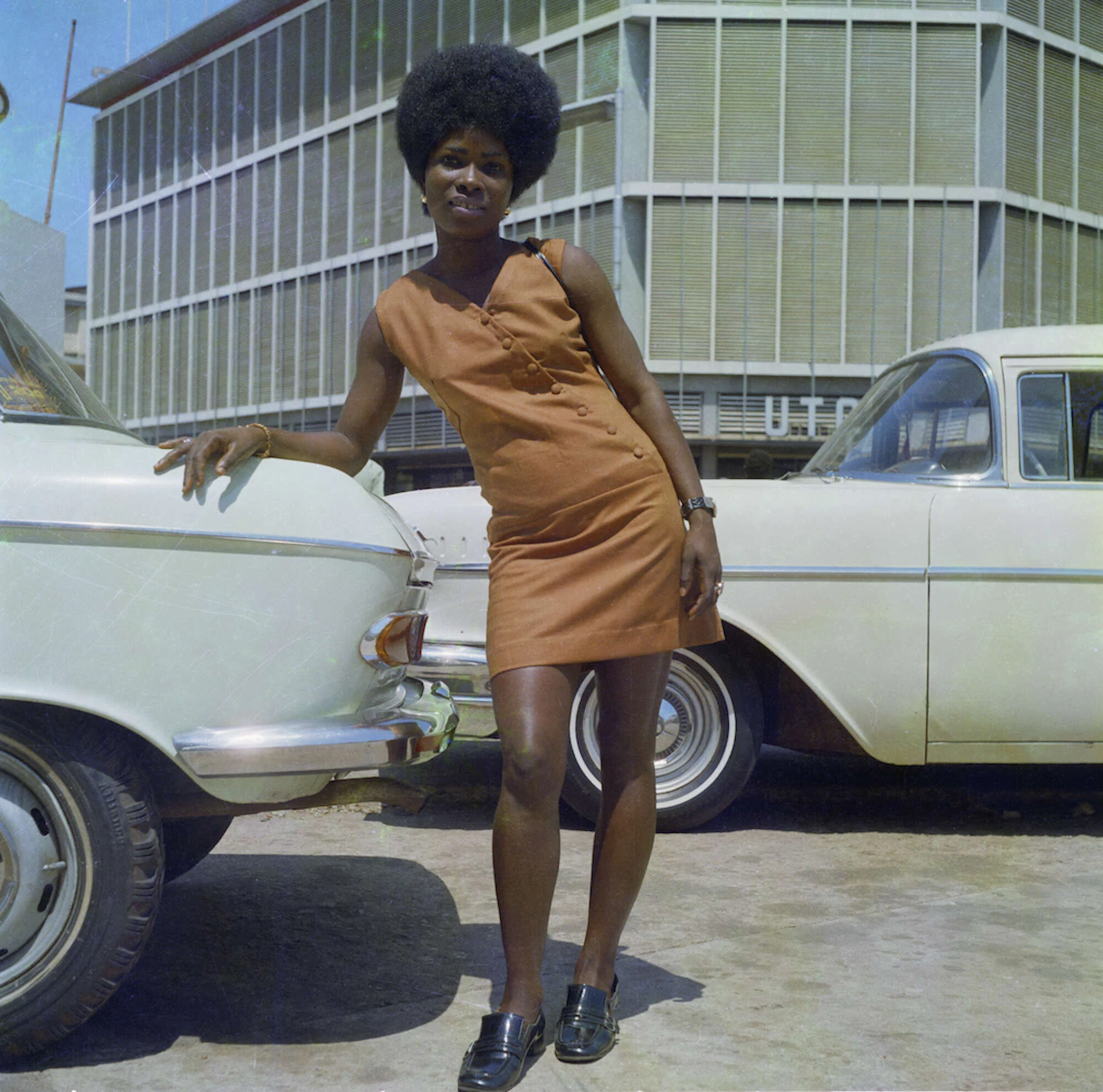
Miss Sophia Saloman, Kokomlemle, Accra, offers a different relationship between clothing and image. The V&A identifies the portrait as photographed around 1972 and records it under accession PH.388-2021. Its contextual article describes a close-up in which a shimmering green-and-yellow dress becomes central to the colour treatment. The same account identifies green shapes scattered through the photograph. They are not another textile or a deliberate background design; they result from deterioration of the original negative. The V&A observes a correspondence between those shapes and the green in Saloman’s dress. That distinction changes the analysis. A viewer can encounter a colour relationship that was not wholly present at the original sitting. The garment belongs to the photographed scene; the deterioration belongs to the negative’s material history. Their interaction in the surviving image should not be credited automatically to a planned colour composition.
The Dress Persists While the Image Changes
This is the most consequential difference between Saloman’s portrait and the two earlier photographs. In the first, the dress contributes printed language. In the second, uniform and salute reinforce a documented role. In the third, clothing participates in a relationship produced partly by what happened to the photograph after exposure. The green-and-yellow dress remains a reference point through which we can understand the later green shapes. The resemblance does not make deterioration an intentional embellishment. It shows that a portrait’s present appearance can contain more than the photographer arranged and more than the sitter wore.
The V&A’s interpretation is therefore useful precisely because it names the cause. Without that explanation, an account might mistake material change for deliberate scenery or assign Barnor authorship of every colour relationship. Knowing the negative’s history makes the dress’s role more particular: it connects the original scene with an altered photographic surface.
What Dress Contributes Most Clearly
Of the three photographs, Everything in My Hand I Bring offers the strongest documented connection between clothing and the image’s recorded identity. The printed phrase becomes its catalogued title, while the hand motif can be read alongside the sitter’s hands. Dress contributes both language and a relationship with the pose. Opong’s portrait makes a different contribution most clearly. The uniform identifies a role already supported by the record, and the salute activates that role within the sitting. Saloman’s portrait provides the most complex account of photographic material: dress becomes part of a colour relationship that cannot be explained solely through choices made before the camera.
These distinctions are more informative than describing all three sitters as stylish, confident or modern. Such words can flatten the photographs into a shared mood. A closer account asks what the clothing actually contributes in each case, and keeps that contribution connected to the person, gesture, setting and surviving image.
The Omiren Argument
The principle is relationship. Clothing does not explain a portrait alone. Its contribution emerges through what surrounds it and what the photographed person does.
In these Accra portraits, printed words meet actual hands, uniform accompanies a salute, and a dress becomes a point of continuity within an altered colour image. These are three different ways clothing helps build a photograph.
Barnor’s authorship remains central, but a precise reading does not assign every garment, gesture or later material change to his intention. It identifies the relationships the evidence supports, and shows why dress matters within them.
Also Read:
- Fashion History Through African Women’s Wardrobes: Cabinets, Trunks and Family Archives
- 10 African Fashion Photographers Shaping a New Editorial Era
- Ghanaian Highlife and the Origins of Afrocentric Formal Dress
- Ghanaian Funeral Fashion: The Most Serious Fashion Event in West Africa
Frequently Asked Questions
Which photographs does this article examine?
Everything in My Hand I Bring, photographed around 1953; Selina Opong, Policewoman #10, photographed in 1954; and Miss Sophia Saloman, Kokomlemle, Accra, photographed around 1972. The V&A documents all, and each is read for what the clothing contributes alongside the pose, setting and material form of the image.
Why distinguish photograph dates from print dates?
A later print can reproduce an earlier photograph. The V&A records the two 1950s studio portraits discussed here as prints made in 2011. That does not move the original sittings into the twenty-first century; it identifies when the physical works in the collection were produced.
What caused the green shapes in Sophia Saloman’s portrait?
The V&A attributes them to deterioration of the original negative. Their relationship with the green-and-yellow dress is an effect in the surviving image, not evidence that Barnor deliberately placed green shapes around the sitter or planned the colour composition. The garment belongs to the scene; the deterioration belongs to the negative’s later history.
Who was Selina Opong?
The V&A record identifies her as the tenth woman to graduate as a police officer from the newly established academy in Accra. Photographed in 1954, she stands saluting in uniform. The museum reads the portrait through civic pride and the ambitions of urban professionals as Ghana approached independence.