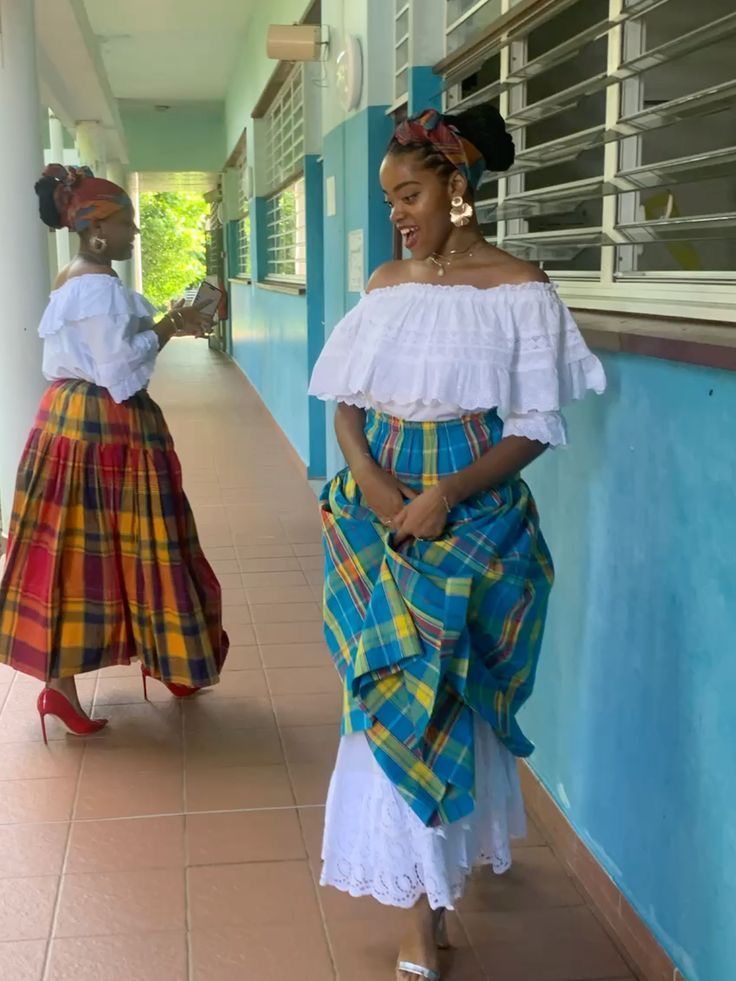
Dominica is a small island. It has a population of just over 70,000 people, a land area of 750 square kilometres, and no international fashion week. It has also produced one of the most structurally sophisticated traditional dress systems in the entire Caribbean, a garment whose construction involves five distinct components, whose headwear carries social coding as precise as anything documented in Martinique or Senegal, and whose gold jewellery tradition reflects an African aesthetic inheritance that runs unbroken from the era of enslavement to the present. That garment is the Wob Dwiyet, and almost no international fashion editorial has ever covered it properly.
Wob Dwiyet translates from Antillean Creole as douillette robe, a French term for a padded or quilted gown. The name references its French colonial origins, but the garment that exists today is not a French dress. It is a Creole one, shaped by three centuries of African, French, and Caribbean cultural exchange on an island whose history of repeated colonial transfers between Britain and France left it with a Creole identity more layered and more deliberately preserved than almost anywhere else in the region. Understanding the Wob Dwiyet means understanding Dominica itself.
The Wob Dwiyet is Dominica’s national dress and one of the most structurally complex traditional costume systems in the Caribbean. This is its full history, its components, and the cultural argument it carries.
The Gwan wob came first.
The direct ancestor of the Wob Dwiyet is the Gwan Wob, meaning Grand Robe, the everyday Creole dress worn by women across Dominican towns and villages during the colonial period. Historian Dr Lennox Honychurch, whose documentation of Dominican cultural heritage remains the primary scholarly reference for the dress tradition, traces the Gwan Wob to the holiday clothing of enslaved women on feast days and Sundays during the plantation era. The earliest truly Creole dress was a floor-length skirt in a bright colour worn over a white cotton chemise, trimmed at the neck, sleeves, and hem with lace. It was the clothing that enslaved women made and wore in the limited time they were not working, combining the European dress silhouette imposed on them through plantation life with the African traditions of colour, embellishment, and textile as identity that they carried with them.
The transition from Gwan Wob to Wob Dwiyet happened gradually as madras cloth became available through colonial trade routes. When madras replaced the earlier plain and striped fabrics, the entire dress system transformed. Creole women began using imité, a pliable imitation fabric, for their foulards and jupes. Ribbons came into fashion, threaded through the lace at the sleeves and neckline. The chemise, which had once reached halfway down the calves, was shortened into something closer to a blouse. Heavily starched lacy petticoats replaced the earlier underskirt. The thoroughly West African custom of lifting the skirt and flinging it over one arm became fashionable, allowing a deliberate glimpse of the petticoat underneath. Each of these changes was driven by the women wearing the garment, not by any external designer or colonial authority.
Five Pieces. One Complete System.
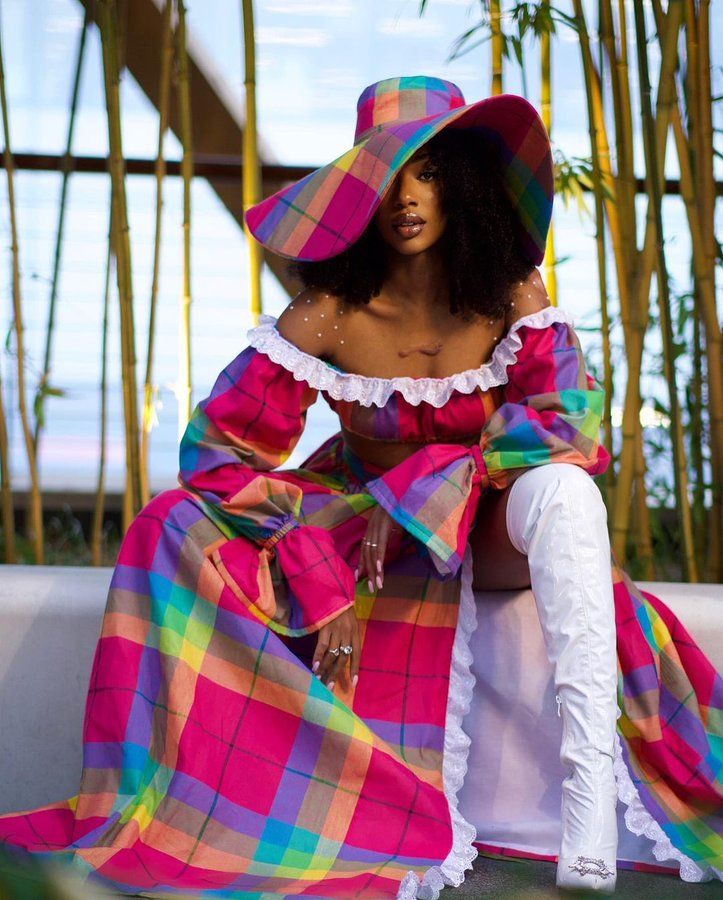
The full traditional Wob Dwiyet is a five-component ensemble, and each piece has a specific name, function, and place within the complete dress. The jupe is the primary skirt: a long, full, brightly coloured madras skirt that forms the centrepiece of the silhouette. It is cut with volume and worn with a jupon and a dantell, the lace-edged petticoat that adds structure and movement beneath it. The chemise is the white cotton blouse, long-sleeved in the formal Wob Dwiyet, trimmed with Broderie Anglaise lace and red ribbons at the collar and cuffs. The foulard is the shawl, draped over the shoulders in a specific configuration. The mouchoir is the headpiece, a folded madras cloth tied with deliberate precision over the hair.
Each component is constructed with a level of care and technical knowledge that most fashion commentary has never engaged with. The jupon must be starched to a specific stiffness to provide the correct volume under the jupe without collapsing in the heat. The lace trim on the chemise and jupon must be Broderie Anglaise in the proper tradition. The foulard must fall in a particular drape across the shoulders. Black shoes are required: never white, which is one of the dress’s most specific and least discussed rules. Aileen Burton, cultural custodian of the Roseau Cultural Group and author of the book National Dress of Dominica, has been direct about the stakes of getting this wrong: “People have a misconception,” she has said, that once they use madras, lace and gold, that is the national dress. It is not.
The Mouchoir: Where the Head Becomes the Statement
Of all the components of the Wob Dwiyet, the mouchoir, the madras headwrap, carries the most concentrated cultural meaning. In Dominican tradition, as in the broader French Creole dress system that connects Dominica to Martinique, Guadeloupe, and St. Lucia, the headwrap is not a finishing accessory. It is a structural element of the complete ensemble, and its tying style communicates information. The tête cassée, meaning broken head, is the Creole term for the headwrap in its formal configuration, referring to the precise folding and knotting technique that produces the elevated, pointed forms seen in the full Wob Dwiyet.
The specific point system that Martinique developed with such precision, in which one, two, three, or four points declare the wearer’s marital and social availability, is part of the same regional dress tradition from which the Dominican mouchoir emerges. In Dominica, headwrap traditions are documented as part of the Creole dress system associated with the bèlè dance culture, where the specific way the mouchoir is tied signals the wearer’s status and role within the community. Gold earrings, bracelets, and necklaces are worn with the mouchoir as part of the complete ensemble, the gold pinned directly to the cloth of the headwrap and worn on the body, so that the head itself becomes weighted with cultural communication.
Gold as Language, Not Ornament
The gold jewellery tradition of the Wob Dwiyet is one of its most significant and least discussed dimensions. The complete ensemble specifies gold on the arms, neck, ears, and mouchoir: the full body is adorned, and the head is adorned specifically. This is not a decorative display of wealth in the European tradition of showing assets through jewellery. It is the continuation of an African aesthetic philosophy in which gold carries spiritual and cultural weight beyond its monetary value, in which the act of adorning the body in gold is a ritual assertion of dignity, identity, and connection to ancestral tradition.
The specific forms the gold takes in the Wob Dwiyet tradition, heavy chain necklaces, wide bangles, large hoop earrings, and smaller pieces pinned to the mouchoir, mirror the gold jewellery traditions of West African cultures, particularly those of the Akan peoples of Ghana and Côte d’Ivoire, whose gold traditions were among the most developed on the continent before the slave trade. That the women brought to Dominica as enslaved people maintained and transmitted a gold aesthetic culture across generations, incorporating it into a dress tradition that blended their heritage with French colonial silhouettes, is one of the clearest examples of cultural survival through fashion in the Caribbean.
The Jip: Dominica’s Shorter Answer
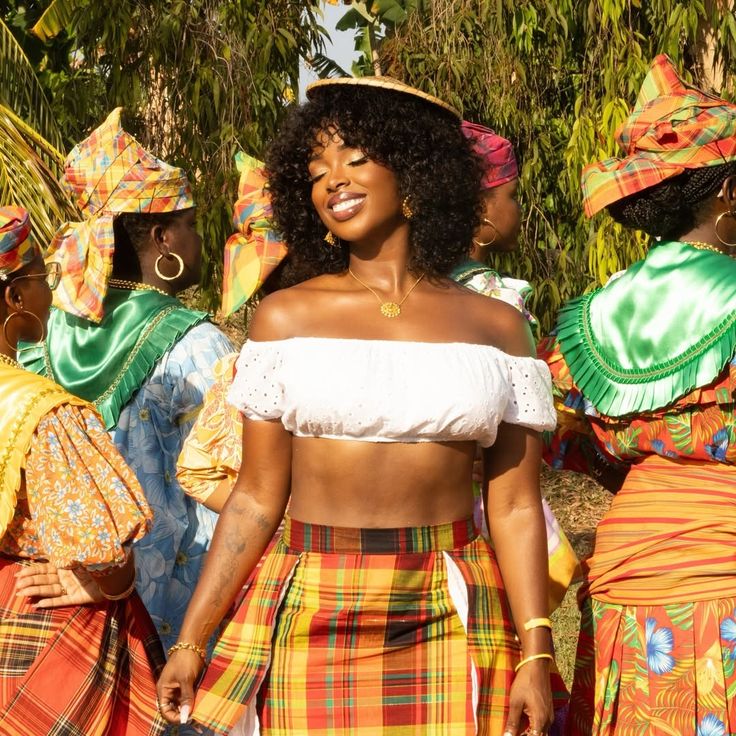
Alongside the Wob Dwiyet, Dominica also recognises the Jip, a shorter and more accessible version of the national dress developed in the twentieth century specifically to address complaints that the full Wob Dwiyet was too hot, too expensive, and made younger women feel old. The Jip, whose development is credited to a cultural figure named Cece Calderon, replaces the long-sleeved dress with a white Chemise Décolleté, a blouse open at the neck with frills and Broderie Anglaise in the French style, worn with a madras or floral skirt. The Jip carries the same madras fabric tradition and the same gold jewellery requirement, but without the full volume and complexity of the Wob Dwiyet.
The Jip and the Wob Dwiyet coexist on Dominican Creole Day, with the Wob Dwiyet treated as the more formal and historically specific garment and the Jip as the more everyday Creole dress alternative. Cultural custodians, including Aileen Burton, have been careful to distinguish between them: the Jip is an acceptable and legitimate version of Dominican national dress, but it is not the Wob Dwiyet, and the two should not be conflated. That distinction matters for the same reason any distinction between a simplified and a complete form of a cultural practice matters: the full tradition carries more, and losing precision about what the full tradition requires is how traditions fade.
Jounen Kwéyòl and the Living Calendar
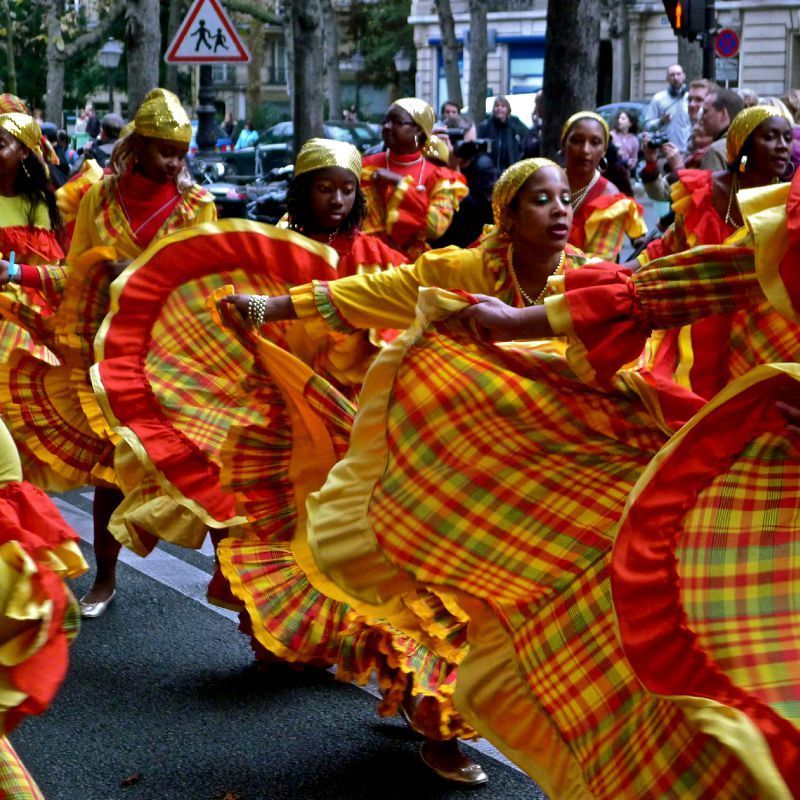
The Wob Dwiyet is not a museum piece. It is worn, debated, competed in, and occasionally argued over every year in Dominica as part of a cultural calendar that makes October one of the most distinctively dressed months in the Caribbean. Jounen Kwéyòl, Creole Day, falls on the last Friday of October, when Dominicans across the island wear national dress and speak Creole in a full-day celebration of Creole cultural identity. The streets of Roseau fill with women in Wob Dwiyet and Jip, men in white shirts with madras sashes and waistcoats, and children in miniature versions of the adult dress. The entire island participates.
The Miss Wob Dwiyet competition, held annually as part of Independence celebrations, is the garment’s highest public stage. Participants are judged not only on the beauty and accuracy of their Wob Dwiyet but on their cultural knowledge of its history, components, and traditions. The Madame Wob Dwiyet pageant, held at the Arawak House of Culture, honours older women in the tradition. The Ti Matador Creole Pageant involves younger children. The Creole Day Parade moves through Roseau. The garment that the international fashion press has never covered properly is, in Dominica, the centre of a month-long national conversation about identity, heritage, and what it means to maintain cultural knowledge across generations.
The Authenticity Debate Dominica Is Already Having
One of the most striking things about the Wob Dwiyet tradition is that Dominica itself is actively, publicly wrestling with what counts as authentic. Aileen Burton and the Roseau Cultural Group have consistently raised concerns that the national dress is being diluted through misconceptions about what it requires. The use of African prints to make the Wob Dwiyet, instead of madras, has been specifically called historically incorrect. The belief that any combination of madras, lace, and gold constitutes the national dress has been challenged repeatedly by cultural custodians who insist that the specific components, their construction, and their wearing conventions all matter.
This internal debate is not a sign of crisis. It is a sign of health. A dress tradition that nobody is willing to argue about is already starting to fade. The fact that Dominican cultural organisations, historians, and community figures continue to insist on precision about what the Wob Dwiyet actually is, what it requires, and why those requirements matter, is the clearest evidence that the tradition is alive and that the people who carry it understand its value. The international fashion press has not been part of that conversation. It has not even been aware that the conversation was happening.
READ ALSO:
- The Pollera, the Wob Dwiyet, and the Baiana: The African Women Who Dressed the Americas
- What Jamaica Kept: The African Fabrics and Head-Tie Traditions That Survived The Middle Passage
OMIREN ARGUMENT
The Wob Dwiyet is absent from international fashion editorial for the same structural reason that most Caribbean and African diasporic dress traditions are absent: the editorial infrastructure of global fashion is concentrated in cities that have decided in advance which traditions are worth covering, and small island nations with populations of 70,000 do not appear on that list. This is not a question of access.
The information about the Wob Dwiyet is documented in detail by Dominican historians, including Dr Lennox Honychurch, and cultural custodians, including Aileen Burton. The book National Dress of Dominica exists. The annual Miss Wob Dwiyet competition exists. The Jounen Kwéyòl celebrations exist and have existed for decades. What does not exist is any sustained international fashion press that represents all of this.
The Wob Dwiyet is a five-piece ensemble whose construction requires specific knowledge of lace type, fabric starch, headwrap folding, gold placement, and shoe colour. It carries a cultural history that runs from African enslavement through French colonial dress codes, through emancipation and into a living national identity that an entire island celebrates for a month every year. By any editorial standard that claims to take fashion seriously, this is a story. The fact that it has not been told is not an oversight. It is a choice about whose dress traditions count as fashion and whose count as folklore. This article disagrees with that choice.
Frequently Asked Questions
- What is the Wob Dwiyet?
The Wob Dwiyet, also written as ‘Wòb Dwiyèt’ and sometimes called ‘robe dwiyet’ or ‘wob douillette’, is the national dress of the Commonwealth of Dominica. The name comes from the French robe douillette, meaning padded or quilted gown. It is a traditional five-component dress ensemble consisting of the jupe (madras skirt), jupon a dantell (lace petticoat), chemise (long-sleeved white blouse), foulard (shoulder shawl), and mouchoir (madras headwrap), worn with gold jewellery on arms, neck, and ears and pinned to the headwrap. It is worn primarily during Jounen Kwéyòl, Creole Heritage Month, and Independence Day celebrations, and is the central garment in the annual Miss Wob Dwiyet competition.
- What is the history of the Wob Dwiyet?
The Wob Dwiyet evolved from the Gwan Wob, the everyday Creole dress worn by women in Dominica during the colonial period. Historian Dr Lennox Honychurch traces its origins to the holiday clothing of enslaved women on feast days and Sundays, consisting of a bright-coloured floor-length skirt over a white lace-trimmed chemise. As madras cloth became available through colonial trade routes, it replaced earlier plain fabrics, and the dress system gradually evolved into its current form. The cut and silhouette reflect Victorian and Edwardian European dress transported to the island during the colonial period, while the colour combinations and gold jewellery reflect a direct African cultural inheritance from the enslaved women who shaped it.
- What are the components of the full Wob Dwiyet?
The traditional Wob Dwiyet consists of five components. The jupe is the primary madras skirt, long and full. The jupon à dentelle is the lace-edged petticoat worn beneath to add volume and structure. The chemise is a long-sleeved white cotton blouse trimmed with Broderie Anglaise lace and red ribbons at the collar and cuffs.
- What is the difference between the Wob Dwiyet and the Jip?
The Jip is a shorter, more accessible version of Dominican national dress, developed in the twentieth century and credited to cultural figure Cece Calderon, to address complaints that the full Wob Dwiyet was too hot, expensive, and associated with older generations. The Jip replaces the long-sleeved dress with a white chemise décolleté, an open-necked blouse with frills and broderie anglaise, worn with a madras or floral skirt. Both garments incorporate madras fabric and gold jewellery. The Wob Dwiyet is treated as the more formal and historically specific national dress, while the Jip is an accepted everyday alternative. Cultural custodians carefully distinguish between the two and argue that, specifically on Creole Day, the full Wob Dwiyet should be worn.
- What is Jounen Kwéyòl, and how does the Wob Dwiyet feature in it?
Jounen Kwéyòl, or Creole Day, is an annual celebration held on the last Friday of October in Dominica as part of Creole Heritage Month. On this day, Dominicans across the island wear national dress and speak Creole throughout the day. The streets of Roseau fill with women in Wob Dwiyet and Jip, men in white shirts with madras sashes and waistcoats, and children in miniature versions of the adult dress. Throughout October, Fridays are designated as Creole Dress Day, with the full Wob Dwiyet tradition reaching its peak expression on Jounen Kwéyòl itself. Associated events include the Miss Wob Dwiyet competition, the Madame Wob Dwiyet pageant, the Ti Matador Creole Pageant, and the Creole Day Parade through Roseau.
- Why is the gold jewellery so significant in the Wob Dwiyet tradition?
The gold jewellery of the Wob Dwiyet, worn on the arms, neck, and ears, and pinned to the mouchoir headwrap, reflects a continuous African aesthetic tradition carried by the enslaved women who shaped the Dominican Creole dress culture. Cultural historians have noted that the specific forms of gold used in the tradition, heavy chains, wide bangles, large hoop earrings, and pinned pieces, mirror the gold jewellery practices of West African cultures, particularly those of the Akan peoples of Ghana and Côte d’Ivoire. The wearing of gold in the Wob Dwiyet is therefore not decorative in the European sense of displaying wealth. It is the continuation of an African cultural philosophy in which gold carries spiritual and ancestral significance, passed down through generations through the dress tradition.