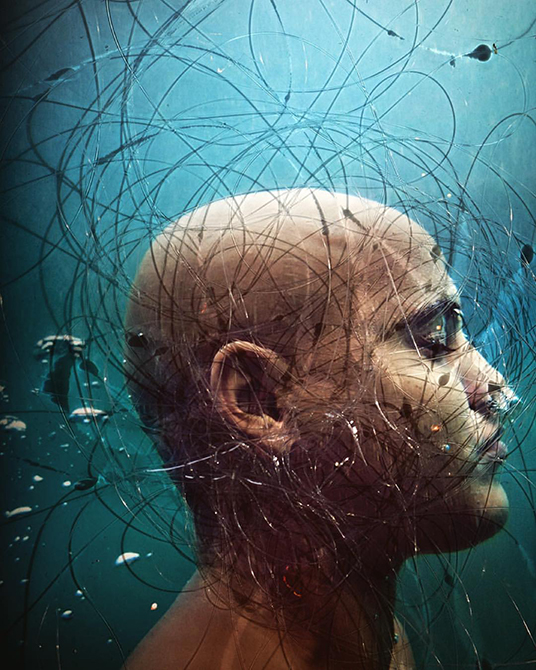
In Circa’s future, water changes the terms of the portrait. Bodies remain present, but their outlines, gestures, and expressions become harder to interpret at first glance.
In Indian Bay, Saint Vincent and the Grenadines, Nadia Huggins photographs adolescent boys above and below the water. In her account of Circa’s no future, the transition between those two positions changes their relationship with the camera. Above the surface, the boys are aware they are being photographed and posture accordingly. Below it, that awareness recedes. Her website dates the project “2014–ongoing”, and individual works carry their own dates within that span.
“I am reconfiguring ways of seeing the familiar.” — Nadia Huggins, speaking to Laura Snoad for It’s Nice That, 2019
The movement between those positions supplies the work with more than a sequence of actions. It changes the conditions of visibility itself. A body preparing to jump can present itself to an audience. Underwater, forces other than self-presentation shape its outline, balance, and orientation. The photograph encounters someone responding to an environment, not simply holding a pose. And Huggins is clear that this environment is not unfamiliar territory — she told Laura Snoad that she was working relatively close to shore, rather than exploring unknown oceanic depths. The strangeness of these pictures begins in a known place.
Explore how Nadia Huggins’s Circa No Future uses submersion, movement and interrupted visibility to examine adolescent bodies at Indian Bay, Saint Vincent.
A Body Returning to the Surface
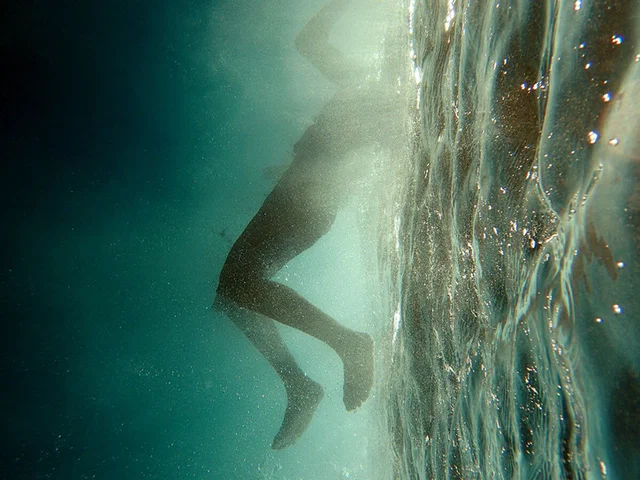
One photograph offers a focused entry point into how that change works in practice. In her 2025 study, art historian Kate Keohane discusses Circa No Future No. 10, dated 2014. She describes a boy moving back toward the surface, hands extended as though seeking balance, while bubbles make his figure appear both substantial and ghostlike.
Keohane’s reading locates the picture between actions. The jump has already happened; the return to the air is not yet complete. That interval matters to how the portrait works. The hands need not be understood as an expressive gesture directed towards the camera. Consider them in relation to the swimmer’s immediate physical situation, what the body is doing to meet the water, rather than what it tries to communicate to a viewer.
The distinction redirects attention usefully. Instead of asking what a pose supposedly reveals about character, the viewer can ask how a body is meeting its environment. A portrait does not become less attentive because it declines to offer an easily readable expression. Here, attention can rest on a transitional moment: a person remaining visible while the conditions surrounding them interrupt a stable presentation of self.
The project’s title requires similar care. Keohane traces Circa’s future to a slogan on one boy’s T-shirt. That origin should discourage treating the phrase as a prediction about the subjects’ lives or as a broader statement about Caribbean youth. The title is observed, not assigned.
What Water Does to the Portrait
Huggins’s photographs make the environment an active participant within the image rather than a backdrop. In the It’s Nice That interview, Laura Snoad describes refraction rendering limbs unfamiliar, while Huggins explains how water clarity, light, depth, and the stretch of coast affect her working conditions from one session to the next. The sea is not simply behind the subjects. It participates in how they can be photographed at all.
This changes abstraction’s function in the work. A partially obscured body is not necessarily a retreat from the person depicted. It can record how that person appears within a medium that genuinely interrupts outline and orientation. Writing for the British Council, Andre Bagoo identifies bubbles, distance, perspective, and cropping as ways recognition becomes unsettled in Circa no future. A face may be blocked or excluded rather than offered as the unquestioned centre of the portrait.
The result need not be interpreted as anonymity alone. Presence and identification are different things. The photograph can insist someone is there without supplying every cue a viewer might use to categorise them. That hesitation is productive: it slows the movement from seeing a body to claiming to understand a person. For photography concerned with subjects whose bodies have often been read too quickly, that slowing matters.
Vulnerability Is a Physical Condition
Huggins’s account of vulnerability is grounded in something concrete: breathing. In the It’s Nice That interview, she connects the moment she seeks to photograph with the swimmer’s need to resurface for air. The body’s awkwardness and dependence underwater matter as much as its freedom of movement. That framing complicates an easy contrast between restrictive land and liberating sea.
Water may permit a different relationship to posture and self-presentation — the boys move differently below the surface than they do above it. But it also imposes demands. Buoyancy does not remove the need to breathe, and play does not eliminate physical limits. The photographs can therefore hold freedom and dependence together in the same frame rather than resolving the tension in either direction.
This is more precise than treating vulnerability as an emotion a critic can diagnose from a facial expression. It locates the question in a specific activity and environment, allowing discussion without assigning private feelings to an unidentified swimmer. The body’s actual situation — underwater, needing to rise — is enough to sustain the reading.
Indian Bay Is Not Interchangeable Scenery
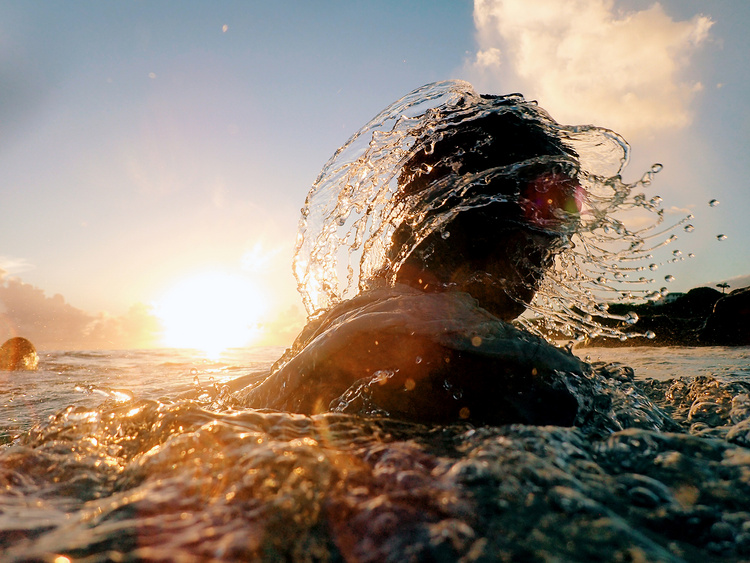
Huggins’s attention to a particular location also shapes her account of what representation is doing in this work. In a 2021 interview with Photoworks, she described the limited presence of Black and mixed-race Caribbean bodies in familiar underwater imagery. She contrasted that absence with how people living in the region relate to the surrounding water as part of everyday life, not as tourists.
Circa no future can be understood against that concern, but the project deserves more than a label like “anti-tourist”. It does not simply add people to an otherwise empty view. It centres an activity through which local people experience a specific place. Nor does it need to remove beauty from the sea to make its point. Huggins’s challenge is to show relationships a scenic image can leave out: the swimmer’s breath, the particular conditions of Indian Bay, and the interrupted visibility the water produces.
Indian Bay remains a named location rather than a generic symbol of island life, and that particularity matters. These photographs need not represent every Caribbean shoreline, swimmer or experience to offer a significant account of one sustained encounter with one place over time.
The Photographer Is Also Submerged
“I am as much a subject as the boys,” Huggins writes in her project statement. She places her relationship with those she photographs within the work itself, rather than presenting herself as an absent, neutral observer outside the scene.
Keohane adds a practical dimension to that position. She describes Huggins taking photographs with a small handheld underwater camera, without a breathing apparatus, during the intervals when she can hold her breath. The environment therefore sets conditions for both the photographer and the subjects. Both are in the water. Both are subject to its demands.
That does not make their roles identical — Huggins still selects the images and shapes how they are presented. But her bodily position in the water helps explain why the camera does not offer an orderly view from outside the action. The camera is inside it. Submersion is a method of making, not just the subject being represented. That distinction is part of what makes Circa no Future a different kind of underwater portrait series from those made from a position of greater technical control.
What the Work Adds Up To
The strongest word for what Circa no Future is doing is submersion — not as metaphor but as a physical condition that changes both how a body appears and how a photographer can access it. Huggins centres the swimmers’ interaction with the sea rather than treating them as incidental figures within a view. At the same time, the water prevents their presence from becoming completely legible to a viewer who was not there.
That is the project’s distinctive contribution to portraiture. Visibility does not produce instant understanding. A body can be close, recognisable in parts, and still resist a confident reading. The work is most rewarding when criticism stays with those conditions: the interrupted outline, the uncertain gesture, the surface approached but not yet crossed. Indian Bay becomes neither an empty paradise nor a convenient metaphor. It is the place where these particular encounters take form, in water, over time.
Also Read:
- Caribbean Photography and the Body: How the Region’s Image-Makers Are Reframing Representation
- Underwater and Unseen: The Tradition of Submersion in Black Photography
- Saint Vincent and the Grenadines: Culture, Identity and the Creative Scene
Frequently Asked Questions
Where was Circa’s future made?
Huggins identifies Indian Bay, Saint Vincent and the Grenadines as the project’s location. The site is significant: it is a known, local place rather than a generic or remote seascape, and Huggins has spoken about working close to shore throughout the project.
When did the project begin?
The artist’s website dates Circa no future as “2014–ongoing”. Individual works carry their own dates within that span. The photograph discussed most closely in this article, No. 10, is dated 2014.
Does the project include moving images?
Yes. The Art Gallery of Ontario identifies a related three-minute, single-channel video dated 2016-2019. That record concerns the particular video rather than the full chronology of the photographic project.
What does the title ‘Circa no future’ mean?
Art historian Kate Keohane traces the phrase to a slogan on one boy’s T-shirt, observed during the making of the project. Knowing the origin matters: it discourages treating the title as a statement about the subjects’ prospects or as a summary of a broader social condition. The phrase was found, not imposed.