The Kalabari Ijaw of the Niger Delta say that Injiri carries a person from the womb to the tomb. That is not a metaphor embellished by distance or time. It is a literal account of how this cloth moves through a woman’s life in Kalabari, Ibani, Okrika, and the other Ijaw communities of Rivers, Bayelsa, and Delta States. When a Kalabari father acknowledges his newborn child at the naming ceremony, he presents an uncut length of Injiri as the public declaration of his paternity. When a new mother completes her dedication ceremony, she ties Njiri at the waist and walks through the town so the community can see that her husband has cared for her well. When an Ijaw woman completes the Iria rite of passage that transforms her from a girl into a full woman with the right to tie the double wrapper, the fabric that marks that crossing is Injiri. And when an Ijaw woman of high standing is prepared for burial, Injiri wraps the conclusion of the same life it dressed at the beginning.
Injiri is the Kalabari name for Indian madras, the plaid-checked cotton cloth woven in Tamil Nadu and imported into the Niger Delta through Portuguese and later British trade for over two hundred years. The name itself is a Kalabari pronunciation of Injeram, an old port north of Madras where much of this cloth originated. The cloth arrived as a trade commodity. What the Ijaw made of it is one of the most extraordinary acts of cultural transformation in the history of African dress. They received an import, gave it a Kalabari name, subjected it to an original cut-thread art form that exists nowhere else in the world, built their most sacred rite of passage around it, and made it the fabric through which the most significant transitions of a woman’s life are marked and witnessed.
This is not a story about a community that adopted a foreign cloth. It is a story about a community that remade a foreign cloth into the most culturally specific textile tradition in the Niger Delta. The five styles in this article are the evidence.
Discover the top 5 Injiri styles for Ijaw women in 2026, from the sacred Njiri double wrapper of the Iria ceremony to the Pelete-bite cut-thread art form. A cultural guide to Injiri cloth in the Niger Delta, Kalabari dress tradition, and the styles worn from birth to burial.
Injiri and the Ijaw: A Trading Nation and Its Cloth

The Ijaw are one of the world’s most ancient peoples, inhabiting the Niger Delta region of Nigeria for at least 5,000 years and trading along the Delta’s waterways and maritime routes since the late 14th century. As documented in Wikipedia’s account of the Ijaw people, the Ijaw population has grown to an estimated 14.39 million as of 2024, making them the fourth-largest ethnic group in Nigeria. Their settlements along key maritime trade routes placed them at the centre of the Gulf of Guinea’s commerce: palm oil, fish, cloth, and, later, the catastrophic trade in enslaved people all passed through the Oil Rivers of the Niger Delta, and the Ijaw were primary participants in and witnesses to all of it.
Injiri arrived in this world, most likely carried by Portuguese traders who reached the Niger Delta shores as early as the 15th century, then reinforced by British colonial trade networks that brought cloth from Fort St. George in Chennai, India. As Paperclip’s account of the Kalabari-Madras connection documents, the Kalabari chiefs readily accepted the cloth, and it immediately took on a special significance in their culture, serving as a metaphor for the journey from the womb to the tomb. The word Injiri is the Kalabari pronunciation of ‘Injeram’, the old port north of Madras, where the cloth was produced, shipped to England, and then exported to West Africa. That naming act, the community pronouncing the cloth in their own tongue and claiming it as their own, is the first and most fundamental act of the cultural transformation that produced the Injiri tradition.
The hierarchy of textiles that the Kalabari prize in their dress culture reflects centuries of active, sophisticated trading relationships. As academic research by Professor Joanne Eicher, the foremost scholar of Kalabari dress, records in the Fashion History Timeline’s documentation of Pelete-bite, the Kalabari textile hierarchy runs from Indian cloth (the finest Injiri) through lokobite, sinini, Akwete, and down to Injiri itself at its lowest register. The very breadth of that hierarchy demonstrates a community that has been thinking about cloth, trading cloth, and making cultural judgements about cloth for centuries. Injiri is not something the Ijaw stumbled into. It is the outcome of long, deliberate textile intelligence.
The Kalabari did not adopt Injiri. They absorbed it, named it, cut it, built a rite of passage around it, and made it carry the full weight of Kalabari womanhood. That is not adoption. That is civilisational authority over a foreign material.
Pelete-bite: The Art of Cutting What Was Given
Before the styles, the technique that makes Injiri fully Kalabari must be understood. Pelete-bite is the Kalabari art of cutting selected threads from Injiri madras cloth to create an openwork pattern that did not exist in the original fabric. A Kalabari woman takes a needle to pick up a single thread in the plaid, cuts it at both ends with a penknife or razor blade, and pulls it out. She does this across the entire cloth, thread by thread, section by section, producing a lace-like openwork pattern against the original colour ground of indigo, red, burgundy, or dark green. As the Fashion History Timeline’s Pelete-bite entry records, examples of Pelete-bite cloth are held in the Dallas Museum of Art, the Brooklyn Museum, and the British Museum, collected by Professor Eicher over decades of fieldwork.
The cultural argument of Pelete-bite is perhaps the most radical in this entire series. The Kalabari take an imported commodity, cut it apart thread by thread, and produce from the act of cutting a cloth that is considered quintessentially Kalabari. The transformation is not decorative. It is ontological. The cloth becomes Kalabari not by replacing the Injiri, but by subjecting it to a process known only to Kalabari hands, for purposes understood only by Kalabari culture. Mythological heroines in Kalabari praise songs are described wearing cloth with the same symbolic motifs as Pelete-bite. The patterns refer to important mythological and historical knowledge held by women who pass the symbols on to future generations as they teach the technique. Pelete-bite is, in that sense, a library as much as a textile.
The technique is practised predominantly by Kalabari women, though not exclusively, and the skill is passed from mother to daughter. Each piece is unique. The openwork patterns cannot be precisely replicated by machine, and the act of making one is an act of cultural transmission as much as artistic production.
The 5 Injiri Styles Defining Ijaw Women’s Fashion in 2026

1. The Njiri Double Wrapper (The Foundation of Kalabari Womanhood)
The Njiri double wrapper is the standard form of full Kalabari women’s dress and the style that carries the most direct cultural weight across the broadest range of Ijaw occasions. Two lengths of Injiri cloth, one tied at the waist falling to the ankle and a second layered over it, worn with a matching blouse, a head tie, and the coral bead accessories that communicate the wearer’s standing in the community: this is the complete Kalabari women’s dress that an Ijaw woman earns the right to wear upon completing her Iria ceremony. As Daily Trust’s account of the Iria ceremony records, completing the Iria grants a woman the right to tie two waist George wrappers and all the other large wrappers that full-fledged women tie in Ijaw communities. Before the Iria, a girl may not wear the double wrapper. After it, she must. The cloth does not simply mark the transition: it constitutes it.
The colour palette of authentic Injiri is specific and limited: indigo, red, and burgundy grounds offset with white, yellow, and black. These are not arbitrary choices. The colours carry the trading history of the cloth, the visual language of the Niger Delta, and the aesthetic preferences of communities that have been living on and by the water for five thousand years. An Ijaw woman who ties her Njiri double wrapper in deep indigo with white check at the crossing of threads is wearing the colour of the Delta’s water at night, the colour of mourning and depth, the colour that the Kalabari have read as the ground of formal dress for generations.
In 2026, the Njiri double wrapper remains the ceremonial standard across Kalabari, Ibani, Okrika, and Bonny communities. It is worn at traditional weddings, at the Iria ceremony, at naming ceremonies, at the first and second burial rites, and at every gathering at which a full Ijaw woman’s cultural membership in the occasion is required to be visibly declared. No other style in this series carries the same weight of earned status. You do not simply buy this wrapper. You qualify for it.
2. The Pelete-bite Wrapper (The Cut-Thread Art Form)
The Pelete-bite wrapper is Injiri transformed by the hands of a Kalabari woman into a cloth that could not have been made anywhere else in the world. The imported Madras plaid, cut thread by thread, emerges from the process carrying openwork patterns that reference Kalabari mythology, historical knowledge, and the visual motifs passed through generations of women who teach the technique by teaching the meaning of the patterns it produces. As the Fashion History Timeline documents, the Kalabarisation of this cloth is particularly striking because not only the cloth but also the tools used to make it, needles and penknives, are themselves acquired through trade. The entire process of transformation, from an imported commodity to a cultural emblem, is accomplished with foreign instruments on foreign cloth to produce something wholly Kalabari.
A Pelete-bite wrapper is, among Kalabari Ijaw women, the highest expression of Injiri dressing. Its presence at a ceremony communicates not only wealth and standing but knowledge: the knowledge of the woman who made it, the knowledge of the women who taught her, and the knowledge of the community that can read its patterns. Pieces are held in major international collections, including the Brooklyn Museum, the Dallas Museum of Art, and the British Museum, not as historical artefacts but as ongoing productions of a living Kalabari textile tradition.
In 2026, Pelete-bite wrappers are worn at the most significant Kalabari ceremonial occasions: the Iria ceremony at its highest stages, the Iya form of traditional marriage (the most expensive and prestigious of the three Kalabari marriage forms), chieftaincy installations, and the funerals of senior community figures. A woman who appears in Pelete-bite at a gathering has signalled her household’s investment in the occasion and her own understanding of the cloth’s cultural register. Both signals are read.
3. The Injiri Iriabo Look (The Womanhood Ceremony)
The Injiri Iriabo is the specific Injiri ensemble worn by the Iriabo, the maiden undergoing the Iria ceremony and transitioning into full womanhood. The Iria ceremony, as Wikipedia’s entry on the Iria ceremony documents, is practised across the Ijaw ethnic group in Rivers State, primarily in the Ibani, Kalabari, Okrika, and Opobo-Nkoro communities, and it is one of the most significant rites of passage in all of Ijaw culture. An Iriabo initiate cannot be buried in Ibani land without having completed the ceremony. It is not optional. It is not archaic. It is a living cultural requirement that places the Injiri wrapper at the centre of Ijaw women’s most important public moment.
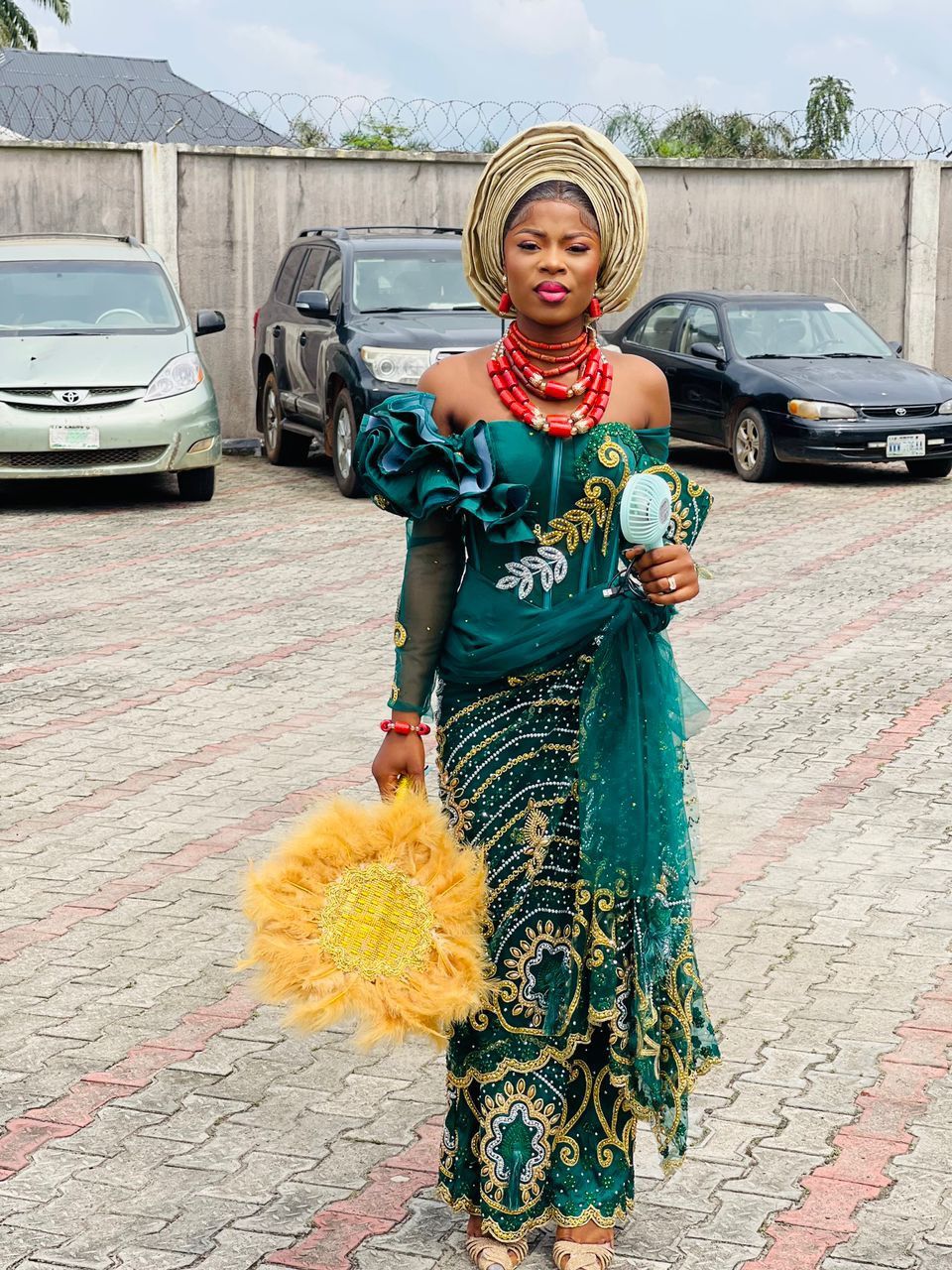
The Injiri Iriabo look is assembled in stages, reflecting the ceremony’s own three-stage structure from adolescence through to mature womanhood. In the highest stage, the Iriabo wears her Injiri wrapper at the waist, coral beads on her neck and ankles, a walking stick in her hand, and a ceremonial beaded hat at the crown: the Kiliali Suon (the flat-draped beaded hat worn at burial-related Iria stages) or the Angara Sun (the beaded hat for joyful ceremonies including the celebration of womanhood) depending on the specific occasion. As Unravelling Nigeria’s documentation of Kalabari traditional attire, these beaded hats are as essential to the Iria look as the wrapper itself. The walking stick, the flat ceremonial plate sometimes carried in the hand, and the body decorations applied during the fattening room period all contribute to a complete ceremonial statement that the community has been reading in exactly this form for generations.
The fattening room, the Wari So, is the period of seclusion that precedes the Iria ceremony. The Iriabo is rubbed with white chalk, palm oil, and turmeric to make her skin glow. She is fed well. She is taught what she needs to know. When she emerges to dance before the assembled community, she does so in the full Injiri Iriabo look, and the community assesses her transition. Potential husbands are in that crowd. Her family’s investment in her preparation is visible in the quality of her clothes. The ceremony is, among other things, a statement by a household about the value of the woman they are presenting to the world.
4. The Injiri Bridal Ensemble (The Wedding Double Wrapper)
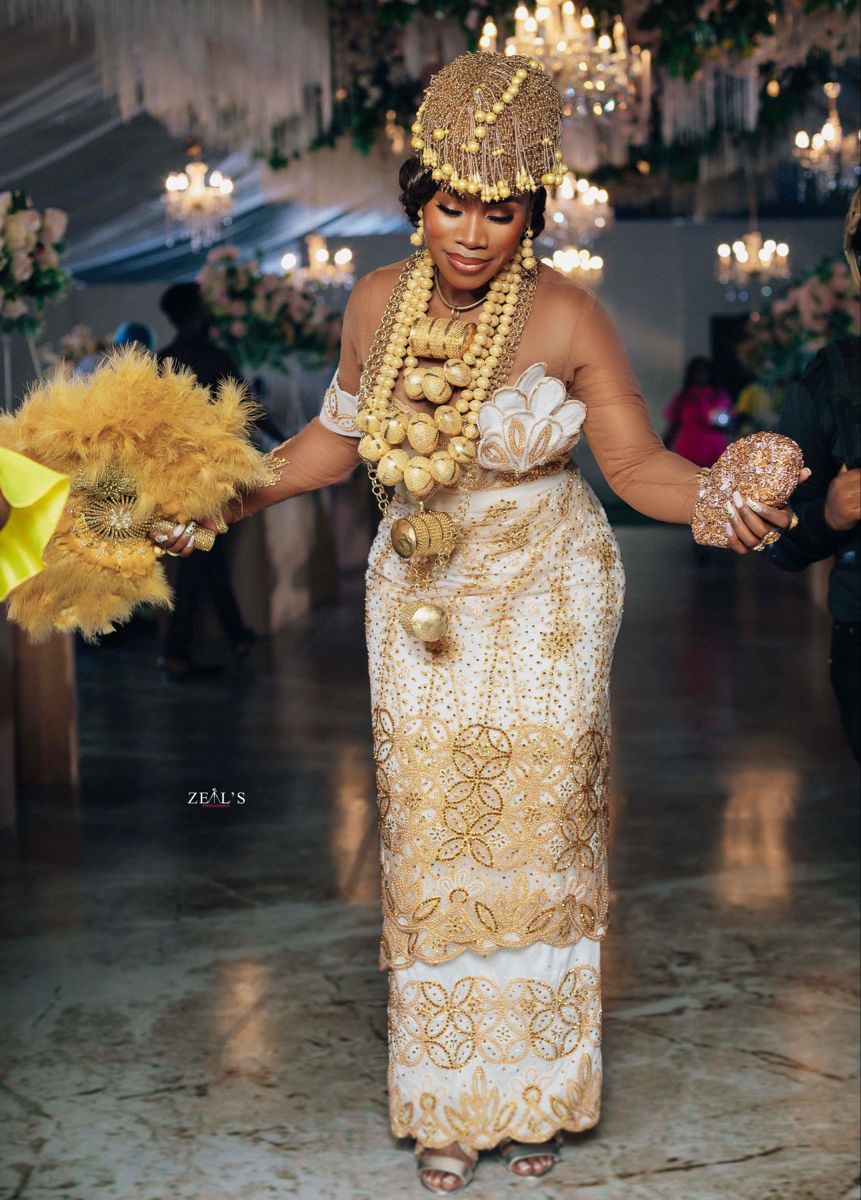
The Ijaw traditional wedding is, in the Niger Delta fashion canon, among the most flamboyant and coral-weighted ceremonial occasions in Nigeria. As Eucarl Wears’ documentation of Ijaw traditional marriage attire records, the beaded accessories of the Ijaw bride, from the coral beads on her head to the ivory beads at her neck, wrist, waist, and ankles, make the Ijaw bridal dress one of the most visually complete in the country. The Injiri double wrapper is the fabric foundation of that completeness.
The Kalabari marriage system has three forms, the most prestigious of which, the Iya, is the highest and most expensive, permitting no divorce and conferring full rights on the children within the man’s house. The Iya marriage includes the Bibife ceremony, in which an elderly woman serves food to the bride, who cannot eat until her “mouth is bought” by the groom, a rite signifying his responsibility to feed her for the rest of their lives. The bride is dressed richly throughout, with coral accessories, a crown, and chunky coral beads, in Injiri cloth that signals the household’s investment in the match. As documented in Sugar Weddings’ complete Kalabari traditional wedding guide, the bride wears the Kiliali Suon or Angara Sun beaded hat appropriate to the ceremony, and the Injiri Iriabo material paired with full red coral beads. The wedding is not a single outfit. It is a sequence of presentations, each carrying its own cloth and accessory vocabulary, read by every Kalabari woman in the room.
In 2026, the Ijaw bridal ensemble in Injiri is one of the most photographed traditional wedding looks on Nigerian social media, with the coral weight, the Injiri plaid, and the beaded hat creating a silhouette immediately recognisable as Niger Delta. Ijaw brides in Port Harcourt, Yenagoa, Warri, and across the diaspora are commissioning Injiri bridal looks with increasing attention to the specific Injiri quality (the finest India cloth is the highest register), the coral grade, and the hat style. Each of these choices communicates something the community reads without explanation.
5. The Contemporary Injiri Gown (The River Woman in a New Silhouette)
The contemporary Injiri gown, a floor-length fitted or A-line dress cut from Injiri madras cloth, is the style that carries the Niger Delta textile tradition into the full range of settings a modern Ijaw woman occupies. As Greenweblife’s account of Ijaw fashion notes, new-generation Niger Delta designers have started modifying Ijaw traditional wear with silhouettes that suit the younger generation while maintaining authentic Ijaw design. George and Injiri fabrics are now used for formal occasion wear, including gowns, jumpsuits, and tailored suits. The contemporary Injiri gown is the style through which that design energy is most confidently expressed in 2026.
A floor-length fitted gown cut from deep burgundy Injiri madras, with a modest neckline and long sleeves, worn with coral bead earrings, a simple head tie, and the quiet confidence of a woman who knows exactly what fabric she has put on: this is the contemporary Injiri gown at its most authoritative. The plaid geometry of the cloth, its specific colour palette, and its weight all communicate Niger Delta heritage to anyone in the room with the cultural literacy to read them. For Ijaw diaspora women in London, Houston, and Lagos, the gown is the style that carries Injiri into settings where the double wrapper may not be the expected register without reducing the cultural statement to an aesthetic nod.
The gown form also creates space for Pelete-bite panels: some contemporary designers are incorporating cut-thread sections into the bodice or sleeves of Injiri gowns, creating a single garment that carries both the imported madras and its Kalabari transformation within the same silhouette. That combination is not a design experiment. It is a precise cultural statement about what it means to be an Ijaw woman who dresses with full knowledge of her tradition.
When Injiri Speaks: The Cloth Across Ijaw Life
Injiri is the only fabric in this series that is worn at the beginning of a person’s life, at every significant transition in a woman’s life, and at the end of it. That is not a poetic observation. It is a practical description of how the cloth functions in Kalabari and broader Ijaw life.
Iria Ceremony (Rite of Passage to Full Womanhood)
The Iria ceremony is the cornerstone occasion in Ijaw women’s lives. It’s three stages, from adolescent puberty through to older womanhood, each of which carries specific wrapper expectations. At the first stage, a simple native wrapper called Suu. At the second stage, Ikaki (Akwete), Poppy, and Damask. At the completion stage, the full Injiri double wrapper and all the large wrappers of full Ijaw womanhood. As the Dimabo Finapiri account of the Iria ceremony documents, any Ibani daughter getting married who has not completed the Iria must have it done before the wedding as part of the dowry. And if a woman has not completed her Iria, her family must do it for her before she can be buried in Ibani land. The cloth is not separable from the ceremony. The ceremony is not separable from the cloth.
The Naming Ceremony
At the naming ceremony, the Kalabari father presents an uncut length of Injiri to acknowledge his paternity publicly. The cloth is the declaration. It is not spoken. It does not need to be. The community assembled at the naming recognises the gesture and its weight. A length of Injiri given to a newborn child is the first time that child is dressed in the cloth that will accompany them through every significant transition of their life.
New Motherhood Celebration
After dedicating her child at church, the Kalabari new mother ties the Njiri wrapper at her waist. She walks through the town with a walking stick and her full accessory vocabulary. People give her money as she passes. The walk is a public display of her husband’s care during her confinement and of her own beauty and cultural standing as she re-enters public life. As Daily Trust’s account records, she must use Njiri for this occasion. It is the prescribed cloth. No other fabric performs this cultural function.
The Traditional Wedding
The Iya, Igwa, and Waribiobesime forms of Kalabari marriage all involve Injiri cloth at different registers of investment and formality. At the highest level, the Iya marriage: the Injiri ensemble is of the finest quality, the coral accessories at their heaviest and most significant, the beaded hat, appropriate to the occasion, worn at the crown. The wedding look conveys both the form of the marriage and the family’s standing. Both families dress with knowledge.
Funeral and Burial Rites
Death, in Ijaw understanding, is a crossing of the river into the spirit world. The cloth that wraps the passage is Injiri. At the first and second burial ceremonies, the Kiliali Suon, the flat-draped beaded hat associated with burial, is paired with the India wrapper. The Njiri Iria is described by Kalabari cultural practitioners as being used specifically for first and second burials as well as for the childbirth celebration, the same cloth marking both the arrival of new life and the departure of a completed one. The journey from womb to tomb is, in the Niger Delta, a journey measured in Injiri.
An Ijaw woman ties Injiri for the first time before she is old enough to choose. She earns the right to tie the double wrapper by completing the Iria. She ties it at her wedding, at her children’s naming ceremonies, and when she celebrates their births. When she crosses into the spirit world, the community that dressed her for all of those occasions dresses her one final time in the same clothes. That continuity is not tradition. It is civilisation.
ALSO READ:
- Top 5 George Styles for Igbo Women in 2026
- Top 5 Akwete Styles for Igbo Women in 2026
- Top 5 Igbo Traditional Bridal Looks for Igba Nkwu in 2026
- Culture As Currency: Africa’s Legacy on the Marketplace
The Omiren Argument
Every article in this series has made the same foundational observation in a different form: the African women who adopted imported textiles did not become lesser versions of themselves. They became more specifically themselves. The Igbo made George Yorji and built a ceremonial grammar around it, erasing its Indian origin. The Fulani made Bazin the prestige fabric of their most significant occasions. The Kalabari Ijaw took Indian madras, called it Injiri in their own tongue, subjected it to a thread-cutting technique found nowhere else in the world, and built around it a rite of passage so culturally significant that it must be completed before a woman can be buried in her homeland.
The Pelete-bite cloth, cut thread by thread from the same Indian import that George fabric comes from, is held by the Brooklyn Museum, the British Museum, and the Dallas Museum of Art. A scholar collected it because it is among the world’s most distinctive textile traditions. The community that produced it has been living in the Niger Delta since 800 BCE. Their cloth knowledge is older than every trade route that brought them the madras they transformed. The question of whether Injiri is authentically Ijaw is a question only an outsider would ask. The Ijaw know the answer. They have known it for over two hundred years.
Injiri is not what the Niger Delta received. It is what the Niger Delta made.
Browse the full African Style collection at Omiren Styles.
Frequently Asked Questions
1. What is Injiri, and why is it central to Ijaw dress culture?
Injiri is the Kalabari Ijaw name for Indian madras, the plaid-checked cotton cloth imported into the Niger Delta from Tamil Nadu, India, for over two hundred years. The name comes from the Kalabari pronunciation of Injeram, an old port north of Madras. The cloth arrived as a trade commodity and was transformed by the Kalabari into the most culturally significant textile in Ijaw life, used at naming ceremonies, coming-of-age rites, weddings, new motherhood celebrations, and funeral rites. It is the only fabric in Nigerian dress culture that is documented as carrying a woman’s life from birth to burial. A detailed account of the cloth’s introduction and significance is available at Paperclip.
2. What is Pelete-bite?
Pelete-bite is the Kalabari Ijaw art of cutting individual threads from imported Indian madras cloth using a needle and penknife or razor blade, thread by thread, to create an openwork pattern that did not exist in the original fabric. The resulting cloth is considered quintessentially Kalabari, carrying patterns that reference Kalabari mythology and historical knowledge passed from mother to daughter through the teaching of the technique. Examples of Pelete-bite cloth are held in the Brooklyn Museum, the Dallas Museum of Art, and the British Museum. The technique and its cultural significance are documented in the Fashion History Timeline’s Pelete-bite entry.
3. What is the Iria ceremony, and what role does Injiri play in it?
The Iria ceremony is the Ijaw rite of passage marking a woman’s transition from girlhood to full womanhood. It is practised across the Kalabari, Ibani, Okrika, and Opobo-Nkoro communities in Rivers State. It is culturally obligatory: an Ibani woman who has not completed the Iria cannot be buried in Ibani land without it being done. The ceremony has three stages corresponding to different life stages, each with specific wrapper requirements culminating in the right to wear the full Injiri double wrapper. The Iriabo initiate is dressed in the Injiri Iriabo look with coral beads, a walking stick, and a ceremonial beaded hat. The full account of the ceremony’s stages and dress requirements is documented at Daily Trust.
4. What are the Kiliali Suon and the Angara Sun?
The Kiliali Suon and the Angara Sun are the two primary ceremonial beaded hats worn by Kalabari Ijaw women with the Injiri wrapper. The Kiliali Suon is a flat-draped beaded hat worn primarily at burial-related ceremonies and the burial stages of the Iria. The Angara Sun is a beaded hat worn at joyful ceremonies, including traditional weddings and the celebration stages of the Iria. Both are worn draped over the head rather than structured above it, and both are paired with the full coral bead accessory set. The choice of hat communicates the nature of the occasion to every Kalabari woman present. Neither can be substituted for the other without changing the cultural meaning of the entire look.