On May 5, 2026, the Met Gala arrived in New York under the theme Fashion is Art and asked one of fashion’s oldest questions at its loudest possible volume. Four days later, in Lagos, at the 12th Africa Magic Viewers’ Choice Awards, Nigerian designers answered it without being asked. A cathedral made in Lagos out of Gothic spires and metallic silver. A dress built from over 400 iron metal sponges. A host’s gown sewn from thousands of strip lashes. A hand-painted silk waterfall constructed from the Igbo concept of water as life. A crimson helix that wrapped a body and dissolved the boundary between garment and wearer. These were not responses to New York’s theme. They were the outputs of a creative culture that has been building its own answers to fashion’s deepest questions for years, in its own language, at its own pace, without waiting for a New York institution to frame the conversation.
The AMVCA 12 weekend, spanning the Cultural Night of May 8 and the main ceremony of May 9, produced the most concentrated demonstration yet of what African fashion is when given a platform equal to its ambition. The theme, Honouring Craft, Celebrating Culture, was both a brief and a statement. The designers who showed up for it understood exactly what it required: not looks that referenced African heritage, but looks that were built from it, from the inside out, in the hands of people for whom African cultural knowledge is not a reference library but a living inheritance.
From a crimson helix gown to a waterfall built from hand-painted silk to a Gothic cathedral made in Lagos — AMVCA 2026 told the world exactly where Africa’s fashion centre is.
AMVCA 2026 Fashion Designers: The Looks, the Stories, the Craft
Veekee James: Three Looks, Three Arguments
Veekee James arrived at AMVCA 12, pregnant with her first child, and delivered three of the most-discussed looks of the entire weekend. That fact is worth holding before the looks are described: a designer whose body is transforming, whose atelier is under the sustained commercial pressure that comes with AMVCA-level clients, who is simultaneously building a brand and building a life, produced work in 2026 that set new creative benchmarks for her own practice. That is not resilience as a talking point. It is the specific quality of creative commitment that the Omiren Styles brand positioning has always argued is the distinguishing mark of African fashion at its most authoritative. Veekee James builds without permission. AMVCA 12 was the clearest recent demonstration of what that looks like at full extension.
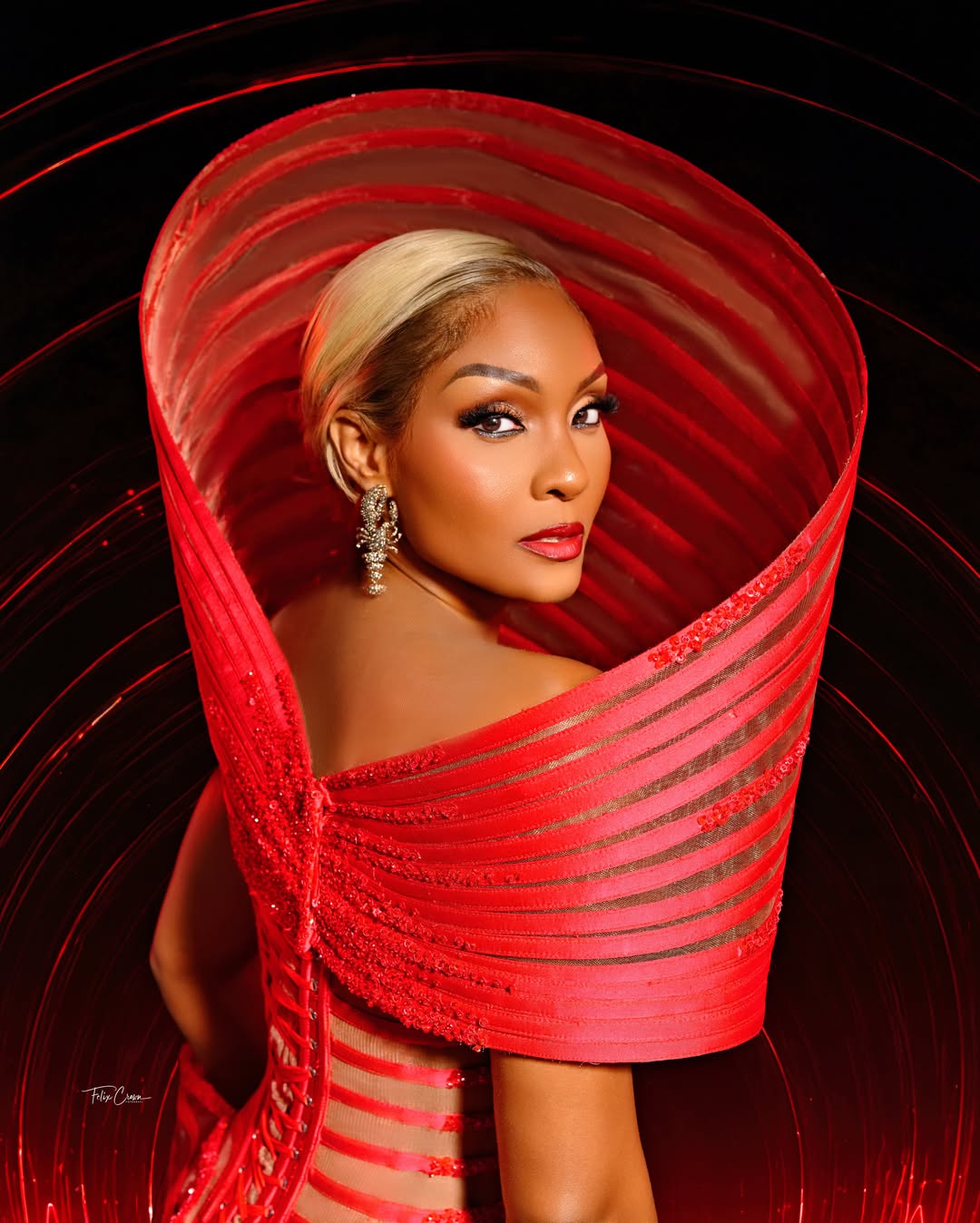
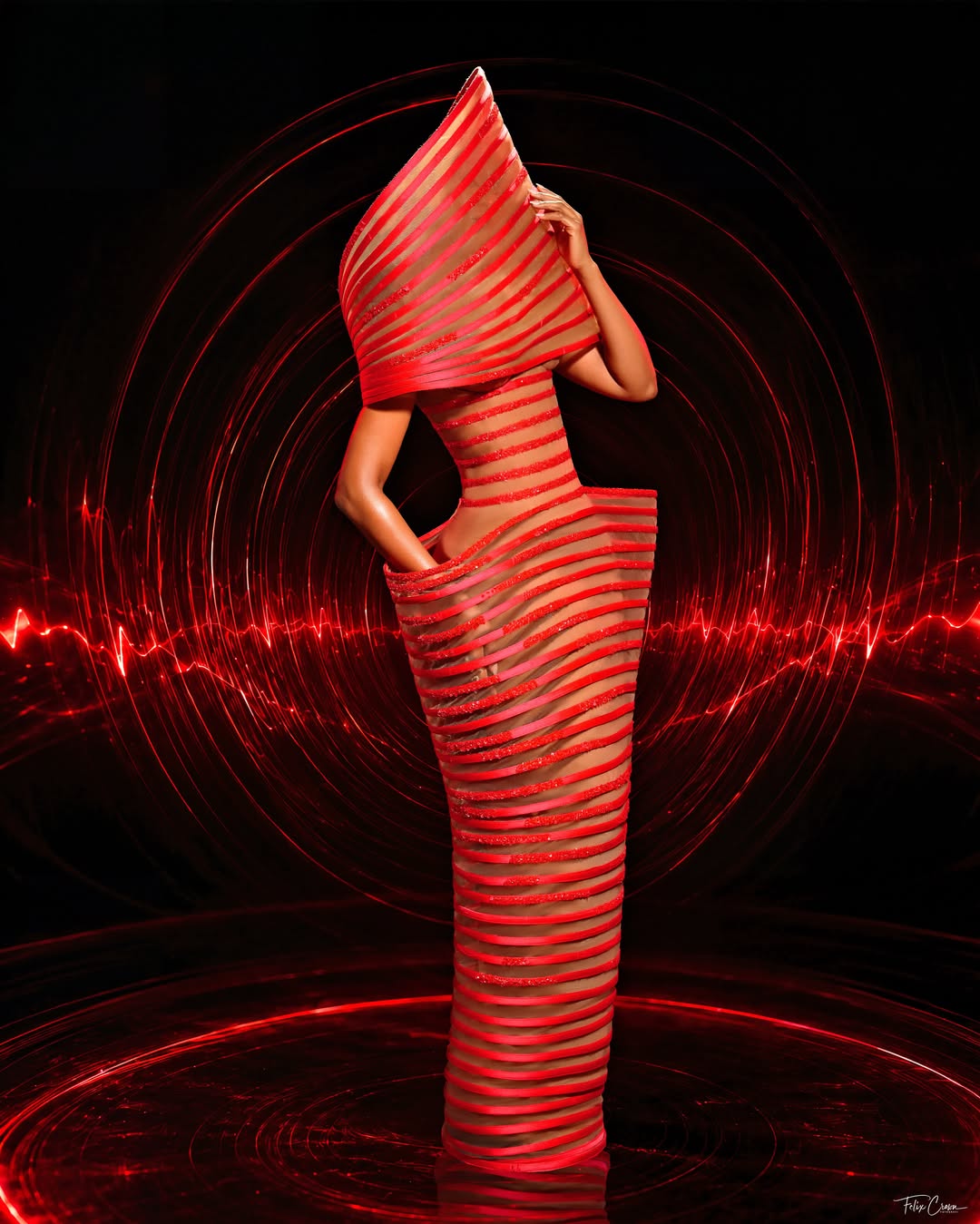
The first look, worn by Osas Ighodaro before the red carpet had properly opened, was a crimson sculptural gown constructed from horizontal bands wrapped around the body in a continuous helix spiral. The bands extended outward at the hip into a sharp rectangular structure that interrupted the gown’s silhouette and added spatial tension. Above it, a towering headpiece enclosed Ighodaro’s head entirely, dissolving the boundary between garment and wearer until both became part of the same visual composition. Crystals lined the bands, adding texture without overpowering the construction. Makeup was by Damola Adeniji; photography by Felix Crown. Funke Akindele declared her the winner immediately. Mercy Aigbe agreed. Social media took approximately twenty minutes to reach consensus.
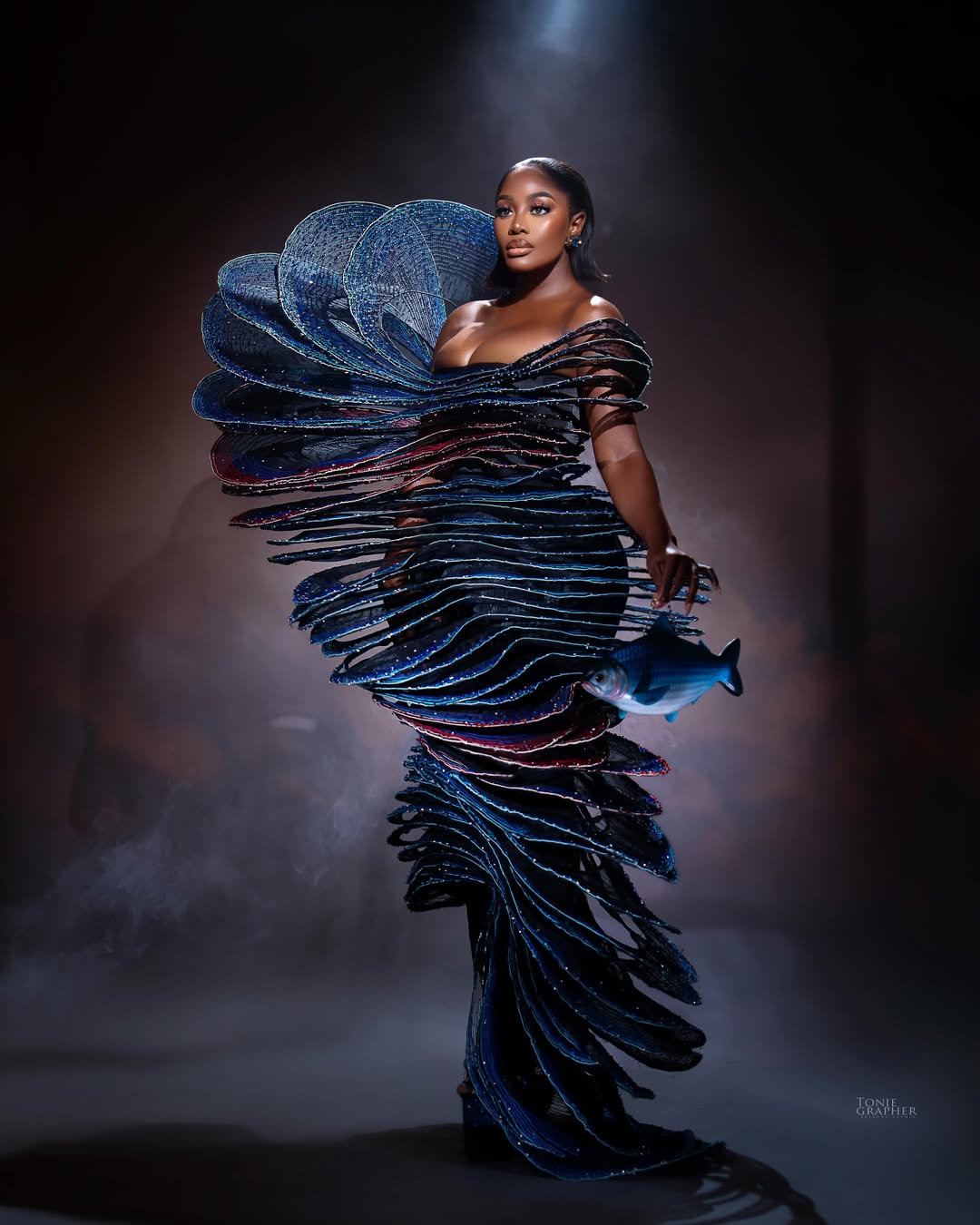
The second look revealed the creative methodology most clearly. Veekee James constructed a silver ensemble from over 400 pieces of iron metal sponge. The material, a household cleaning item, was transformed through labour and design intelligence into something textured, reflective, and liquid under the lights. That transformation is the argument: in Veekee James’s hands, the distinction between a couture material and a domestic material is not inherent to the material. It is the product of what you know how to do with it.
AMVCA co-host Nomzamo Mbatha wore the third look: a gown built from thousands of strip lashes, created in collaboration with beauty brand Msmetics. The look blurred the line between cosmetics and couture in a way that BellaNaija Style described as soft yet dramatic, intricate yet wearable, transforming a beauty product into high-fashion art. Three looks in a single weekend from a single designer: architecture, material transformation, and the dissolution of the boundary between beauty and fashion. Each one is a complete argument. Together, a body of work that belongs in the same critical conversation as any couture output from any city in the world.
KGZ Opulence Couture: A Landscape Built in Silk
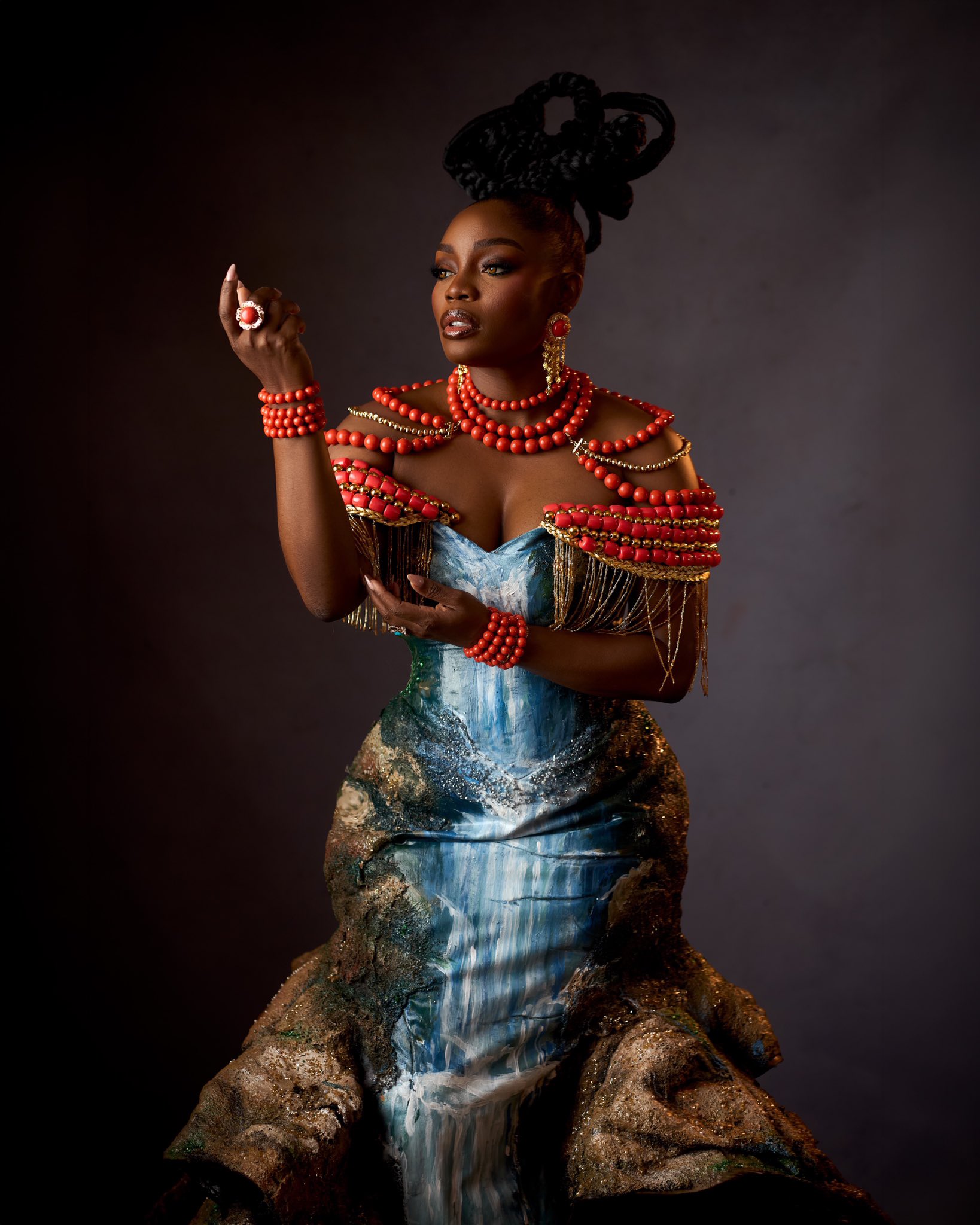
At the Cultural Night, Best Supporting Actress nominee Bisola Aiyeola wore a look titled Mmiri Ndu — Water of Life — that operated not as a garment but as a landscape. As BellaNaija confirmed, the dress was designed by KGZ Opulence Couture with creative direction by Kingsley Okoye Rex. A stream of vivid hand-painted blue silk ran from the neckline straight down the centre of the gown, gathered and layered to resemble water in motion. Brown and moss-green elements curved around the skirt like rocks, tree bark, and foliage growing at a riverbank’s edge. Traditional coral beads completed the ensemble. From certain angles, the dress was less a gown than a terrain: an Igbo spiritual concept rendered three-dimensionally in fabric. Mmiri Ndu holds specific cosmological weight in Igbo culture, where water is not merely a physical element but a carrier of life force, ancestral memory, and divine connection. Kingsley Okoye Rex and KGZ Opulence Couture did not reference that weight. They built it.
Mohammed Abbas Ossu: The Cathedral Made in Lagos
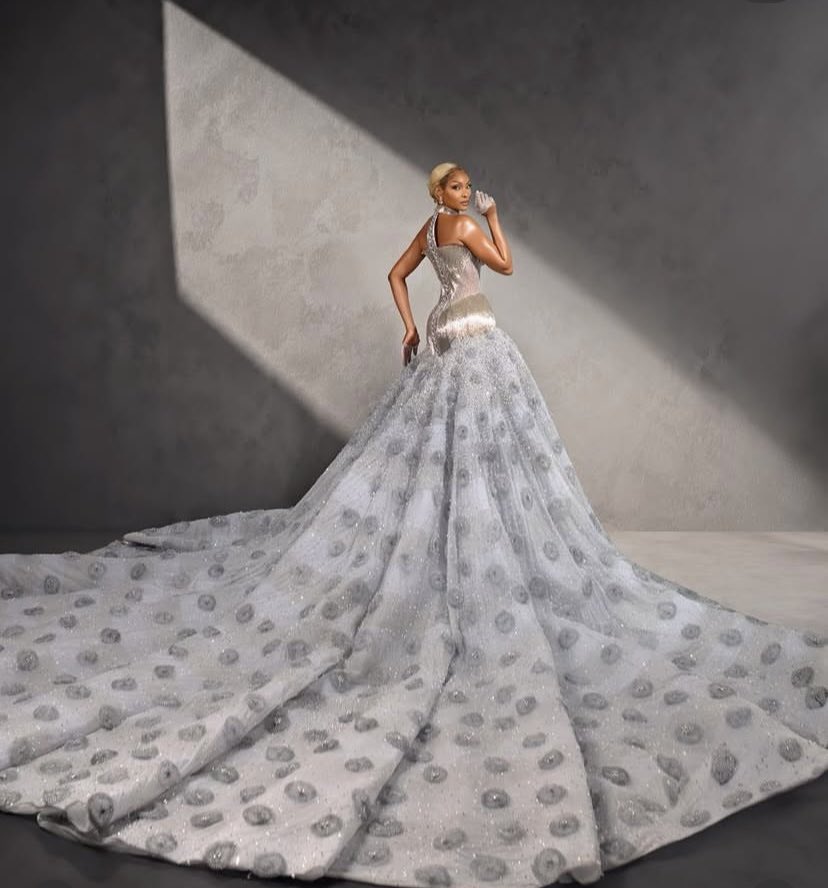
Ghanaian style icon Nana Akua Addo walked onto the AMVCA 12 carpet in a gown that BellaNaija described as turning the red carpet into a sacred site of high fashion. The look was designed by Mohammed Abbas Ossu and made entirely in Lagos, Nigeria. It replicated the soaring spires and intricate arches of a Gothic cathedral in three-dimensional precision fabric construction. The grey-toned skirt was a triumph of spatial engineering. A metallic silver corset and sharp torso spires gave the upper body an edgy, avant-garde finish. Adunni Ade’s reaction — “You didn’t wear couture, you became the cathedral” — was the sharpest critical summary of the evening. It was also a statement about Lagos. The architectural knowledge required to produce a garment of that structural complexity existed in this city. It produced this work. The cathedral came from Lagos.
While New York debated whether fashion could be art, Lagos built a cathedral gown, a silk waterfall, a silver dress from metal sponges, and a host’s gown from strip lashes. The AMVCAs answered a question nobody in Lagos was asking, because they already knew.
The Cultural Night: Heritage as Living Craft, Not Museum Piece
The Cultural Night of May 8 produced a different kind of fashion argument. As Omiren Styles documented in dedicated coverage, the Edo looks worn by Ibrahim Suleiman, Shaun Okojie, and Prince Enwerem were not outfits assembled for an occasion. They were institutional statements in coral, velvet, and centuries of craft knowledge. Kaybobo’s green and purple Aso-Oke Agbada, built on the OKIN peacock cosmology, encoded Yoruba design philosophy in every choice of colour and weave. Mensan’s Ijaw brocade robe and George’s fabric drape carried the Niger Delta’s ceremonial language to a national platform. Bisola Aiyeola’s Mmiri Ndu look demonstrated that the Cultural Night’s creative brief could sustain work of the same conceptual rigour as the main red carpet, just operating in a different register: not personal creative expression but communal cultural statement.
The designers who produced Cultural Night looks were not all ateliers with Instagram pages. They were Aso-Oke weavers in Iseyin and Ilorin, coral bead artisans in Benin City, George cloth specialists in Port Harcourt, and embroiderers whose knowledge is passed down through family apprenticeship rather than fashion school. These are the upstream creative community that the atelier economy builds on and that the fashion press rarely covers. The Cultural Night is their annual public appearance at the highest level of Nigerian culture, wearing what they know how to make, for people who know how to read it.
Africa as the Next Fashion Hub: What AMVCA 2026 Proves
The comparison between AMVCA 2026 and the Met Gala’s Fashion is Art theme was not a provocation. It was an observation made by audiences who watched both events with equal seriousness and who found, this year, that the AMVCA delivered more genuinely conceptual fashion than the event that positions itself as the industry’s annual art statement. The reasons are structural, not accidental.
African fashion’s advantage as a creative force rests on a specific kind of knowledge that no fashion school on any other continent teaches, because it cannot be taught outside the culture that produced it. Mohammed Abbas Ossu did not research Gothic architecture and apply it to fashion. He built a three-dimensional structural gown in a city whose creative community had developed the technical capacity to execute it. Veekee James did not reference material transformation as a design concept. She transformed materials repeatedly, in a single weekend, because her creative practice has spent years developing the precision to do so. KGZ Opulence Couture did not illustrate the Igbo concept of Mmiri Ndu. They built it in hand-painted silk with coral, in a look that conveyed the concept’s full cultural weight to an audience that recognised it immediately.
That is what African fashion’s cultural diversity produces. Fifty-four nations. Hundreds of ethnic groups. Thousands of distinct textile traditions, dress systems, colour grammars, and ceremonial vocabularies. Designers who grew up inside those traditions are not drawing on a reference library. They are operating from an inherited intelligence that gives their work specificity, depth, and cultural authority that cannot be approximated by any designer working from the outside. The AMVCA red carpet is where that intelligence is most publicly visible. And what was visible at AMVCA 12 confirmed the argument Omiren Styles has been making since its founding: Africa is not the next fashion hub. It is the most complete creative culture in the world, building fashion from within civilisations that have been thinking about what dress means for longer than the global fashion industry has existed.
Also Read
- AMVCA 12 Cultural Night: When Nigerian Stars Dressed With Memory
- Dressed With Power: How Nigerian Men Redefined Traditional Fashion at the AMVCA 12 Cultural Night
- While the World Debates Vogue Africa, Veekee James Is Already Building It
- The Silence Around African Luxury: Why the Continent’s Most Expensive Fashion Is Almost Never Discussed
AMVCA 12 Designer Reference: All Confirmed Looks
|
Designer |
Client / Night |
Look & Story |
|---|---|---|
|
Veekee James |
Osas Ighodaro (Look 1) | Main Ceremony |
Crimson sculptural gown: horizontal bands in continuous helix spiral, sheer mesh, geometric hip extension, towering headpiece, crystal-lined bands. Photographer: Felix Crown. |
|
Veekee James |
Osas Ighodaro (Look 2) | Main Ceremony |
Silver ensemble crafted from over 400 iron metal sponges — a household material transformed into couture—textured, reflective, liquid under lights. |
|
Veekee James x Msmetics |
Nomzamo Mbatha (Host) | Main Ceremony |
Gown made from thousands of strip lashes — beauty product transformed into high-fashion art. Blurs the boundary between cosmetics and couture. |
|
KGZ Opulence Couture (Creative direction: Kingsley Okoye Rex) |
Bisola Aiyeola | Cultural Night |
“Mmiri Ndu” (Water of Life): hand-painted blue silk waterfall, brown/moss-green rocks and foliage, coral beads. Igbo-inspired landscape reimagined in fabric. |
|
Mohammed Abbas Ossu |
Nana Akua Addo | Main Ceremony |
Cathedral gown: Gothic spires, pointed arches, metallic silver corset, sharp torso spires, grey-toned. 3D precision skirt. Made in Lagos, Nigeria. |
|
ATAFO (Mai Atafo) |
Ebuka Obi-Uchendu | Main Ceremony |
Precision menswear: Nigerian masculine identity as a design argument. Tailoring that carries cultural authority and contemporary structure simultaneously. |
|
Mamadi Couture (Mitchelle Amadi-Bamuyiwa) |
Doyin David | Main Ceremony |
Sculpted metallic masterpiece — phoenix, serpent, fish-scales queen. Armour construction. Two consecutive years of viral AMVCA looks from the same atelier. |
|
Amy Aghomi |
Mercy Eke | Main Ceremony |
Crystal-encrusted structural gown. Water and Diamond concept — light as material. Each crystal is individually placed. |
|
Erica Moore Brand (Nwanyibuife Eunice Okam) |
Multiple clients | Main Ceremony |
Avant-garde sculptural work across multiple looks: root structures, bedazzled velvet, corset mesh. Dressed four clients across the event. |
|
Atelier by Kunbi |
Multiple clients | Main Ceremony |
Contemporary elegance. Balances trend intelligence with timeless structural construction. |
|
Lawson Artistry |
Jenni Frank | Main Ceremony |
Garden Dress: wearable fantasy. Nature as couture vocabulary. Living landscape translated into occasion wear. |
|
Toyin Lawani (Tiannah Empire) |
Multiple clients | Main Ceremony |
Safety-pin gown (one million pins used). Extraordinary material transformation — the mundane as luxury couture. |
The Omiren Argument
The AMVCA 2026 weekend produced a body of fashion work that belongs in the same critical conversation as any fashion week output from any city in the world, and that exceeds most of it in the specific quality that matters most: cultural depth. A gown built from a hand-painted silk waterfall around the Igbo concept of water as life force carries more cultural intelligence in its construction than any garment that references African aesthetics from outside the cultures that created them. A cathedral made in Lagos by a Nigerian creative proves that the technical and conceptual capacity to produce architecture-level fashion exists here, not as an aspiration but as a demonstrated fact. Three looks from a single pregnant designer in a single weekend, each using a different material in a way that transforms it into something the material was never intended to be, document a creative methodology that any serious fashion capital would be proud to claim.
Omiren Styles covers AMVCA 12 as what it is: not Africa’s answer to the Met Gala, not Nigeria’s fashion moment, but a demonstration that the most compelling fashion being produced anywhere in the world right now is coming from a creative community whose relationship to culture, craft, and material is not borrowed, referenced, or approximated. It is owned. The designers who showed at AMVCA 12 are not trying to break into global fashion. They are building the fashion that the world will eventually understand it needs. That is the Omiren Styles position, and it is proven, look by look, across the two nights of the most important fashion weekend Africa produced in 2026.
Frequently Asked Questions
What was Veekee James’s most talked-about look at AMVCA 2026?
Veekee James delivered three headline looks at AMVCA 12, all of which generated significant social media discussion. The first, and the one that opened the weekend’s fashion conversation, was the crimson sculptural gown worn by Osas Ighodaro: horizontal bands wrapped in a continuous helix spiral around the body, a sharp geometric extension at the hip, a towering headpiece that dissolved the boundary between garment and wearer, and crystal-lined bands throughout—photographed by Felix Crown with makeup by Damola Adeniji. Funke Akindele declared Ighodaro the winner on sight. The second look for Ighodaro was a silver ensemble made from over 400 iron metal sponges. The third look, worn by host Nomzamo Mbatha, was a gown made from thousands of strip lashes, created in collaboration with beauty brand Msmetics.
Who designed Bisola Aiyeola’s Cultural Night look at AMVCA 2026?
Bisola Aiyeola’s Cultural Night look, titled Mmiri Ndu (Water of Life), was designed by KGZ Opulence Couture with creative direction by Kingsley Okoye Rex. The Igbo-inspired look was built around the image of a waterfall: a stream of vivid hand-painted blue silk running from the neckline down the centre of the gown, gathered to resemble water in motion. Brown and moss-green elements curved around the skirt as rocks, tree bark, and foliage near water. Traditional coral beads completed the ensemble. Together, the outfit constructed a landscape rather than a garment, encoding the Igbo spiritual significance of water as a life force in fabric and beadwork.
Who made Nana Akua Addo’s cathedral gown at AMVCA 2026?
Nana Akua Addo’s cathedral gown at AMVCA 12 was designed by Mohammed Abbas Ossu and made entirely in Lagos, Nigeria. The gown replicated the soaring spires and intricate arches of a Gothic cathedral in three-dimensional fabric construction. It featured a grey-toned skirt of remarkable structural precision, a metallic silver corset, and sharp torso spires giving the upper body an avant-garde silhouette. Adunni Ade’s reaction, “You didn’t wear couture, you became the cathedral,” became the most quoted summary of the look. The gown was cited as one of the clearest interpretations of the AMVCA 12 Honouring Craft, Celebrating Culture theme.
Why is the AMVCA considered one of Africa’s most important fashion platforms?
The AMVCA red carpet has become a creative platform where Nigerian designers showcase some of their most ambitious conceptual work, knowing it will be seen by millions across Africa and the diaspora. Designers invest months in individual AMVCA looks, developing new technical approaches, new material experiments, and new conceptual arguments for each edition. The two-night structure of AMVCA 12 covered both traditional cultural fashion on the Cultural Night, documenting the full range of Nigerian ethnic dress traditions, and contemporary Nigerian couture on the main red carpet, where designers like Veekee James, Mohammed Abbas Ossu, KGZ Opulence Couture, Mamadi Couture, Amy Aghomi, and Erica Moore Brand demonstrated work at the highest level of global fashion ambition.
How does the AMVCA position Africa as a global fashion hub?
The AMVCA positions African fashion not through external validation or international press attention but through the demonstrated quality and cultural specificity of the work produced for it. The designers who show at the AMVCA are building fashion from inside cultural traditions whose depth and specificity give their work an authority that cannot be approximated by designers working from outside those traditions. Africa’s advantage as a fashion hub rests on this: the continent holds more distinct textile traditions, dress systems, and ceremonial colour grammars than any other region in the world. Designers who grew up inside those traditions produce work whose cultural intelligence is not borrowed or referenced but owned. The AMVCA is the most publicly visible annual demonstration of what that ownership produces.
Explore More
Read the full Events archive at omirenstyles.com/category/events/ and the Designers section at omirenstyles.com/category/designers/ for Omiren Styles’ complete documentation of the designers, stories, and cultural arguments that make African fashion the most compelling creative force in the world right now.