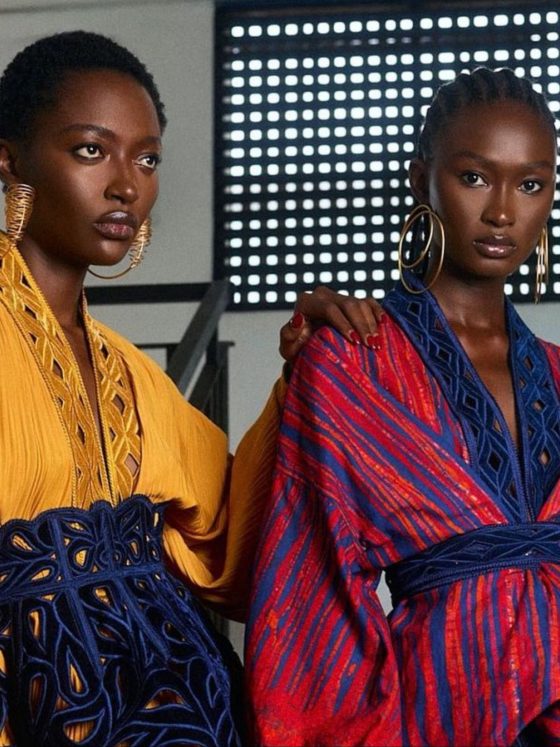
In the visual languages of West African textiles, few traditions carry the layered histories, symbolic depth, and communal meaning of adire, a hand‑dyed indigo cloth historically produced among the Yoruba people of southwestern Nigeria. Long before it appeared on fashion runways or in design studios, adire served as a canvas for community identity, social narrative, and cultural memory. Its resist‑dye patterns were rarely random; they were read as visual texts that carried stories of lineage, local proverbs, ritual transitions, and communal experience.
Into this tradition steps Ade Bakare, a Nigerian-born, UK-trained designer whose work has woven Adire into contemporary couture. Through collections such as “Adire Meets Modernity”, Bakare situates an ancient craft within global fashion without reducing it to mere surface ornamentation. His work invites us to see adire not merely as a pattern, but as a material history embedded in cloth and carried forward into a modern, transnational context.
This article provides an in-depth profile of Ade Bakare and his use of Yoruba adire, demonstrating how this traditional indigo resist cloth informs cultural meaning, design evolution, and global reach.
The Historical Roots of Adire

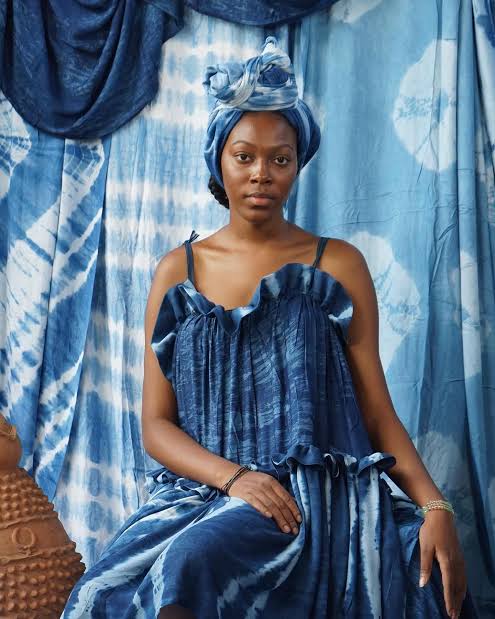
Adire is a Yoruba word meaning “tie and dye.” It refers to a resist‑dye technique in which cloth is prepared, tied, or stitched in specific ways, and then dyed with indigo, a natural dye extracted from locally grown plants. This practice flourished especially in Abeokuta, where the mineral‑rich, alkaline water created ideal conditions for deep indigo dyeing.
Textile historians note that adire, in its earliest forms, was hand‑spun and hand‑woven, often used for everyday attire, ceremonial garb, and rites of passage. Unlike cloth that functioned merely as an aesthetic statement, traditional adire carried communal grammar; specific patterns had names, stories, and meanings linked to local proverbs, historic events, or spiritual signifiers.
Patterns like “ilari” (comb) and “ododo” (flower) were not merely decorative motifs; they also echoed real objects, social practices, and symbolic references. ‘Ilari’ could connote structure or order, while “ododo” evoked renewal, growth, and community ties.
Importantly, adire was not produced in isolation. Its creation and circulation were deeply social: women often led the dyeing and design processes, while woven cloth was tied with regional community knowledge. This made adire a shared cultural practice rather than an individual artistic gesture.
Ade Bakare’s Beginnings
Ade Bakare’s career bridges local Nigerian culture and global couture education. Ade Bakare was born and educated in Nigeria, where he earned a degree in history and education from the University of Lagos, before later training in fashion design at Salford University College in Manchester, UK. Bakare gained exposure to high couture craftsmanship and tailoring by working with established London houses such as Christiania Stambolian and Victor Edelstein before launching his own label.
In 1991, he launched Ade Bakare Couture in London, a label rooted in classical elegance but open to cultural exploration. Early in his career, his pieces were carried by European boutiques and presented in fashion capitals such as London, Paris, New York, Cape Town, and Mozambique.
Adire Meets Modernity: A Conscious Design Evolution
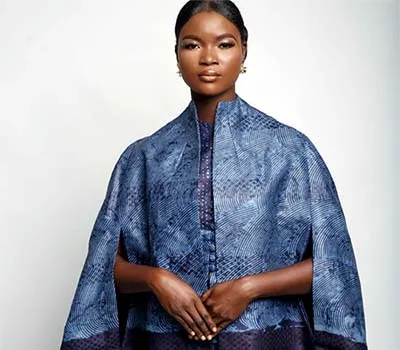
Though Bakare’s early work focused on classic couture, by the mid‑2000s, he began integrating Nigerian indigenous textiles, particularly adire, into his collections. He aimed not to use adire as a “print” but to elevate the material’s inherent narrative through craftsmanship, silhouette, and context.
The landmark “Adire Meets Modernity” collection (Spring/Summer 2014) exemplifies this approach. For this body of work, Bakare collaborated directly with adire producers, experimenting with dyeing on luxury fabrics like silk while retaining traditional patterns such as ilari, ila (lines), and ododo.
This effort was not a superficial remix: adire was the core of the textile story, and motifs were preserved in their full symbolic intent while positioned within couture pieces, including structured jackets, flowing gowns, and textured separates.
The result was garments that did not merely reference Yoruba textile culture but also invited viewers to engage with its lineage and visual language in a contemporary context.
Textile Meaning Carried Forward Through Design
Bakare’s incorporation of adire is deliberate and contextually grounded. Rather than using the cloth solely as fabric decoration, his design process treats the material as a living cultural text:
- Pattern integrity: Traditional motifs are retained and placed with intentional respect for their symbolic associations.
- Material fusion: Adire is paired with luxurious materials such as silk and organza, allowing the cloth’s traditional texture and dye depth to resonate in styled couture.
- Structural dignity: Garments are cut in ways that give space to adire’s motifs, preserving their visual narrative rather than obscuring them.
This balances respect for craft with contemporary design language; the cloth informs the silhouette rather than being subordinated to it.
Prominent Collections and Their Cultural Implications
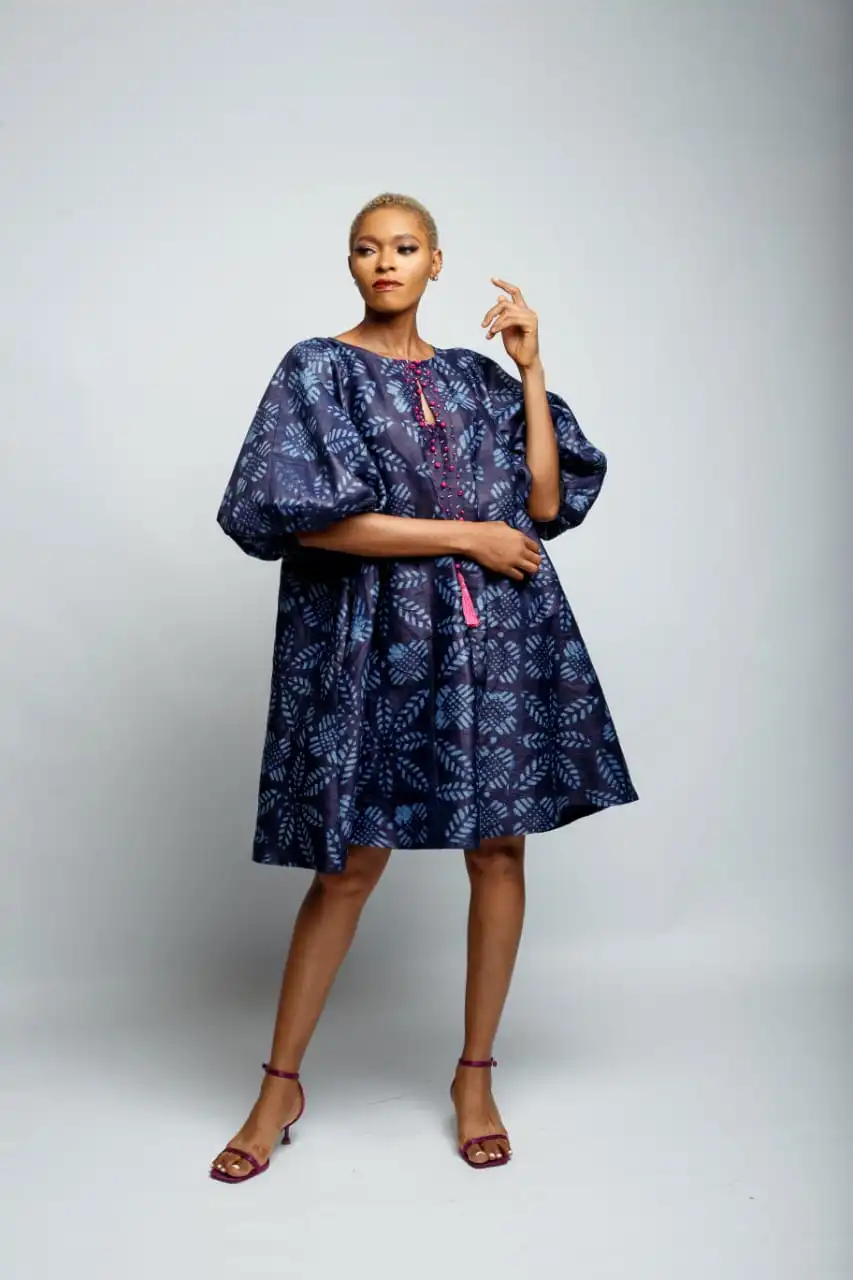
“Adire Meets Modernity” — S/S 2014
This collection is a key moment in Bakare’s career. By treating adire as central to couture pieces, Bakare amplified the cloth’s historical resonance:
- Silk‑dyed adire blouses and gowns conveyed the indigo cloth’s rich visual history.
- Structured tailoring did not erase pattern meaning but highlighted motifs through contrast and placement.
- The collection was positioned as both a heritage statement and a global fashion proposition, remapping adire’s place in contemporary design.
READ ALSO:
- Thabo Makhetha-Kwinana and the Basotho Blanket: Sovereignty Woven into Cloth
- Fikirte Addis and the Handwoven Cloth That Carries African Memory
Global Reach and Cultural Reception
Bakare’s work has been featured at national and international fashion weeks, gaining visibility not only for its aesthetic appeal but also for its contribution to bringing Nigerian textile identity to global audiences. In particular:
- His collections have been showcased in London, Paris, New York, Cape Town, and Mozambique.
- He has dressed prominent figures, including serving as official designer for the late First Lady of Nigeria, Stella Obasanjo.
- Media coverage recognises his commitment to blending cultural heritage with global luxury sensibilities.
This global presence is significant because it positions Nigerian textiles and design narratives alongside established couture practices, thereby affirming cultural production as worthy of inclusion in global fashion discourse.
Cultural Preservation, Artisan Collaboration, and Ethical Context

Bakare’s use of adire bleeds into cultural preservation and economic engagement. By collaborating with local artisans and referencing traditional dyeing techniques, his work supports:
- Artisan Livelihoods: Commissioning local producers helps sustain traditional skills that might otherwise decline.
- Textile Visibility: Adire, once marginalised by industrial textile competition, regains cultural visibility through high-fashion applications.
- Cultural Education: Bakare publicly explains the origins, methods, and meanings of adire, enhancing the audience’s understanding beyond just its surface aesthetics.
However, unlike designers who build entire careers around preserving a craft’s ancestral language, Bakare’s engagement is interpretive rather than archival. He does not attempt to document every traditional symbol or restore the textile’s indigenous functions. Still, he ensures that its cultural resonance informs and inspires design rather than being abstracted away.
Comparative Insight: Textiles as Living Archives in African Fashion
Bakare’s work exists within a broader movement of African designers engaging with historical materials, yet his stance is distinct:
- Unlike Awa Meité’s bogolanfini, where the cloth’s symbolic code is central to the garment’s identity and meaning, Bakare treats adire’s patterns as cultural texture within a couture narrative.
- Compared with designers such as Fikirte Addis, who foregrounds cloth as a symbol of spiritual continuity, Bakare’s work fuses cultural materials with global fashion frameworks, supporting artisanal techniques without anchoring entire collections in indigenous symbolic lexicons.
This position is meaningful: it demonstrates an approach in African fashion that dignifies heritage while navigating global couture spaces, showing that historical fabrics can inform design without necessarily being the sole narrative anchor.
Why Ade Bakare’s Work Matters Today

In a global fashion ecosystem where indigenous textiles are often appropriated as “exotic print,” Bakare’s work matters because:
- It elevates adire beyond surface ornament, giving it structural and conceptual weight in couture design.
- It remains rooted in cultural practice by collaborating with traditional producers and publicising the cloth’s origins.
- It demonstrates that African craft traditions have a place in global fashion narratives when respected for their history and meaning.
Bakare’s work does not reduce culture to a commodity. Instead, it uses the material meaning of adire as an anchor, inviting audiences to see the cloth’s deep lineage while appreciating the contemporary form.
FAQs
1. What is adire, and where does it originate?
Adire is a traditional Yoruba resist-dye textile from southwestern Nigeria, made using indigo dyes and resist techniques. It historically carried community meaning through patterns and was produced, especially in Abeokuta, as both everyday cloth and ceremonial attire.
2. How does Ade Bakare use adire in his designs?
Ade Bakare incorporates adire into couture by collaborating with local artisans to dye patterns onto luxury fabrics such as silk and organza, then placing these textiles into tailored garments that preserve the integrity of the patterns and cultural resonance.
3. Why is adire culturally significant?
Adire patterns were historically associated with Yoruba proverbs, social identities, and community narratives, serving as a visual language that conveyed meaning beyond decoration.
4. Has Ade Bakare’s work been shown internationally?
Yes. Bakare’s collections have been showcased at major fashion events in London, Paris, New York, and Cape Town, elevating Nigerian textile traditions on global platforms.
5. How does Bakare’s approach differ from other designers using indigenous textiles?
While other designers foreground cloth as a central symbolic archive, Bakare integrates adire into couture in ways that respect its cultural identity while engaging global luxury frameworks, supporting artisan production without erasing cultural context.